
Determining Non Target Screening Thresholds for Recycled Polyolefins
Determining non target screening thresholds requires deriving analytical detection limits from toxicological thresholds divided by GC and LC response uncertainty factors.
Determining non target screening thresholds requires deriving analytical detection limits from toxicological thresholds divided by GC and LC response uncertainty factors.
Screening recycled polyolefins via chromatography and toxicological thresholds isolates unlisted migrant degradation products below ten parts per billion.

Decontaminated HDPE migration compliance relies on temperature-dependent Fickian diffusion models parameterized by matrix density and surrogate mass.

Select high flow polypropylene homopolymers by balancing melt flow rate against impact loss, verifying narrow molecular weight distribution and peroxide residues.
Mathematical peak deconvolution separates coeluting volatile degradation products from polyolefin oligomer baselines, enabling accurate resin qualification.
Headspace volatile extraction quantifies residual odorants and degradation products in recycled resin to establish compliance and prevent lot failures.

Coulometric thermal desorption isolates bound water from organic volatiles in rPET flake, enabling precise incoming quality control and preventing hydrolytic degradation.

Post-consumer HDPE sourcing relies on batch melt testing, DSC thermal screening, and mass balance audits to prevent factory scrap and field failure.

High vacuum twin screw devolatilization of rPET removes VOCs down to food contact limits by maximizing melt surface renewal at sub millibar pressures.

Adaptive baseline subtraction routines isolate volatile contaminant peaks from matrix background noise, preventing costly false positive resin lot rejections.
Polyolefin food contact validation requires surrogate challenge testing demonstrating matrix devolatilization down to safe migration thresholds under worst-case parameters.
Non-aqueous volatile desorption kinetics in post-consumer polyester depend on flake thickness, Arrhenius diffusion limits, and sweep gas partial pressures.
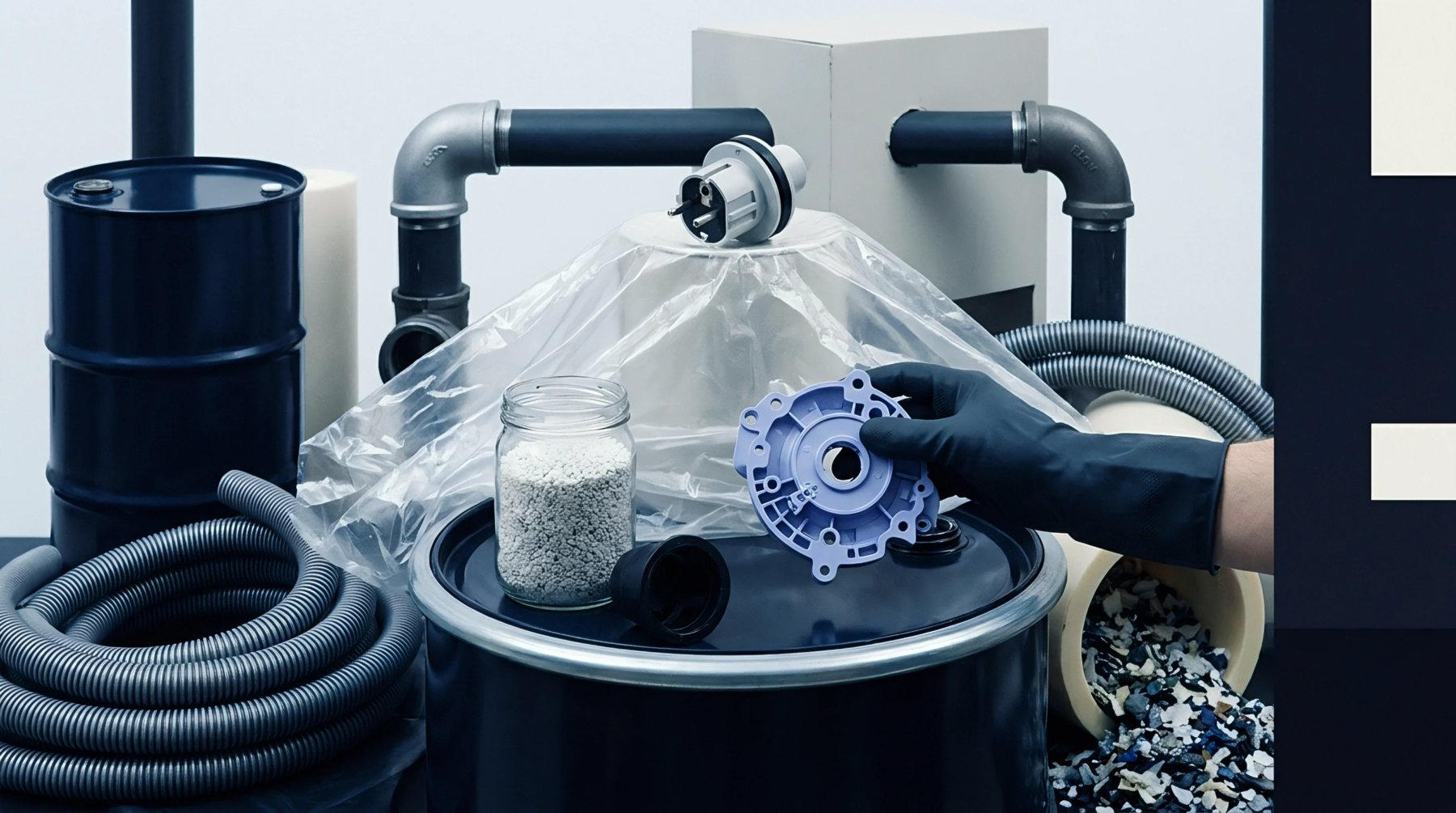
Coulometric baseline correction eliminates volatile organic interference in recycled resin moisture analysis to prevent over-drying energy waste and hydrolytic chain scission.

Coulometric baseline deconvolution separates true matrix moisture from organic volatile interference in rPET, preventing false lot rejections and IV degradation.

Accurate quantification of recycled polyolefins requires combining DSC thermal integration, high-temperature GPC, ICP-MS trace metals, and melt rheology sweeps.

Recycled polyolefin NIAS compliance requires high-resolution mass spectrometry screening paired with Cramer structural toxicological limits down to 0.15 ppb.
Analytical screening for recycled polyolefin food contact articles requires mass spectrometry thresholds below 10 ppb to prove compliance under EU rules.
Expertise is a utility, not a secret. sentiention™ publishes its working knowledge as open reference: intelligence layer covering the materials it sources, the markets it enters, and the reference that serves both.