Rheological Variance and Gel Contamination in House Blended Compounds
House blending recycled resins causes melt viscosity drift and crosslinked gel contamination that disrupts mold filling and degrades part mechanical strength.


Swell
Polymer melt deformation through extrusion dies reveals structural changes introduced during compounding cycles. Primary producers synthesize virgin polyolefins under tight control over molecular weight distribution. In contrast, house compounding operations running single- or twin-screw extruders introduce regrind, off-spec scrap, and post-industrial waste into virgin matrices.
This shifts the material’s relaxation spectrum, altering elastic recovery as the melt exits a molding nozzle or extrusion die.
Die exit expansion depends directly on the ratio of elastic storage to viscous dissipation in the melt. In virgin polypropylene homopolymers tested at 230 degrees Celsius under standard capillary conditions, extrudate swell ratios remain predictable. Adding reprocessed post-industrial fractions, however, shifts the high molecular weight tail.
Thermal oxidation induces chain scission that reduces average molecular weight while generating localized crosslinked networks or long-chain branching, resulting in erratic swell during automated molding.

Viscous Behavior in Recycled Polyolefin Blends
Combining reprocessed material with virgin base stocks alters flow properties substantially. Having passed through earlier processing cycles, recycled streams carry accumulated shear damage that breaks down long polymer backbones. Melt viscosity drops at shear rates typical of injection molding gates (1,000 to 10,000 reciprocal seconds).
Yet at low shear ~ such as inside extruder barrels below 10 reciprocal seconds ~ oxidized species and high molecular weight gels actually drive zero-shear viscosity higher.
A 15 percent shift in melt flow rate measured at 230 degrees Celsius under a 2.16 kilogram load alters mold cavity filling time by over eight percent in multi-cavity tooling.
Melt behavior directly dictates mold filling, as variations in melt flow rate alter the pressure drop needed to fill thin-walled tool geometries. When compounders mix virgin resin with unverified regrind, the nominal melt flow index on certificates of analysis rarely captures shear-dependent viscosity changes. A batch rated at a nominal melt flow rate of 12 grams per 10 minutes can show viscosity deviations exceeding 35 percent at actual processing shear rates.
| Material Grade Composition | MFR 230 C / 2.16 kg (g/10 min) | MFR 230 C / 10.0 kg (g/10 min) | Flow Rate Ratio (FRR 10 / 2.16) | Zero-Shear Viscosity Pa s at 190 C | Die Swell Ratio (D/D0) at 1000 s-1 |
|---|---|---|---|---|---|
| Virgin Injection Grade PP Homopolymer | 12.2 | 115.8 | 9.49 | 2,450 | 1.18 |
| House Blend: 80% Virgin + 20% In-Plant Regrind | 13.8 | 142.1 | 10.30 | 2,100 | 1.26 |
| House Blend: 60% Virgin + 40% Post-Industrial Scrap | 16.5 | 189.7 | 11.50 | 1,750 | 1.38 |
| Uncontrolled Post-Consumer Regrind Stream | 21.4 | 278.2 | 13.00 | 1,200 | 1.52 |
Elastic Recovery and Polymer Chain Entanglement
Die exit expansion reflects stored elastic energy in the melt during high-shear flow. Long-chain entanglements act like molecular springs: as molten polymer passes through a die or runner, shear stresses stretch these chains. Once free of the channel, the melt relaxes, expanding the extrudate cross-section beyond the physical die dimensions, while shear heating accelerates crosslinking in variable recycle lots.
Uncontrolled swelling causes dimensional instability in extruded profiles, wall thickness variations in blow-molded containers, and severe hesitation marks in injection-molded parts. High elastic recovery elevates first normal stress differences, triggering flow instabilities such as sharkskin and gross melt fracture at lower critical shear stresses than seen in virgin resins.
Whether ultra-high molecular weight entanglements degrade into lower-viscosity fractions or agglomerate into rigid domains under prolonged thermal exposure remains unresolved across high-shear compounding runs.


Screen
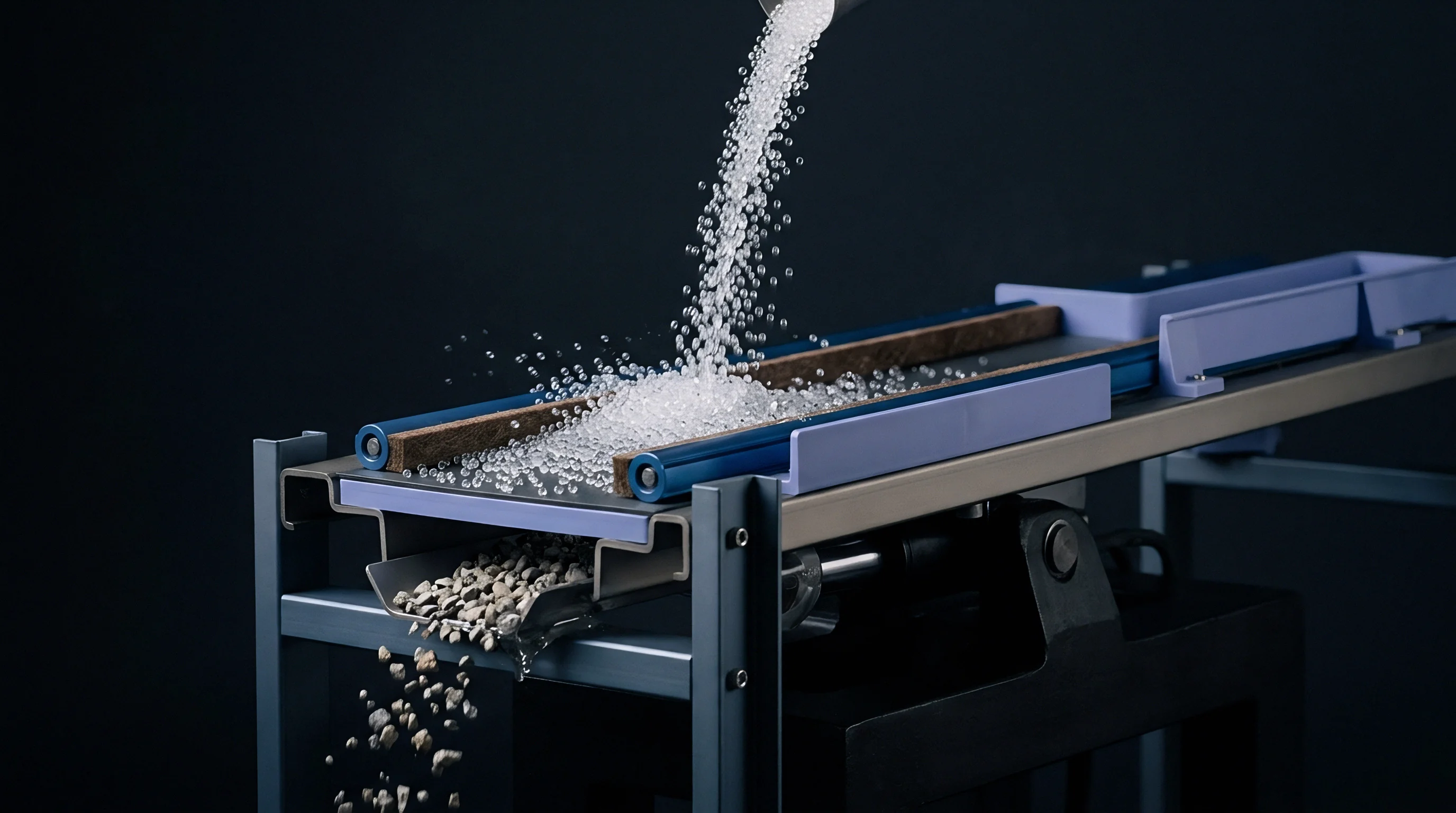
Melt filtration systems on compounding lines catch foreign contaminants and degraded gels before pelletization. Breaker plates fitted with woven wire mesh packs build barrel backpressure, which aids thermal homogenization while screening out solids. In house blending, choosing screen packs requires balancing filtration efficiency against output requirements.
Gel contamination presents distinct challenges. Unlike metallic or ceramic inclusions, polymer gels consist of crosslinked or ultra-high molecular weight networks that deform under pressure. Subjected to high pressure drops across a blinding screen pack, flexible gels stretch and pass through mesh openings much smaller than their undeformed diameter.
Consequently, crosslinked particulates reach final pellet lots undetected by standard sieve checks.

Particulate Gel Categorization and Morphological Origins
Defects embedded in translucent molded parts originate from specific thermal and chemical degradation pathways. Identifying gel morphology helps pinpoint the underlying compounding failure mode.
- Oxidized Crosslinked Gels manifest as rigid, amber spherical inclusions that refuse to melt at standard processing temperatures, originating in stagnant resin zones inside the extruder barrel.
- Unmelted High-Molecular-Weight Fractions appear as translucent, soft-core defects that diffuse into the matrix when exposed to higher melt temperatures and strong shear fields.
- Particulate Inorganic Agglomerates consist of undispersed mineral fillers, titanium dioxide, or carbon black masterbatch carriers clustered around degraded polymer cores.
- Carbonized Thermal Degraded Specks present as black, friable particles formed by thermal degradation of polymer residues on screw flights and barrel walls during extended hot standbys.
Failing to specify optical gel counting standard ISO 22497 in resin purchase contracts leaves buyers without commercial recourse when crosslinked particulates clog hot runner nozzles.

Filtration Pressure Spikes in Extrusion Hardware
Continuous melt flow forces particulate agglomerates against fine wire mesh packs. As gels and debris collect on the upstream side, open filtration area shrinks rapidly, driving extruder head pressure up to maintain volumetric flow. On automated lines, a sudden surge in head pressure signals heavy contamination in incoming feedstock.
| Gel Defect Size Class | Equivalent Diameter (microns) | Max Permissible Count per kg (Film Grade) | Max Permissible Count per kg (Molding Grade) | Primary Mechanical and Visual Failure Mode |
|---|---|---|---|---|
| Micro Gels | 20 to 50 | 500 | 5,000 | Surface haze, pinholes in thin films, micro-void initiation |
| Medium Gels | 51 to 150 | 50 | 1,000 | Tensile strength drop, cosmetic surface blemishes, web breaks |
| Macro Gels | 151 to 400 | 5 | 100 | Die lines, gate clogging, Charpy impact resistance degradation |
| Severe Inclusions | Greater than 400 | 0 | 5 | Hot runner tip blockage, part cracking under cyclic loading |
Filter medium selection dictates gel retention. Standard Dutch weave wire meshes capture rigid contaminants efficiently, but allow elastic gels to squeeze through when differential pressure exceeds 5 MPa. Continuous ribbon changers and sintered metal powder screens limit gel passage by maintaining stable pressure profiles and providing tortuous paths that trap deformable crosslinked domains.
Unfiltered gels accelerate gate freezing, shorten mold maintenance intervals, and cause micro-void failures across thin structural ribs.


Decomposition
Polymer backbones break down under severe thermo-mechanical stress inside twin-screw barrels. Elevated temperatures combined with shear forces cleave carbon-carbon bonds along the chain. Free radicals from homolytic scission react instantly with ambient or entrained oxygen, forming alkylperoxy radicals that drive auto-oxidative degradation cascades.
In polypropylene, thermal degradation proceeds mainly through beta-scission, shortening chains and raising the melt flow rate. In polyethylene, radical recombination and crosslinking compete directly with chain scission: low-shear zones favor crosslinking and high molecular weight gels, while high-shear zones accelerate mechanical scission. House-blending unstabilized regrind accelerates these pathways in subsequent passes.

Thermal Mechanical Oxidation during Reprocessing Cycles
Repeated melt processing exposes resin to high shear and residual oxygen. Extruding virgin polypropylene through five successive passes increases melt flow rate from 3.0 to over 14.0 grams per 10 minutes at 230 degrees Celsius under a 2.16 kilogram load. Each pass lowers average molecular weight and broadens the molecular weight distribution.
Repeated extrusion passes narrow the processing window faster than they alter the nominal melt flow index.
Tensile yield strength declines moderately during degradation, whereas notched impact resistance drops sharply once shortened chains can no longer form effective tie molecules between crystalline lamellae.

Additive Depletion and Secondary Crosslinking Mechanisms
Stabilizer packages degrade progressively as feedstock undergoes multiple thermal cycles. Primary phenolic antioxidants scavenge free radicals, converting to quinone methides, while secondary phosphite antioxidants reduce hydroperoxides to stable alcohols. Once primary antioxidants are depleted, thermo-mechanical degradation accelerates rapidly.
- Quantify residual antioxidant content in incoming feedstock using differential scanning calorimetry oxidation induction time testing per ISO 11357-6 at 200 degrees Celsius under a pure oxygen atmosphere.
- Determine melt flow rate stability across five consecutive capillary extrusion passes to establish degradation kinetics for the target house blend ratio.
- Introduce secondary phosphite processing stabilizers at let-down ratios calculated to replenish depleted antioxidants to minimum effective levels above 800 parts per million.
- Monitor screen pack pressure build-up on compounding extruders to confirm that stabilization prevents micro-gel formation under high-shear conditions.
Stabilizer depletion leaves the matrix unprotected. Without active antioxidants, secondary reactions crosslink degraded polymer fragments during extended residence times in hot runners or extruder barrels.
A melt index drift within twenty percent of nominal rating falls within typical manufacturing tolerances.

Assay
Laboratory verification confirms whether incoming materials meet target compounding specifications. Relying solely on single-point melt flow rates from supplier certificates of analysis introduces severe operational risk. Dual-load testing, capillary rheometry, and gel quantification provide the data needed to qualify house-blended lots for production.
Extrudate swell measurements combined with multi-shear viscosity profiling reveal broad molecular weight distributions and gel contamination that single-point testing misses. Establishing clear analytical gates prevents off-spec resin from reaching the plant floor.

Multi Load Melt Rate Characterization Protocol
Standard single-point flow tests fail to detect shifts in molecular weight distribution. Testing polyolefin compounds under two distinct loads per ISO 1133-1 or ASTM D1238 yields a Flow Rate Ratio that surfaces structural changes immediately.
- Dual Load Melt Index Limits mandate measuring melt flow at 2.16 kilograms and 21.6 kilograms, enforcing a maximum Flow Rate Ratio variance of plus or minus seven percent from approved reference standards.
- Maximum Permissible Gel Densities cap optical gel counts measured via ISO 22497 at fewer than 50 macro-gels per kilogram of compounded pellets intended for injection molding.
- Capillary Shear Viscosity Bands require high-shear viscosity profiles across 100 to 5,000 reciprocal seconds to stay within an eight percent envelope relative to virgin baseline curves.
- Differential Scanning Calorimetry Enthalpy Thresholds enforce minimum crystallization temperature windows to detect cross-contamination between incompatible polyolefins in recycled feedstocks.
Shifted Flow Rate Ratios point directly to structural changes. High values indicate broad molecular weight distributions, long-chain branching, or gel precursors, whereas low values reflect uniform, narrow distributions.
Single-point melt flow rate testing hides structural branching changes that dual-load testing surfaces immediately.

Capillary Viscometry and Optical Particle Inspection
High-shear flow characterization reveals structural behavior at realistic injection molding velocities. High-pressure capillary rheometers force polymer melt through precision tungsten carbide dies across shear rates from 10 to 10,000 reciprocal seconds. Applying Bagley corrections for entrance pressure losses and Rabinowitsch corrections for non-Newtonian behavior yields true shear viscosity curves.
| Property Target | Standard Test Method | Test Parameters and Conditions | Acceptance Criteria (Virgin Baseline) | Action Limit for Lot Rejection | |
|---|---|---|---|---|---|
| Melt Flow Rate (MFR) | ISO 1133-1 / ASTM D1238 | 230 C / 2.16 kg (PP) or 190 C / 2.16 kg (PE) | Nominal +/- 10 percent | Greater than +/- 15 percent shift | |
| Flow Rate Ratio (FRR) | ASTM D1238 Condition M/N | FRR = MFR (21.6 kg) / MFR (2.16 kg) | Nominal +/- 5 percent | Greater than +/- 10 percent shift | |
| Optical Gel Count | ISO 22497 / ASTM D3591 | Extruded tape, gel size > 100 microns | Less than 20 count / sq meter | Greater than 100 count / sq meter | |
| Oxidation Induction Time | ISO 11357-6 / ASTM D3895 | DSC 200 C, pure Oxygen atmosphere | Greater than 30 minutes | Less than 10 minutes | |
| Zero-Shear Viscosity | ISO 6721-10 (Rotational) | Frequency sweep 0.01 to 100 rad/s at 190 C | Nominal +/- 8 percent | Greater than +/- 12 percent shift |
Optical gel inspection systems evaluate continuous film tapes extruded from pellet samples. High-speed CCD cameras and line-scan sensors categorize defects down to 10 microns, sorting gels by size, shape, and opacity. Automated particle analysis distinguishes soft high-molecular-weight unmelted gels from rigid, carbonized black specks, producing quantitative gel frequency distributions per kilogram of sampled resin.
Standard resin supply agreements citing ASTM D1238-23 Annex A1 limit batch-to-batch flow rate variation to plus or minus ten percent under specified test conditions, requiring compounders to replace off-spec lots at their own expense.


Ledger
Financial losses from mold downtime and scrap reflect incoming pellet quality drift. Processing house blends with unmonitored rheological variance quickly turns raw material savings into operational expense. A facility saving $200 per tonne on low-grade regrind loses money when molding cycle times expand by two seconds to accommodate melt index instability.
Evaluating total cost per good part requires factoring in scrap rates, tool maintenance frequency, energy consumption per shot, and warranty claims from latent structural defects.

Landed Cost Effects of Polymer Variance
Unit production economics deteriorate rapidly when melt flow instability disrupts molding cycles. Injection molding machines running multi-cavity hot runner molds require consistent viscosity to balance cavity filling. Fluctuating viscosity shifts the V/P transition point, causing flash on low-viscosity shots and short shots on high-viscosity shots, which drives scrap rates up exponentially.
Assessing a 40-tonne order of house-blended polypropylene compound illustrates the landed cost reality. Virgin polymer costs $1,450 per tonne, while a 70/30 virgin-regrind house blend quotes at $1,250 per tonne, yielding an apparent savings of $8,000 on the shipment. However, processing the house blend with an unverified Flow Rate Ratio introduces a 4.5 percent scrap rate from gel contamination and weight variance, compared to 0.5 percent for virgin resin.
Extra mold maintenance to clear blocked hot runner tips adds $3,500 in labor and machine downtime. Total realized resin cost for the house blend rises to $1,492 per delivered good tonne, entirely negating the initial purchase discount.

Contractual Tolerances for Recycled Pellet Deliveries
Purchase specifications enforce numeric boundaries for rheological drift and particulate contamination. Procurement contracts must require lot-specific certificates of analysis covering dual-load melt flow rates, optical gel counts, and oxidation induction times before offloading bulk railcars or gaylords into silos.
Contractual penalty clauses allocate rework and scrap expenses back to the compounder when delivered lots exceed agreed rheological tolerances. Clear acceptance thresholds protect molding operations from paying virgin prices for degraded house blends.
Buying low-cost regrind without verified shear distribution data leads directly to elevated mold downtime.