Meaning
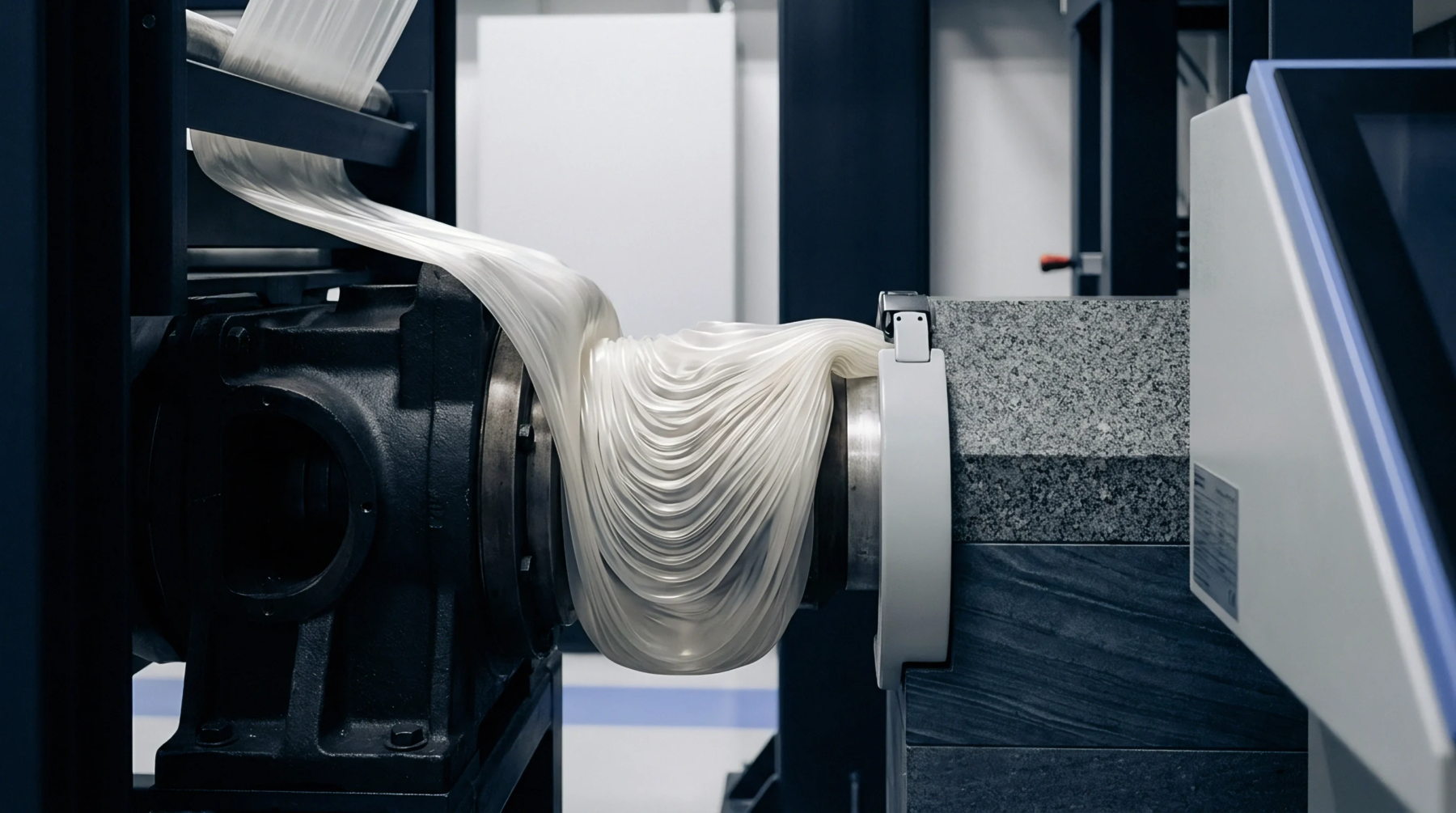
Viscosity decreases in polymer fluids as the rate of deformation increases during transport through nozzles and gates. This shear thinning phenomenon describes how long chain molecules uncoil and align themselves with the flow direction under high velocity conditions. It governs the pressure required to fill narrow sections of a mould and the speed at which the injection screw can advance.
The property applies to almost all commercial thermoplastics processed in the molten state above their melting points. It stops applying at very low shear rates where Brownian motion keeps the chains in a random state or at extremely high rates where saturation occurs.
Molecular Alignment
Polymer chains start as a tangled mass that offers significant resistance to any sudden move within the melt. As shear thinning begins, the applied force makes these individual chains stretch out into a linear shape that slides past neighbors easily. This reduction in viscosity is dramatic and allows the moulder to fill large cavities with relatively low machine tonnage.
Without this property, injection moulding would require far higher temperatures and pressures that would likely damage the resin. The rate of thinning is unique to each grade of plastic and is measured as a power law index in viscosity charts. Managing this characteristic is how processors balance fill time against potential resin burning at the gates.
Consistent behavior here is critical for maintaining stable cycle times over several production shifts.
Process Optimization
High speed filling strategies take advantage of the fluid behavior by increasing injection rates to lower the effective viscosity. Utilizing shear thinning effectively allows for the creation of thin walled products like cell phone cases or medical device housings. If the shear rate is too high, the resulting heat from internal friction can degrade the polymer and cause aesthetic defects like silver streaks.
Technicians use rheology data to find the sweet spot where the resin flows well enough to prevent short shots but stays cool enough to avoid degradation. If the speed is too low, the viscosity rises quickly and might cause the part to freeze off early. These transitions are monitored at the control screen by tracking the peak injection pressure for every cycle.
This constant feedback ensures that the machine settings stay within the range where the resin stays fluid.
Technical Limitations
Extreme thinning eventually reaches a limit where no additional speed can lower the viscosity further for that material grade. Designers should verify that the shear thinning behavior of their specific polymer fits the geometric constraints of the mould assembly. If the resin reaches its high shear plateau too early, filling deep ribs or complex intersections becomes difficult.
It can also cause local overheating in hotspots near small orifices where the velocity is at its maximum. Lubricants or additives are sometimes mixed in to shift the thinning curve for easier processing in older machinery. This changes how the material reacts to the moving screw and the static die walls.
Reliable data from the supplier ensures that the mould build accounts for these physical limits before production starts.