Standardized Melt Flow Rate Test Parameters across Polyolefin Grades
Polyolefin melt flow testing requires strict ISO and ASTM temperature-load pairings to prevent molecular weight drift from inflating scrap rates.

Bench
Datasheets present single numbers that conceal test mechanics. A polypropylene homopolymer listed at 12 g/10 min carries zero operational meaning until the certificate states 230 °C under a 2.16 kg load. Place that identical polymer inside an extrusion index condition of 190 °C with 2.16 kg, and the output drops below 3.5 g/10 min.
Polyolefin procurement fails routinely at this interface: buyers equate numbers across mismatched test regimes, compounders deliver resin to the nominal integer, and injection tools suffer short shots or flash across alternating lots.
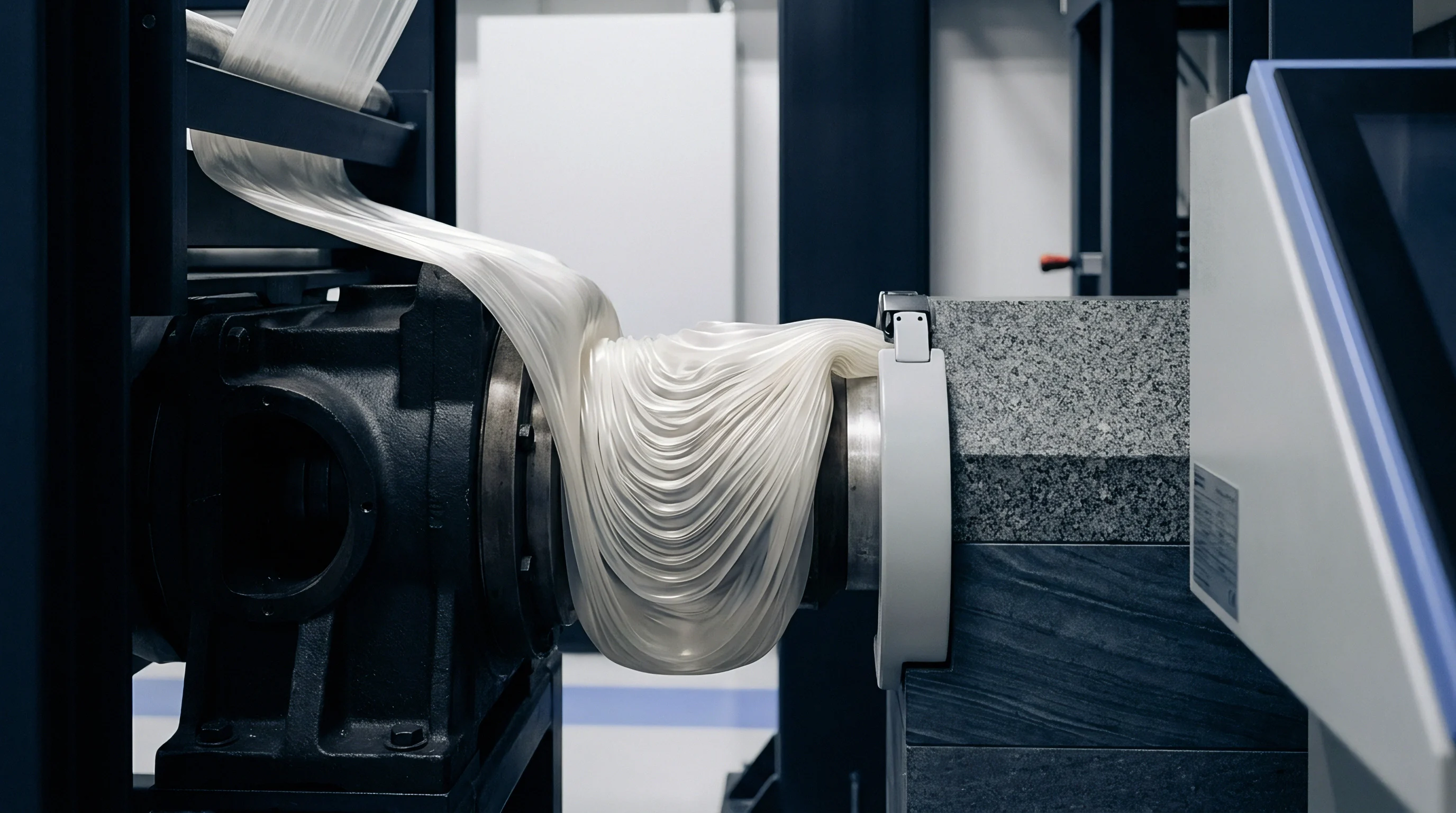
Melt flow rate measures the mass of molten polymer extruded through a standard tungsten carbide capillary die over ten minutes. The capillary maintains an internal diameter of 2.095 mm and a length of 8.000 mm under both ISO 1133 and ASTM D1238. Differences in preheating durations, cut-off mechanisms, and barrel cleanliness generate variance between testing stations.
A clean barrel bore of 9.550 mm diameter demands mechanical swab inspection before every test run. Residual carbonized film shifts the apparent shear stress, distorting the velocity profile across the die entrance.
A single integer on a raw materials datasheet remains operational fiction until the temperature, test load, and die orifice geometry are bound to the invoice.
Polymer rheology inside the extrusion plastometer operates under low shear rates, typically between 1 and 50 reciprocal seconds. Industrial injection moulding operates between 1,000 and 100,000 reciprocal seconds, while blown film extrusion sits between 100 and 1,000 reciprocal seconds. The melt flow rate supplies an inverse surrogate for zero-shear viscosity and average molecular weight.
It does not measure shear-thinning response. Resins sharing an identical flow index under deadweight conditions diverge violently when forced through hot runner gates or spiral film dies.

Thermodynamic Equilibrium and Residence Timers
Standardized execution demands strict temporal control over the polymer charge. ASTM D1238 Procedure A specifies a preheat duration of 7.0 minutes plus or minus 0.5 minutes at the target temperature before the deadweight load acts on the piston. ISO 1133-1 sets preheat windows at 5.0 minutes, permitting adjustments based on thermal mass.
Shortening the preheat period leaves core pellets partially solid, producing artificially low flow values. Extending the residence time induces thermal degradation, peroxidic chain scission in polypropylenes, or post-condensation effects in damp feedstocks.
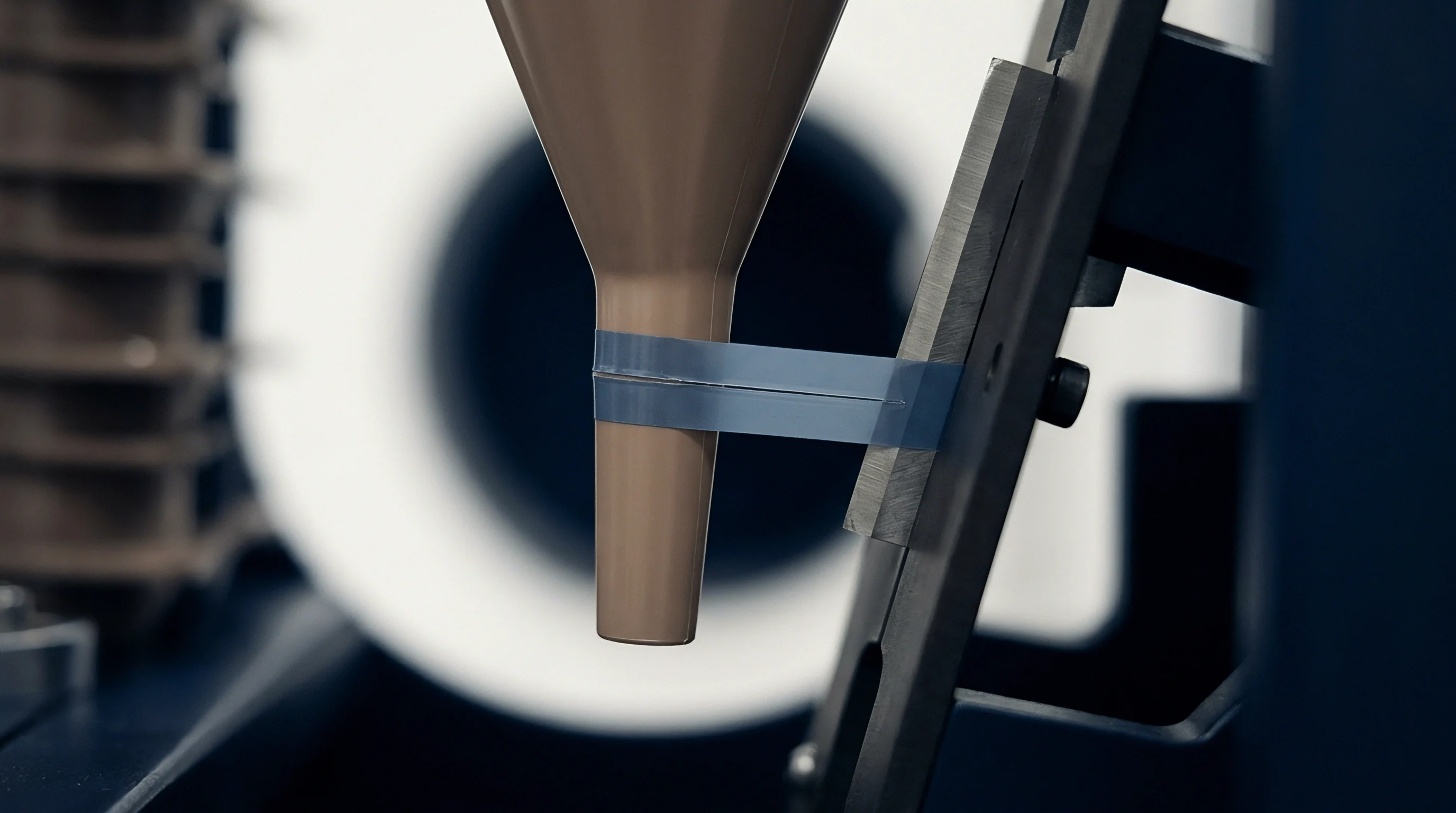
Piston displacement during timing cycles requires optical or mechanical tracking. Automated flag cutters eliminate operator hand-slicing variance at high extrusion speeds. For materials yielding extrudates faster than 10 g/10 min, manual timing intervals of 15 to 30 seconds amplify cut-timing error into full percentage-point discrepancies on final lot certifications.
Automating the cut cycle isolates operator reaction times from the gravimetric sum.
Standard barrel cleaning protocols govern reproducibility across incoming checks. Operators clear the cylinder using cotton patches saturated with high-flash-point hydrocarbon solvents or run high-density polyethylene purging compounds at 220 °C. Steel wire brushes scour barrel walls, while brass scrapers clear the capillary bore without scratching mirror surfaces. A single microscopic scratch on the inner tungsten carbide surface creates local flow separation, increasing apparent resistance and lowering recorded flow figures systematically across every subsequent batch.
Load
Standard testing regimes assign specific temperature and mass combinations to each polymer family. Polyethylenes test uniformly at 190 °C, while polypropylenes test at 230 °C. Testing polyethylene at 230 °C accelerates thermal degradation and invalidates published tolerances. Testing polypropylene at 190 °C risks incomplete crystalline core melting, yielding erratic wall slip through the capillary.
The testing standard fixes these combinations to establish reproducible baselines for trade and quality acceptance.
The standard nominal load of 2.16 kg represents the historical standard baseline, though high-molecular-weight grades demand heavier charges. Pipe-grade bimodal high-density polyethylene resists extrusion under 2.16 kg, producing negligible flow over a standard test cut. ASTM D1238 and ISO 1133 resolve this through high-load melt index conditions utilizing a 21.6 kg mass, occasionally supplemented by an intermediate 5.0 kg mass for film-grade linear low-density polyethylene.
| Polyolefin Family | Primary Process | Temperature (°C) | Nominal Mass (kg) | Typical MFR (g/10 min) | Governing Standard Condition |
|---|---|---|---|---|---|
| LDPE (Autoclave) | Blown Film | 190 | 2.16 | 0.25 to 2.0 | ISO 1133-1 Condition D / ASTM D1238 Condition 190/2.16 |
| LLDPE (C4/C6 Butene/Hexene) | Cast Film | 190 | 2.16 | 2.0 to 4.5 | ISO 1133-1 Condition D / ASTM D1238 Condition 190/2.16 |
| HDPE (Unimodal) | Blow Moulding | 190 | 2.16 | 0.15 to 0.40 | ISO 1133-1 Condition D / ASTM D1238 Condition 190/2.16 |
| HDPE (Bimodal Pipe) | Extrusion | 190 | 5.0 / 21.6 | 0.20 to 0.45 (5 kg) / 6.0 to 12.0 (21.6 kg) | ISO 1133-1 Condition T / ASTM D1238 Condition 190/21.6 |
| PP Homopolymer | Injection Moulding | 230 | 2.16 | 12.0 to 35.0 | ISO 1133-1 Condition M / ASTM D1238 Condition 230/2.16 |
| PP Impact Copolymer | Battery Cases / Crates | 230 | 2.16 | 1.5 to 8.0 | ISO 1133-1 Condition M / ASTM D1238 Condition 230/2.16 |
| PP Random Copolymer | Thin-Wall Packaging | 230 | 2.16 | 40.0 to 100.0 | ISO 1133-1 Condition M / ASTM D1238 Condition 230/2.16 |
Shifting the load moves the shear stress applied to the polymer column. Linear polymers with narrow molecular weight distributions show modest sensitivity to increased mass. Branched resins and bimodal distributions demonstrate high non-Newtonian shear-thinning behavior under identical escalations.
A processor calculating flow rates must track both the nominal condition and the high-load variant to identify processability shifts across incoming shipments.
High-Load Ratios and Flow Ratio Evaluation
The relationship between outputs at divergent weights reveals polymer architecture without requiring gel permeation chromatography. The Melt Flow Ratio divides high-load output by standard-load output. For polyethylene, laboratories calculate the ratio using the 21.6 kg value divided by the 2.16 kg value, designated as I21 / I2.
Alternatively, they compute I10 / I2 using a 10.0 kg mass against the baseline.
Broad molecular weight distributions yield high flow ratios, frequently exceeding 30:1 in bimodal pipe resins. Narrow distributions produced by metallocene single-site catalysts yield ratios clustering tightly between 14:1 and 18:1. When a supplier ships a supposed metallocene hexene linear low-density resin whose I21 / I2 ratio spikes from 16 to 28, the resin contains unlisted broad-distribution Ziegler-Natta material or unblended reactor regrind.
The high-load test serves as an incoming gatekeeper against structural substitutions.
Testing laboratories encounter piston friction artifacts when operating at high loads. The 21.6 kg weight assembly induces slight lateral deflection on the piston foot if the plastometer cylinder sits even one degree out of true vertical alignment. Piston friction against the cylinder wall absorbs load energy, reducing the effective pressure driving the melt through the orifice.
True high-load verifications require precision leveling bubbles mounted directly to the upper barrel plate before the heating cycle begins.
The standard allows no interpolation across test weights when qualifying shipments against a purchase contract.

Shift
Physical transformations during processing trace back directly to molecular mass distributions. Polypropylene and polyethylene react oppositely to thermal and oxidative stress during compounding cycles. Polypropylene chains suffer thermal degradation through tertiary carbon radical formation, leading inexorably to beta-scission.
The molecular backbone breaks apart, average chain length decreases, and the melt flow rate rises uncontrollably. Polyethylene radicals undergo radical recombination and cross-linking under low-oxygen heat, increasing molecular weight and dropping the melt flow rate.
Incoming inspection logs capture this divergence clearly. An injection grade polypropylene homopolymer rated at 20 g/10 min that exits a compounding extruder at 32 g/10 min has undergone severe thermal abuse or aggressive peroxide visbreaking. The part moulder gains faster cycle times and lower cavity pressures, but loses notched Izod impact strength and environmental stress crack resistance.
The chain fragments fail to distribute structural mechanical loads across inter-spherulitic boundaries.
A compounding extruder that turns 12-flow polypropylene into 25-flow pellets sells injection speed at the direct expense of impact strength.
Visbreaking intentionally injects organic peroxides, such as 2,5-dimethyl-2,5-di(tert-butylperoxy)hexane, into reactor flakes inside twin-screw extruders. This controlled chemical degradation narrows the molecular weight distribution, raising melt flow from 2 g/10 min to 40 g/10 min for thin-wall packaging applications. Controlled degradation differs fundamentally from heat damage: visbroken polymers display sharp shear-thinning shifts and minimal broad-tail elasticity, reducing die swell inside narrow tooling geometries.

Mechanical Degradation Trajectories
Molecular weight reductions impair physical performance long before colour shifts or odor issues emerge in finished parts. The relationship between melt flow rate and tensile performance behaves non-linearly across typical commercial ranges. Small reductions in molecular weight yield minor differences in tensile yield stress, but drop ultimate tensile elongation and low-temperature drop-impact performance catastrophically.
- Homopolymer Chain Cleavage reduces impact strength, where a rise from 10 to 25 g/10 min drops notched Izod impact at 23 °C from 35 J/m to below 20 J/m.
- Peroxide Additive Depletion consumes the primary phenolic and phosphite antioxidant package, leaving zero stabilization reserve for secondary conversion passes.
- Environmental Stress Cracking accelerates in blow-moulding polyethylenes, as higher flow rates indicate shorter tie molecules spanning adjacent crystalline lamellae.
- Melt Strength Collapse starves the bubble during blown film extrusion, destabilizing the frost line and inducing cyclic gauge variations across the web circumference.
Recycled polyolefins amplify these physical shifts through uncontrolled compounding histories. Post-consumer polypropylene fractions routinely display elevated melt flow values caused by repeated mechanical conversions and degradation cycles. Post-consumer polyethylene fractions demonstrate unpredictable swings: gel fractions from cross-linked contamination drop flow rates locally, while polypropylene contamination cross-contaminates the matrix, causing erratic phase separation during capillary extrusion.

Drift
Discrepancies between certification sheets and receiving inspections follow distinct mechanical and chemical origins. A Certificate of Analysis records values generated at the petrochemical production facility, frequently taken from composite reactor head samples or blended silo lots. Transit delays, pneumatic conveying friction, and localized moisture accumulation alter the material before the receiving hopper opens.
Sourcing operations encounter baseline variance from standard test mechanics alone.
ISO 1133 and ASTM D1238 publish precision statements detailing within-laboratory repeatability and between-laboratory reproducibility. For a standard 2.0 g/10 min polyethylene, ASTM D1238 precision tables confirm that acceptable laboratory-to-laboratory variation reaches plus or minus 8 to 10 percent of the mean value. A lot measuring 2.1 g/10 min at the petrochemical port laboratory legitimately tests at 1.9 g/10 min or 2.3 g/10 min on an incoming receiving plastometer without indicating material fraud or adulteration.
| Polyolefin Grade Class | Nominal Mean MFR | Repeatability (r, Single Lab) | Reproducibility (R, Multi-Lab) | Maximum Statistically Normal Spread |
|---|---|---|---|---|
| HDPE Blow Moulding | 0.30 g/10 min | ±0.02 g/10 min | ±0.05 g/10 min | 0.25 to 0.35 g/10 min |
| LLDPE Cast Film | 2.00 g/10 min | ±0.08 g/10 min | ±0.22 g/10 min | 1.78 to 2.22 g/10 min |
| PP Homopolymer Moulding | 12.0 g/10 min | ±0.45 g/10 min | ±1.35 g/10 min | 10.65 to 13.35 g/10 min |
| PP High-Flow Injection | 45.0 g/10 min | ±2.10 g/10 min | ±5.80 g/10 min | 39.20 to 50.80 g/10 min |
When incoming test results fall outside statistical multi-laboratory bands, process contamination or physical lot dilution explains the error. Compounders frequently blend off-spec wide-spec virgin reactor runs into prime lots to lower inventory costs. Unblended pellets generate severe bimodal flow spikes inside the test barrel: the first cut registers 8 g/10 min, while the second cut registers 14 g/10 min from the exact same sample barrel fill.
Consistent lot charges produce extrudate cuts with mass variances below two percent.

Can Additive Packages Distort Test Results?
Additive packages alter the apparent flow values without changing the molecular weight of the base polyolefin. Fluoropolymer-based processing aids coat the barrel walls and capillary die surfaces during high-shear compounding. In standard melt index testing, these fluoropolymers introduce wall slip inside the tungsten carbide die, lowering frictional resistance and falsely elevating the measured melt flow rate by up to 15 percent.
Mineral fillers introduce opposing physical artifacts. Calcium carbonate and talc masterbatches increase the effective shear viscosity of the suspension, driving down the measured flow rate. A compound containing 20 percent fine-particle talc drops an initial 15 g/10 min polypropylene matrix down to 8 g/10 min.
Moisture absorbed onto polar mineral surfaces vaporizes inside the 230 °C barrel, creating micro-bubbles that reduce apparent mass per volume or accelerate flow through steam expansion. Filled polyolefins demand thorough desiccant drying before the piston drops.
Pigment masterbatches based on low-molecular-weight polyethylene wax carriers skew injection moulding polypropylene verification. A two percent let-down ratio of a cheap masterbatch containing a 2,000 molecular weight wax introduces high-flow fractions that accelerate the plastometer cut. Sourcing audits isolate base polymer certificates from final blended compounds to establish where flow drift originates along the supply line.
The lot clears commercial acceptance only when the gravimetric spread between consecutive cuts remains within three percent of their shared mean value.

Money
Melt flow variance converts directly into manufacturing scrap, unstable cycle times, and commercial contract claims. When a converter qualifies an injection mould around a 20 g/10 min polypropylene copolymer, tools are tuned for specific injection pressures, switch-over points, and cooling durations. If incoming material drifts to 14 g/10 min, injection pressures spike, causing short shots in multi-cavity tools.
If the resin shifts to 28 g/10 min, the tool flashes, demanding costly hand-trimming and packing down cavity surfaces.
Consider a practical processing scenario. Assume an operational baseline producing polypropylene automotive interior clips across 32 cavities: an annual conversion volume of 1,200 metric tonnes running continuously at a raw polymer price of 1,150 dollars per metric tonne delivered. The tool runs an automated cycle time of 14.0 seconds, yielding 8,228 parts per hour with an acceptable baseline part rejection rate of 0.8 percent under a qualified resin lot measuring 22.0 plus or minus 1.5 g/10 min.
A spot-market broker delivers two 20-tonne containers of nominal 22-flow resin that actually tests at 16.5 g/10 min due to high-molecular-weight wide-spec blending upstream. Cavity pressures rise by 18 percent, forcing the injection moulder to extend the injection boost phase and increase melt temperature by 15 °C to fill distal gates. The operational consequences unfold through direct compounding arithmetic:
- Cycle Time Inflation extends cooling requirements from 7.0 seconds to 9.5 seconds to solidify the hotter melt, lengthening overall cycle time from 14.0 to 16.5 seconds and reducing total hourly output by 15.1 percent.
- Scrap Escalation drives the baseline rejection rate from 0.8 percent to 4.2 percent through intermittent short shots and gate blush on outer cosmetic surfaces across the tool.
- Direct Financial Loss on the 40-tonne container lot equates to 1,680 kilograms of rejected parts, generating 1,932 dollars in raw material write-downs, accompanied by 62 machine operating hours lost to cycle extension valued at 5,270 dollars in plant overhead.
ASTM D1238 Clause 10 requires documented verification of thermal cut-off intervals before any commercial rejection claim survives legal arbitration.
The compounding invoice provides no protection unless purchase contracts stipulate rigid melt flow acceptance corridors. Relying on nominal manufacturer marketing codes leaves the buyer completely exposed to ASTM and ISO reproducibility margins. Sourcing contracts covering continuous processing operations must replace nominal grade calls with narrow window parameters, backed by mandatory pre-shipment lot retention testing.
The supplier will maintain that the resin conforms to the broad commercial designation on the bag face whenever the contract omits verified load and temperature conditions.