Basic Introduction to Bimodal Polyethylene Molecular Structure and Flow
Bimodal PE decouples strength from processability by pairing low MW matrix lubricant with branched high MW tie chains for high ESCR and low extrusion pressure.


Fraction
High-density polyethylene performance depends directly on the distribution of chain lengths within the polymer matrix. Conventional unimodal resins synthesize polymer chains within a single continuous bell curve of molecular weight, forcing a direct trade-off between mechanical strength and melt processing behavior. Increasing molecular weight raises melt viscosity, which elevates extruder head pressure and motor load beyond operational limits.
Bimodal polyethylene resolves this processing limitation by decoupling long-chain structural performance from short-chain fluidity through two distinct molecular weight populations synthesized within the same compound.
The lower molecular weight population acts as an internal processing aid during extrusion. These shorter chains, ranging from 1,000 to 20,000 grams per mole, lower the bulk shear viscosity under high shear rates inside the extruder screw and die land. Under processing conditions at 190 °C, these mobile chains lubricate the shear field, preventing thermal degradation and reducing torque demand on the drive motor.
This short-chain matrix exhibits minimal short-chain branching, yielding high local crystallinity that provides stiffness, tensile yield strength, and resistance to chemical permeation.
Mechanical durability resides entirely in the high molecular weight population. Chain lengths in this secondary population extend from 200,000 to well over 1,000,000 grams per mole. During polymerization, alpha-olefin comonomers such as 1-butene, 1-hexene, or 1-octene are preferentially incorporated into these long chains.
Short-chain branches created by comonomer insertion interrupt local chain packing, preventing the long chains from fully crystallizing into lamellar sheets. Instead, these extended molecules span the amorphous zones between crystalline lamellae, forming durable tie molecules and topological entanglements.
| Structural Metric | Unimodal HDPE | Bimodal HDPE | Test Method Standard |
|---|---|---|---|
| Weight-Average Molecular Weight (Mw) | 120,000 to 180,000 g/mol | 240,000 to 400,000 g/mol | ISO 16014-2 (HT-GPC) |
| Polydispersity Index (Mw/Mn) | 4.5 to 8.0 | 15.0 to 30.0 | ISO 16014-3 |
| Short-Chain Branching Location | Uniform across MWD | Concentrated in Mw > 10^5 g/mol | NMR ISO 17855-2 / FTIR |
| Full-Notch Creep Test Failure Time | 50 to 150 hours | > 1,000 hours | ISO 16770 (80 °C, 4.0 MPa) |
| Slow Crack Growth Resistance (PENT) | 100 to 300 hours | > 2,000 hours | ASTM F1473 (80 °C, 2.4 MPa) |
Tie molecules transfer mechanical stress across crystalline domain boundaries. When an external force acts upon a pipe or container wall, these long entangled chains absorb impact energy and arrest micro-crack propagation. In unimodal resins, crack initiation occurs rapidly along amorphous boundaries under sustained stress.
Bimodal distribution concentrates comonomer units where they yield maximum resistance to environmental stress cracking, leaving the stiff matrix uncompromised.
An MFR ratio of ISO 1133 Condition Y to Condition T exceeding 28 marks the structural boundary of bimodal architecture.
Tie molecule concentration dictates environmental stress crack resistance. The specific ratio between short-chain matrix mass and long-chain copolymer mass establishes both processability and long-term hydrostatic strength. Polymerization systems that fail to control the target mass ratio produce resins susceptible to localized stress cracking under load.
Engineers evaluate whether inter-monomer chain entanglement limits can be extended further without inducing phase separation during long melt hold times.

Reactor
Synthesizing two distinct polymer populations demands precise control over polymerization conditions in sequence. Single-reactor configurations cannot produce a true bimodal distribution because hydrogen concentration, comonomer ratio, and temperature remain uniform throughout the reaction volume. Commercial bimodal production relies on multi-reactor cascade systems operating in series, where each vessel maintains isolated environmental parameters to build one specific portion of the molecular weight curve.

Sequential Synthesis in Dual Loop Cascades
Slurry loop cascades operate with two reactors connected by a flash chamber. The primary vessel receives ethylene feed, recycled diluent such as isobutane, high concentrations of hydrogen gas, and an active Ziegler-Natta or dual-site metallocene catalyst. Hydrogen acts as a chain-transfer agent.
High hydrogen concentration terminates growing chains rapidly, producing a low molecular weight homopolymer matrix with high melt flow index. No comonomer enters the first vessel when producing maximum stiffness grades.
Slurry passes into an intermediate flash vessel to strip unreacted hydrogen gas. Complete removal of hydrogen prevents premature termination of chains in the subsequent vessel. The concentrated slurry enters the secondary reactor, where processing conditions invert completely.
Hydrogen concentration drops to minimal levels, while 1-hexene or 1-butene comonomer enters the feed stream. Catalyst particles continuing from the first vessel synthesize extremely long polymer chains around the original LMW core.
- First Reactor Polymerization creates the rigid homopolymer base under high hydrogen partial pressure to restrict chain length growth.
- Inter-Stage Degassing strips volatile light ends and hydrogen gas down to concentrations below 0.01 mole percent in the transfer line.
- Comonomer Injection feeds 1-hexene into the secondary reactor to initiate short-chain branching along high molecular weight backbones.
- Secondary Polymerization extends chain growth under low hydrogen concentration until target bulk density and melt flow index land within tolerance.
- Diluent Recovery and Drying separates liquid isobutane from powder granules prior to extrusion compounding and pelletization.

Inhomogeneity and Melt Homogenization
Granules exiting the secondary vessel contain intimate physical mixtures of low and high molecular weight fractions within each catalyst grain. Disruption of reactor residence time distribution alters the proportion of LMW to HMW polymer, creating local viscosity disparities. Unmixed ultra-high molecular weight droplets form visual and structural defects known as gels during final product extrusion.
Compounding extruders convert reactor powder into uniform commercial pellets through high-intensity shear mixing. Twin-screw extruders designed for bimodal processing feature specialized mixing elements, such as targeted gear-mixers and counter-rotating kneaders, configured to supply severe specific energy input without degrading long polymer backbones. Inadequate energy input leaves high molecular weight domains un dispersed, leading directly to pipe wall pinholes or film bubble instability.
Resin suppliers attribute lot-to-lot melt flow variations to minor temperature shifts in secondary flash vessels during gas-phase transitions.


Rheology
Flow behavior in bimodal polyethylenes demonstrates extreme non-Newtonian shear-thinning characteristics across commercial shear rate domains. At rest or under low shear conditions, long polymer chains remain entangled, imparting exceptionally high zero-shear viscosity. This high static viscosity prevents gravity-induced sagging in thick-walled pipe extrusions and maintains structural stability in large blow-molded parisons during drop cycles.
Shear rate escalates inside extruder screws and die channels, forcing entangled chains to orient along the flow direction. Low molecular weight components act as solvent-like lubricants, enabling rapid disentanglement of the bulk polymer melt. Viscosity drops by up to three orders of magnitude as shear rate increases from 0.1 reciprocal seconds to 1,000 reciprocal seconds.
High shear processing requirements remain comparable to lower-performing unimodal grades while delivering superior physical properties in the solid state.

Viscoelastic Properties and Oscillatory Shear Metrics
Dynamic Mechanical Analysis measures storage modulus and loss modulus under oscillatory shear across a spectrum of frequencies. High molecular weight tails elevate the storage modulus in the low-frequency region, reflecting elasticity and melt strength. The crossover point where storage modulus equals loss modulus shifts toward lower frequencies in bimodal systems, signaling a broad relaxation time spectrum.
| Processing Method | Dominant Shear Rate Domain | Critical Rheological Parameter | Operational Failure Mode from Rheology Deficit |
|---|---|---|---|
| Pipe Extrusion Die | 100 to 500 s⁻¹ | High shear viscosity | Excessive head pressure and motor load overload |
| Pipe Vacuum Sizing | 0.01 to 0.1 s⁻¹ | Zero-shear viscosity (η₀) | Melt sagging causing non-uniform wall thickness |
| Blown Film Die Lip | 500 to 2,000 s⁻¹ | Extrudate swell / Elastic recovery | Gauge variation and bubble instability |
| Blow Molding Parison Drop | 1 to 10 s⁻¹ | Melt strength / Storage modulus (G’) | Parison curtaining and excessive vertical drawdown |
Melt relaxation spectrum analysis quantifies chain orientation dynamics during exit from die geometries. Rapid relaxation prevents frozen-in stresses, whereas delayed relaxation of the high molecular weight fraction induces anisotropic shrinkage in molded components.
Higher zero-shear viscosity holds parison walls uniform against gravitational shear during slow extrusion drops.
Melt strength rises proportionally with high molecular weight tail length.

Swell
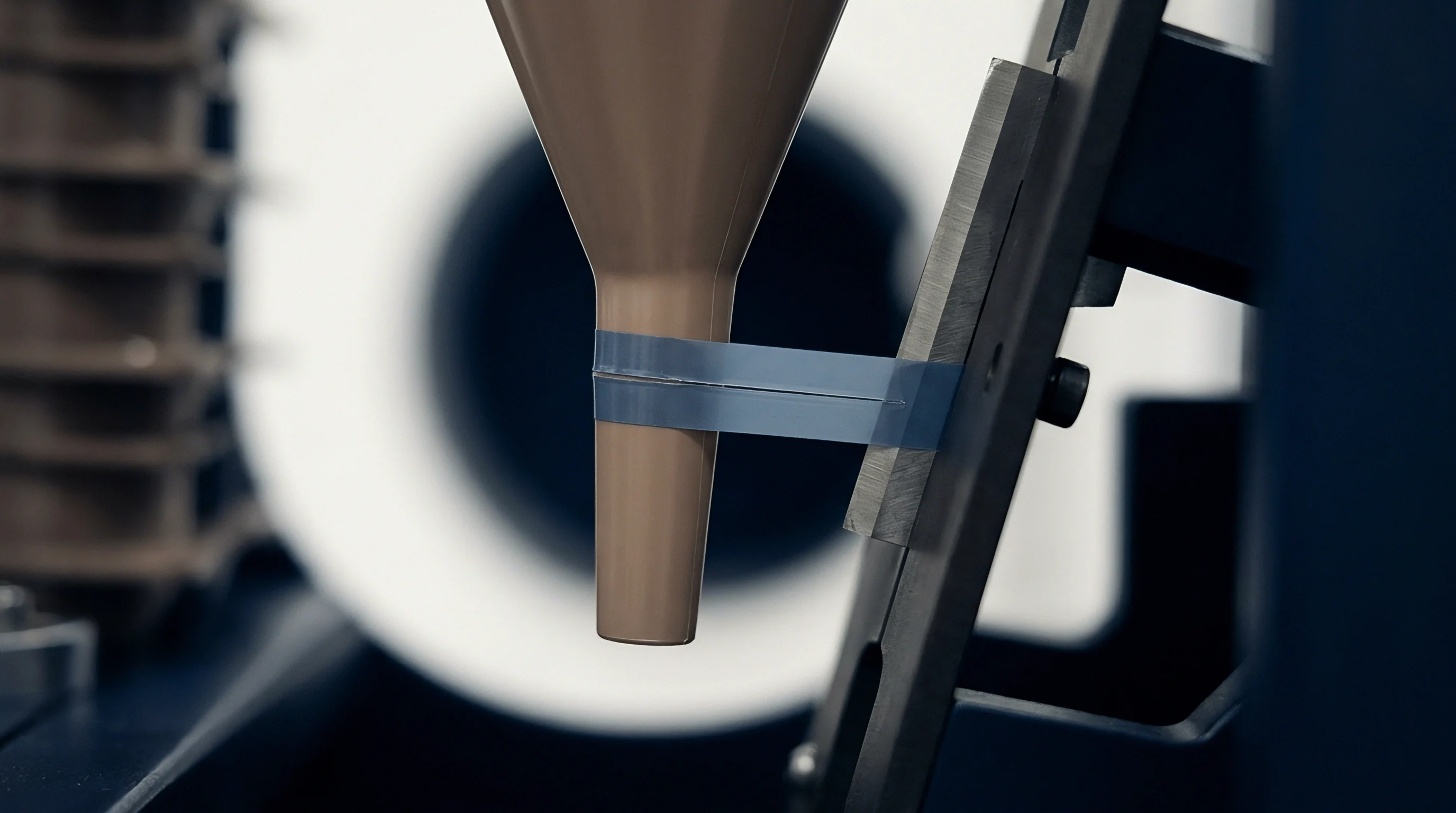
Extrudate swell occurs as molten polymer exits an extrusion die and recovers stored elastic energy. Long polymer chains compress within the die land, orienting along the axis of flow. Upon exiting the constraining die walls, entanglements force chains back toward isotropic coil conformations, expanding the extrudate cross-sectional area while contracting its length.
Bimodal resins exhibit complex swell behavior because their constituent fractions respond on radically different time scales.
Elastic recovery responds directly to the highest molecular weight components. High molecular weight chains require extended relaxation times, maintaining elastic memory long after leaving the land region. Uncontrolled swell leads to dimensional instability, profile distortion, and wall thickness variations in extruded goods.
Tooling design compensates for this dimensional expansion by shrinking die entry angles and adjusting land length ratios.

Melt Fracture and Processing Window Boundaries
Melt fracture manifests as surface roughness or gross structural distortion when shear stress at die walls exceeds critical limits. Surface melt fracture, known as sharkskin, initiates at die exit locations when the outer skin of polymer undergoes severe stretching. The critical shear stress threshold for unimodal high-density polyethylene typically lands between 0.10 and 0.14 MPa.
Bimodal architecture elevates this critical threshold, permitting higher line speeds before surface defects appear.
Flow instability transitions from surface sharkskin to stick-slip melt fracture as throughput increases. During stick-slip flow, the polymer melt periodically slips along die wall boundaries, causing pressure oscillations and alternating clear and cloudy bands on extruded pipe or film surfaces. The low molecular weight fraction in bimodal grades delays stick-slip onset by lubricating wall interfaces, widening the acceptable extrusion processing envelope.
A worked construction illustrates tooling adjustment calculations for bimodal PE-100 pipe extrusion. Target pipe dimensions are 110 millimeter outer diameter with a 10 millimeter nominal wall thickness, operating at a line speed of 1.2 meters per minute through a land length of 250 millimeters.
- Unimodal PE Grade Baseline exhibits an extrudate swell ratio of 1.45 at 190 °C under die shear rates of 250 s⁻¹, demanding a die ring diameter of 82 millimeters to land target pipe dimensions.
- Bimodal PE-100 Grade Alternative exhibits a higher elastic swell ratio of 1.62 under identical temperature and throughput conditions due to its ultra-high molecular weight tail.
- Die Land Sizing Adjustment requires expanding the die outer ring diameter to 89 millimeters while increasing land length to 300 millimeters to extend dwell time and relieve internal elastic strain.
- Head Pressure Consequence drops from 28.5 MPa on the unimodal die setup to 22.1 MPa on the recalibrated bimodal die configuration, lowering melt temperature by 7 °C at the die entrance.
Tooling geometry must match resin rheology exactly. Failure to recalculate die land length for high-swell bimodal lots results in severe wall-thickness tolerance failures, generating off-spec scrap rates exceeding twelve percent on continuous extrusion lines.


Assay
Verifying incoming bimodal resin shipments requires analytical routines beyond standard single-point melt flow index testing. Standard MFR tests under 2.16 kilogram loads fail to characterize high molecular weight fractions, because long chains remain largely immobile under light stress. Complete lot qualification demands multi-load melt flow index comparisons, gel permeation chromatography, and high-load shear testing to confirm molecular weight distribution integrity.

How Does Flow Rate Ratio Reveal Hidden Blend Inhomogeneity?
Flow Rate Ratio calculates the proportion between high-load melt flow rate and standard-load melt flow rate. Measuring melt flow according to ISO 1133 or ASTM D1238 under 21.6 kilograms (I21.6) and 5.0 kilograms (I5) provides a sensitive index of molecular breadth. Unimodal resins yield flow rate ratios (I21.6 / I5) between 8 and 12, whereas bimodal resins generate ratios between 25 and 45.
Drops in this ratio indicate missing high molecular weight polymer or incomplete cascade polymerization.
| Analytical Test Description | Standard Test Reference | Acceptable Specification Range | Rejection Trigger Condition |
|---|---|---|---|
| Melt Flow Rate (190 °C / 5.0 kg) | ISO 1133 Condition T | 0.20 to 0.35 g/10 min | Variance > ±10% from nominal grade target |
| High Load Melt Rate (190 °C / 21.6 kg) | ISO 1133 Condition Y | 8.0 to 14.0 g/10 min | Variance > ±12% from nominal grade target |
| Flow Rate Ratio (I₂₁․₆ / I₅) | ISO 1133 Derived | 28.0 to 42.0 dimensionless | Ratio < 25.0 (Signals loss of HMW tail) |
| Pellet Density (23 °C Annealed) | ISO 1183-1 Method A | 0.948 to 0.953 g/cm³ | Density shift > 0.002 g/cm³ from specification |
| Gel Count Area (Size > 200 µm) | ISO 11420 / Optical Film | < 500 mm² per m² film | Gel count > 1,500 mm² per m² film |
Pellet density determinations verify comonomer distribution across incoming shipments. Density drops when comonomer content increases. Because comonomers reside primarily in the high molecular weight tail of bimodal resins, density shifts signal errors in secondary reactor comonomer metering.
Testing requires annealed samples to ensure full crystalline relaxation prior to gradient column measurement.
Uncontained gels degrade pressure pipe endurance and thin film puncture resistance. Optical scanning systems evaluate cast tape extruded from sample pellets, counting and categorizing gel sizes from 50 micrometers up to 600 micrometers. Unmixed high molecular weight gels above 200 micrometers create stress concentration sites that induce premature brittle failure under hydrostatic load.
- High-Load Flow Rate Measurement confirms the structural weight fraction of long-chain molecules within specified tolerance windows.
- High-Temperature Gel Permeation Chromatography generates complete molecular weight distribution curves, pinpointing Mn, Mw, and Mz values.
- Differential Scanning Calorimetry records peak melting temperature and enthalpy, verifying crystallinity percentage and comonomer incorporation uniformity.
- Carbon Black Dispersion Analysis checks masterbatch distribution quality, ensuring particle size remains below 25 micrometers for UV stabilization.
Pellet density increases by zero point zero zero two grams per cubic centimeter after molecular relaxation in annealing baths.
Degradation during repeated processing heat cycles alters the high molecular weight tail first. Chain scission reduces bulk viscosity while broadening molecular weight distribution, lowering long-term stress crack resistance before changes manifest in low-load melt flow index readings.
Non-compliance with ISO 17855-2 classification limits triggers automatic rejection of delivered resin lots prior to silo discharge.

Ledger
Commercial sourcing decisions balancing unimodal against bimodal high-density polyethylene extend beyond raw pellet price per metric tonne. Bimodal grades command a price premium over commodity unimodal grades, ranging between $140 and $240 per tonne depending on comonomer selection and certification level. Standard pipe grades utilize 1-butene, whereas high-performance PE-100 and PE-RC (Resistance to Crack) grades require 1-hexene, elevating monomer costs for resin producers.
Wall thickness reduction yields major structural polymer savings in extruded goods. Pressure pipes rated for identical working pressures require significantly thinner walls when produced from bimodal PE-100 resin instead of unimodal PE-80 resin. Upgrading from PE-80 (Standard Dimension Ratio 11) to PE-100 (Standard Dimension Ratio 17) cuts required polymer mass per meter of pipe by 22 percent to 30 percent, offsetting resin premiums within the first operational production shift.
Processing energy calculations further alter the economic balance. Bimodal resins reduce melt viscosity under high extrusion shear rates, lowering motor power consumption measured in kilowatt-hours per kilogram processed. Lower processing temperatures reduce cooling trough length demands and chiller load requirements on continuous production lines.
Scrap generation rates drop significantly when processing stabilized bimodal compounds. Broader processing windows reduce startup waste, thermal degradation, and bubble breakage on blown film towers. Shipping container logistics, import tariff lines under HS code 3901.20, and extended warranty obligations solidify bimodal polyethylene as the lowest total landed cost option for long-term structural applications.