Non Linear Degradation Modeling for Coated Carbide Tooling Shutoff Lands under High Shear Volatiles
Non-linear degradation modeling protects coated carbide shutoff lands by predicting exponential wear acceleration from volatile chemical binder leaching.
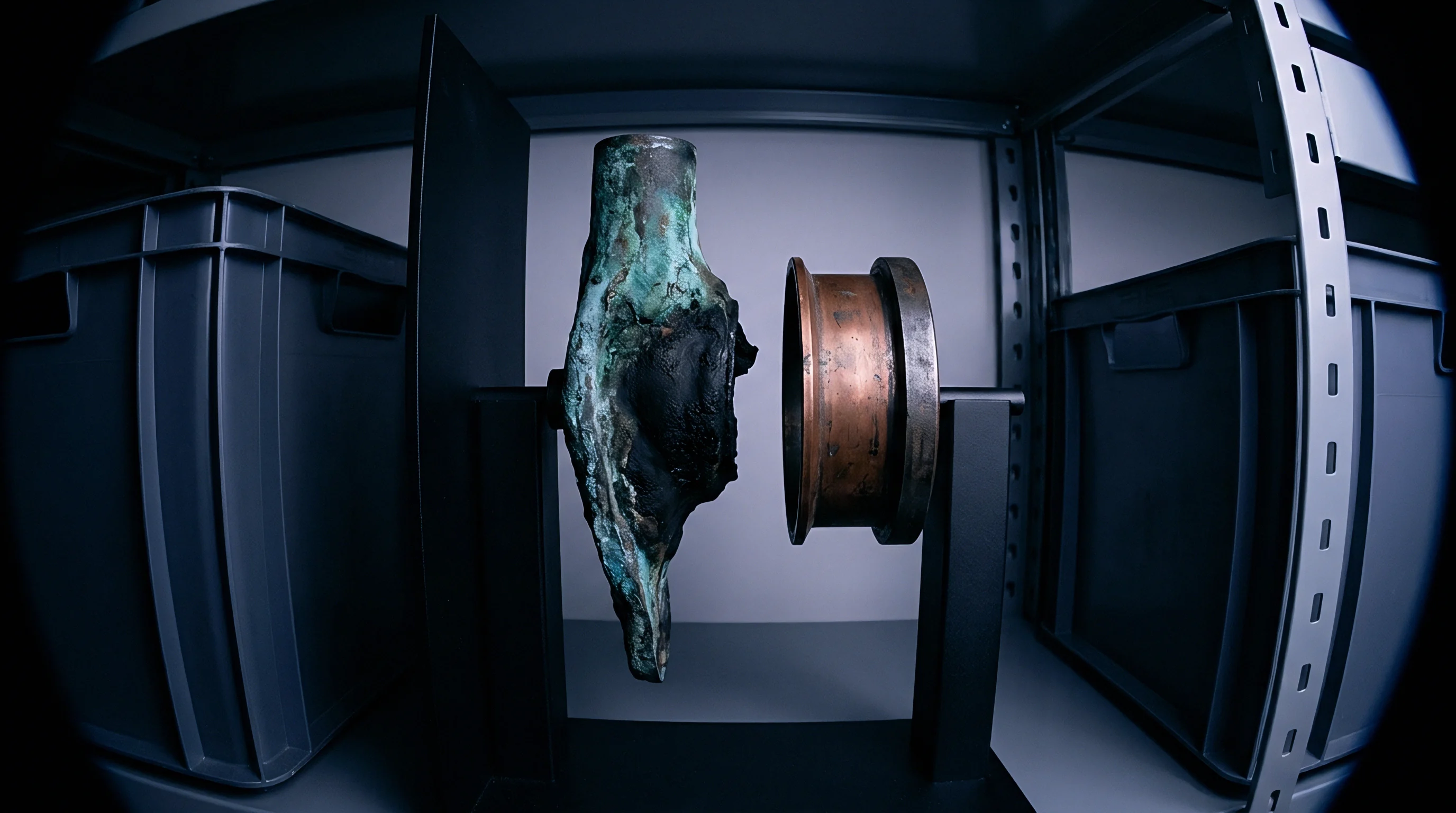

Land
Mould cavities operating at clamp pressures between 40 and 120 megapascals generate extreme localized compressive stress along parting line shutoffs. When high-velocity polymer melts enter thin-wall sections, volatile byproducts separate from the flow front and compress against these sealing surfaces. Solid tungsten carbide tooling inserts with sub-micron grain sizes of 0.5 to 0.8 microns resist gross mechanical deflection under repetitive press cycling.
Physical vapor deposition coatings applied to these carbide substrates protect against mechanical gouging. The combination of cyclic contact tonnage and volatile chemical impingement creates an aggressive degradation pathway that defies linear wear calculations. Shutoff surfaces fail abruptly once chemical stripping compromises the ceramic thin film.
The parting perimeter bears the primary clamping tonnage before cavity pressure reaches peak intensity during packing. Tool deflection under mechanical tonnage causes microscopic lateral displacement across the shutoff face. Melt enters at extreme velocity.
Shear rates exceeding 50,000 reciprocal seconds liberate organic volatiles, residual monomer compounds, halogenated flame retardants, and fluorinated acids. These volatile gases migrate into parting micro-gaps measuring between 5 and 15 microns. Compression heating during gas entrapment elevates the local surface temperature past 400 degrees Celsius within microseconds.
Standard tool steels such as AISI H13 or DIN 1.2343 pit rapidly under this combined thermal and chemical onslaught. Carbide inserts hold compressive integrity, yet their surface coatings face immediate chemo-mechanical depletion.
Physical vapor deposition films of aluminum chromium nitride lose interfacial cohesion after 180,000 cycles under cyclic parting pressures exceeding 85 megapascals.
Standard tool room preventative maintenance schedules rely on shot counters that assume steady, linear wear profiles across production runs. Linear wear assumptions extrapolate flat material removal rates derived from pin-on-disk tribological bench evaluations. Actual toolroom measurements reveal extended periods of zero detectable surface change followed by exponential land collapse.
Tool steel deflects under tonnage. Once the physical coating ruptures, volatile acids attack the metallic cobalt binder phase that cements the tungsten carbide matrix. Pitting accelerates exponentially across subsequent cycles, widening the shutoff clearance beyond permissible flash limits.
Flash exceeding 0.02 millimeters on precision electrical connectors produces immediate assembly line rejection, scrapping entire production shifts and forcing unscheduled tool extraction.

Chemistry
Thermal degradation of high-performance engineered thermoplastics during the injection phase liberates volatile compounds that destabilize protective tool coatings. Polyphenylene sulfide processed above 320 degrees Celsius releases sulfur dioxide alongside volatile oligomers. Halogenated polyamides liberate hydrobromic acid during high-shear screw recovery and injection injection through restricted sub-gates.
Fluoropolymers and fluoroelastomers release trace hydrofluoric acid at melt temperatures near 380 degrees Celsius. These volatile chemical species deposit directly onto parting lands during mold filling, condensing onto the steel surfaces before cavity pressure vents through perimeter channels.
The binder phase leaches first. Cobalt binder matrices inside standard ISO K10 to K30 grade cemented carbides undergo aggressive chemical dissolution when exposed to halogen-containing volatiles. Hydrobromic and hydrofluoric condensates dissolve cobalt through acidic extraction, leaving brittle, unsupported tungsten carbide grains on the shutoff surface.
Titanium aluminum nitride and chromium aluminum nitride coatings act as barrier layers against this leaching mechanism. The deposition process creates micro-porosity and columnar boundary pathways through which volatile molecules diffuse during prolonged high-temperature exposure. Thermal shocks crack thin films.
| Coating Architecture | Hardness (GPa) | Diffusion Barrier Integrity | Binder Protection Capacity | Observed Stripping Mechanism |
|---|---|---|---|---|
| TiAlN Monolayer | 33 | Permeable to HBr past 250k shots | Moderate cobalt depletion | Columnar boundary delamination |
| AlCrN Monolayer | 36 | Stable against SO2 to 450k shots | High cobalt retention | Oxidative micro-spallation |
| AlTiN/Si3N4 Nanocomposite | 42 | Dense amorphous phase arrests halogen flux | Superior retention to 700k shots | Interfacial shearing under cyclic slip |
| CrN/Diamond-Like Carbon Duplex | 28 | Acid resistant to 150k shots | Rapid leaching after graphitization | Thermal graphitization and flaking |
The progression of chemical and mechanical failure across a shutoff boundary follows an escalating chain of physical phenomena:
- Volatile Condensation deposits acidic byproducts directly onto cold shutoff surfaces below the polymer dew point during decompression.
- Chemical Infiltration drives acidic radicals through coating columnar defects down to the cobalt binder interface.
- Cobalt Solubilization extracts the binding metal, reducing surface fracture toughness from 10 to below 3 megapascals per root meter.
- Micro-Fracture Inception shears unsupported carbide grains away from the substrate during clamping lockup.
Suppliers routinely dismiss early shutoff land erosion by asserting that melt temperatures ran outside recommended processing datasheets during unattended shifts.

Mechanics
Cyclic mechanical loading at the mold parting interface drives complex fatigue phenomena throughout the thin-film microstructure. Every press closure applies severe normal stresses that flatten microscopic surface asperities. Substrate deflection breaks the interface.
Coated carbide blocks deflect less than standard tooling steels, but the shear stress concentrated at the interface between the thin physical vapor deposition layer and the carbide substrate exceeds several gigapascals. When volatile acid attack weakens the underlying cobalt matrix, the substrate loses the elastic modulus needed to support the ceramic coating layer. The coating flexes into microscopic voids left by leached binder material, inducing high tensile stress states within the brittle film.
Tooling specifications referencing DIN 16742 TG3 dimensional bands become unenforceable once shutoff land clearance drifts beyond twelve micrometers.
Fatigue spallation initiates through ring cracking around contact asperities. Repeated mold clamping produces microscopic sliding displacements measuring between 0.5 and 2.0 microns along the shutoff contact boundary. This micro-fretting motion removes passivating oxide films from the coating surface, exposing raw material to fresh volatile condensate on each injection cycle.
Corrosion accelerates physical contact fatigue. Microcracks propagate along grain boundaries. The combined wear velocity accelerates non-linearly, transitioning from gentle abrasive polishing to macroscopic delamination and chipping.
| Substrate Carbide Grade | Cobalt Content (wt%) | Mean Grain Size (µm) | Non-Linear Wear Exponent (n) | Cycles to Boundary Breach |
|---|---|---|---|---|
| Fine Grain ISO K10 | 6.0 | 0.8 | 2.45 | 420,000 |
| Sub-Micron ISO K20 | 8.5 | 0.5 | 2.88 | 310,000 |
| Ultra-Fine ISO K05 | 4.5 | 0.4 | 1.92 | 680,000 |
| Corrosion-Resistant Ni Binder | 6.0 | 0.8 | 1.65 | 890,000 |
| Data derived from automated production monitoring of halogenated PA66 running at 340 degrees Celsius melt temperature and 90 megapascals shutoff contact stress. | ||||
The structural destruction of the parting land manifests across several recognizable degradation states:
- Interfacial Blistering separates the ceramic coating from the carbide substrate due to trapped gas expansion during mold decompression.
- Cobalt Washout hollows the microscopic support matrix beneath the primary contact zone.
- Micro-Chipping shears individual carbide grains away from unsupported shutoff edges under direct clamp tonnage.
- Gross Land Collapse crushes porous carbide bulk material, opening parting gaps directly into the cavity volume.
The operational threshold where sub-surface cobalt depletion converts into irreversible ceramic coating delamination remains an open question in long-run production monitoring.

Simulation
Predictive life calculation models for shutoff lands require multi-variable mathematical functions that account for chemical kinetics alongside mechanical contact fatigue. Classical Archard wear equations assume volumetric wear volume is directly proportional to sliding distance and applied normal load while remaining inversely proportional to material hardness. In environments containing corrosive polymer volatiles, that linear relationship completely misrepresents tooling behavior.
The actual degradation volume over cumulative molding cycles incorporates a power-law acceleration term that tracks coating thinning and chemical depletion of the substrate.
The cumulative degradation volume follows an augmented formulation where mechanical contact wear combines with an exponential chemical damage function:
V = K (P^a) (L^b) exp(lambda N)
In this governing equation, V represents the total volume of lost tool material across the shutoff face. Parameter K defines the base tribological wear coefficient under non-reactive sliding conditions. Variable P tracks the peak normal contact pressure experienced during machine clamp lockup, modified by pressure exponent a.
Term L represents the microscopic slip distance across the parting land during mold breathing and pressurization, modified by slip exponent b. Factor lambda designates the chemical damage rate, which scales with volatile concentration and contact zone temperature. Scalar N represents the cumulative mold cycle count.
Linear wear assumptions fail here. Consider a high-speed electrical connector tooling package running thirty percent glass-filled halogenated polyphthalamide at 340 degrees Celsius melt temperature. The tool incorporates an eight-cavity configuration operating inside a 100-ton press with a cycle time of 8.5 seconds.
The shutoff land experiences 65 megapascals of compressive stress over a 1.2-millimeter contact width. Laboratory pin-on-disk measurements assign the AlTiN-coated fine-grain carbide a nominal wear coefficient K of 1.2 x 10^-7 cubic millimeters per Newton-meter. A standard linear calculation predicts a shutoff land life of 1,800,000 cycles before clearance opens by 0.015 millimeters.
Flashing begins at twelve microns. Factoring in the chemical damage rate lambda of 4.8 x 10^-6 per cycle, alongside a pressure exponent a of 1.35 and slip exponent b of 1.10, collapses the predicted failure horizon. The mathematical formulation reveals a stable, near-zero wear progression through 350,000 cycles, during which the AlTiN coating remains intact.
Once chemical diffusion breaches the 3-micron coating barrier at cycle 410,000, cobalt leaching drops substrate load-bearing capacity. The calculated wear rate spikes exponentially. The clearance reaches the 0.015-millimeter terminal failure boundary at precisely 520,000 cycles.
Relying on linear predictions leaves tooling managers unprepared for catastrophic flash during production runs.
Shutoff lands running aggressive volatiles experience abrupt failure once substrate leaching undermines coating support.
Accurate life modeling demands rigorous validation across specific process variables:
- Volatile Concentration Auditing quantifies the exact outgassing mass per shot through thermogravimetric analysis of production resin lots.
- Contact Pressure Verification measures actual compressive stress distribution using calibrated tactile pressure films during mold setup.
- Micro-Slip Quantification tracks platen deflection and die alignment shifts during dynamic injection cycles.
- Coating Deposition Thickness Mapping measures thin-film consistency across shutoff faces using non-destructive optical interferometry.
Coatings outlast their substrates only when the base carbide resists the chemistry of the gas.

Allowance
Procurement contracts for precision injection molds running volatile polymers require explicit financial allocations for shutoff wear components. Production tool designs isolate high-wear parting regions onto modular, interchangeable carbide sub-inserts. Hard-machined cavity blocks made from single billets of tool steel force complete tool rebuilds when a shutoff washes out.
Tool replacement stops entire lines. Utilizing sub-micron carbide inserts retained by wedge locks allows rapid press-side replacement within two hours, avoiding lengthy toolroom tear-downs.
Carbide inserts demand balanced preloads. Engineering drawings must designate specific tolerances for insert stand-off heights relative to the main parting face. Ground carbide shutoffs require a calibrated preload between 0.010 and 0.015 millimeters above adjacent steel runner plates to ensure positive cavity sealing before primary clamping tonnage distributes across the mold base.
Excessive preload crushes carbide edges during lockup. Insufficient preload allows volatile gases to escape freely across the land, initiating rapid erosive jetting. Part tolerances drift out rapidly.
Tooling capital budgets must incorporate three sets of spare coated carbide shutoff inserts per production year for each high-volume cavity program.
Tooling maintenance contracts should allocate six percent of total mold purchase value annually for spare carbide wear inserts.
Quality warranties between contract molders and OEMs collapse when resin formulations change without tooling reviews. Switching from an unfilled grade to a flame-retardant compound containing brominated additives doubles the volatile attack velocity, reducing shutoff insert life by two-thirds. Sourcing documentation must define whether tool degradation stems from mechanical wear or chemical degradation.
Clear master supply agreements assign insert replacement expenses directly to the buyer whenever resin lot certificates reveal volatile moisture or additive variances beyond agreed material specifications.
Supply agreements incorporating DIN 16742 tolerance verification clauses transfer tooling replacement costs directly to the buyer when processing logs demonstrate resin outgassing exceeded the baseline chemical limits documented during original tool commissioning.