Mass Transport Kinetics and Diffusion Modeling in Decontaminated High Density Polyethylene
Decontaminated HDPE migration compliance relies on temperature-dependent Fickian diffusion models parameterized by matrix density and surrogate mass.

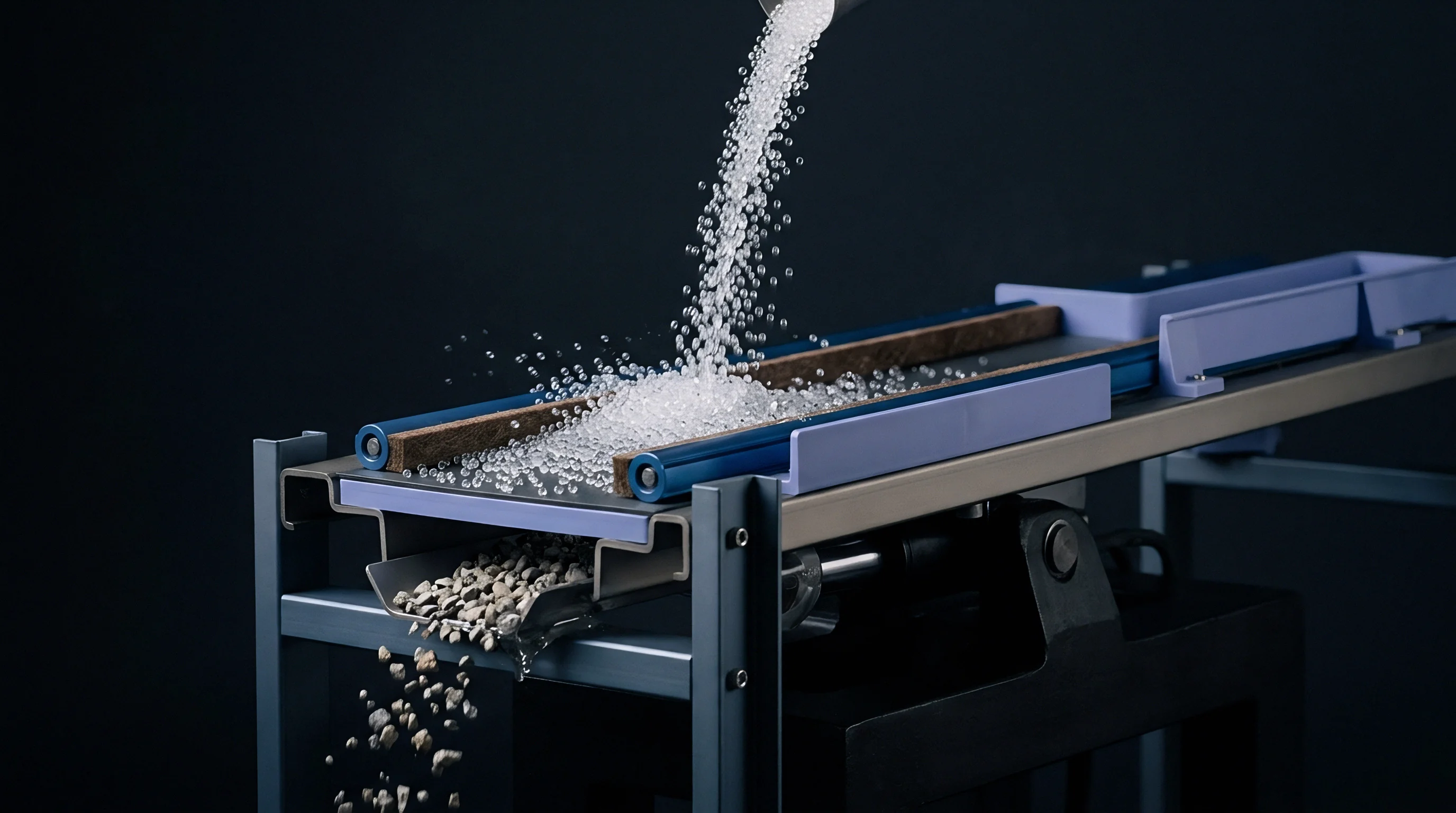
Contaminants
Post-consumer high density polyethylene streams originating from rigid packaging, such as milk containers, detergent bottles, and industrial pails, contain complex mixtures of absorbed volatile and semi-volatile organic compounds. Matrix density dictates transport kinetics. High density polyethylene possesses a density between 0.941 and 0.965 grams per cubic centimeter, accompanied by a crystalline mass fraction ranging from 60 to 80 percent.
The crystalline lamellae act as impenetrable physical barriers to diffusing molecules, forcing all mass transport to occur within the tortuous amorphous channels between folded polymer chains.

Surrogate Molecule Selection for Challenge Testing
Evaluating the decontamination capability of a recycling process requires physical spiking of uncleaned polyolefin flakes or pellets with representative challenge chemicals. Regulatory guidance from the European Food Safety Authority and the United States Food and Drug Administration specifies five distinct chemical classes for surrogate challenge testing. These classes encompass volatile non-polar compounds, volatile polar compounds, non-volatile non-polar compounds, non-volatile polar compounds, and heavy organophilic substances.
Toluene and chlorobenzene represent low molecular weight volatile species. Phenylcyclohexane models mid-range non-polar contaminants. Benzophenone serves as a surrogate for UV-curing inks and non-volatile polar migrants.
Methyl stearate represents high molecular weight fatty acid esters and slip agents.
Amorphous channels govern migrant travel. Surrogate absorption into post-consumer high density polyethylene occurs during prolonged initial contact with packaged consumer goods. The depth of contaminant penetration into the polymer matrix depends directly on contaminant exposure time, temperature, and compound polarity.
Non-polar organic molecules absorb rapidly into the non-polar polyolefin structure. Crystalline domains block diffusion entirely.
| Surrogate Compound | Chemical Category | Molecular Mass (g/mol) | Boiling Point (°C) | Target Inoculation (mg/kg) | Decontamination Target (%) |
|---|---|---|---|---|---|
| Toluene | Volatile Non-Polar | 92.14 | 110.6 | 500 to 1000 | 99.5 |
| Chlorobenzene | Volatile Polar | 112.56 | 131.7 | 500 to 1000 | 99.5 |
| Phenylcyclohexane | Non-Volatile Non-Polar | 160.26 | 240.0 | 200 to 500 | 99.0 |
| Benzophenone | Non-Volatile Polar | 182.22 | 305.4 | 200 to 500 | 99.0 |
| Methyl Stearate | Heavy Organophilic Ester | 298.51 | 443.0 | 100 to 300 | 95.0 |

Absorption Mechanics in High Density Matrices
Contaminant sorption follows classic Fickian absorption behavior during consumer storage. Surface concentration reaches equilibrium rapidly, after which a steep concentration gradient drives surrogate molecules deeper into the amorphous regions of the polymer. The lower free volume of high density polyethylene relative to low density polyethylene severely restricts structural relaxation during chemical absorption.
Consequently, contaminant accumulation remains concentrated within the outer 100 to 300 micrometers of rigid container walls during typical product shelf life.
Semi-crystalline polymer regions block migrant penetration, forcing all mass transport into amorphous channels between folded crystallites.
Feedstock quality variations present serious challenges to recycling plants. Feedstock contamination profiles vary significantly between collection lots. Shredded post-consumer flakes exhibit surface contamination along with bulk absorbed species.
Melt filtration removes insoluble particulate matter, but volatile and semi-volatile migrants remain dissolved within the molten polyolefin matrix unless stripped by thermal vacuum decontamination.
- Cross-contamination by low-density fractions alters baseline polymer crystallinity, increasing total free volume and accelerating migrant diffusion rates beyond standard high-density predictions.
- Deep matrix absorption occurs during extended chemical storage, driving migrants deep into structural amorphous core zones where standard surface washing fails to extract them.
- Thermal degradation products form during high-shear extrusion, generating low molecular weight alkanes, alkenes, and aldehydes that register as non-intentionally added substances during migration screening.
- Surrogate cross-linking interactions alter localized polyolefin chain mobility when heavy organic contaminants concentrate within amorphous regions at high temperatures.
Recyclers frequently claim that high vacuum levels compensate for reduced residence times during melt decontamination, asserting that vapor pressure overrides solid-state diffusion constraints.


Volatilization
Extracting absorbed contaminants from high density polyethylene requires overcoming the thermodynamic enthalpy of sorption alongside internal mass transfer resistance. Thermal decontamination processes rely on elevated temperatures and reduced system pressures to drive volatile and semi-volatile migrants out of the polymer matrix. Vapor pressure drives surface evaporation.
The rate-limiting step in thermal decontamination shifts from surface evaporation to solid-state internal diffusion as surface contaminant levels deplete.
Thermal Desorption Kinetics and Degassing Mechanics
Solid-state decontamination operates on clean post-consumer flakes or regrind pellets at temperatures below the polymer melting point, typically between 100 and 130 degrees Celsius. Temperature shifts activation energy rapidly. The temperature dependence of the diffusion coefficient follows an Arrhenius relationship, where activation energy for contaminant transport in high density polyethylene ranges from 60 to 110 kilojoules per mole depending on contaminant molecular size.
Raising processing temperature increases polyolefin chain segment mobility, expanding local free volume and enabling faster migrant transport toward the pellet surface.
Vacuum stripping during solid-state decontamination removes desorbed surface molecules, preventing re-absorption and maintaining maximum concentration driving force across the solid-gas interface. Extrusion degassing operates at higher temperatures, typically between 190 and 240 degrees Celsius, where the polymer exists in a fully molten state. Chain mobility controls extraction speed.
Molten polyolefin diffusivity increases by two to three orders of magnitude relative to solid-state conditions, but reduced residence times inside twin-screw extruders limit total mass transfer unless high vacuum levels below 5 mbar are maintained across dedicated degassing zones.
Operating solid-state decontamination at 180 degrees Celsius under 0.5 mbar vacuum for four hours reduces residual toluene concentrations below 0.05 milligrams per kilogram.

Super-Clean Process Limits for Rigid Feedstocks
Decontamination technology performance depends on pellet size, vacuum depth, gas sweep rate, and reactor temperature control. Solid-state reactors treating rigid flakes achieve deep cleaning due to small average diffusion path lengths. Rigid high density polyethylene flakes measuring 0.8 millimeters in thickness require substantially shorter decontamination residence times than pelletized regrind measuring 3.0 millimeters in diameter.
The diffusion time scale scales quadratically with characteristic diffusion length, making flake-based decontamination kinetics significantly faster than pellet-based treatment under identical thermal regimes.
Higher processing temperatures accelerate contaminant extraction far more effectively than extending residence times at ambient pressure.


Equations
Quantifying mass transport in post-consumer high density polyethylene relies on mathematical formulations derived from Fick’s Second Law of diffusion. Transient mass transport in a isotropic polymer matrix follows a partial differential equation relating concentration change over time to spatial concentration gradients. Modeling specific migration into food or food simulants assumes planar or spherical geometry, uniform initial contaminant distribution, and constant environmental conditions.
Fickian Transport Models and Boundary Conditions
The mathematical representation of one-dimensional diffusion through a polymer sheet of thickness d appears as the partial differential equation where the rate of change in concentration equals the product of the diffusion coefficient and the second spatial derivative of concentration. Solving this equation under specific boundary conditions yields the total quantity of migrant transferred from the polymer into an contacting phase over time. For food contact packaging, boundary conditions assume limited volume contact, zero initial contaminant concentration in the food simulant, and a constant partition coefficient between polymer and simulant phases.
Calculated values establish theoretical boundaries. When internal diffusion inside the polymer matrix governs the rate of mass transport, the mass fraction of migrant released into the simulant at time t scales with the square root of the diffusion coefficient divided by the square of polymer thickness. Accurate modeling requires precise values for the temperature-dependent diffusion coefficient and the polymer-to-food partition coefficient.

Piringer Parameterization for Semi-Crystalline Polyolefins
Direct experimental measurement of diffusion coefficients for every potential contaminant remains unfeasible. Compliance modeling relies on semi-empirical estimation models, primarily the Piringer model. The Piringer model estimates the maximum expected diffusion coefficient based on migrant molecular weight, absolute temperature, and a polymer-specific parameter designated as A_P prime.
The model deliberate overestimates diffusion coefficients to provide a protective, worst-case migration value for regulatory evaluation.
The polymer-specific parameter A_P prime incorporates matrix density, chain rigidity, and free volume availability. Unmodified high density polyethylene uses a standard A_P prime value of 11.5, whereas low density polyethylene uses a value of 14.5. The lower value for high density polyethylene reflects the restrictive influence of high crystallinity on molecular transport.
Adding recycled content or processing aids can alter localized chain density, causing actual diffusion rates to deviate from standard A_P prime estimates.
| Polymer Grade | Density (g/cm³) | Piringer Parameter (A’_P) | Migrant Molecular Mass (g/mol) | Calculated D_P at 20°C (cm²/s) | Calculated D_P at 40°C (cm²/s) |
|---|---|---|---|---|---|
| Virgin HDPE Rigid | 0.955 | 11.5 | 100 | 1.2e-11 | 1.8e-10 |
| Recycled HDPE Flake | 0.952 | 11.5 | 180 | 2.1e-13 | 4.5e-12 |
| Virgin HDPE Blow Mold | 0.948 | 12.0 | 180 | 6.8e-13 | 1.4e-11 |
| Virgin LDPE Film | 0.922 | 14.5 | 180 | 2.1e-10 | 3.8e-09 |
Consider a worked calculation for specific migration verification. Assume a 40-tonne manufacturing lot of blow-molded high density polyethylene milk bottles with a average wall thickness of 0.8 millimeters (0.08 centimeters) and a density of 0.95 grams per cubic centimeter. The decontaminated post-consumer resin contains a residual phenylcyclohexane (molecular mass 160.26 grams per mole) concentration of 15 milligrams per kilogram.
The packaging contacts liquid food with a surface-to-volume ratio of 6 square decimeters per kilogram of food for 10 days (864,000 seconds) at 40 degrees Celsius (313.15 Kelvin).
First, calculate the estimated diffusion coefficient using the Piringer equation with an A_P prime value of 11.5. At 40 degrees Celsius, the calculated maximum diffusion coefficient for phenylcyclohexane in high density polyethylene equals 8.2e-13 square centimeters per second. Second, calculate the dimensionless diffusion parameter tau, defined as the product of the diffusion coefficient and time divided by the square of half the polymer thickness.
Inserting the values yields a tau parameter of 0.443. Third, calculate the specific migration value into the food simulant assuming a conservative partition coefficient of 1, meaning the migrant dissolves readily in the contact medium. The calculated specific migration rate yields 0.038 milligrams of phenylcyclohexane per kilogram of food, which sits safely below the default specific migration threshold of 0.05 milligrams per kilogram.
- Establish baseline polymer morphology by measuring density and degree of crystallinity through differential scanning calorimetry to select the appropriate polymer parameter value.
- Determine contaminant chemical structure and exact molecular weight from mass spectrometry screening reports to calculate molecular size factors.
- Define precise exposure boundary conditions including packaging surface area, enclosed food mass, contact duration, and worst-case storage temperatures.
- Execute numerical migration solving using Fickian finite element models when simple analytical solutions overestimate partitioning in multi-layer structures.
Whether non-linear plasticizer interactions in recycled high density polyethylene streams alter the polymer matrix backbone enough to invalidate standard Piringer A_P prime constants remains an unresolved debate among compliance laboratories.


Simulants
Demonstrating compliance of decontaminated high density polyethylene with European food contact regulations requires rigorous testing against official food simulants. Regulation (EU) 10/2011 defines specific test media designed to mimic the extraction behavior of different food categories. Simulant A (10% ethanol) models aqueous foods.
Simulant B (3% acetic acid) evaluates acidic environments. Simulant C (20% ethanol) covers alcoholic media, while Simulant D1 (50% ethanol) and Simulant D2 (vegetable oil or alternative fatty simulants) evaluate milk, dairy, and fatty food contact. Simulant E (poly(2,6-diphenyl-p-phenylene oxide), known commercially as Tenax) tests dry food applications.

Does Mathematical Modeling Replace Migration Testing under European Rules?
Mathematical modeling based on scientifically validated diffusion models is officially recognized under Article 16 of Regulation (EC) 1935/2004 and Annex V of Regulation (EU) 10/2011 as a valid tool to demonstrate compliance. Modeling serves as a legally binding alternative to experimental migration testing provided the mathematical parameterization yields safe overestimates of real migration. If calculated specific migration values remain below regulatory specific migration limits, physical migration testing is not legally required for non-fatty contact media.
Ethanol plasticizes amorphous polyolefin chains. Fatty food testing introduces experimental challenges when evaluating high density polyethylene. Vegetable oil testing requires complex solvent extraction and analytical separation techniques.
Alternative fatty simulants, such as 95% ethanol and synthetic polyisobutylene oil mixtures, are permitted for physical testing provided they match or exceed the extraction power of vegetable oil.
Article 16 of Regulation (EC) 1935/2004 permits food contact compliance demonstration through either experimental migration testing or recognized mathematical modeling.

Solvent Swelling Effects and Contact Testing Protocols
Exposing high density polyethylene to strong organic simulants like 95% ethanol or non-polar organic solvents causes matrix swelling. Solvent absorption expands free volume. Organic molecules penetrate the amorphous regions, plasticizing polyolefin chain segments and lowering the activation energy for migrant diffusion.
This artificially induced swelling accelerates surrogate migration far beyond realistic food contact conditions, generating mass transfer rates two to ten times higher than those observed in vegetable oil or aqueous media.
Fatty simulants promote matrix swelling. Testing protocols must account for solvent uptake when interpreting experimental mass loss or analytical extraction figures. Standard contact conditions of 10 days at 60 degrees Celsius simulate long-term storage exceeding 30 days at room temperature, including hot-fill processing up to 70 degrees Celsius.
- Clean test specimens harvested from molded decontaminated high density polyethylene containers are measured for thickness and total contact surface area.
- Specimens undergo complete immersion in chosen food simulant inside sealed glass migration cells, maintaining a standard ratio of six square decimeters per kilogram of simulant.
- Migration cells remain placed in calibrated temperature chambers for ten days at sixty degrees Celsius to simulate extended shelf life at room temperature.
- Simulant extracts undergo gas chromatography with mass spectrometry screening to quantify specific migrant concentrations against specific migration limits.
- Mass balance calculations compare measured migrant mass against worst-case diffusion modeling results to confirm model conservatism.
Section 4.2 of EN 13130-1 requires laboratories to report specific migration values alongside measurement uncertainty thresholds, preventing rounded zero entries from masking limit breaches.


Penalties
Placing non-compliant decontaminated high density polyethylene packaging on the market carries severe administrative, commercial, and financial consequences. Regulatory oversight across the European Union operates under Regulation (EU) 2022/1616, which governs recycled plastic materials intended for food contact. Reprocessors and packaging converters are required to maintain strict quality assurance systems and issue detailed Declarations of Compliance for every production batch.
Incomplete compliance documentation or failed migration tests invalidate material status instantly.

Commercial Liabilities in Recycled Content Declarations
Recycled feedstock requires continuous testing. Commercial contracts between material suppliers and brand owners include explicit compliance warranties covering non-intentionally added substances and surrogate decontamination limits. If post-consumer resin batches contain residual contaminants exceeding specific migration thresholds, the converter incurs immediate liabilities for defective material supply.
Re-sorting, re-processing, or incinerating non-compliant polyolefin stock destroys profit margins across entire production runs.
Customs inspectors enforce batch declarations. Packaging compliance failures discovered after product filling trigger cascading costs across the distribution chain. Food brands face mandatory product withdrawals, inventory destruction costs, and brand reputation damage when illegal migrant levels are detected by market surveillance authorities.
| Substance / Migrant Type | Regulatory Status | Analytical Method | Limit of Detection (mg/kg) | Specific Migration Limit (mg/kg) |
|---|---|---|---|---|
| Toluene | Volatile Surrogate | Headspace GC-MS | 0.005 | 0.05 |
| Chlorobenzene | Volatile Surrogate | Headspace GC-MS | 0.005 | 0.05 |
| Benzophenone | Inks / Photoinitiator | Solvent Extract GC-MS | 0.010 | 0.60 |
| Primary Aromatic Amines | Restricted Impurity | LC-MS/MS | 0.002 | 0.002 per amine |
| Unspecified NIAS | Screened Unknowns | GC-QTOF / LC-QTOF | 0.010 | 0.010 default limit |

Regulatory Verification and Market Withdrawal Costs
National enforcement agencies perform random sampling of packaging materials at port entry points and processing facilities. Detection of unauthorized decontamination technologies or unvalidated recycled resin lots triggers immediate administrative holds under Regulation (EU) 2019/1020. Landed cost calculations must incorporate testing costs, border inspection fees, and potential customs penalty surcharges.
Improper decontamination invalidates material claims. Under plastic packaging tax systems, such as the United Kingdom Plastic Packaging Tax or national levies across European Member States, failing to prove that recycled high density polyethylene meets food contact safety standards voids its qualification as tax-exempt recycled content. Exporters face retroactive tax liabilities, penalty interest, and legal sanctions if packaging claims rest on unvalidated decontamination data.
Failing to verify recycled decontamination efficiency on a per-batch basis converts minor material cost savings into major product recall liabilities.
Customs seizures and mandatory product recalls occur when port health authorities detect non-intentionally added substances exceeding default specific migration thresholds in unvalidated recycled packaging.