Solid State Polymerization Volatile Stripping Mass Transfer Limits in rPET
Solid state polymerization stripping rate is dictated by internal Fickian diffusion limits of condensation by-products and volatiles within rPET pellet cores.


Kinetics
Solid state polymerization increases the molecular weight of post-consumer polyolefin-ester flake and pellet stock through step-growth condensation in the semi-crystalline phase below the crystalline melting temperature. Reversible esterification and transesterification reactions release water and ethylene glycol as small molecule condensation by-products. System equilibrium dictates that continuous removal of these by-products from the polymer matrix remains mandatory to advance intrinsic viscosity from a baseline of 0.72 dL/g to values exceeding 0.84 dL/g for bottle-grade or high-tenacity industrial filament applications.
Reaction kinetics inside the solid phase split into two distinct regimes based on temperature, crystallite morphology, and species mobility. Chemical reaction rate constants govern the system at lower thermal states where polymer chain end mobility remains constrained. At operational processing temperatures between 190 degrees Celsius and 220 degrees Celsius, the rate of chemical esterification exceeds the rate at which water and ethylene glycol diffuse through the amorphous regions between crystalline lamellae.
Mass transfer of the released condensate out of the solid core becomes the rate-limiting mechanism for intrinsic viscosity accumulation.
The intrinsic viscosity build rate drops by 64 percent when pellet core water concentration exceeds 50 parts per million at 205 degrees Celsius.
Diffusive flux within the polymer matrix follows Fickian transport dynamics described by temperature-dependent diffusion coefficients. Effective diffusivity of water and ethylene glycol within semi-crystalline polyethylene terephthalate depends heavily on fractional crystallinity. Crystalline domains act as impenetrable obstacles, forcing diffusing volatile molecules along convoluted paths through the amorphous fraction.
High initial crystallinity reduces the effective diffusion coefficient by increasing path tortuosity, which slows overall stripping kinetics despite stabilizing pellets against agglomeration and sticking inside continuous vertical reactors.

Fickian Diffusion and Transesterification Balance
Reaching target molecular weight requires balancing transesterification reaction velocity against species escape velocity. Water exhibits a significantly higher diffusion coefficient than ethylene glycol due to its smaller kinetic diameter of 0.265 nanometers compared to 0.44 nanometers for ethylene glycol. Consequently, water evacuation proceeds rapidly from surface layers, leaving transesterification driven by ethylene glycol removal as the primary chemical governor in deep pellet cores.
| Parameter Description | Test Condition | Value Range | Unit |
|---|---|---|---|
| Water Diffusion Coefficient | Semi-crystalline PET at 200 C | 1.2 x 10^-8 to 3.5 x 10^-8 | cm2/s |
| Ethylene Glycol Diffusion Coefficient | Semi-crystalline PET at 200 C | 4.5 x 10^-10 to 1.1 x 10^-9 | cm2/s |
| Esterification Activation Energy | Temperature 180 C to 220 C | 85.0 to 92.5 | kJ/mol |
| Ethylene Glycol Diffusion Activation Energy | Temperature 180 C to 220 C | 112.0 to 128.0 | kJ/mol |
| Equilibrium Constant Transesterification | Melt State at 280 C | 0.35 to 0.50 | Dimensionless |
Higher thermal activation expands the free volume of the amorphous phase, increasing the diffusion coefficient according to Arrhenius behavior. Raising reactor temperature from 195 degrees Celsius to 215 degrees Celsius increases the diffusion coefficient of ethylene glycol by a factor of three. This thermal shift simultaneously accelerates thermal degradation pathways, vinyl ester formation, and color index drift toward yellow.
Optimizing solid state reactors involves maintaining operational points where internal mass transfer resistance matches chemical reaction resistance without inducing thermal degradation.
The exact threshold where the rate-limiting step transitions fully from chemical esterification kinetics to internal condensate diffusion across varying rPET flake thickness distributions remains unresolved in current industrial modeling.


Pellet
Particle geometry directly sets the physical diffusion distance that condensate molecules and volatile organic contaminants must traverse to reach the boundary layer. Diffusive transport time scales quadratically with characteristic diffusion length. Decreasing pellet radius or flake thickness produces drastic reductions in the residence time required to strip volatile compounds down to parts-per-billion levels.
Regrind flake exhibits highly non-uniform geometry with varied thickness distributions ranging from 0.2 millimeters to 1.5 millimeters. Thin flakes achieve rapid volatile stripping and intrinsic viscosity build due to minimal internal mass transfer resistance. Thick flake fractions lag severely behind, creating wide intrinsic viscosity distributions within a single processing lot.
Standardizing particle dimensions through re-pelletization eliminates geometric variance but introduces an additional melt history that lowers baseline molecular weight through hydrolytic and thermal scission.
Geometric Profiles and Skin Core Morphologies
Underwater strand pelletizing produces spherical or cylindrical geometry with an amorphous skin and a crystalline core created during rapid water quench. Crystallization during pre-heating stages generates non-uniform density profiles across the pellet cross-section. The presence of a highly crystalline outer shell severely restricts volatile release, establishing a physical barrier that restricts species flux despite favorable core temperatures.
Spherical pellets with a diameter of 2.0 millimeters display homogenous heat and mass transfer vectors compared to standard cylindrical extrudates measuring 3.0 millimeters in length and 2.2 millimeters in diameter. Micro-pellets manufactured at 1.1 millimeter diameters offer ultra-short diffusion pathways, allowing solid state processing times to drop by half while achieving equivalent intrinsic viscosity gains.
Particle radius reduction yields exponential decreases in internal diffusion residence times across all crystallite geometries.
Particle shape controls packing density and gas void fractions within continuous counter-current reactor columns. Spherical micro-pellets pack tightly, reducing void space and increasing pressure drop across the bed. Cylindrical pellets maintain ideal bed voidage, balancing gas velocity against bed pressure drop, but carry longer internal diffusion distances that govern overall stripping efficiency.
Geometric non-uniformity introduces severe operational performance variances across solid state stripping runs. Common geometric failure mechanisms observed during high-temperature decontamination include:
- Flake Thickness Variance creates non-uniform intrinsic viscosity distributions where thin particles over-index on molecular weight while thick particles retain unacceptably high volatile organic concentrations.
- Amorphous Surface Smearing occurs during cutting tool dulling, producing localized non-crystalline surface zones that fuse at elevated reactor temperatures and block interstitial gas flow.
- Core Crystallization Voiding forms during aggressive cooling quenches, creating central micro-voids that trap ethylene glycol vapor and slow mass transfer rates.
- Fines Accumulation fills interstitial void space within the reactor bed, causing gas channeling and uneven volatile stripping across the pellet cross-section.
A simple operational rule applies: spherical particle geometries with uniform cross-sectional radii yield predictable volatile stripping behavior, whereas planar geometries with wide thickness distributions guarantee uneven molecular weight distribution.

Flux
Volatile species reaching the pellet surface must cross the external gas boundary layer to be swept away by the carrier gas stream or drawn into the vacuum manifold. Mass transfer flux across this surface film depends on the concentration gradient between the polymer surface and the bulk gas phase. Mass transfer coefficients increase directly with higher sweep gas velocities or deeper vacuum levels.
Under nitrogen sweep configurations, carrier gas purity determines the maximum achievable driving force. Trace moisture or glycol vapor in recirculated nitrogen reduces the surface concentration gradient, suppressing volatile evacuation. Regenerative desiccant drying systems maintain nitrogen dew points below minus 40 degrees Celsius to prevent hydrolytic back-reactions at the pellet surface during solid state processing.

What Determines Gas Phase Mass Transfer Resistance?
Gas phase mass transfer resistance depends on the relative values of the internal solid phase diffusion rate and the external convective film mass transfer rate. The dimensionless Biot number for mass transfer compares internal transport resistance to external convective resistance. High Biot numbers indicate that mass transfer control resides entirely inside the polymer pellet, rendering further increases in gas sweep velocity ineffective for accelerating volatile stripping.
| Operating Pressure Regime | Carrier Gas Dew Point | Mass Biot Number Range | Dominant Resistance Location |
|---|---|---|---|
| Deep Vacuum (< 1 mbar) | Not Applicable | Bi_m > 50 | Internal Solid Core Diffusion |
| Moderate Vacuum (10-50 mbar) | Not Applicable | 10 < Bi_m < 50 | Combined Solid and Boundary Layer |
| Inert Gas Sweep (1 bar) | -20 C Dew Point | 1 < Bi_m < 10 | External Boundary Layer Gas Film |
| Inert Gas Sweep (1 bar) | -60 C Dew Point | Bi_m > 30 | Internal Solid Core Diffusion |
Operating under deep vacuum below 2 mbar eliminates gas phase film resistance entirely. Molecular evaporation proceeds unhindered at the interface, maintaining near-zero volatile concentration at the pellet surface. Vacuum systems reduce nitrogen consumption costs but demand stringent reactor vessel sealing to prevent oxygen ingress that causes severe oxidative degradation and yellowing at 200 degrees Celsius.
Inadequate gas sweep distribution creates stagnant zones within continuous moving beds. Volatiles accumulate in these unvented spaces, forcing localized equilibrium that halts further decontamination and yields off-spec resin lots that fail food-contact migration limits.

Contaminants
Post-consumer recycled polyethylene terephthalate contains legacy volatile organic contaminants absorbed during previous use phases. Limonene from food flavorings, non-food chemicals like toluene, chlorobenzene, and benzophenone, alongside polymer degradation products like acetaldehyde, represent the primary target species for decontamination. European Food Safety Authority and United States Food and Drug Administration guidelines dictate strict residual migration limits, typically requiring residual concentrations below 10 parts per billion in the final converted article.
Decontamination kinetics for heavy volatile contaminants differ substantially from water and ethylene glycol stripping. Limonene possesses a large molecular volume and a high boiling point of 176 degrees Celsius, resulting in diffusion coefficients two to three orders of magnitude lower than water in semi-crystalline PET. Stripping these heavy molecules requires extended thermal treatment at maximum operational temperatures where chain mobility permits diffusion through the polymer matrix.

Challenge Test Dynamics and Surrogate Volatilization
Validating solid state stripping efficiency requires standardized challenge tests using surrogate chemicals of varying polarity and molecular size. Toluene serves as a volatile non-polar model, chlorobenzene models medium volatiles, limonene represents heavy non-polar contaminants, and benzophenone acts as a non-volatile migrant model. Challenge test protocols spike rPET flake with high concentrations of these surrogates, typically 100 to 1000 milligrams per kilogram, prior to solid state decontamination processing.
ISO 17025 accredited gas chromatography headspace analysis verifies residual surrogate limits following 12-hour solid state decontamination sweeps.
Surrogate removal rates track their respective diffusion coefficients within the polymer matrix. Toluene strips rapidly within the first two hours of thermal treatment. Limonene evacuation proceeds slowly, requiring sustained operational conditions to drop below threshold limits.
Benzophenone remains largely un-stripped, proving that solid state decontamination relies entirely on molecular size boundaries for effective volatile purification.
| Chemical Species | Molecular Weight (g/mol) | Kinetic Diameter (nm) | Diffusivity at 200 C (cm2/s) |
|---|---|---|---|
| Acetaldehyde | 44.05 | 0.38 | 4.2 x 10^-8 |
| Toluene | 92.14 | 0.59 | 1.8 x 10^-9 |
| Chlorobenzene | 112.56 | 0.62 | 8.5 x 10^-10 |
| Limonene | 136.23 | 0.73 | 2.1 x 10^-10 |
| Benzophenone | 182.22 | 0.81 | 1.4 x 10^-11 |
A structured validation evaluation must confirm decontamination performance prior to commercial material commitment:
- Surrogate Doping Verification measures baseline initial contaminant concentrations in raw post-consumer flake before thermal processing commences.
- Crystallinity Profiling confirms that pre-crystallization stages reach at least 40 percent crystallinity to prevent particle sintering inside the primary vacuum reactor chamber.
- Headspace Gas Chromatography quantifies residual volatile organic concentrations in processed pellets down to single-digit parts-per-billion detection thresholds.
- Challenge Decontamination Efficiency Assessment calculates percentage removal rates for each surrogate, confirming compliance with food-contact threshold criteria.
High-vacuum continuous reactors do not strip all post-consumer impurities unconditionally, as fundamental physical diffusion limits prevent high molecular weight migrants from escaping thick-walled pellet cores.
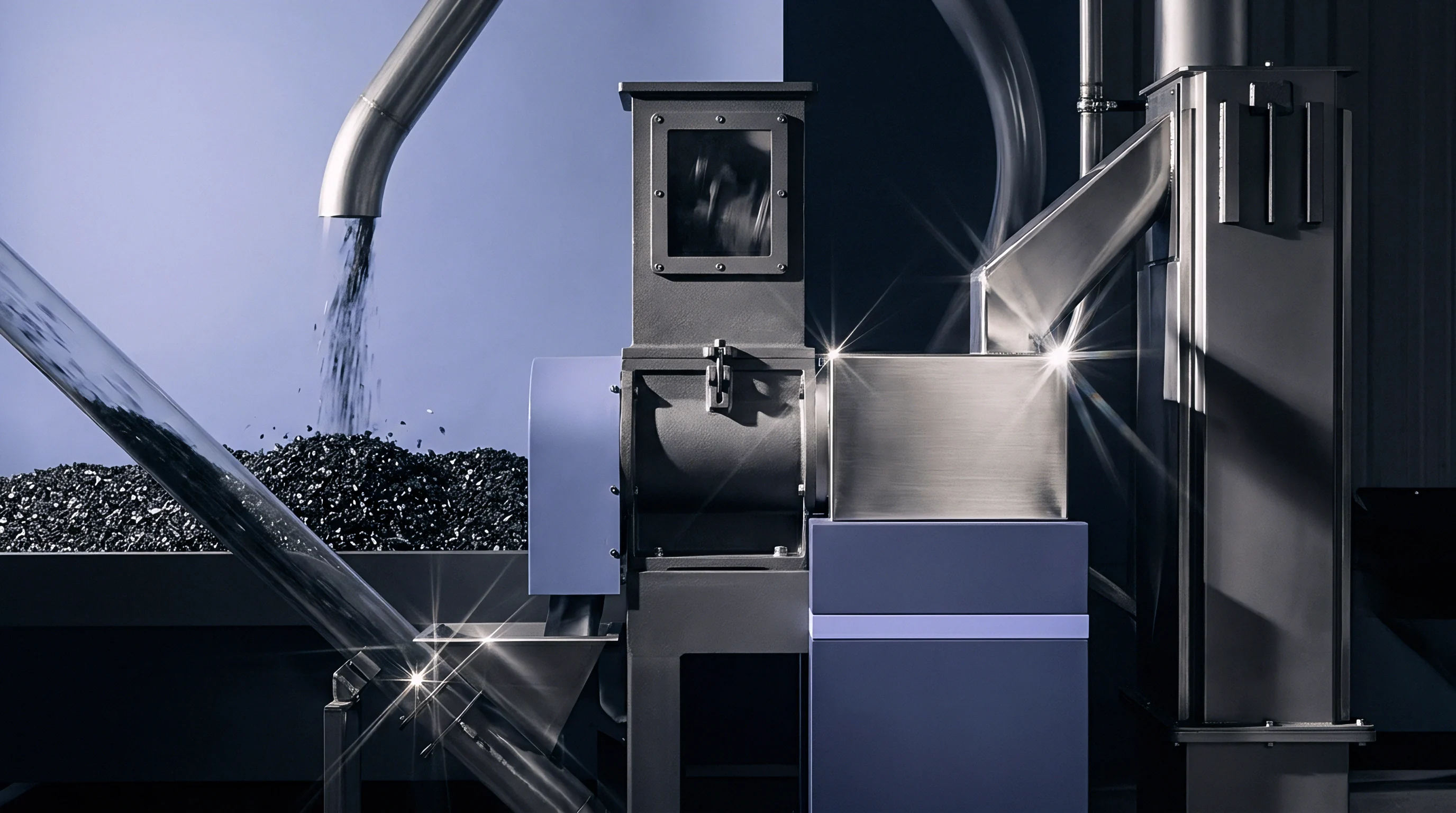
Silo
Industrial solid state polymerization occurs in large-scale continuous vertical gravity-flow reactor silos or batch rotary vacuum dryers. Continuous reactors utilize high aspect ratio vessel geometries to ensure plug flow behavior, where pellets move downward under gravity while hot nitrogen gas flows counter-currently upward through the moving bed. Plug flow performance ensures uniform residence time distributions across the entire pellet population.
Deviations from true plug flow create severe process instabilities. Wall friction and internal geometry can induce funnel flow, where central pellet channels move rapidly while peripheral pellets stagnant near vessel walls. Funnel flow broadens the residence time distribution, causing portions of the discharge lot to suffer from under-decontamination and inadequate intrinsic viscosity build while other portions over-cook and degrade.

Residence Time Distribution and Energy Balances
Residence time inside continuous silos ranges between 8 and 24 hours depending on target molecular weight and incoming flake quality. Thermal management demands precise controls; pellets enter pre-crystallizers at ambient temperatures and must heat uniformly to 200 degrees Celsius using fluid bed pre-heaters before entering the main reactor column. Heating consumes significant energy, often exceeding 180 kilowatt-hours per tonne of processed rPET resin.
Plug flow reactors maintain tight residence time distributions, ensuring uniform molecular weight and complete volatile removal.
Nitrogen recirculation loops require continuous volatile removal through catalytic combustion or carbon bed adsorption. Accumulation of stripped acetaldehyde or ethylene glycol within recirculated gas streams decreases the driving potential for mass transfer at the top of the reactor column. Efficient gas purification systems maintain volatile organic carbon concentrations below 5 parts per million in the entering nitrogen sweep.
Process control in continuous silos relies on balancing production speed against mass transfer kinetics. Specific operational adjustments are required when transitioning input feedstock grades:
- Pre-heat carrier gas loops to establish isothermal temperature profiles across the lower heating zone of the vertical reactor vessel.
- Adjust pellet discharge rotary valves to set target solid residence times based on incoming feedstock intrinsic viscosity measurements.
- Monitor bed differential pressure continuously to detect local agglomeration or channeling before localized stagnation impairs bulk material flow.
- Sample discharge streams hourly to verify intrinsic viscosity build via dilute solution viscosity testing according to ISO 1628-5 standard specifications.
Standard supply contracts stipulate that if intrinsic viscosity standard deviation across a continuous 24-tonne railcar shipment exceeds 0.02 dL/g, the entire lot fails acceptance criteria and reverts to lower-tier non-food packaging applications.


Dossier
Procuring post-consumer rPET grades for food-contact applications demands a comprehensive technical dossier demonstrating regulatory compliance and lot-to-lot consistency. The compliance dossier combines challenge test certificates, analytical verification data, and process operating logs. Buyers inspect these records to ensure that mass transfer limits were successfully managed during resin production.
Headspace gas chromatography combined with mass spectrometry serves as the primary analytical tool for verifying volatile stripping efficiency. Testing protocols according to EN 13130 guidelines establish total volatile organic compound content and specific migration limits. Certificates of analysis accompanying shipments report residual acetaldehyde content, which must remain below 1.0 milligram per kilogram for direct-contact bottle preform moulding.

Regulatory Criteria and Lot Acceptance Thresholds
FDA non-objection letters and EFSA scientific opinions establish the precise operational limits required for decontamination processes. These documents specify maximum acceptable operating pressure, minimum solid temperature, and minimum residence time inside the reactor column. Process logs must prove that every pellet lot spent the mandatory minimum time at specified mass transfer conditions.
| Quality Parameter | Standard Test Method | Acceptance Specification | Commercial Consequence of Non-Compliance |
|---|---|---|---|
| Intrinsic Viscosity | ISO 1628-5 (Dichloroacetic acid) | 0.84 +/- 0.02 dL/g | Lot rejection due to preform drop failure |
| Residual Acetaldehyde | ASTM F2013 (Headspace GC) | < 1.0 mg/kg | Off-flavor contamination in bottled water |
| Limonene Content | EN 13130-1 / GC-MS | < 0.02 mg/kg | Loss of food-contact compliance status |
| Crystallinity Level | ISO 11357-3 (DSC) | 45% to 55% | Pellet bridging and hopper feed failure |
| Color Index (b ) | CIE L a b Spectrophotometry | < 2.0 Hunter units | Yellowing complaints in clear packaging |
Incoming inspection procedures require representative sampling from delivered super-sacks or bulk silotrucks according to ISO 5667 sampling protocols. Testing intrinsic viscosity and moisture content prior to secondary conversion protects injection moulding equipment from severe degradation during processing.
Documenting process parameter compliance provides the final layer of risk mitigation for resin purchasers. Continuous recording of reactor temperature profiles, vacuum levels, and gas dew points creates an unbroken quality audit trail. Material trace-ability connects final container lot numbers directly back to primary decontamination reactor logs, validating that volatile stripping limits were maintained within certified boundaries across the entire manufacturing cycle.