High Temperature Non Aqueous Volatile Acid Titration in Recycled Polyethylene
High temperature non-aqueous titration strips volatile carboxylic acids from hot PE melt into organic media to quantify corrosion risks and thermal stability.
Acidity

Thermo-Oxidative Origins in Recycled Polyethylene
Post-consumer resin streams carry organic acid species generated during high-temperature extrusion cycles. When polyethylene is exposed to shear and oxygen above 180 degrees Celsius, it undergoes chain scission and auto-oxidation, breaking backbone hydroperoxides down into aldehydes, ketones, and carboxylic acids. The lighter organic acids ~ predominantly formic, acetic, propionic, and butyric ~ stay trapped within the crystalline matrix of the recycled pellet.
During conversion re-melting, these volatile species vaporize, corroding extrusion dies, compromising melt strength, and giving off strong off-odors.
Chemical residues from post-consumer collection add further contamination to the polymer matrix alongside thermal breakdown products. Residual detergent formulations, carboxylic acid surfactants, washed food residues, and degraded ethyl vinyl acetate or ethylene acrylic acid copolymers all introduce short-chain carboxylic groups. Standard room-temperature aqueous titrations miss these acids entirely because polyethylene remains insoluble in water and polar solvents below 110 degrees Celsius, leaving occluded species locked inside the solid matrix and yielding deceptively low acid numbers that misrepresent true corrosive potential.
Acid species in molten polyolefins trigger autocatalytic degradation during secondary compounding. Carboxylic groups catalyze the cleavage of peroxide radicals to accelerate molecular weight reduction and widen the melt flow ratio as processing temperatures release trapped acids. Left unquantified, this acid content leads directly to die plate-out, equipment surface pitting, and unexpected mechanical failures in converted parts.

Limitations of Standard Melt Characterization
Standard melt flow rate tests under ISO 1133 or ASTM D1238 at 190 degrees Celsius with a 2.16 kg load reflect rheological changes but cannot pin down the underlying chemistry behind viscosity loss. A lot jumping from a melt flow of 0.8 g/10 min to 2.3 g/10 min could have undergone thermal chain scission, hydrolytic breakdown of ester contaminants, or acid-catalyzed scission. Similarly, oxidation induction time measurements via differential scanning calorimetry record residual antioxidant protection, yet acidic species deplete these antioxidants prematurely without showing up on baseline thermograms.
Thermal oxidation of recycled polyethylene at 220 degrees Celsius generates up to 450 parts per million of volatile carboxylic acids within fifteen minutes of processing.
Direct high-temperature extraction paired with non-aqueous titration separates the volatile acidic fraction ~ which actively corrodes extrusion tooling ~ from static backbone acidity. Working between 120 and 150 degrees Celsius swells or dissolves the polyolefin network enough to release occluded volatile acids into an inert sweep gas or liquid carrier without thermally destroying the polymer chains themselves.

Chemical Sources in Recycled Streams
Volatile acidic contaminants enter recycled polyethylene through several distinct pathways:
- Thermo-oxidative scission products form via hydroperoxide decomposition during primary conversion and post-consumer re-extrusion, generating volatile formic and acetic acid molecules.
- Degraded copolymer fractions release volatile acrylic and methacrylic acid fragments when ethylene-vinyl acetate or ethylene-acrylic acid barrier layers are co-processed in film fractions.
- Residual wash additives survive post-consumer flake scrubbing, leaving fatty acid salts and alkyl benzene sulfonic acids that decompose at processing temperatures above 200 degrees Celsius.
- Crosslinking initiator residues from crosslinked polyethylene or peroxide-assisted viscosity modification decompose into acidic byproducts during melt homogenization.
Failing to quantify these volatile acid fractions leads to accelerated damage on nickel-plated and chrome-coated tooling surfaces, forcing early mold refinishing and costly production downtime.

Rig
Thermal Stripping Reactor Architecture
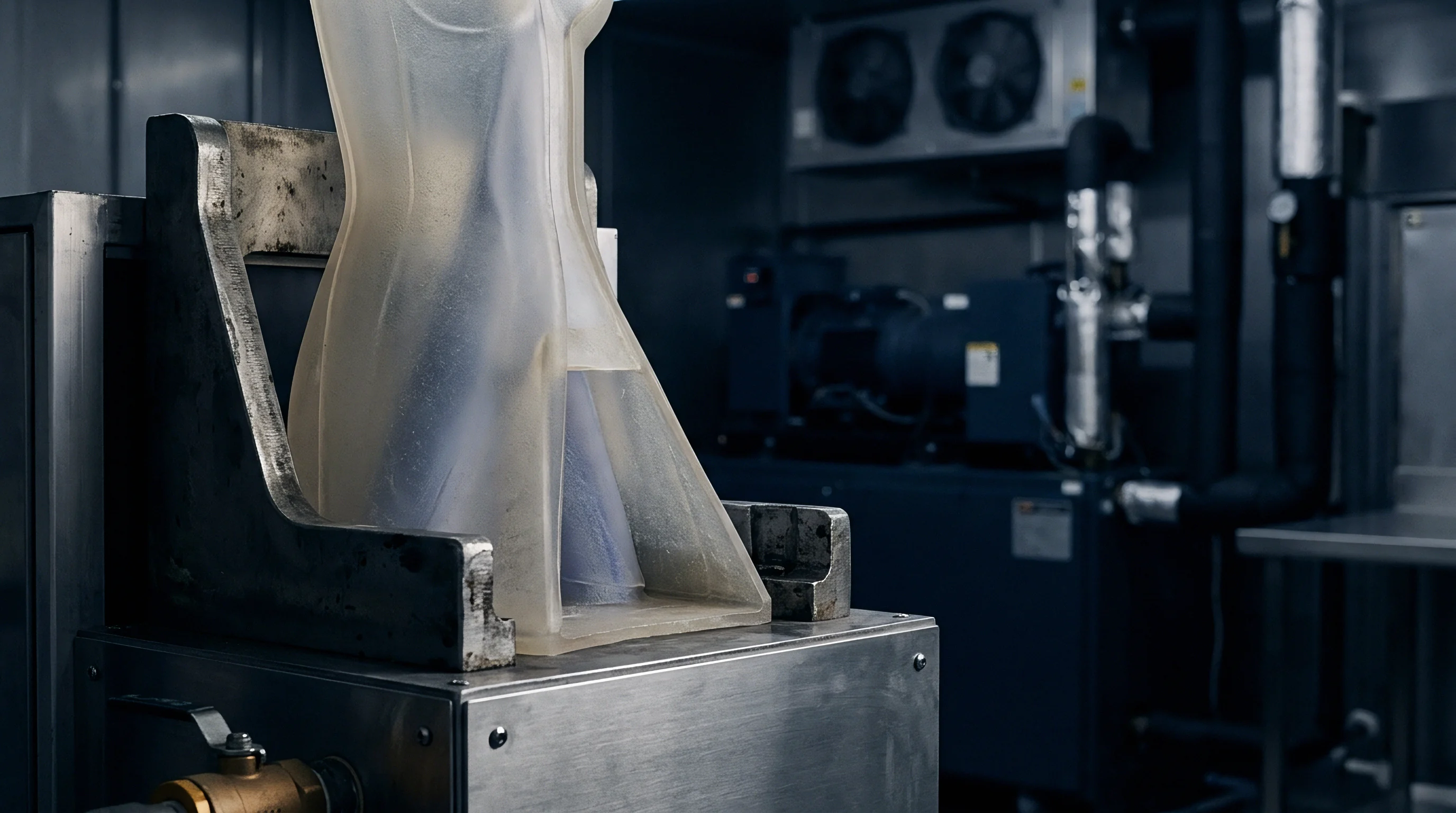
The extraction rig passes prepurified nitrogen through a molten polymer column inside a borosilicate glass reactor. Because high-temperature extraction demands strict oxygen exclusion to prevent thermo-oxidation during testing, nitrogen containing less than two parts per million oxygen is metered through a mass flow controller between 100 and 250 milliliters per minute. This gas enters a sealed double-walled reaction vessel maintained at 130 to 150 degrees Celsius using a circulating silicon oil bath or specialized aluminum heating block.
Inside the heated glass reactor, granulated recycled pellets or ground flake sit mixed in a high-boiling carrier solvent or high-temperature heat transfer oil. A PTFE sparging tube positioned at the base of the vessel bubbles the nitrogen stream directly through the molten polymer suspension to sweep out volatile acids. The gas stream absorbs carboxylic species, carrying them upward through a heated glass neck to prevent premature condensation along the vessel walls.

Vapor Line Management and Condenser Configuration
Vaporized organic acids move through insulated transfer lines into an ambient-temperature receiving vessel. The line connecting the reactor to the receiving cell requires active silicone ribbon heating maintained at 120 degrees Celsius, as cold spots along the route cause higher-boiling species like butyric or valeric acid to condense on tube walls and generate severe negative analytical bias.
The absorption trap relies on a tall glass bubble tube filled with a non-aqueous receiving fluid such as isopropanol, benzyl alcohol, or an ethanol-toluene mixture. As nitrogen bubbles through a fine fritted glass disc, the solvent absorbs incoming volatile organic acids. A secondary downstream safety trap guards against solvent back-siphoning and collects any carryover acid during high-flow sparging cycles.

Equipment Calibration and Thermal Uniformity
Temperature distribution inside the sparging vessel determines how quickly volatile acids evolve. A core temperature sensor submerged directly in the melt verifies that the sample reaches the target dissolution temperature within six minutes of immersion, as thermal variations greater than two degrees Celsius alter the volatilization kinetics of higher molecular weight fatty acids and skew lot repeatability.
Room-temperature solvent washes measure surface acid numbers rather than total resin purity, leaving internal volatile acids locked inside crystalline spherulites until the polymer matrix expands above its melting point.

Solvent
Dissolution Thermodynamics of Polyolefins
Polyolefin chains unfold completely when suspended in xylene or ortho-dichlorobenzene at 120 to 135 degrees Celsius. Because solid low-density and high-density polyethylenes are highly crystalline, they resist solvent penetration at ambient temperatures. Reaching complete dissolution without thermal degradation requires non-polar aromatic hydrocarbons boiling above 130 degrees Celsius; xylene isomers, ortho-dichlorobenzene, decalin, or tetralin overcome inter-chain van der Waals forces to convert solid pellets into a uniform, low-viscosity liquid.
Once the polymer matrix dissolves into the non-aqueous carrier, volatile organic acids diffuse freely into the liquid phase and evaporate into the nitrogen sweep gas. The chosen solvent must remain chemically inert toward carboxylic acids and basic titrants, carrying no native acidic or basic functional groups that could distort baseline titrations.

Receiving Phase Chemistries
Receiving traps require a combined polar and non-polar fluid blend to dissolve non-polar volatiles along with incoming organic acids. Pure water is unsuitable in high-temperature non-aqueous setups because condensing moisture clogs the transfer line and forms two-phase mixtures that blur potentiometric endpoints. A 1:1 or 2:1 mix of isopropanol and toluene serves as an ideal absorption medium.
| Solvent Blend | Boiling Point (°C) | Polyethylene Dissolution at 130°C | Dielectric Constant | Potentiometric Sharpness Index |
|---|---|---|---|---|
| Potentiometric Sharpness Index evaluates the slope derivative (dE/dV) at the inflection endpoint using 0.01 N tetrabutylammonium hydroxide. | ||||
The solvent mixture must remain conductive enough for accurate glass-electrode potentiometry. Isopropanol supplies sufficient polarity to dissolve ionic species formed during neutralization with quaternary ammonium hydroxide titrants, preventing phase separation during the run.
Blank Subtraction and Solvent Purity
Reagent-grade solvents contain trace acidic impurities, absorbed carbon dioxide, and ambient moisture that consume titrant and distort non-aqueous endpoint curves. Every solvent batch must therefore undergo blank determination using the identical thermal cycle and nitrogen sparging rate applied during sample testing.
Solvents with high dielectric constants yield sharper potentiometric inflection breaks than pure non-polar hydrocarbon liquids during non-aqueous base titrations.
Pre-titrating the receiving solvent to a neutral potentiometric baseline prior to connecting the thermal reactor eliminates background solvent acidity. Before entering the sparging assembly, the nitrogen sweep gas passes through a moisture and carbon dioxide trap containing molecular sieves and supported sodium hydroxide.
Distilling carrier solvents over potassium hydroxide prior to use removes trace organic acids, reducing baseline blank consumption to under 0.05 milliliters of titrant.
Reagent

Quaternary Ammonium Hydroxide Titrants
Tracking millivolt shifts in non-aqueous media requires specialized double-junction glass electrodes charged with lithium chloride in ethanol. Standard aqueous sodium or potassium hydroxide titrants are unusable here, as potassium hydroxide precipitates in non-polar hydrocarbon media to clog delivery lines and corrupt drop precision. Tetrabutylammonium hydroxide (TBAOH) dissolved in isopropanol or methanol-toluene serves as the primary basic titrant for non-aqueous carboxylic acid determination.
In organic media, TBAOH acts as a strong base that completely neutralizes weak carboxylic and phenolic acids without causing phase separation. Its bulky tetrabutylammonium cation enhances solubility of the resulting carboxylate salts in organic solvent blends. Standard titrant concentrations range from 0.005 N to 0.02 N, allowing high-precision volumetric or automated coulometric titrations of trace acidic species down to sub-ppm levels.

Potentiometric Endpoint Detection and Electrodes
Visual indicators such as phenolphthalein or thymol blue fail in recycled polyethylene analysis due to sample discoloration, pigment contamination, and poor solubility in solvent blends. Instead, potentiometric endpoint detection tracks electromotive force (EMF) across a specialized non-aqueous electrode pair as titrant is added.
- Fill the reference electrode outer sleeve with a 1.0 M solution of lithium chloride dissolved in anhydrous ethanol.
- Immerse the glass combination electrode into the absorption solvent trap containing the collected volatile acids.
- Connect the reaction cell to an automated titrator set to dynamic voltage addition with a signal stability criterion of 0.5 millivolts per second.
- Dispense 0.01 N tetrabutylammonium hydroxide titrant in increments of 0.01 to 0.05 milliliters while stirring continuously with a PTFE magnetic bar.
- Log the potential in millivolts after each addition until a sharp sigmoidal inflection point corresponding to the neutralization of volatile acids is recorded.
- Calculate the blank-corrected volatile acid concentration expressed as milligrams of potassium hydroxide per gram of polymer sample.
Standard aqueous pH glass electrodes develop high electrical resistance and unstable junction potentials when placed in non-aqueous solvents like xylene and isopropanol. A lithium chloride sleeve electrolyte prevents salt precipitation at the glass junction, maintaining steady signal output during long titration sequences.
Standardization and Volumetric Calculations
Primary standards such as benzoic acid establish the exact normality of quaternary ammonium hydroxide titrants. Vacuum-dried at 60 degrees Celsius, benzoic acid is weighed to 0.1 milligrams and dissolved in pre-neutralized isopropanol to yield the exact titrant factor used in subsequent polymer acid value calculations.
Standard purchase specifications for film-grade recyclate require blank-corrected titrations to deduct solvent acidity before applying price penalties.
Consider a typical calculation for volatile acid determination in a post-consumer recycled high-density polyethylene pellet lot:
Sample mass (m) = 5.000 grams of rPE pellets Titrant (N) = 0.0100 N tetrabutylammonium hydroxide in isopropanol Sample titrant volume (Vs) = 2.85 milliliters Blank titrant volume (Vb) = 0.15 milliliters Molar mass of KOH = 56.10 g/mol Molar mass of acetic acid equivalent = 60.05 g/mol
The net titrant volume consumed by volatile acids isolated from the sample is:
Vnet = Vs – Vb = 2.85 mL – 0.15 mL = 2.70 mL
The Volatile Acid Value (AV), expressed in milligrams of KOH per gram of resin, is calculated as:
AV = fracVnet × N × 56.10m = frac2.70 mL × 0.0100 N × 56.10 mg/mmol5.000 g = 0.303 mg KOH/g
To convert the Acid Value into volatile acetic acid equivalent concentration in parts per million (ppm):
Acid Content (p±) = fracVnet × N × 60.05 × 1000m = frac2.70 × 0.0100 × 60.05 × 10005.000 = 324.3 p±
Standard supply agreements state that any shipment evaluated without documented blank-corrected standardization curves permits the buyer to reject acid-based claims.

Matrix

Inorganic Neutralization Vectors
Fine particles of calcium carbonate react with free carboxylic acids at elevated processing temperatures, converting volatile species into stable calcium salts. Post-consumer polyolefin streams frequently contain inorganic fillers such as calcium carbonate, talc, titanium dioxide, and glass fibers. Within the melt, calcium carbonate acts as a basic scavenger, reacting with volatile acids as they form:
2 R-COOH + CaCO3 → (R-COO)2Ca + H2O + CO2
This reaction neutralizes free carboxylic acids into non-volatile calcium carboxylate salts, which standard thermal stripping cannot release ~ causing test methods to underreport the polymer’s actual degradation history. When these bound salts later encounter acidic processing additives or masterbatch carriers during final conversion, they decompose and release organic acids back into the melt.

When Does Peroxide Residue Interfere with Potentiometric Endpoints?
Residual organic peroxides from incomplete crosslinking or degradation reactions can oxidize the alcohol carrier during elevated-temperature titrations. Post-industrial polyolefins modified with dicumyl peroxide or di-tert-butyl peroxide often retain unreacted peroxide molecules. When heated to 140 degrees Celsius under nitrogen sparging, these peroxides break down into alkoxy radicals that abstract hydrogen atoms from isopropanol carrier solvents, creating synthetic acetone and acetic acid artifacts.
Screening for matrix interferences requires systematic testing across multiple sample parameters:
- Peroxide decomposition testing involves heating the sample in an inert solvent without sparging, followed by peroxide strip testing to quantify active oxygen content.
- Carbonate filler extraction requires dissolving the polymer in hot xylene, filtering out inorganic minerals via a pre-heated 0.45-micron PTFE membrane, and titrating the clear filtrate.
- Ester saponification checks demand running titrations at reduced temperatures (below 40 degrees Celsius) to prevent base titrants from cleaving non-acidic ester additives.
- Antioxidant additive isolation uses solid-phase extraction to separate phenolic antioxidants from organic acids before performing potentiometric neutralization runs.
Because peroxide residues generate synthetic acid species during testing to skew readings upward, adding trace triphenylphosphine to the extraction solvent neutralizes active peroxides prior to heating and eliminates thermal oxidation artifacts.
Saponification Interferences from Plasticizers and Ester Additives
Hydroxide titrants decompose esters present in contaminated polyolefin streams, inflating the calculated acid count. Recycled polyethylene containing trace polyethylacrylate, ethylene-butyl acrylate copolymers, or ester slip agents like erucamide and oleamide undergoes ester saponification during basic titrations, as strong base titrants like tetrabutylammonium hydroxide cleave ester bonds at elevated temperatures:
R-COOR’ + TBAOH → R-COO-TBA+ + R’-OH
This saponification reaction consumes titrant and creates significant positive analytical bias. Preventing it requires keeping thermal stripping conditions mild enough for volatile organic acids to evaporate into the sweep gas without stripping heavy ester plasticizers or driving saponification reactions in the receiving vessel.
Whether non-aqueous titration protocols can cleanly differentiate between free carboxylic acids and the thermal decomposition products of phosphite antioxidants remains an open question in current analytical practice.


Valuation

Commercial Specifications and Acid Limits
Specification sheets for film-grade recyclate enforce maximum thresholds on volatile organic acid content to prevent die buildup and odor formation. Converters producing thin-gauge blown packaging require low-acid post-consumer resin, as excess acidity causes bubble instability, pinhole defects, and severe extruder corrosion that quickly depresses resin valuation.
| Resin Quality Grade | Volatile Acid Value (mg KOH/g) | Acetic Acid Equiv. (ppm) | Hardware & Operational Risk | Commercial Discount Range ($/tonne) |
|---|---|---|---|---|
Volatile acid off-gassing during compounding leads directly to internal voids and micro-porosity in blown film extrusion.

Commercial Discount Formulas for Corrosive Lots
Chemical analysis showing elevated volatile acidity triggers automatic price adjustments during incoming inspection. Sourcing contracts typically incorporate dynamic pricing formulas tied to non-aqueous titration certificates of analysis, applying a standard price deduction whenever volatile acid values exceed agreed baseline limits:
Price Adjustment (/tonne) = -left( (AVmeasured – AVcontract) × Kpenalty right)
Where AVmeasured represents the verified volatile acid value in mg KOH/g, AVcontract represents the specification limit (tyπcally 0.05 mg KOH/g), and Kpenalty is a negotiated commercial penalty factor (tyπcally 350 per mg KOH/g per tonne). For a 22-tonne container load of recycled HDPE pellets testing at an acid value of 0.28 mg KOH/g against a contract limit of 0.05 mg KOH/g:
Price Adjustment = -left( (0.28 – 0.05) × 350 right) = -$80.50 per tonne
The total financial penalty assessed on the 22-tonne shipment comes to $1,771.00, deducted directly from the final invoice settlement.

Purchase Order Quality Clauses
Enforceable purchasing specifications for high-grade recycled polyolefins require clear testing language, typically mandating certified high-temperature non-aqueous volatile acid titration data for every 20-tonne production lot. Inspection protocols specify that incoming lots exceeding 0.20 mg KOH/g acid value grant the buyer the right to reject the shipment or apply automatic commercial price discounts.
Receiving inspection procedures demand that representative samples be drawn from five separate bags per railcar or tote shipment within forty-eight hours of delivery. Verification testing using standardized non-aqueous thermal stripping protects the buyer from inadvertently accepting contaminated, highly corrosive post-consumer resin streams.