Multi-Dimensional Gas Chromatography Integration for Polyethylene Non-Intentionally Added Substances Compliance
Comprehensive multi-dimensional chromatography quantifies non-target polyethylene migrants down to ten parts per billion to secure food contact declarations.


Trap
A single-dimension gas chromatography run of a polyethylene extract produces an unresolved complex mixture. High-density polyethylene, linear low-density film, and blown packaging resins release hundreds of low-molecular-weight volatile species during thermal extraction. When passed through a standard non-polar capillary column, branched alkanes, terminal alkenes, side-chain cleavage products, and additive residues co-elute into a continuous unresolved baseline hump.
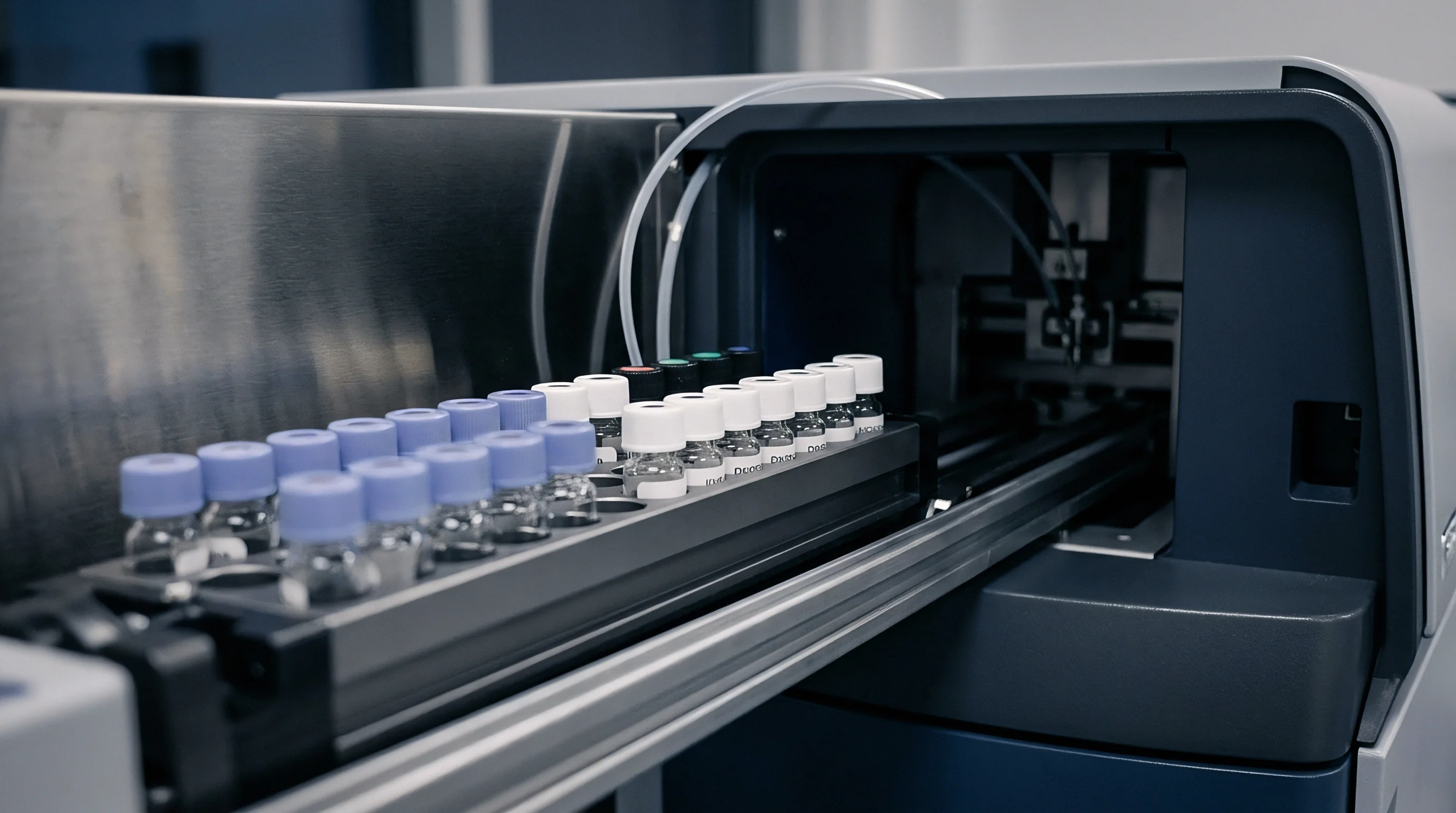
Multi-dimensional gas chromatography addresses co-elution by connecting two analytical columns with different stationary phase chemistries through a cryogenic or thermal modulator. The primary column separates volatile and semi-volatile compounds by vapor pressure across a thirty-meter non-polar phase such as five percent phenyl methylpolysiloxane. As fractions exit the primary column, a thermal trap captures and focuses narrow bands of effluent before re-injecting them onto a short secondary column.
Running a polar or mid-polar phase like fifty percent phenyl methylpolysiloxane across one to two meters, the secondary column achieves a second orthogonal separation based on chemical functionality and polarity within a three-second modulation cycle.
| Separation System | Stationary Phase Pair | Peak Capacity | Hydrocarbon Resolution | Limit of Quantification |
|---|---|---|---|---|
| Standard 1D GC-MS | 100% Dimethylpolysiloxane (30m x 0.25mm x 0.25µm) | 120 – 180 | Co-eluting UCM profile | 0.050 mg/kg food |
| Heart-Cutting 2D GC-MS | Non-polar to Mid-polar (30m + 15m) | 350 – 450 | Targeted band unmixing | 0.010 mg/kg food |
| Comprehensive GCxGC-FID | Non-polar x Polar (30m x 1m x 0.1µm) | 1,800 – 3,200 | Structured retention grid | 0.002 mg/kg food |
| Comprehensive GCxGC-QTOF-MS | Non-polar x Mid-polar (30m x 1.2m x 0.1µm) | 2,200 – 3,800 | Full non-target resolution | 0.005 mg/kg food |
Sample preparation dictates what the modulator receives. Solvent extraction using ninety-five percent ethanol or iso-octane at sixty degrees Celsius for five hours simulates worst-case fatty food contact under European Regulation 10/2011 testing conditions. Total immersion of five grams of film cut into tiny strips in twenty milliliters of solvent swells the polyethylene matrix, releasing non-optionally present compounds, secondary degradation products, and resin synthesis residuals without dissolving the high-density polymer backbone.
Direct liquid injection of the concentrated extract into a splitless inlet transfers volatile oligomers from dodecane up to hexatriacontane directly onto the primary column inlet.
Peak capacities exceeding two thousand individual signals emerge from a single comprehensive two-dimensional run. Linear alkane homologous series form predictable structured bands across the two-dimensional chromatogram retention space. Oxygenated species, including carboxylic acids, aldehydes, alkyl phenols, and degraded hindered amine light stabilizers, shift higher along the secondary retention time axis due to polar interactions.
This spatial separation isolates trace non-intentionally added substances from the high-concentration polymer oligomer backbone, lowering detection thresholds by a factor of ten compared to single-column methods.
The primary extraction protocol yields a quantitative limit of detection of two parts per billion for volatile alkane fractions under total immersion conditions at sixty degrees Celsius.
Unresolved chromatographic humps often represent linear polyethylene wax fragments intrinsic to the polymer synthesis process.
Spectrum
Mass spectrometry coupled to comprehensive multi-dimensional separation provides the empirical evidence needed to identify non-target peaks. Electron ionization at seventy electronvolts generates fragment patterns that match commercial spectral databases for known additive breakdown products like 2,4-di-tert-butylphenol. Custom synthesized oligomer fragments and cyclic hydrocarbons fail to return matches above eighty percent spectral similarity scores in standard reference libraries, leaving mass accuracy to limit candidate selection.
High-resolution quadrupole time-of-flight mass spectrometry measures exact mass-to-charge ratios within a tolerance of two parts per million. Sub-millimass accuracy narrows empirical formula options for unknown compounds exiting the secondary column. Isotope abundance patterns for carbon, oxygen, nitrogen, and sulfur confirm atomic compositions for molecular ions and major fragment ions.
A measured accurate mass of 206.1822 matches the protonated ion of oxidized phosphite fragments from processing stabilizers, separating them from isobaric hydrocarbon structures.
- Structural Elucidation Level 1 Confirmed identity through accurate mass, retention indices on both chromatographic dimensions, and direct match with an authentic reference standard.
- Structural Elucidation Level 2 Probable structure assigned via library spectral matches exceeding ninety percent similarity alongside consistent secondary retention time mapping.
- Structural Elucidation Level 3 Chemical class assignment achieved through characteristic fragment ions and isotopic ratios without confirming isomer positions.
- Structural Elucidation Level 4 Unidentified mass signal assigned an empirical formula derived from high-resolution isotopic profiling while retaining unknown structural status.
Quantitative estimation across non-target spectra poses analytical challenges. Flame ionization detectors yield near-equimolar carbon responses for hydrocarbon structures, allowing semi-quantification of non-identified peaks against internal standards like deuterated dodecane or hexadecane. Electron impact mass spectrometers show variable ionization efficiencies across different functional groups, while matrix suppression further alters detector response.
Applying flame ionization response factors to high-resolution mass spectrometry signal intensities creates a balanced quantitative dataset. Hydrocarbon oligomers quantified on the flame ionization detector establish baseline concentrations for cyclic and linear fractions. Mass spectral data collected simultaneously via a post-column split supplies identity assignments for oxygenated species present down to five parts per billion in the simulant extract.
Addressing quantitation errors when non-target compounds lack authentic reference standards remains a core technical challenge for analytical laboratories.


Hazard
Evaluating non-intentionally added substances requires toxicological risk characterization based on exposure thresholds. Article 19 of European Regulation 10/2011 obligates packaging converters to assess safety for substances not listed in the Union positive list. When chemical identities remain unconfirmed or lack specific toxicological dossiers, toxicological decision frameworks establish permissible migration limits.

Which Cramer Class Applies to Unidentified Volatiles?
Because molecular structure determines toxicological risk, the Threshold of Toxicological Concern concept categorizes unidentified or semi-identified substances into exposure groups based on structure and predicted reactivity. Cramer Class I covers simple structures with efficient metabolic pathways, assigning a human exposure threshold of eighteen hundred micrograms per person per day. Cramer Class III encompasses complex structures, aromatic rings, or functional groups that suggest potential toxicity, assigning a restrictive threshold of ninety micrograms per person per day.
| TTC Assessment Category | Human Exposure Ceiling | Packaging Migration Limit | Structural Alert Criteria | Analytical Requirement |
|---|---|---|---|---|
| Genotoxicity Alert | 0.15 µg/person/day | 0.0005 mg/kg food | Aromatic amines, alkylating agent motifs | Targeted GCxGC-MS/MS |
| Cramer Class III | 90.0 µg/person/day | 0.0150 mg/kg food | Aromatic, heterocyclic, unassigned structures | GCxGC-QTOF-MS screening |
| Cramer Class II | 540.0 µg/person/day | 0.0900 mg/kg food | Substituted ring systems lacking reactive groups | GCxGC-FID semi-quantification |
| Cramer Class I | 1800.0 µg/person/day | 0.3000 mg/kg food | Acyclic hydrocarbons, simple esters and alcohols | GCxGC-FID trace quantification |
Unidentified peaks missing structural assignments must default to conservative toxicity assumptions, as genotoxicity overrides standard thresholds. Any non-target peak exhibiting structural features associated with DNA reactivity receives a toxicological intake limit of 0.15 micrograms per person per day, translating to a migration ceiling of 0.0005 milligrams per kilogram of food. A standard European packaging ratio assumes six square decimeters of plastic contact one kilogram of food eaten daily by a sixty-kilogram adult.
- Convert two-dimensional peak volumes from simulant extracts into concentration equivalents using internal standard response factors.
- Screen accurate mass fragments for structural alerts including epoxides, hydrazines, aromatic nitro groups, and organophosphates.
- Assign unidentified peaks lacking structural alerts to Cramer Class III to enforce a default migration limit of fifteen parts per billion.
- Compare calculated migration values against toxicological threshold limits to determine pass or fail status for the packaging batch.
Calculating safety margins demands precise conversion between extracted quantities and actual food migration values. Exhaustive solvent extraction overestimates migration into dry or aqueous media. Direct exposure testing into ethanol ten percent or poly-2,6-diphenyl-p-phenylene oxide at set temperature-time profiles yields migration values suitable for comparison against Threshold of Toxicological Concern limits.
European Regulation 1935/2004 Article 3 mandates that materials do not transfer constituents to food in quantities that endanger human health.
Screening unidentified volatile migrants against conservative toxicity limits avoids unsafe release without requiring individual toxicological studies for every synthesized oligomer.

Drift
Polyethylene processing conditions heavily influence the creation of non-intentionally added substances. Thermal energy, shear stress inside extrusion barrels, and reactive oxygen exposure degrade resin additives and polymer chains. Linear low-density polyethylene extruded at two hundred forty degrees Celsius exhibits chemical drift compared to unprocessed virgin pellets, driven by heat-accelerated oxidation pathways.
Antioxidant breakdown represents a major source of low-molecular-weight reactive migrants. Tris(2,4-di-tert-butylphenyl) phosphite oxidizes into its corresponding phosphate during processing, while simultaneously releasing free 2,4-di-tert-butylphenol. Subsequent thermo-oxidative breakdown of free alkylphenols yields 1,3-di-tert-butylbenzene and quinone methide derivatives, both of which migrate readily into fatty food simulants.
- Phosphite Stabilizer Hydrolysis Degradation of secondary antioxidants releases sterically hindered phenols that undergo further oxidation into quinones and volatile aromatics.
- Polymer Chain Scission Thermal shear splits high-molecular-weight polyethylene chains into cyclic alkane and terminal alkene oligomers spanning carbon ranges from C10 to C35.
- Slip Agent Transformation Erucamide and oleamide undergo thermal nitrilation and oxidative cleavage, generating unsaturated fatty acids and alkyl amides.
- Recycled Resin Contamination Post-consumer material introduces ink solvents, fragrance compounds, photoinitiators, and previous product residues into virgin matrix streams.
Batch variance complicates compliance control. Virgin resin lots processed on different manufacturing lines exhibit distinct volatile profiles due to residence time variations and temperature spikes, making single tests insufficient. In recycled streams, post-consumer polyethylene contains residual printing inks, adhesive components, and ester plasticizers that shift signal profiles and alter two-dimensional chromatographic fingerprints between production runs.
Post-consumer polyethylene blends require continuous lot-by-lot GCxGC screening due to variable contaminant profiles in feedstocks.
Purchasing specifications must include mandatory maximum allowable peak area ceilings for non-assigned signals appearing in secondary chromatographic dimensions.

Contract
Declarations of Conformity carry legal liability across supply chains. While a raw resin producer provides a declaration covering primary polymer chemistry and listed additives, packaging converters modify the chemical profile during compounding, masterbatch addition, printing, and lamination ~ meaning declarations often outrun raw analytical data.
| Chain Tier | Document Type | Analytical Scope | Regulatory Exclusion |
|---|---|---|---|
| Resin Manufacturer | Raw Material DoC | Monomers, intentional additives, heavy metals | Processing-induced NIAS, printing ink reaction products |
| Masterbatch Compounder | Additive Statement | Colorants, slip agents, carrier resin purity | Thermo-oxidative breakdown products from converting |
| Packaging Converter | Finished Article DoC | Specific migration, non-target NIAS screening | Unintended thermal abuse during end-user processing |
| Food Packer / Importer | Compliance Dossier | Full article migration, toxicological safety assessment | Non-standard storage conditions beyond stated intent |
A finished article Declaration of Conformity must explicitly state the analytical screening boundaries used to evaluate non-listed substances. A statement claiming absence of non-intentionally added substances without detailing the extraction media, detection limits, and chromatographic resolution represents an invalid legal claim, as test simulants must reflect worst-case exposure. Test reports backing the declaration must link directly to specific resin lot numbers and converting machine parameters.
Worked compliance verification relies on exact mathematical concentration assignments. Consider a ten-micrometer linear low-density polyethylene lamination film tested for fatty food contact. Total extraction with iso-octane yields an unidentified peak with a calculated concentration of 0.08 milligrams per square decimeter.
Applying the European standard packaging ratio converts this extraction value to an estimated food migration concentration of 0.48 milligrams per kilogram of food. This value exceeds the Cramer Class III threshold of 0.015 milligrams per kilogram by thirty-two times, triggering an immediate non-compliance finding.
A compliance declaration missing explicit multi-dimensional screening data for non-listed volatile substances fails to satisfy European Regulation 10/2011 Article 19 audit checks.
Failing to verify non-target migrant profiles before placing packaging on the market transfers civil liability directly to the brand owner named on the retail container.

Penalty
Enforcement authorities execute market surveillance using advanced analytical testing. Regulatory agencies across European member states utilize comprehensive multi-dimensional gas chromatography paired with high-resolution mass spectrometry to verify compliance claims, and customs agencies routinely hold non-compliant shipments. Rapid Alert System for Food and Feed notifications trigger automatic detention of imported packaging materials at port facilities upon initial testing failure.
| Enforcement Level | Trigger Event | Direct Financial Impact | Operational Remediation Required |
|---|---|---|---|
| Port Rejection | Screening failure for non-listed migrants at border inspection | €12,000 – €45,000 demurrage and testing fees | Mandatory re-export or destruction of shipment |
| Retail Withdrawal | Market surveillance detection of Cramer Class III exceedance | €80,000 – €350,000 stock buyout and logistics loss | National market recall and public notice filing |
| Supply Contract Breach | Incompatible Declaration of Conformity backing documentation | €200,000+ liquidated damages and indemnity claims | Full supply line re-qualification and audit |
Unidentified peaks can stall approvals and trigger immediate quarantine, stopping distribution. The financial cost of analytical screening pales in comparison to the expenses incurred during an official product recall. Standard multi-dimensional gas chromatography screening protocols cost between fifteen hundred and three thousand euros per sample, delivering definitive peak identification down to trace parts per billion.
A single container quarantine generated by an unverified non-target migrant result incurs daily demurrage, storage, and re-testing costs that rapidly exceed the original value of the imported plastic goods.
Commercial contracts require precise language defining screening procedures, target limits of quantification, and financial indemnification clauses. Buyers who accept generic compliance statements without demanding raw multi-dimensional chromatographic data assume all legal exposure when public authorities conduct border checks. Securing full multi-dimensional analytical validation before container loading establishes an unassailable legal defense, protecting market access and brand equity against regulatory enforcement actions.