Quantifying Polypropylene Contamination in Post-Consumer Polyolefin Blow Molding Compounds
Calibrate differential scanning calorimetry against solvent-extracted matrix standards to reject post-consumer blow molding lots carrying over two percent polypropylene.

Threshold
Incoming post-consumer high-density polyethylene reprocess runs through blow molding dies at a melt temperature between 190 °C and 210 °C, where contamination by polypropylene manifests as melt elasticity instability, localized die swell fluctuations, and sudden wall thinning. High-density polyethylene (HDPE) fractional melt grades designed for continuous extrusion blow molding possess high molecular weight chains and a broad molecular weight distribution, yielding melt flow rates typically between 0.25 and 0.40 g/10 min under 2.16 kg at 190 °C per ASTM D1238. Polypropylene (PP), originating from post-consumer bottle caps, closures, and injection molded tubs, enters the recycling stream with melt flow rates exceeding 12 to 25 g/10 min at 230 °C under 2.16 kg.
Because these two polyolefins display thermodynamic immiscibility driven by positive enthalpy of mixing and negligible combinatorial entropy, molten mixtures form two-phase emulsions. Polypropylene forms isolated dispersed phases. These molten droplets deform into elongated fibrils inside the die land.
Extrusion blow molding machines amplify interfacial weak points because the process lacks the packing pressure characteristic of injection tools. Molten parisons hang freely under gravitational pull prior to mold closure. The presence of polypropylene phases reduces melt strength, inducing erratic parison sag.
When the blow air expands the parison at 0.6 to 1.0 MPa against chilled cavity walls, regions containing dispersed polypropylene domains experience uneven circumferential stretching. A contamination level of 1.5 weight percent PP induces pinhole ruptures along the bottle handle pinch line. Contamination ruins bottle drop resistance.
Above 3.0 weight percent, the finished containers fail the standard 1.2-meter drop test at 4 °C.
Analytical quantification forms the foundation for commercial acceptance. Datasheets regularly mislabel post-consumer compounds as pure extrusion-grade polyethylenes when incoming lots contain between 2.0 and 8.5 weight percent polypropylene. Blow molders purchasing recycled compound on open contracts absorb the cost of blown bottle rejects unless the incoming material inspection isolates the contamination fraction before hopper loading.
Melt index measurements mask phase separation. The measured melt flow rate of a contaminated blend often mirrors virgin specification values because low-viscosity polypropylene compensates for crosslinked polyethylene gel fractions, producing a deceptive composite viscosity.
Unchecked polypropylene levels above two percent cause immediate parison tears and customer container rejections across high-speed packaging lines.


Thermogram
Differential scanning calorimetry measures heat flow as a function of temperature, resolving separate melting transitions for high-density polyethylene and polypropylene. High-density polyethylene melts between 128 °C and 135 °C, while isotactic polypropylene melts distinctly between 160 °C and 168 °C. Testing according to ASTM D3418 or ISO 11357-3 utilizes a heating ramp of 10 °C per minute under nitrogen flow at 50 mL/min. Accurate quantification demands complete thermal erasure of previous mechanical processing histories.
The technician heats the 5 to 10 mg sample to 200 °C, holds the melt isothermally for five minutes, cools the specimen to 30 °C at 10 °C per minute to record crystallization behavior, and executes a second heating run to 200 °C. Quantification relies exclusively on the second heating cycle.
Differential scanning calorimetry resolves polypropylene contamination down to 0.4 weight percent when integrated between 150 °C and 170 °C at a heating ramp of 10 °C per minute under dry nitrogen.
Enthalpy calculation evaluates the integrated area under the polypropylene endotherm. The theoretical heat of fusion for 100 percent crystalline isotactic polypropylene stands at 207 J/g, whereas 100 percent crystalline high-density polyethylene delivers 293 J/g. Contaminated post-consumer compounds do not consist of neat homopolymers.
Post-consumer polypropylene fractions encompass random copolymers, impact copolymers containing ethylene-propylene rubber (EPR), and degraded matrices. These structural variations depress the actual enthalpy of fusion of the contaminant phase, introducing quantification divergence when analysts deploy a single homopolymer reference value. Copolymer fractions lower overall crystallite dimensions.
What Governs Thermal Enthalpy Integration across Recycled Polyolefins?
Baseline selection dictates the calculated polypropylene percentage. Operators encounter curved heat flow profiles caused by instrument drift or overlapping tail ends of the polyethylene melting peak. A linear baseline drawn from 145 °C to 170 °C captures the polypropylene endotherm while avoiding the primary polyethylene crystal recovery zone.
The baseline must terminate cleanly on the post-melting plateau. If the integration boundary clips the high-temperature tail of the polyethylene peak, calculated polypropylene mass fractions skew high by 0.5 to 1.2 percentage points.
| Polymer Fraction | Peak Temperature Range (°C) | Reference Heat of Fusion (J/g) | Integration Limits (°C) | Quantification Limit (wt%) |
|---|---|---|---|---|
| High-Density Polyethylene | 130.5 to 134.2 | 293.0 | 95.0 to 142.0 | 0.50 |
| Isotactic Polypropylene Homopolymer | 162.0 to 166.5 | 207.0 | 148.0 to 172.0 | 0.30 |
| Polypropylene Random Copolymer | 146.0 to 154.0 | 160.0 to 180.0 | 140.0 to 162.0 | 0.80 |
| Impact Copolymer (EPR modified) | 158.0 to 163.0 | 155.0 to 175.0 | 145.0 to 170.0 | 1.00 |
| Values determined per ISO 11357-3 on second heating cycle following controlled cooling at 10 °C per minute. | ||||
Specific analytical interferences disrupt thermal quantification during incoming lot testing:
- Fractional crystallization accelerates secondary polyethylene crystal formation, shifting high-temperature melting shoulders into the low-temperature polypropylene integration baseline.
- Impact copolymer inclusion conceals amorphous ethylene-propylene elastomeric rubber content that evades detection in the melting endotherm, leading technicians to underestimate total polypropylene compound mass.
- Inorganic filler loading such as calcium carbonate or talc dilutes total organic mass, demanding ash content correction per ISO 3451-1 before applying enthalpy formulas.
- Thermal degradation from repeated reprocessing generates chain-cleaved species that widen melting distributions, lowering peak maximum temperatures by up to 4 °C.
Suppliers routinely argue that secondary crystallization shoulders represent high-density polyethylene crystal variations rather than incoming polypropylene contamination.

Infrared
Fourier-transform infrared spectroscopy delivers rapid quantification of polypropylene levels without lengthy thermal cycles. The measurement monitors vibrational transitions unique to the methyl side groups along the polypropylene backbone. High-density polyethylene consists of linear methylene repeating units, exhibiting strong C-H stretching bands at 2915 cm⁻¹ and 2848 cm⁻¹, a scissoring doublet at 1472 cm⁻¹ and 1462 cm⁻¹, and a rocking doublet at 730 cm⁻¹ and 719 cm⁻¹.
Isotactic polypropylene introduces a distinct methyl symmetric bending absorption band located precisely at 1376 cm⁻¹. The absorbance ratio of the 1376 cm⁻¹ methyl peak against the 1462 cm⁻¹ methylene reference peak provides the numerical basis for compositional analysis.
Extrusion blow molders experience parison split defects long before infrared spectra reveal significant methyl absorption peaks.
Attenuated total reflectance (ATR) sampling probes the pellet surface to an optical depth of 0.5 to 2.5 micrometers using a diamond or germanium crystal. Surface analysis on unground recycled pellets yields erratic figures because post-consumer resin pellets exhibit internal compositional gradients caused by skin-core cooling dynamics in underwater pelletizers. Polypropylene migrates inward or forms discrete inclusions larger than the sampling depth.
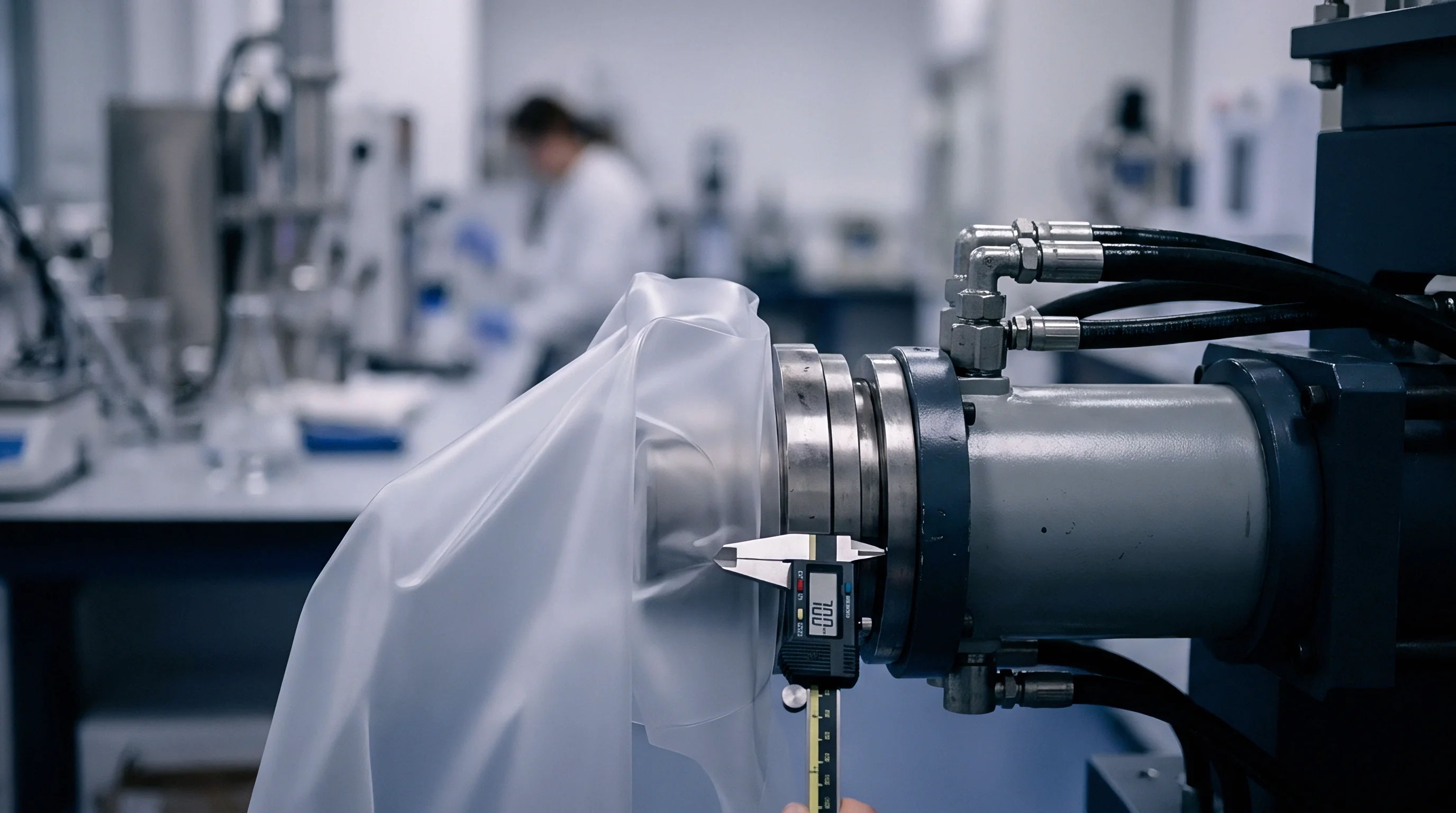
Accurate spectroscopic testing demands hydraulic hot pressing of pellets into homogeneous films possessing uniform thickness between 100 and 150 micrometers. Pressing takes place at 190 °C under 10 MPa for two minutes, followed by chilled water quenching to suppress excessive crystal haze that scatters the infrared beam.
Spectroscopic Baseline Construction and Peak Deconvolution
Transmission infrared measurements on compression-molded films eliminate surface bias. The 1376 cm⁻¹ absorption peak partially overlaps with minor polyethylene skeletal vibration bands located at 1368 cm⁻¹ and 1353 cm⁻¹. Accurate quantification employs second-derivative spectral processing or multi-peak Gaussian deconvolution to isolate the true methyl peak area.
A three-point calibration curve prepared from known binary standards containing 0.5, 2.0, 5.0, and 10.0 weight percent polypropylene in blow-molding grade HDPE establishes the baseline slope. The coefficient of determination across this curve must exceed 0.995 to validate factory gate screening.
| Analytical Methodology | Standard Designation | Sample Size | Test Duration | Practical Lower Limit (wt%) |
|---|---|---|---|---|
| Differential Scanning Calorimetry (DSC) | ASTM D3418 / ISO 11357 | 5 to 10 mg | 45 minutes | 0.30 |
| FTIR Compression Film Transmission | ASTM D5577 / ISO 1043 | 150 µm film | 12 minutes | 0.50 |
| FTIR Attenuated Total Reflectance | ASTM E1252 | 1 pellet surface | 3 minutes | 1.50 |
| Crystallization Elution Fractionation (CEF) | ISO 25762 | 20 mg dissolved | 180 minutes | 0.10 |
| High-Temperature Gel Permeation (HT-GPC) | ASTM D6474 | 15 mg dissolved | 120 minutes | 2.00 |
Advanced fractionation provides cross-validation when spectroscopic peaks fall into legal dispute. Crystallization Elution Fractionation (CEF) and Temperature Rising Elution Fractionation (TREF) separate polymer species through crystallizability from a solvent such as 1,2,4-trichlorobenzene. High-density polyethylene elutes at temperatures between 95 °C and 102 °C, whereas isotactic polypropylene elutes higher, between 115 °C and 125 °C. The detector resolves ethylene-propylene block copolymers, separating soluble amorphous rubbers that escape infrared methyl peak deconvolution.
Solvent fractionation remains the definitive arbiter for complex blended feedstocks.
Analytical laboratories still debate whether rapid transmission measurements can reliably isolate ethylene-propylene rubber fractions without running multi-hour solvent dissolutions.
Pinch
Parison pinch-off creates the critical structural seam at the base and handle areas of extrusion blow molded containers. When the mold halves clamp shut at velocities exceeding 300 mm/s, steel pinch-off blades compress the molten polyolefin tube, fusing the inner surfaces under localized hydraulic force while cutting excess flash. Pure blow molding HDPE fuses into a ductile, monolithic weld seam displaying isotropic molecular orientation across the joint.
Polypropylene contamination corrupts this interface. Polypropylene droplets coalesce into laminar planes under the shear field generated by mold edge closure. The resulting weld contains micro-scale voids along the joint centerline.
Melt index discrepancies between the resin phases amplify weld defects. Virgin fractional melt HDPE flows slowly under squeeze flow, maintaining high parison web thickness. High melt-flow polypropylene fractions flash out prematurely into the overflow pocket, leaving behind a depleted, brittle boundary layer.
Cooling shrinkage introduces additional residual stress. Polypropylene exhibits volumetric mold shrinkage between 1.5 and 2.2 percent, whereas high-density polyethylene shrinks between 2.0 and 3.5 percent. These differential volumetric contraction rates generate locked-in thermal stresses at the phase boundaries, priming the container base for early brittle failure.
ASTM D1693 bent-strip test failure before forty-eight hours under ten percent surfactant solution voids resin lot acceptance for detergent packaging.

Should Moulders Tolerate Three Percent Copolymer Contamination?
Industrial packaging lines subject detergent and chemical bottles to aggressive surfactant environments that trigger environmental stress crack resistance (ESCR) degradation. Environmental stress cracking proceeds when chemical agents penetrate amorphous interlamellar tie-molecule regions, untangling molecular chains under mechanical loads far below yield stress. Dispersed polypropylene inclusions act as stress concentrators.
Crack propagation initiates directly at the sharp spherical boundaries between the immiscible polymer phases. Once initiated, cracks bridge rapidly from void to void along the parison pinch line.
Laboratory data proves that adding polypropylene to HDPE causes severe degradation of environmental stress crack performance per ASTM D1693 Condition B in 10 percent Igepal CO-630 solution:
- Virgin blow molding compound survives beyond 120 hours without cracking along the pinch seam.
- One percent homopolymer inclusion drops the F50 failure threshold down to 78 hours under identical immersion stress.
- Three percent mixed polyolefin contamination lowers survival time to 26 hours, causing immediate container rupture under stack loading.
- Five percent contamination induces baseline micro-cracking within 9 hours, resulting in total loss of packaging integrity.
Drop testing reflects identical mechanical degradation. Containers blow molded from compounds containing more than 2.0 weight percent polypropylene demonstrate brittle shatter along the bottom pinch-off line when filled with water and dropped from 1.5 meters at 4 °C. The impact fracture surfaces reveal smooth, un-yielded cleavage planes characteristic of mechanical debonding rather than the fibrous, plastic drawing observed in uncontaminated polyethylene seams. Industrial sorting physics mirrors techniques found in mining separation, where density and optical properties govern product recovery, and minute contaminant carryover ruins downstream mechanical viability.
Smooth weld beads yield ductile containers while recessed pinch grooves break during transit drop impacts.

Bale
Post-consumer recycling plants process municipal plastic waste harvested from curbside collection programs. Bales designated as curbside HDPE bottles contain substantial quantities of colored injection-molded closures manufactured from polypropylene homopolymers and random copolymers. Automated near-infrared (NIR) optical sorting systems scan conveyor belts at speeds up to 3 meters per second, firing high-pressure air valves to eject misplaced articles.
Optical sorters operate near their physical limits when scanning lightweight bottles carrying full-wrap oriented polypropylene (OPP) or PET shrink sleeves. The optical signature of the sleeve masks the underlying bottle polymer, allowing container misdirection into the recovery stream.
Wet processing systems attempt physical density separation after granulation. High-density polyethylene displays a solid density range between 0.945 and 0.965 g/cm³. Neat polypropylene homopolymers possess densities between 0.900 and 0.910 g/cm³.
While both polymers float in plain water systems operating at a density of 1.00 g/cm³, conventional sink-float tanks cannot separate polypropylene from polyethylene. Upgrading to hydrocyclone systems or centrifugal separation units operating with controlled alcohol-water mixtures permits separation by exploiting slight buoyancy differentials. Fine air bubbles clinging to irregular flake edges distort apparent density, dragging polypropylene flakes down into the heavy fraction.
Compounding operations process washed flakes through twin-screw co-rotating extruders equipped with continuous melt filtration. Screen packs down to 100 mesh (149 micrometers) remove solid dirt, aluminum, and cellulosic fibers, but molten polypropylene passes unimpeded through the filter medium. The compounder relies on screw shear geometry to disperse the immiscible phase.
Dispersive mixing blocks composed of forward and reverse kneading elements shear polypropylene droplets down to sub-micron dimensions. Fine dispersion delays mechanical failure. It does not eliminate interfacial debonding.
Incoming inspection protocols require systematic railcar and silo sampling before releasing recycled resin lots to blow molding silos:
- Compartment sampling collects five core samples across each bulk railcar compartment using clean, segmented sampling probes.
- Composite blending mixes individual probe captures inside a sealed mechanical divider to generate an unbiased 2-kilogram working composite.
- Differential thermal screening runs duplicate five-milligram samples on a calibrated calorimeter to determine total polypropylene melting enthalpy.
- Melt filtration analysis measures pressure build-up per kilogram across a 200-mesh test screen to confirm total particulate and unmelted crosslinked contamination.
Baggers and warehouse handlers seal the labeled boxes, stage the pallets away from ambient moisture, and load outbound flatbeds for haulage.
Covenant
Raw material purchase contracts determine whether post-consumer blow molding compounds generate production profits or ruin processing margins through scrap accumulation. A comprehensive material specification names precise contamination caps rather than vague references to commercially pure recycled resin. The purchase covenant must specify ASTM D5577 or ISO 18263 test execution on every delivery lot, setting an absolute threshold of no more than 1.5 weight percent polypropylene for general hollow-ware packaging, and a maximum of 0.75 weight percent for containers packaging aggressive industrial chemicals or surfactant-rich detergents.
Virgin polymer pricing dictates recyclate tolerance margins more aggressively than processing equipment limitations.
Commercial valuation models illustrate the financial exposure generated by uncontrolled polypropylene contamination. Consider a manufacturing operation purchasing a 40-tonne railcar of recycled blow molding compound at a landed contract price of 1,280 dollars per metric tonne, operating an extrusion blow molding line converting 500 kilograms per hour into 1-liter chemical bottles. Assume the baseline production generates a scrap rate of 1.5 percent on qualified resin containing under 1.0 weight percent polypropylene.
If an unverified lot arrives carrying 3.8 weight percent polypropylene, the finished bottles display brittle pinch-off zones that elevate the line scrap rate to 8.5 percent due to wall splits and drop test failures.
| Lot Parameter | Qualified Lot (0.8% PP) | Contaminated Lot (3.8% PP) | Variance Impact |
|---|---|---|---|
| Delivered Resin Cost (40 tonnes) | $51,200 | $51,200 | $0 |
| Blow Molding Machine Time (hours) | 80.0 | 85.8 | +5.8 hours |
| Produced Bottle Units (gross) | 800,000 | 800,000 | 0 |
| Defect Rate (pinholes / drop failures) | 1.5% | 8.5% | +7.0% |
| Good Saleable Bottles | 788,000 | 732,000 | -56,000 units |
| Finished Bottle Value ($0.18/unit) | $141,840 | $131,760 | -$10,080 |
| Regrind Value Deduction ($0.45/kg) | -$270 | -$1,530 | +$1,260 recovery |
| Net Conversion Margin Realized | $90,370 | $81,550 | -$8,820 margin loss |
The resulting financial penalty equals 220 dollars per tonne of processed resin. This loss completely erases the raw material cost advantage achieved by selecting recycled compound over prime virgin high-density polyethylene. The buyer must enforce contractual debit clauses that automatically apply deductions based on laboratory Certificates of Analysis (CoA).
Deliveries testing between 1.5 and 2.5 weight percent PP incur an automatic 15 percent price deduction per tonne to offset anticipated scrap losses. Deliveries testing above 2.5 weight percent trigger immediate lot rejection at the compounder’s expense, including freight charges for return transport.
ASTM D5577 specification clauses stipulating mandatory differential scanning calorimetry enthalpy verification per twenty-tonne delivery shift lot liability directly to the recycling compounder.