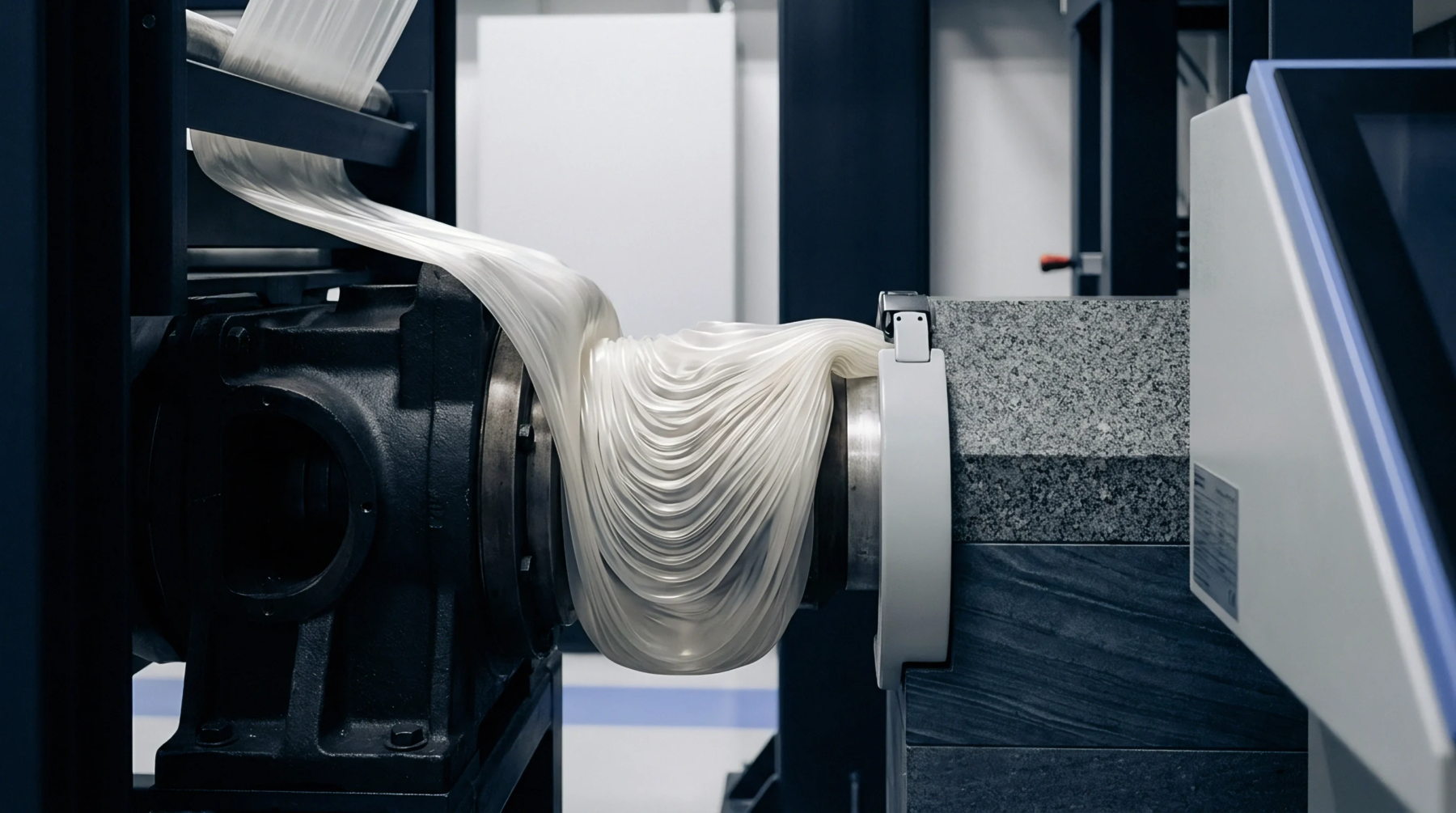
Evaluating Melt Flow Rate Limitations in Recycled Polypropylene Testing
Single point melt flow index testing fails to predict recycled polypropylene processing behavior due to shear thinning and contaminant induced melt instability.
Single point melt flow index testing fails to predict recycled polypropylene processing behavior due to shear thinning and contaminant induced melt instability.

Dynamic shear rheology and oxidative induction testing quantify gel growth and additive depletion in recycled polyolefins to prevent process failures.
Stabilizing post-consumer flake requires baseline infrared oxidation metrology paired with balanced phenolic-phosphite packages to prevent melt chain scission.

Thermal and oxidative degradation alters polyolefin flake viscosity and residual stability, demanding MFR, OIT, and Carbonyl Index verification before processing.
Fused bead XRF customs disputes resolve by pre-ashing polymer carriers at 550 C, normalizing for mineral volatile loss, and matching flux-to-sample dilution ratios.

Standardize muffle furnace ash testing of calcium carbonate polyolefin concentrates at 525 °C to avoid calcite decarboxylation and gravimetric error.

Polymer masterbatches carrying reactive chemistry or microencapsulated payloads require chemical substance classification rather than polymer exemption status.

Determining masterbatch carrier resin ratios via standard thermogravimetric and solvent extraction protocols prevents high-duty polymer tariff reclassifications.

Masterbatch tariff classification hinges on active chemical loading, where inorganic pigments above specific mass thresholds shift import codes from Chapter 39.

Rebuilding intrinsic viscosity in scissioned rPET requires pre-crystallizing pellets to 40% to prevent sintering and controlling gas-phase ethylene glycol partial pressure below 0.05 mbar.

Potentiometric titration of carboxyl end groups quantifies thermal hydrolytic history in rPET lots, revealing latent processing damage and driving lot pricing.

Intrinsic viscosity loss in reprocessed PET flake is quantified by dilute solution viscometry using ASTM D4603 to prevent structural failure in preforms.

Maintain manifold shear rates below 300 s⁻¹ and specify 25-minute minimum OIT to prevent catastrophic molecular weight loss in recycled polyethylene extrusion.

Capillary rheometry establishes binding high-shear viscosity limits that prevent multicavity tool imbalance and part weight variance in post-consumer resins.

High shear molding relies on pseudoplastic shear thinning, requiring capillary rheometry over melt flow index to control viscous heating and pressure losses.

Residual organic peroxide breakdown drives post-moulding melt flow drift and antioxidant depletion in high-speed thin-wall polypropylene injection packaging.

Visbroken polypropylene risks organoleptic contamination and thermal degradation; verify residual peroxide, NIAS limits, and OIT before food contact use.

Select high flow polypropylene homopolymers by balancing melt flow rate against impact loss, verifying narrow molecular weight distribution and peroxide residues.

Compressive jaw pressure forces secondary amides to co-crystallize with metallocene polyethylene, locking slip additives and elevating post-seal friction.

Primary erucamide melts under hot bar sealing platens, increasing viscous drag and tooling varnish; secondary amides preserve boundary slip and seal integrity.

Secondary amides eliminate seal jaw smoking and hot tack decay in polyolefin film sealing by maintaining low volatility at elevated operating temperatures.

High shear compounding degrades ultra-high molecular weight tails through mechanochemical scission, best quantified by zero-shear viscosity and Mz tracking.

Low frequency storage modulus G prime below 0.1 rad/s isolates high molecular weight elastic recovery to predict bimodal pipe swell and prevent over-extrusion.

Dynamic rheology quantifies bimodal polyethylene high mass tail content by tracking zero shear viscosity and low frequency storage modulus at 190 C.

Interfacial viscous fingering during melt fractionation is controlled by tuning temperature gradients and limiting viscosity ratios across polymer phase boundaries.
Low frequency oscillatory rheology unmask hydrolyzed resin fractions by measuring zero-shear viscosity drop and storage modulus slope collapse near zero frequency.

Hydrolytic degradation thresholds require drying virgin polyesters below 0.02 percent and polyamides below 0.10 percent water before melt processing.

Thermal conditioning and standard thermal history resets eliminate density drift errors, securing accurate mold shrinkage during polyethylene resin converting.

Polyethylene hydrostatic testing requires degassed, temperature-corrected fluid baths and void-free plaques to prevent false 0.002 g/cm³ receiving rejections.
Expertise is a utility, not a secret. sentiention™ publishes its working knowledge as open reference: intelligence layer covering the materials it sources, the markets it enters, and the reference that serves both.