Solid State Polymerization Kinetics and Mass Transfer Limits in Rebuilding Intrinsic Viscosity of Heavily Scissioned Post Consumer Polyethylene Terephthalate Pellets
Rebuilding intrinsic viscosity in scissioned rPET requires pre-crystallizing pellets to 40% to prevent sintering and controlling gas-phase ethylene glycol partial pressure below 0.05 mbar.

Degradation
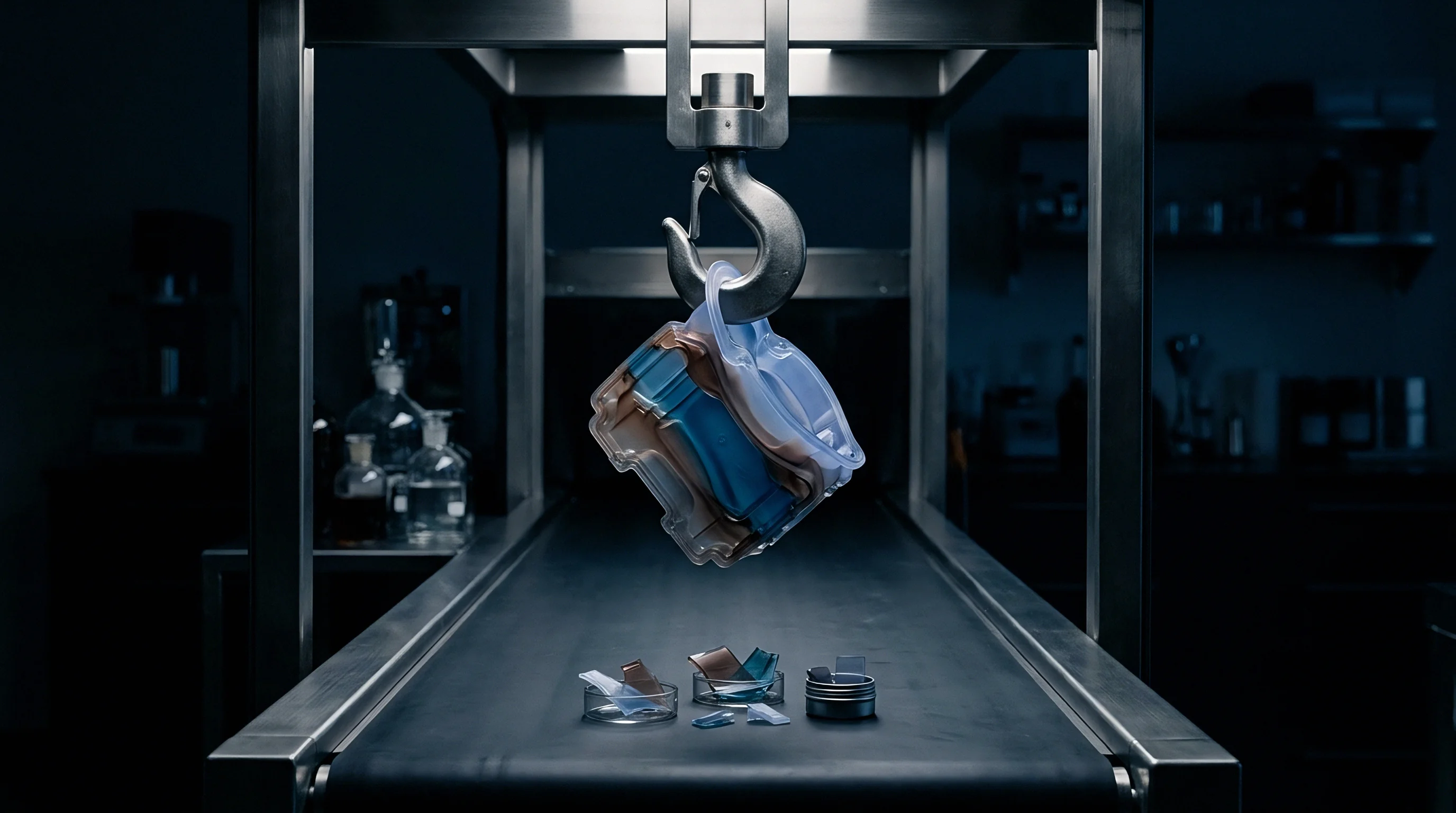
Post-consumer polyethylene terephthalate flakes undergo extensive mechanical and thermal scission during wash lines, melt decontamination, and pelletization. When scrap bottles and thermoforms are re-melted, heat and shear cleave ester bonds along the polymer backbone. This breakdown drops the intrinsic viscosity from bottle-grade levels around 0.80 dL/g down to 0.48 ~ 0.54 dL/g in unconditioned recycled pellets.
Rebuilding this molecular weight in the solid state demands precise knowledge of the starting chemical state, as the ratio of reactive end groups dictates the ceiling of achievable viscosity restoration.

Polymer Backbone Cleavage in Post-Consumer Processing
Chain scission occurs predominantly through hydrolytic and thermal mechanisms when molten polyester encounters entrained moisture or high shear in single-screw extruders. Hydrolysis rapidly cleaves ester linkages at processing temperatures above 260 degrees Celsius, converting one long polymer chain into two shorter fragments. One fragment terminates in a carboxyl end group while the other carries a hydroxyl end group.
Extrusion moisture breaks chains. Un-dried or poorly dried flake containing as little as 0.02 percent water by weight suffers immediate loss in chain length during extrusion. Thermal scission operates concurrently through a beta-scission mechanism, yielding a carboxylic acid group and a vinyl ester end group.
Vinyl ester groups subsequently react or thermalize to liberate acetaldehyde, leaving residual carboxylic acid on the polymer chain.
Mechanical shear in high-output extruders accelerates thermal breakdown by generating localized hot spots inside the melting zone. As chain length drops, the concentration of terminal groups increases proportionally. Heavily degraded post-consumer pellets present a severely shifted distribution of molecular weights, characterized by a high polydispersity index exceeding 2.5 and an accumulation of short-chain oligomers.
High moisture destroys viscosity. The accumulation of these short chains lowers the melt strength, making the re-melted resin unsuitable for technical applications such as strapping, industrial yarns, or blow-molded containers without molecular weight reconstruction.
Carboxyl End Group Accumulation Mechanics
Thermal cleavage of ester linkages forms a vinyl ester intermediate and a free acid moiety. Carboxyl end group concentrations, measured in millimoles per kilogram of polymer, serve as the primary chemical marker of thermal damage. Virgin bottle-grade resins typically maintain carboxyl values between 15 and 25 mmol/kg.
Post-consumer processing elevates carboxyl levels to 45 ~ 60 mmol/kg or higher, depending on flake origin, washing thermal history, and extruder vacuum performance.
Extrusion of post-consumer polyester with moisture levels above 0.005 percent by weight drops intrinsic viscosity by 0.15 dL/g at 280 degrees Celsius.
Excessive acid end groups severely alter the kinetics of solid-state chain extension. In ester interchange chemistry, chain rebuilding occurs through two main pathways: transesterification between two hydroxyl end groups, which liberates ethylene glycol, and direct esterification between a carboxyl and a hydroxyl end group, which liberates water. High concentrations of carboxyl groups shift the dominant reaction path toward direct esterification.
Direct esterification proceeds at a slower rate than hydroxyl-hydroxyl transesterification at typical solid-state temperatures of 200 to 220 degrees Celsius. Elevated carboxyl levels act as autocatalytic sites for further hydrolytic degradation if water vapor is not immediately removed from the pellet interior during thermal treatment.
| Parameter | Virgin Bottle Grade | Post-Consumer Recycled Flake | Scissioned Pellets (Pre-SSP) | Standard Test Method |
|---|---|---|---|---|
| Intrinsic Viscosity (dL/g) | 0.78 – 0.84 | 0.70 – 0.76 | 0.48 – 0.55 | ISO 1628-5 (Phenol/1,2-dichlorobenzene) |
| Carboxyl End Groups (mmol/kg) | 15 – 22 | 25 – 35 | 45 – 65 | ASTM D7409 (Potentiometric Titration) |
| Hydroxyl End Groups (mmol/kg) | 45 – 60 | 35 – 50 | 20 – 35 | NMR / Hydroxyl Number Calculation |
| Acetaldehyde Content (ppm) | < 1.0 | 2.0 – 8.0 | 8.0 – 25.0 | ISO 21898 / GC-Headspace |
| Crystallinity (%) | 35 – 45 | 30 – 40 | 8 – 15 | ISO 11357-3 (DSC Second Heat) |
Ignoring initial acid concentrations when setting reactor residence times leads to brittle resin that fails top-load tests in blow-molded containers.
Purge
Volatile condensate removal from pellet interstitial voids establishes the thermodynamic driving force necessary to advance condensation polymerization. Solid-state reactions are reversible equilibrium processes. To continuously drive chain coupling forward, small byproduct molecules, specifically water from direct esterification and ethylene glycol from transesterification, must be removed from the boundary gas layer surrounding each pellet.
Failure to maintain a low partial pressure of these volatile species halts chain growth and can cause reverse depolymerization.

Inert Gas Mass Transport and Carrier Velocities
High-purity nitrogen flowing counter-currently through a moving pellet bed sweeps liberated glycol and water vapor out of the reactor head space. Gas sweep velocity sets removal. The volumetric flow rate of nitrogen must supply sufficient heat while maintaining gas-phase byproduct partial pressures below critical thermodynamic thresholds.
At 210 degrees Celsius, the partial pressure of ethylene glycol must stay below 0.05 mbar to maintain a continuous forward reaction rate.
Nitrogen conditioning systems recirculate carrier gas through desiccators and catalytic purification units. Gas dew point monitoring at the reactor inlet confirms that entrained water remains below minus 50 degrees Celsius. Low gas velocities allow volatile byproducts to accumulate in the inter-pellet void spaces, establishing localized phase equilibrium where the rate of chain extension equals the rate of glycol-induced scission.
Increasing carrier gas velocity thins the hydrodynamic boundary layer around each pellet, reducing external mass transfer resistance until intrapellet diffusion becomes the sole rate-limiting mechanism.

Boundary Layer Gas Phase Equilibrium Limits
Stagnant gas films surrounding individual pellets create localized partial pressures of ethylene glycol that suppress chain growth. Stagnant gas halts chain growth. The mass transfer coefficient across the external gas film depends on the dimensionless Sherwood number, which scales with carrier gas Reynolds and Schmidt numbers inside packed column reactors.
In deep-vacuum reactors operating below 1 mbar without inert sweep gas, mass transport relies on molecular effusion into the vacuum chamber.
Specifications requiring nitrogen dew points below minus 60 degrees Celsius under ISO 8573 1 prevent hydrolytic chain cleavage during elevated thermal processing.
Vacuum systems eliminate nitrogen circulation infrastructure but require hermetic sealing across rotary valves and discharge airlocks. Operating at 0.1 to 0.5 mbar provides a chemical driving force equivalent to a dry nitrogen sweep running at high space velocities. High vacuum draws volatile contaminants out of heavily scissioned post-consumer feeds, including residual limonene, fatty acid esters, and print solvent residues.
Inadequate vacuum depth allows trapped volatile species to redeposit on hot pellet surfaces, causing severe discoloration and color yellowing.
- Boundary Layer Saturation occurs when low carrier gas velocity allows ethylene glycol vapor to accumulate near particle surfaces, driving the condensation reaction into chemical equilibrium.
- Channeling Phenomenon arises inside packed beds when non-uniform gas flow bypasses regions of high pellet compaction, leaving unreacted cores.
- Dust Entrainment happens at excessive gas velocities, carrying fine polymer particles into condenser loops and clogging heat exchangers.
- Moisture Re-absorption takes place when wet nitrogen sweeps across cooling pellet beds, instantly severing ester bonds.
Compounders often claim that low intrinsic viscosity recovery stems entirely from feedstock contamination rather than inadequate gas sweep flow rates.


Diffusivity
Mass transport within individual solid polymer particles governs the overall rate of esterification once surface volatile concentration approaches zero. Solid-state polymerization operates far below the melting temperature of polyester, typically between 190 and 220 degrees Celsius. At these temperatures, polymer chains possess limited mobility inside crystalline domains, restricting chemical reactions and molecular diffusion strictly to amorphous regions.
Eliminating liberated ethylene glycol requires the byproduct molecule to diffuse through the amorphous polymer matrix to the pellet exterior.

Why Does Core Intrinsic Viscosity Lag Shell Intrinsic Viscosity during Rapid Heating?
Temperature gradients across the pellet radius establish spatial differences in reaction kinetics and volatile mobility during early reactor residence. Ethylene glycol generated deep within the core of a 3-millimeter spherical pellet faces a long diffusion path through dense polymer tissue. The time required for a volatile molecule to diffuse out scales with the square of the particle radius, as defined by Fickian transport mathematics.
Pellet size dictates reaction speed.
Because byproduct concentration remains highest at the core, core transesterification reactions reach equilibrium quickly, halting molecular weight growth in the particle center. Conversely, surface regions experience rapid volatile loss to the sweep gas or vacuum, allowing chain extension to proceed unchecked. This radial concentration profile produces a pronounced core-to-shell gradient in intrinsic viscosity.
Shell polymer reaches high viscosity rapidly, while the core remains scissioned until extended residence time allows internal glycol migration.
Fickian Transport Coefficients in Solid PET Domains
Ethylene glycol molecules migrate through amorphous regions between crystalline lamellae at rates determined by local free volume and temperature. The effective diffusion coefficient of ethylene glycol ranges from 1 × 10-13 m2/s to 5 × 10-12 m2/s across the operational temperature window of 190 to 220 degrees Celsius. Diffusion follows an Arrhenius relationship, with activation energy for ethylene glycol transport in semi-crystalline polyester ranging between 85 and 110 kJ/mol.
Consider a worked calculation for a spherical pellet with a radius of 1.5 millimeters subjected to solid state conditions at 210 degrees Celsius under high nitrogen sweep. Assuming an effective diffusion coefficient of 2.5 × 10⁻¹² m2/s, the characteristic diffusion time (td = r2 / Deff) equals 900,000 seconds, or 250 hours, if diffusion operates in isolation without driving potential gradients. However, continuous chemical reaction generation and volatile evaporation establish steep concentration gradients, accelerating net flux.
The Biot number for mass transfer (Bim = kg r / Deff) evaluates whether external film resistance or internal transport limits growth. For typical pellet beds, Bim exceeds 100, proving that internal Fickian diffusion dominates overall process rate control.
Pellet radius variations impact total processing time far more severely than moderate changes in reactor jacket temperature.
| Parameter | Symbol | Value / Range | Physical Units |
|---|---|---|---|
| Ethylene Glycol Diffusion Coefficient | DEG | 1.2 × 10⁻¹² – 3.5 × 10⁻¹² | m2/s |
| Water Diffusion Coefficient | DH2O | 8.0 × 10⁻¹¹ – 2.0 × 10⁻¹⁰ | m2/s |
| Transesterification Forward Rate Constant | k1 | 0.015 – 0.035 | kg/(mmol·hr) |
| Direct Esterification Rate Constant | k2 | 0.005 – 0.012 | kg/(mmol·hr) |
| Activation Energy for EG Diffusion | Ea | 92 – 105 | kJ/mol |
| Values measured on commercial post-consumer pellets under high-purity nitrogen sweep at ambient pressure. | |||
The exact physical threshold where crystalline perfection completely blocks ethylene glycol transport in heavily re-melted post-consumer feeds remains uncertain across commercial reactor designs.

Sintering
Pellet agglomeration inside reactor vessels presents a severe disruption to continuous solid phase processing. Heavily scissioned post-consumer pellets arrive from re-pelletizing extruders in a highly amorphous or low-crystallinity state, typically under 15 percent crystallinity. When amorphous polyesters pass through their glass transition temperature between 75 and 85 degrees Celsius, chain segments gain rotational freedom, causing the polymer to soften and develop surface tackiness.
Amorphous pellets tack together quickly.

Thermal Crystallization and Sticking Resistance
Amorphous post-consumer extrudates soften rapidly near seventy-five degrees Celsius, causing pellet surfaces to tack together upon contact. If unconditioned pellets enter a solid-state reactor column at target temperatures above 190 degrees Celsius, particle surfaces sinter together, forming large clinkers that bridge across reactor walls and block gravity flow. Agglomeration stops column bed movement.
To prevent sintering, pellets undergo mandatory pre-crystallization before exposure to reaction temperatures.
Pre-crystallization increases polymer crystallinity from initial low values up to 40 ~ 50 percent. Crystalline domains act as physical crosslinks that maintain structural rigidity, preventing polymer chains from interdiffusing across particle boundaries at elevated temperatures. Controlled heating inside mechanical or fluid-bed crystallizers forces cold crystallization to occur under continuous agitation, preventing static contact between softening particles.

Enthalpy Trajectories across Cold Glass Transition Shifts
Differential scanning calorimetry traces reveal lower glass transition temperatures in heavily scissioned resins due to increased chain end concentration. Low-molecular-weight short chains increase free volume, depressing the glass transition temperature by 3 to 8 degrees Celsius compared to prime bottle resin. This thermodynamic shift widens the hazardous sticking window, requiring faster heating rates during initial conditioning.
Cold crystallization kinetics accelerate in damaged post-consumer materials because short chains reorient into crystalline lattices more readily than entagled long chains. Differential scanning calorimetry measurements show an exothermic crystallization peak occurring between 120 and 140 degrees Celsius during baseline heating. The heat released during rapid crystallization can raise local pellet temperatures above the surface softening point if cooling air flow is inadequate.
Pre-crystallizer design utilizes high air flow rates to dissipate exothermic crystallization enthalpy, holding bed temperature stable at 160 to 170 degrees Celsius until heat flow curves level off.
- Transfer amorphous post-consumer pellets into a fluid-bed pre-crystallizer operating at 120 degrees Celsius.
- Agitate the fluid bed using mechanical agitation and hot air flows to maintain continuous particle movement.
- Ramp temperature gradually to 170 degrees Celsius over a 30-minute residence window to induce 40 percent crystallinity.
- Discharge crystallizing pellets into an insulated surge hopper to stabilize density before reactor column feeding.
Proper pre-crystallization always prevents pellet fusion inside continuous reactor columns better than increasing mechanical stirrer agitation.

Polycondensation
Rebuilding chain length relies on ester interchange and direct esterification reactions occurring below the polymer melting point. Once pellets achieve sufficient crystallinity and volatile transport limits are established, chain coupling proceeds via end-group reactions inside the amorphous phases. Solid-state polycondensation increases molecular weight linearly over extended retention times, provided end-group stoichiometry and catalytic activity remain favorable.
Re-Esterification and Chain Extension Kinetics
Hydroxyl terminal groups react with carboxylic acids to yield ester linkages while liberating water molecules into the surrounding matrix. Transesterification couples two hydroxyl-terminated chains, forming a longer chain and releasing ethylene glycol. End group ratios set limits.
Direct esterification consumes one hydroxyl group and one carboxyl group, releasing one water molecule. Because water molecules are smaller than ethylene glycol molecules, water diffuses through the amorphous polymer matrix roughly 20 to 50 times faster than glycol, making direct esterification less limited by intrapellet transport than transesterification.
The rate of intrinsic viscosity build follows second-order reaction kinetics. Kinetic modeling expresses the rate of carboxyl group consumption as a function of instantaneous hydroxyl and carboxyl concentrations, catalyzed by residual metallic compounds. When carboxyl concentrations are high, as found in heavily scissioned post-consumer feeds, water generation dominates early processing stages.
Fast water diffusion produces an initial rapid drop in carboxyl content, followed by a slower transesterification phase limited by ethylene glycol diffusion.
Residual Catalyst Activity and End Group Balance
Antimony compounds remaining from primary melt polymerization reactivate above 190 degrees Celsius to accelerate chain coupling. Antimony trioxide, present in post-consumer bottle resin at levels between 200 and 300 ppm, serves as the primary catalyst for both transesterification and esterification. Titanium-based and germanium-based catalysts exhibit higher specific activity but are less common in post-consumer bottle streams.
Catalyst activity drops over time. Extended thermal exposure and reaction with acidic degradation contaminants can partially deactivate antimony catalysts through the formation of inactive antimony carboxylate salts.
Unequal initial concentrations of hydroxyl and carboxyl groups cap the ultimate molecular weight attainable during solid state treatment.
Achieving high intrinsic viscosity requires a balance between hydroxyl and carboxyl end groups. Stoichiometric imbalance caps achievable molecular weight. If scission consumes virtually all hydroxyl groups, leaving an overwhelming excess of carboxyl groups, chain extension ceases because carboxylic acids cannot react with other carboxylic acids.
In cases of severe imbalance, compounders introduce reactive chain extenders, such as bis-oxazolines or pyromellitic dianhydride, during initial re-pelletization to regenerate hydroxyl functionality prior to solid-state treatment.
- Carboxyl Concentration Verification requires testing incoming pellet batches via titration to ensure values remain below 45 mmol/kg.
- Residence Time Validation mandates tracer studies to confirm plug-flow behavior and eliminate short-circuiting inside column reactors.
- Thermal Homogeneity Check involves multi-point thermocouple logging across reactor cross-sections to prevent localized cold spots.
- Moisture Balance Control calls for dew point sensors on incoming nitrogen lines operating continuously below minus 50 degrees Celsius.
Purchase agreements referencing ISO 1628 5 clauses on intrinsic viscosity testing protect buyers by rejecting lots with carboxyl levels exceeding 35 mmol/kg.

Yield
Rebuilding heavily scissioned post-consumer polyester into high-viscosity resin involves economic trade-offs between retention time, energy consumption, and optical clarity. Solid-state processing restores intrinsic viscosity from low pre-treatment levels around 0.50 dL/g up to target values of 0.80 to 0.88 dL/g suitable for bottle manufacturing or industrial strapping. However, maintaining pellets at temperatures above 200 degrees Celsius for 12 to 24 hours incurs significant operational costs and thermal degradation penalties that impact product value.
Color Thermal Shift and Acetaldehyde Re-Generation
Extended holding times at two hundred degrees Celsius cause chromophore formation, shifting pellet optical properties toward yellow spectrum values. Thermal degradation of residual additives, print residues, and polymer chain ends produces conjugated double bonds and enol structures. Extended heating turns pellets yellow.
Color quality is quantified using the CIELAB scale, where the yellowing index (b parameter) tracks optical degradation. Virgin bottle resin maintains a b value between minus 1.0 and plus 1.0, whereas post-consumer pellets subjected to long solid-state residence times exhibit b values spiking to plus 4.0 or higher.
Acetaldehyde generation presents a secondary operational challenge for food-grade resin recovery. Although solid-state processing strips volatile acetaldehyde down to sub-ppm levels, thermal history accumulated during long reactor residence lowers the thermal stability threshold of the polymer. When rebuilt high-viscosity pellets are subsequently re-melted in injection blow molding machines to produce preforms, regenerated acetaldehyde levels rise rapidly if residual carboxyl content and catalyst concentration are elevated.

Landed Cost Metrics for Rebuilt Viscosity Pellets
Financial evaluations capture nitrogen recovery losses, electricity consumption per metric tonne, and yield reductions from fine generation. Processing one metric tonne of scissioned pellets through continuous pre-crystallization, drying, and solid-state reaction consumes between 180 and 260 kilowatt-hours of electrical energy, depending on continuous continuous nitrogen blower efficiency and vacuum pump sizing. Fine generation reduces net yield.
Thermal mechanical agitation inside crystallizers and moving bed reactors abrades brittle pellet edges, generating polymer dust and fines. Fines choke nitrogen distribution filters. Fine generation ranges from 0.8 to 2.2 percent of total throughput, representing a direct yield loss because fines must be screened out to prevent air balance failures inside column beds.
| Target Viscosity Grade | Target IV (dL/g) | Residence Time (Hours) | Reactor Temp (°C) | Energy Cost ($/Ton) | Yellowing Index (b ) |
|---|---|---|---|---|---|
| Thermoform Sheet Grade | 0.68 – 0.72 | 6 – 10 | 195 – 200 | 35 – 50 | +1.5 to +2.5 |
| Carbonated Soft Drink Bottle Grade | 0.80 – 0.84 | 14 – 18 | 205 – 212 | 70 – 95 | +2.8 to +4.2 |
| High-Tenacity Industrial Strapping | 0.88 – 0.98 | 20 – 28 | 212 – 220 | 110 – 150 | +4.5 to +7.0 |
Moisture control determines final properties. The total landed cost per metric tonne balances energy expenditure against the commercial price differential between generic flake and certified high-viscosity resin.