
The Lot Loaded into the Container against the Sample Tested
Verify bulk container lots against test certificates using statistical ISO 2859-1 sampling and simulant migration screening before releasing payment.
Verify bulk container lots against test certificates using statistical ISO 2859-1 sampling and simulant migration screening before releasing payment.

Polyolefin property degradation stems from chain scission, oxidation, and contamination; managing property drift requires strict OIT, melt index, and blend controls.

Quantification of non-intentionally added substances in recycled polyolefins requires structural class calibration to overcome mass spectrometry response variances.

High-resolution mass spectrometry non-target screening identifies toxicologically uncharacterized polyolefin migrants down to sub-10 ppb compliance thresholds.

Auditing converter additive disclosures against container migration limits requires screening recipe dosages against diffusion kinetics and analytical test results.

Cramer structural classification sets exposure thresholds for unlisted packaging migrants, turning molecular features into defensible specific migration limits.

European food contact polymer compliance mandates measuring total migration below 10 mg/dm² and specific migration limits using exact simulants and conditions.

End of waste validation for secondary polyolefin compounding requires batch migration testing and accredited technical dossiers to convert scrap into compliant resin.

Verifying food contact compliance for polymer granulates connects batch migration test data to resin chemistry, valid declarations, and specific end-use limits.

Non-targeted screening workflows require orthogonal GC-MS and LC-HRMS platforms to detect volatile, non-volatile, and adhesive oligomer migrants down to an analytical evaluation threshold derived from toxicological thresholds of concern.

Zero-shear viscosity drops exponentially before MFR shifts, providing an early indicator of antioxidant depletion in recycled polypropylene.

Analytical screening of additive degradation products in rigid packaging demands hyphenated mass spectrometry matched against finished container migration testing.
Analytical screening of HDPE consignments requires solvent extractions, GC-MS profiling, and diffusion modeling to verify food contact compliance before release.

Screening polymeric minor assembly additives requires precise cryo-milling, solvent extraction, and mass spectrometry to confirm regulatory compliance limits.

Untargeted screening by GC-MS and LC-HRMS combined with Threshold of Toxicological Concern metrics establishes legal food-contact safety for recycled polyolefins.

Standardized NIAS calibration in PET relies on surrogate matrix-matched standards, response factor thresholds, and verified limits of detection below ten parts per billion.

Standardized food simulant selection for polyolefins depends on food solubility, polymer swelling factors, and mandatory thermal contact windows.

Multi-party moisture disputes depend on ISO 15512 Method C baseline sampling at loading and container dew point tracking before silo transfer.
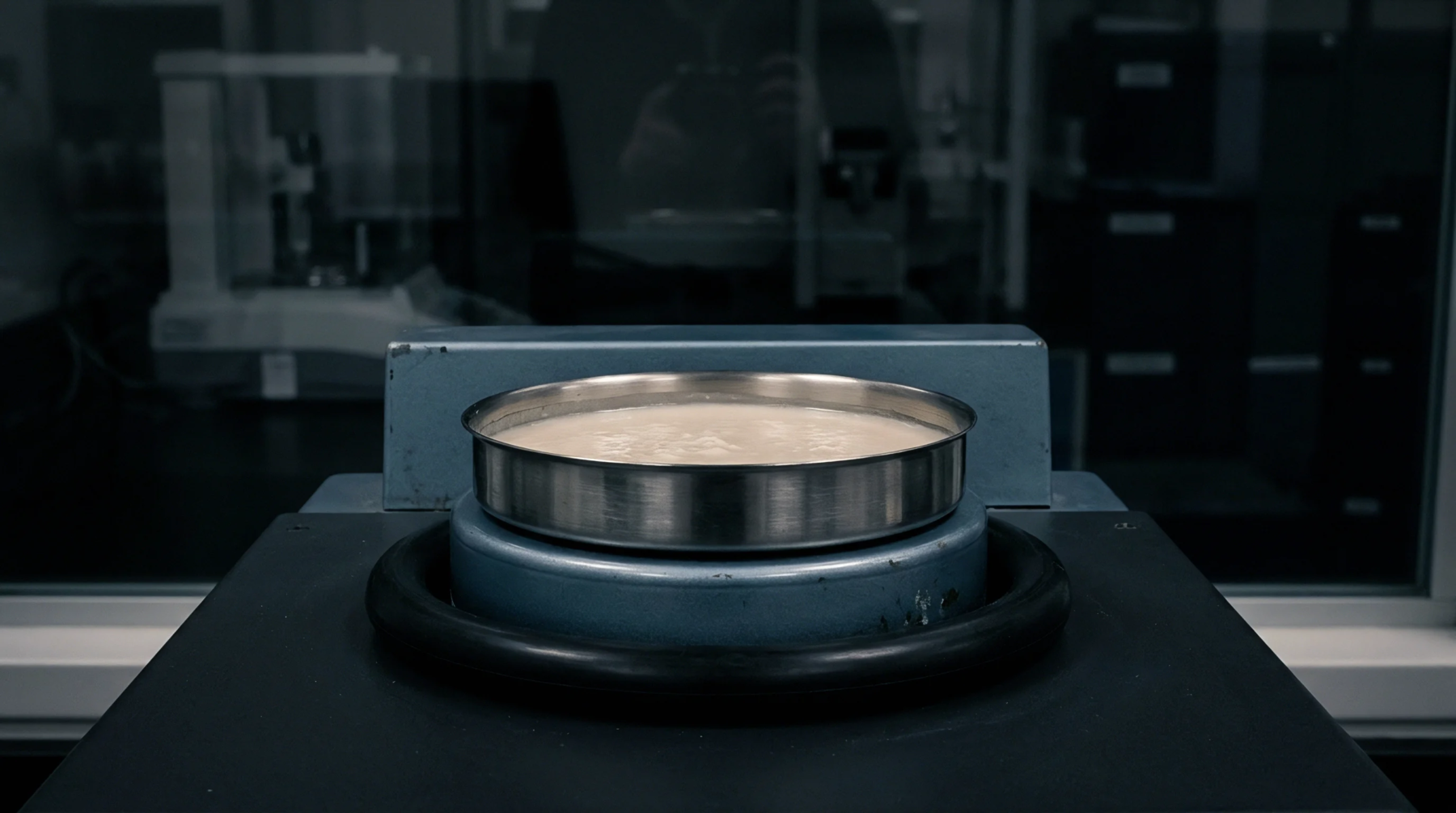
Dynamic low-frequency rheometry identifies thermal degradation in recycled polyolefins that single-point melt flow tests miss entirely.

Verifying food contact reports against resin specifications requires matching batch numbers, validating simulants, and recalculating surface contact ratios.

Validating food contact safety in bulk packaging relies on matching simulant test parameters to geometry and auditing chemical declarations for every additive.

Polyolefin migration compliance requires selecting food simulants based on polarity and fat content while accounting for matrix swelling and thermal limits.

Visbroken polypropylene risks organoleptic contamination and thermal degradation; verify residual peroxide, NIAS limits, and OIT before food contact use.

Validating GC-MS workflows for postconsumer polyolefin migrants requires matrix-matched calibration, accurate mass deconvolution, and response-factor adjusted screening.

Oxidation induction time testing at 200 °C establishes true additive depletion in recycled polypropylene before melt processing causes chain scission.

Analytical screening validates supplier disclosures by identifying degradation products and non-intentionally added substances before market placement.

Hot runner temperature differentials across mold cavities cause localized additive degradation and uneven migration rates that compromise food contact release.
Emulsion structure suppresses fat-contact migration, rendering neat oil simulants excessively aggressive and alcoholic simulants unreliably unconservative.

Polyolefin stabilizer thermal degradation kinetics generate volatile non-intentionally added cleavage products that invalidate virgin resin compliance declarations.
Polyolefin migration compliance demands simulant-specific exposure verification and mass-spectrometric screening for unlisted oligomeric hydrocarbons.
Expertise is a utility, not a secret. sentiention™ publishes its working knowledge as open reference: intelligence layer covering the materials it sources, the markets it enters, and the reference that serves both.