Meaning
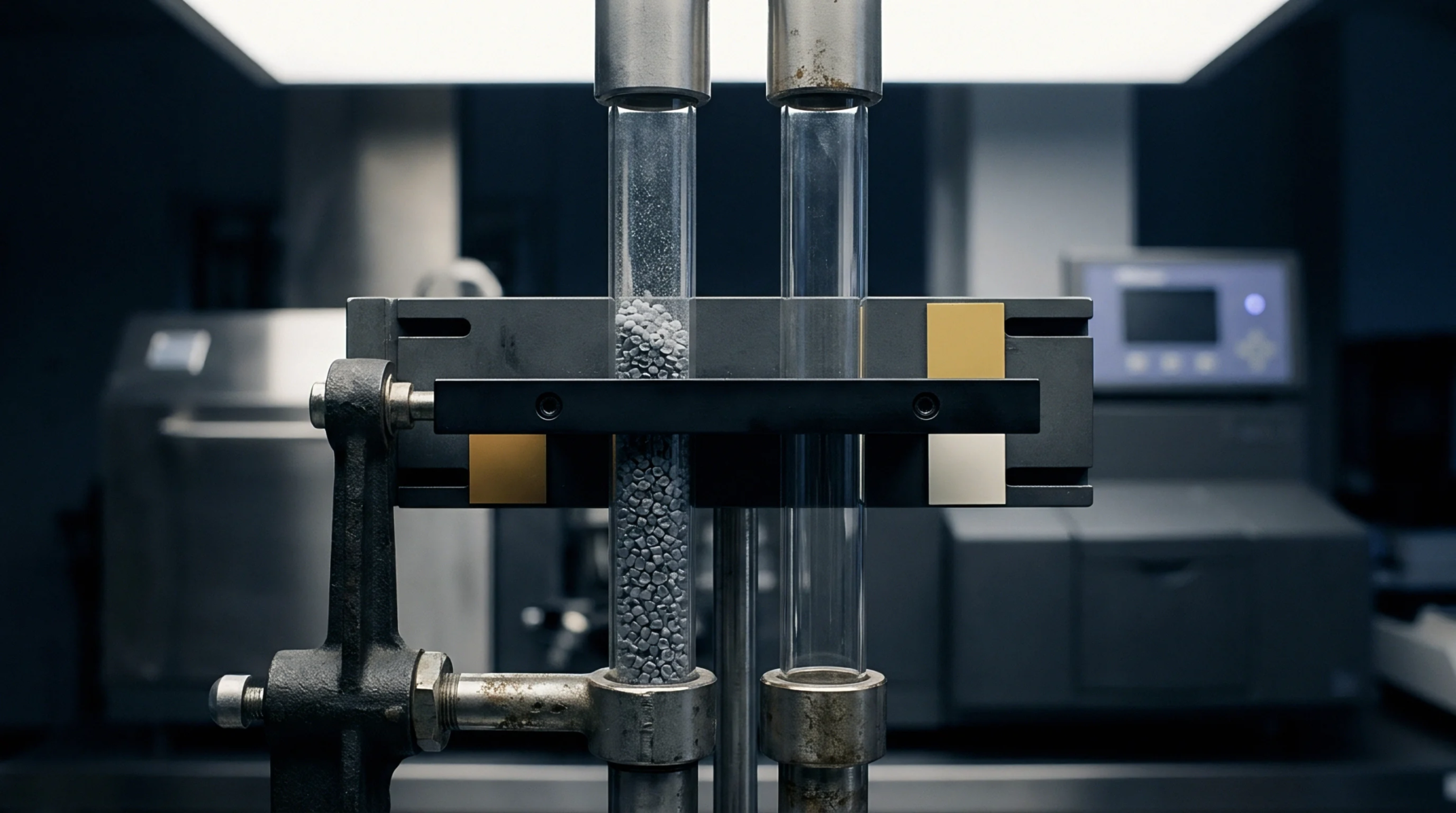
Mathematical description of reinforcement directionality maps local polymer morphology inside injection moulded parts through second order and fourth order components. A fiber orientation tensor quantifies how reinforced fillers align relative to principal part axes during the filling stage of polymer processing. Production engineers track this directional matrix to predict anisotropic mechanical behaviour and structural stiffness under load.
Unreinforced commodity resins lack the anisotropic reinforcement architecture that requires this mathematical descriptor.
Tensile Anisotropy
Polymer chains experience intense shear forces within narrow gating zones during high pressure injection moulding. Molten feedstock aligns glass or carbon fillers along principal flow paths, creating directional mechanical properties across the finished component. Virgin compounds maintain predictable filler distribution, whereas regrind batches contain broken filaments that alter local orientation patterns and reduce tensile strength.
Moulders establish target orientation values during tool qualification runs to prevent unexpected warping and structural failure.
Viscous Shear
High packing pressures alter core and skin layers differently within closed mould cavities. Fluid dynamics dictate parabolic velocity profiles that rotate suspended reinforcement particles away from cavity walls toward the central axis. Processing temperatures govern melt viscosity, directly influencing how freely fillers rotate before the polymer matrix freezes solid.
Operators adjust injection speed profiles to control internal shear rates and minimize localized weakness in structural ribs.
Defect Mechanics
Warpage and dimensional distortion develop when differential shrinkage rates mismatch across thin wall sections. Excessive fiber malalignment generates residual thermal stresses that pull moulded geometries out of tolerance during cooling cycles. Tooling engineers compensate for directional shrinkage by modifying gate locations and runner geometry prior to production scale manufacturing.
Datasheet values represent ideal laboratory conditions, whereas actual shop floor parts exhibit localized variations driven by thermal drift and fluctuating material viscosity.