Nonlinear Viscoelastic Relaxation and Anisotropic Fiber Modulus Drift in Free State Coordinate Metrology
Free state coordinate metrology requires gravity-compensated optical scanning after forty-eight hours of conditioned rest to isolate true viscoelastic warpage.

Datum
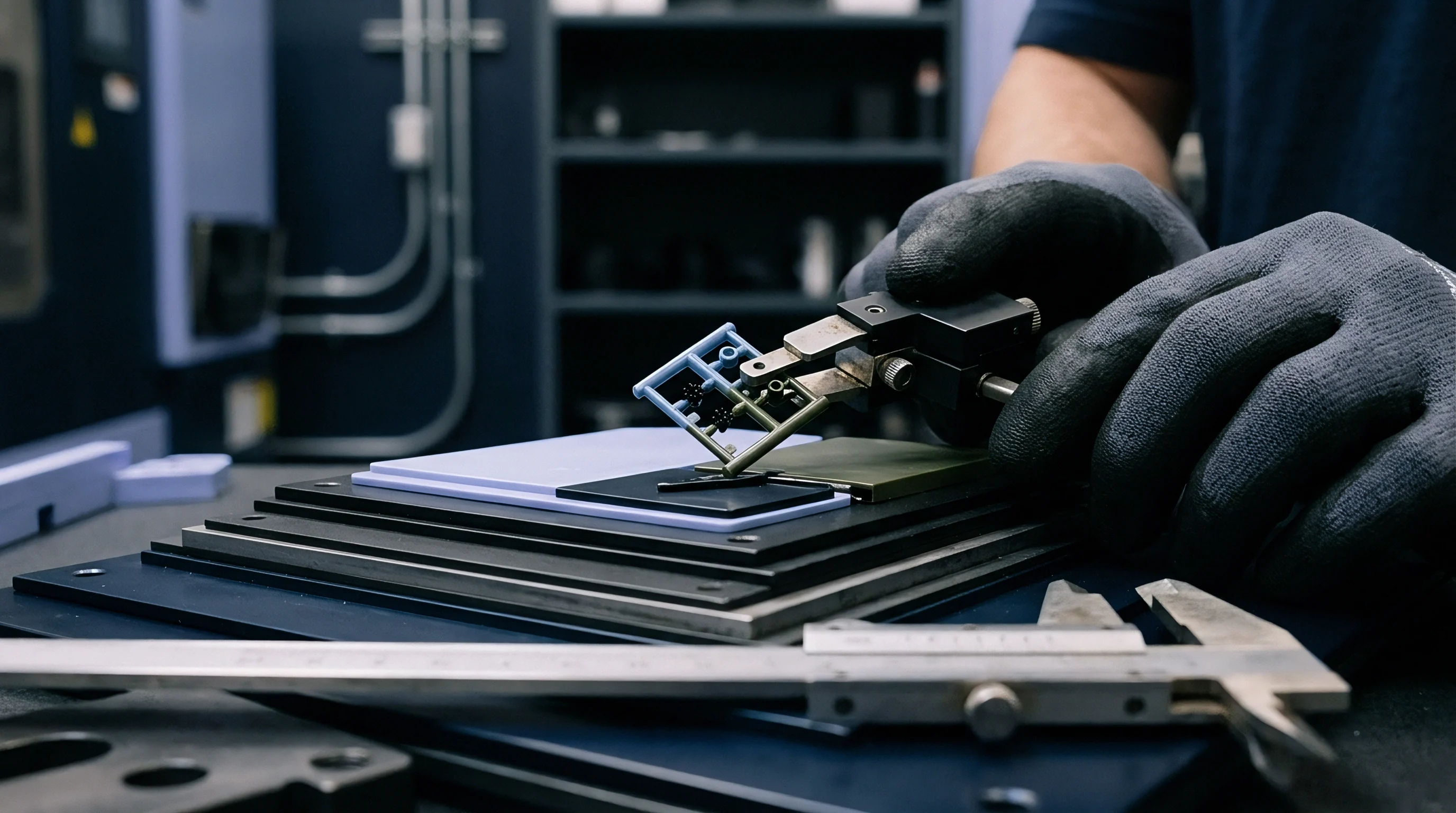
Coordinate measuring machines record spatial coordinates from parts resting unrestrained on three-point kinematic mounts, yet glass-filled semicrystalline polymers alter their resting geometry across seventy-two hours following ejection. Injection moulded structural brackets, electrical housings, and fluid manifolds reinforced with short glass or carbon fibers exit the tool with severe internal stress gradients. Toolroom technicians routinely mount these mouldings into rigid clamping fixtures to force compliance with nominal computer-aided design files, masking the physical equilibrium the component seeks when unconstrained.
ISO 10579 establishes the specification rules for flexible parts in the unrestrained condition, marked on drawings with the circled modifier F. Quality managers who omit this modifier allow suppliers to build over-constrained holding nests that press warped flanges flat against steel locating pads during touch-probe cycles.
Residual stresses originate from differential cooling between frozen exterior surfaces and hot molten cores. Core solidification occurs under diminishing packing pressures while gate freeze seals the runner system. When molders process polyamides, polybutylene terephthalate, or polyphenylene sulfide filled with 30 to 50 percent chopped strands, the problem compounds through fiber alignment.
Solidification freezes polymer chains in nonequilibrium conformations. Ejection into ambient factory air triggers immediate viscoelastic stress relaxation.
Holding nests that clamp distorted automotive flanges flat for tactile inspection generate zero-defect inspection certificates for components that bind during automated assembly.
The unconstrained moulding warps progressively as these frozen stresses relax. Coordinate points taken twelve minutes after mold opening diverge from inspection passes taken forty-eight hours later. Toolmakers cut core and cavity blocks to correct for calculated volumetric shrinkage, but unconstrained stress release rotates reference planes away from nominal vectors.
Steel changes become permanent mistakes.
Production facilities that establish baseline coordinate systems on unconditioned, freshly demolded moldings inevitably scrap expensive progressive tooling when downstream assemblies experience persistent alignment binding and warranty field rejections.

Orientation
Melt fronts entering cavity channels divide into distinct rheological strata governed by shear and extensional flow fields. Adjacent to chilled mold surfaces, fountain flow forces glass fibers into alignment parallel to the filling trajectory, creating a highly oriented skin. In the slower-cooling interior core, extensional divergence dissipates, permitting fibers to orient transverse to the flow or tumble into planar distributions.
This architecture yields pronounced directional anisotropy across every nominal wall section.
Why Do Fiber Fillers Invert Modulus across Orthotropic Axes?
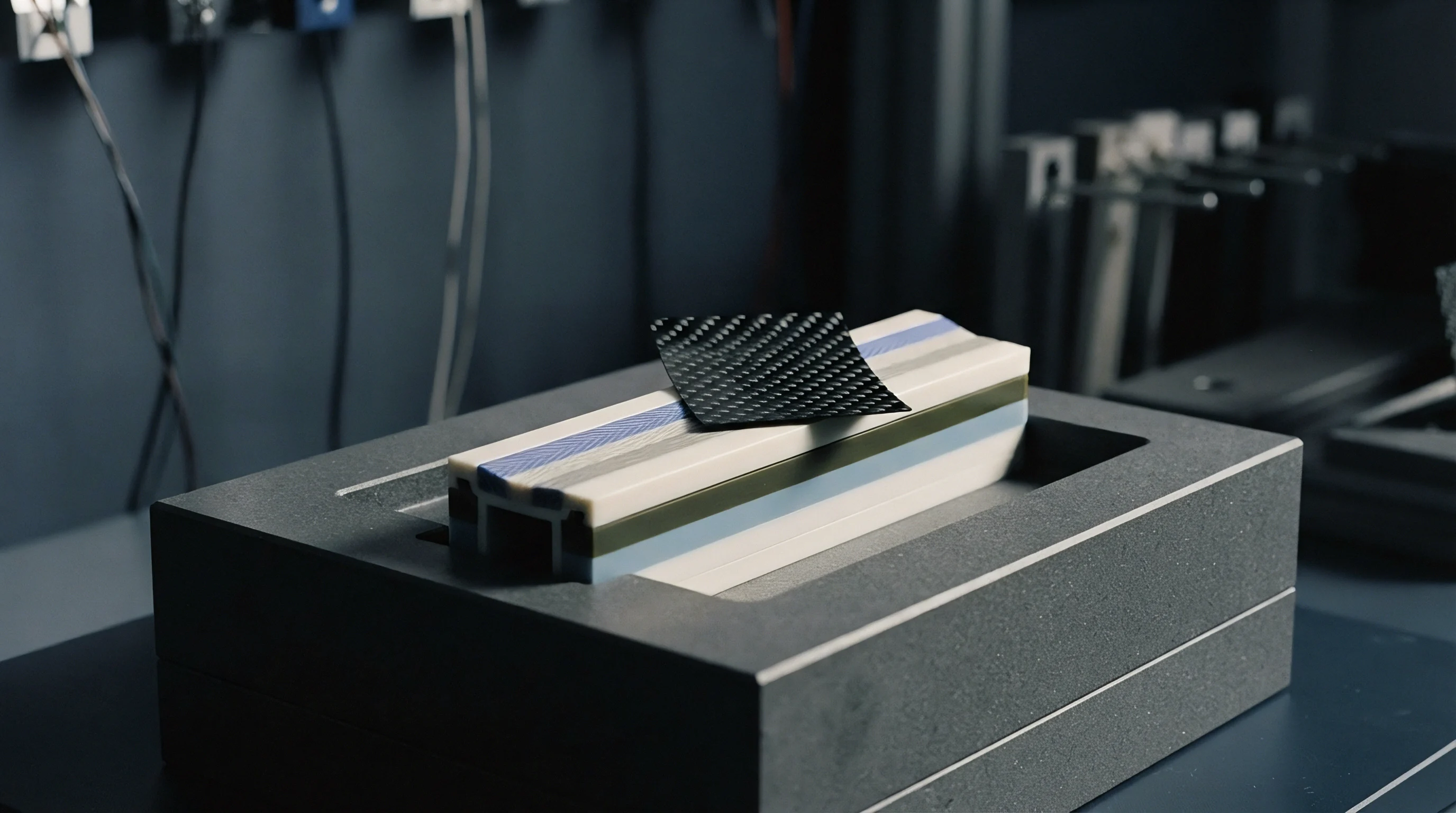
Extrusion compounders suspend rigid glass filaments within flexible aliphatic chains, creating heterogeneous composites where stiffness follows mechanical packing rather than uniform molecular resistance. Longitudinal tensile modulus parallel to flow in 30 percent glass-filled polyamide 66 reaches 8,800 megapascals, whereas transverse modulus measures approximately 5,100 megapascals under dry-as-molded conditions. Tensile modulus drops further as environmental moisture penetrates the matrix, lowering glass transition temperatures toward factory ambient baselines.
| Resin Grade | Fiber Weight Fraction | Flow Direction Modulus (MPa) | Cross Direction Modulus (MPa) | Anisotropy Ratio |
|---|---|---|---|---|
| PA66-GF30 Dry | 30 Percent | 8,850 | 5,120 | 1.73 |
| PA66-GF30 Conditioned | 30 Percent | 6,050 | 3,450 | 1.75 |
| PBT-GF30 | 30 Percent | 9,500 | 4,800 | 1.98 |
| PPS-GF40 | 40 Percent | 14,200 | 7,600 | 1.87 |
| PEEK-GF30 | 30 Percent | 11,400 | 6,200 | 1.84 |
Fiber alignment controls both initial stiffness and directional shrinkage. Along the flow path, fibers mechanically block polymer matrix contraction, limiting linear mold shrinkage to 0.2 percent. Across the flow path, resin contracts against minimal resistance, yielding shrinkage between 0.6 and 1.1 percent.
The resulting strain differential introduces bending moments that twist unconstrained features around thin web transitions. Viscoelastic relaxation uncoils these locked moments long after initial thermal cooling concludes.
Process technicians alter packing pressures, barrel temperatures, and injection velocities across shifts to chase dimensional targets. These machine adjustments redistribute the volumetric proportions of skin and core layers without changing the total part mass.
- Gate relocation alters fill patterns and shifts internal weld lines toward less rigid boss attachments.
- Packing pressure profiling modifies core fiber compression while generating asymmetric density gradients across rib foundations.
- Melt temperature increases reduce resin viscosity, which allows fibers to align closer to metal mold walls and sharpens the mechanical property differential across structural axes.
- Mold temperature differentials between cavity and core halves drive differential crystallization rates, producing uneven internal bending stresses that release when unconstrained parts sit in warehouse cartons.
Molding supervisors often insist that out-of-spec free state warpage stems entirely from raw material lot variance rather than non-uniform tool cooling and inconsistent packing cycle timing.
Bench
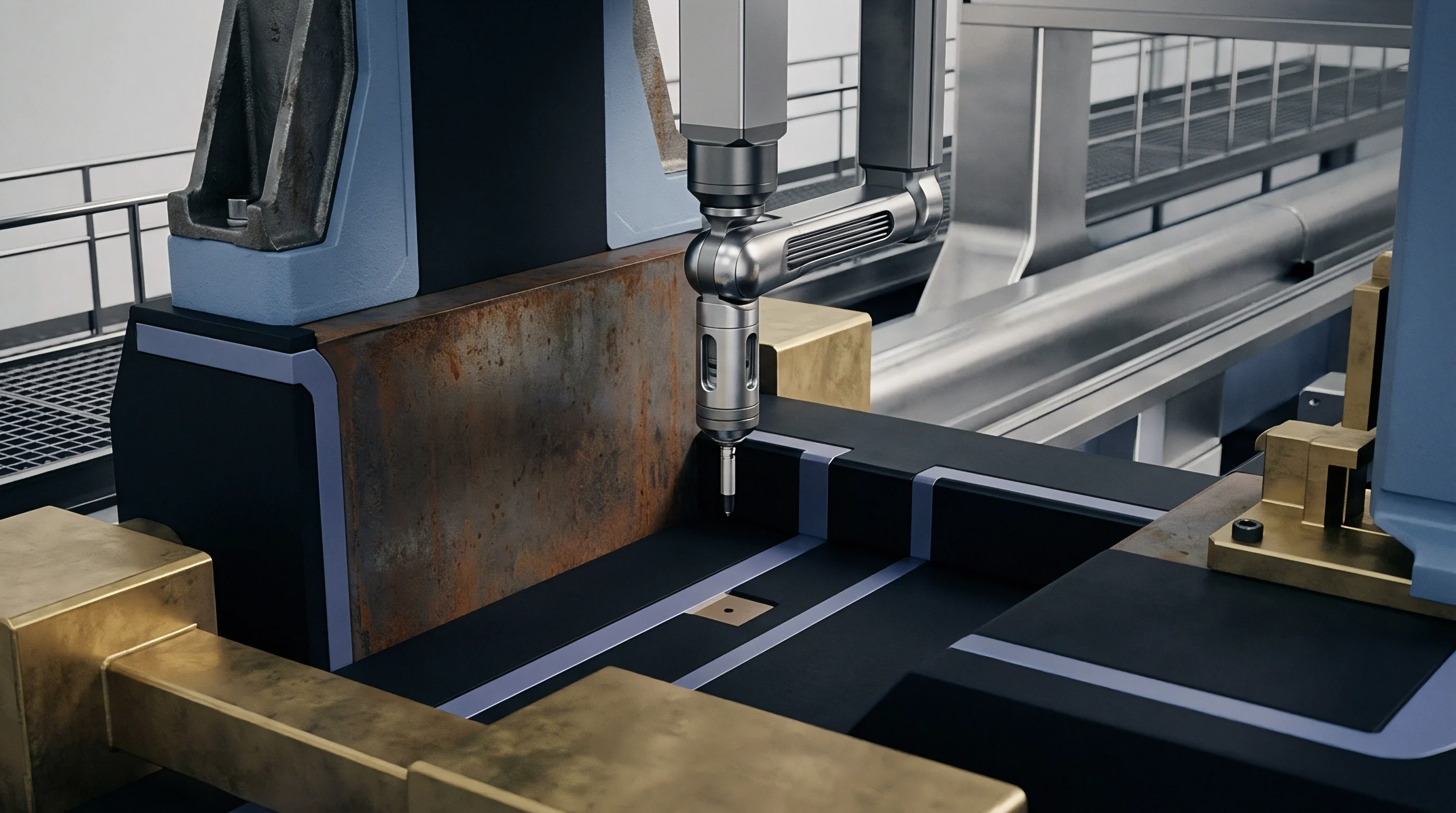
Measuring unrestrained parts requires rigorous physical isolation from gravity sag and clamping influence. Coordinate metrology benches using tactile triggers or structured blue-light optical sensors must isolate structural deformation caused by material relaxation from deflection caused by component self-weight. Thin-walled engineering moldings bend under their own gravitational load when rested on arbitrary datum surfaces, giving false out-of-tolerance readings.
| Uncertainty Parameter | Physical Root Cause | Magnitude Range (mm) | Mitigation Strategy |
|---|---|---|---|
| Gravitational Sag | Component self-weight flexure | 0.080 to 0.450 | Multiposition scanning with software inversion |
| Contact Probe Force | Tactile stylus elastic depression | 0.015 to 0.060 | Non-contact fringe projection optical heads |
| Thermal Expansion | Temperature variance away from 20C | 0.020 to 0.110 | Metrology chamber soaked for twenty-four hours |
| Moisture Uptake | Polyamide matrix plasticization | 0.040 to 0.320 | Sealed barrier pouching until target measurement window |
| Restraint Friction | Locating pin side-wall binding | 0.025 to 0.090 | Polished kinematic balls with PTFE seating nests |
| Data reflects typical uncertainty ranges for glass-reinforced automotive structural housings with wall spans between 150 mm and 450 mm. | |||
Metrologists resolve component self-weight by applying software-driven gravity compensation algorithms. The part rests on three spherical contacts in primary orientation, undergoes complete optical digitisation, flips one hundred eighty degrees onto opposing contact pads, and undergoes a second digitisation pass. Finite element models compute the gravity vector offset and cancel the gravitational sag from the raw point cloud.
This workflow isolates true frozen-in distortion from deadweight sag.
ISO 10579 permits free state inspection callouts only when drawings explicitly define allowable free state variation alongside restrained functional limits.
Clamping nests remain common because they simplify coordinate alignment. When contract drawings do not specify restraint parameters, metrology personnel default to clamping datum targets with toggle clamps, air pistons, or threaded bolts. Tightening fixtures introduces external strain energy.
Fasteners crush micro-ribs. Surface contact points deflect.
- Demold moldings onto flat, insulated conveyor tables without stacking to prevent thermal distortion from trapped heat.
- Transfer parts to climate-controlled staging areas maintained at twenty-three degrees Celsius and fifty percent relative humidity within thirty minutes of ejection.
- Permit components to stabilize unconstrained for forty-eight hours to allow initial high-rate viscoelastic strain relaxation to plateau.
- Place the component onto kinematic ball nests that contact designated datum targets without applying mechanical downward force.
- Capture complete surface point clouds using blue-light optical projection, maintaining sensor triangulation angles below forty-five degrees to reduce edge scatter.
- Align measured meshes to computer-aided design datums using minimum constrained least-squares fitting on primary, secondary, and tertiary functional features.
A part held flat in a heavy fixture proves only that steel forces plastic to conform to metal.
Recovery
Viscoelastic materials do not obey linear Hookean elasticity when internal frozen stresses exceed initial proportional limits. Polymer chains undergo non-affine displacements accompanied by local microstructural shifts around fiber interfaces. Linear viscoelastic approximations, such as the Boltzmann superposition principle, assume that compliance depends solely on elapsed time independent of stress amplitude.
In actual injection molded fiber-matrix topologies, high local stress concentrations around fiber tips drive nonlinear compliance governed by stress-dependent kernel functions.

What Triggers Nonlinear Stress Collapse during Unconstrained Aging?
Internal stresses concentrate at fiber terminations where stiffness jumps by an order of magnitude across the polymer interface. Localized shear stresses frequently exceed twenty-five megapascals even when average gross part stress remains low. These focal stresses accelerate localized creep compliance, initiating structural relaxation while nominal temperatures remain well below thermal distortion thresholds.
Unreinforced polymer resin demonstrates isotropic time-dependent relaxation, whereas fiber-filled matrices display directional relaxation rates governed by local fiber alignment tensors.
Nonlinear behavior matches Schapery representation formulations. Under these formulations, transient creep compliance incorporates stress-dependent scaling factors: parameter g1 accounts for nonlinear stress effects on elastic strain, g2 scales transient creep contributions, and a stress-shift factor accelerates internal material clocks. In a molding cooling from processing temperatures, internal stress states sit on the steep slope of this shifted timescale.
Relaxations that would normally require weeks under ambient low-stress states unfold across the initial twelve hours post-ejection.
Fiber modulus drift introduces an additional metrological complication. The effective load-bearing modulus along individual coordinate directions shifts as the surrounding matrix relaxes around stiff glass fibers. When the resin relaxes, shear transfer efficiency at fiber ends diminishes, reducing the apparent directional stiffness of the composite structure.
A component measured on day one demonstrates higher initial spring-rate resistance to handling forces than the same component inspected on day seven.
Moisture uptake directly superimposes onto this mechanical relaxation process. Polyamides absorb atmospheric water molecules, which sever hydrogen bonds between polymer chains. This water acts as an internal plasticizer.
Glass transition temperatures drop from seventy degrees Celsius to beneath room temperature. The unconstrained part accelerates its approach to mechanical equilibrium, shifting its dimensional profile outward along weak orthotropic axes.
Whether numerical simulation models can ever fully predict the precise spatial geometry of an unconstrained glass-filled molding without measuring actual shot samples across ambient humidity shifts remains an open industrial debate.
Arbitration
Commercial contracts routinely break down over discrepancies between toolmaker CMM reports and incoming inspection passes at the customer plant. Toolmakers measure fresh parts twenty minutes after press ejection using dedicated holding fixtures to meet delivery deadlines. Receiving docks set parts on granite tables forty-eight hours later, apply touch probes in unconstrained states, and flag extensive dimensional non-conformance.
Both parties hold certified metrology dossiers, yet their numbers diverge by full millimeters.
| Dispute Parameter | Toolmaker Stance | Purchaser Stance | Governing Standard Or Contract Mechanism |
|---|---|---|---|
| Free State Warpage | Restrained fixture compliance proves steel accuracy | Free state distortion creates downstream assembly jams | ISO 10579 drawing callout with circled F modifier |
| Measurement Timing | First-article inspection immediately post-mold | Inspection upon arrival after seventy-two-hour soak | DIN 16742 conditioning protocol clause 5.2 |
| Moisture Content | Parts inspected dry as molded | Parts inspected at equilibrium ambient humidity | ISO 1110 accelerated conditioning specification |
| Datum Clamping Force | Clamping permitted to overcome shipping twist | Zero clamping force allowed on functional datums | ASME Y14.5M nonrigid part definition |
Resolving these disputes requires moving beyond subjective manufacturing opinions. Drawings must explicitly declare whether dimensions apply in restrained or free state conditions. DIN 16742 provides clear tolerance groups for injection molded polymers, classifying dimensions into tool-specific dimensions, which cross no parting lines, and non-tool-specific dimensions, which cross slides, split lines, or unconstrained warpage spans.
Non-tool-specific tolerances demand wider acceptance bands to account for viscoelastic movement.
Tool buyers must write stabilization periods directly into procurement purchase agreements. Specifications must define ambient temperature, relative humidity, support point coordinates, and the exact hour window for coordinate acquisition. Specifying an inspection window of forty-eight to ninety-six hours post-molding provides sufficient time for primary viscoelastic relaxations to settle while avoiding endless drift from seasonal humidity swings.
Purchase contracts that incorporate DIN 16742 clause 5.2 bind both parties to measure dimensions only after molded parts achieve thermal and moisture equilibrium at twenty-three degrees Celsius and fifty percent relative humidity, eliminating unconditioned dockside rejections entirely.