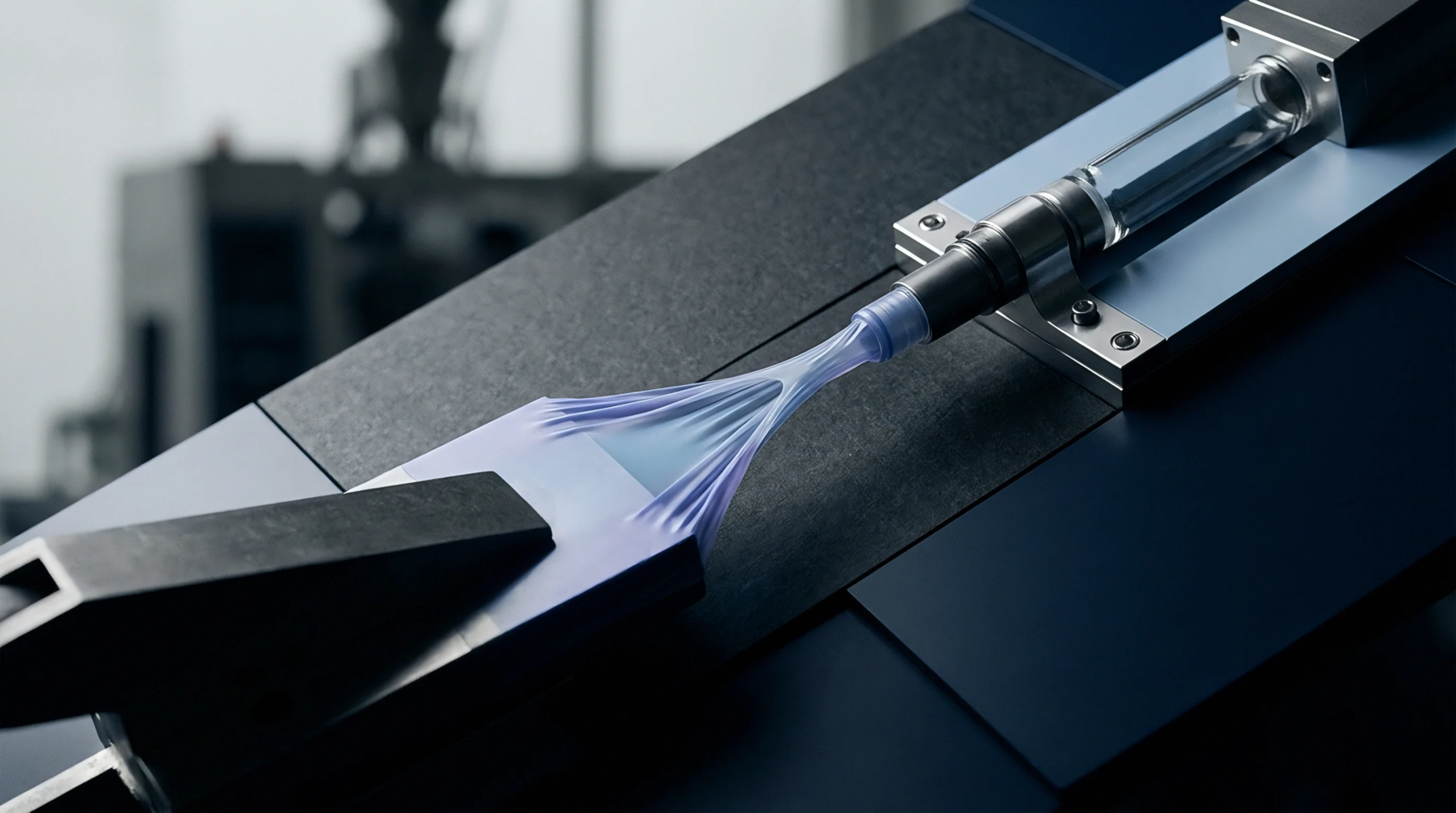
Transient Entanglement Disentanglement Kinetics in Deep Draw Thermoforming under Multiaxial Strain Gradients
Matching plug speed to polymer disentanglement kinetics prevents corner thinning and optimizes wall thickness in deep draw thermoforming.
Matching plug speed to polymer disentanglement kinetics prevents corner thinning and optimizes wall thickness in deep draw thermoforming.

Strain hardening rheology metrics define thermoforming process windows by predicting extensional melt strength to eliminate corner thinning and sheet sag.
Trimming blow moulded bottle weight reduces unit resin costs but narrows drop test safety margins along bottom pinch seams and heel radii.
Accurate non isothermal tube characterization reduces thermoforming wall variance to under six percent at hundred hertz stretch rates.

Deriving Ogden constitutive parameters pairs non-linear biaxial stretch data with Drucker stability constraints to ensure reliable finite element simulations.
Predicting adiabatic shear banding during high-velocity preform inflation requires coupled thermomechanical models evaluating strain hardening against rate-dependent thermal dissipation.
Polypropylene impact copolymers containing disperse ethylene propylene rubber phases maintain cold drop impact strength down to minus 40 degrees Celsius where homopolymers shatter.
Quantifying non-isothermal entanglement slip rates prevents localized wall thinning and thermal rupture during rapid plug assisted thermoforming pre stretch.

Biaxial stretch testing above glass transition yields multiaxial strain hardening data essential for accurate finite element wall thickness prediction in amorphous polymer thermoforming.
Expertise is a utility, not a secret. sentiention™ publishes its working knowledge as open reference: intelligence layer covering the materials it sources, the markets it enters, and the reference that serves both.