Integrating Tube Constitutive Models into High Speed Plug Assisted Thermoforming Simulations
Integrating tube models into explicit thermoforming solvers accurately captures high-rate extensional hardening, preventing expensive tool recuts and scrap.

Sheet
Extruded polypropylene rollstock entering a rotary thermoforming line at twenty cycles per minute carries a frozen thermal and molecular history that defeats simplistic hyperelastic approximations. When an operator indexes the extruded web into the radiant oven bank, quartz heaters raise the exterior face to one hundred sixty-five degrees Celsius while the core remains eight degrees cooler. That thermal gradient interacts directly with the molecular weight distribution of the resin.
Standard Mooney-Rivlin or Ogden material formulations assume instantaneous elastic recovery and rate-independent stress responses. At forming velocities where mechanical plugs plunge into polymer at speeds between eight hundred and fifteen hundred millimeters per second, true local strain rates exceed twenty-five reciprocal seconds. Under these conditions, real polymer chains do not merely deform like rubber bands; they disentangle, stretch, align, and relax along distinct time constants governed by reptation mechanics.
Melt memory dictates the stretch.
Ignoring the time-dependent relaxation spectra of molten polypropylene causes finite element models to predict uniform sidewall distribution when physical press trials deliver localized thinning bands near the container bottom corner. In a high-speed packaging application producing a deep-draw barrier cup with a draw ratio of 2.4:1, standard elastic simulations estimate a minimum corner wall of 0.38 millimeters. The actual moulded part produced on an Illig or Kiefel thermoformer running at thirty-five cycles per minute drops to 0.19 millimeters, falling below oxygen-barrier transmission thresholds.
A tool designed against the uncorrected model produces scrap on day one.
A temperature divergence of four degrees Celsius across a 1.4-millimeter polypropylene sheet alters peak drawing stress by twenty-eight percent at fifteen reciprocal seconds.
Biaxial strain rates reach fifteen reciprocal seconds.
Accurate process simulation demands capturing both the non-isothermal thermal distribution across the sheet thickness and the non-linear viscoelastic response under combined shear and extensional deformation. Toolmakers frequently attempt to salvage out-of-specification parts by altering the mechanical plug geometry or re-machining the cavity aluminium, incurring tooling modifications between twelve thousand and twenty-eight thousand dollars per cavity block. Correct numerical simulation establishes the required initial sheet gauge, the precise pre-stretch displacement profile, and the cycle-limiting chill time before steel cutting begins.
Omitting the strain-hardening response of the entangled molecular network forfeits tool approval, forcing expensive mould recuts and delaying production launch schedules.
Reptation
Polymer chains in a concentrated molten web move within virtual constraints imposed by neighboring macromolecules, a topological confinement defined in Edwards tube theory. In a molten thermoplastic polyolefin above its melting point, individual macromolecules cannot cross one another. Thermal Brownian motion forces each chain to slither back and forth along its own contour length inside a snake-like tube.
Two fundamental timescales govern this molecular architecture: the Rouse relaxation time, characterizing the equilibration of chain segments between entanglement points, and the reptation or disengagement time, characterizing the complete escape of the macromolecule from its original tube.
Orientation hardens the polymer chains.
Why Do Entanglement Relaxations Diverge in Biaxial Extension?
Deformation modes encountered during thermoforming subject the polymer network to rapid planar and equibiaxial stretching rather than simple shear. In simple shear flows, chains rotate and tumble, mitigating excessive stretch. In planar and biaxial extension, such as the deformation occurring as the sheet balloons into the female mould cavity under thirty pounds per square inch of differential pneumatic pressure, the macroscopic flow continuously stretches the tube diameter and tube contour.
Tube models accommodate this physics through specific internal state variables: the orientation tensor representing the alignment of tube segments, and a scalar stretch parameter tracking the relative elongation of the polymer backbone.
The Rolie-Poly constitutive model, developed as a single-mode or multi-mode differential simplification of the Graham-Likhtman-Milner-McLeish theory, provides a computationally viable framework for finite element implementation. The constitutive equation governs the evolution of the tube orientation and stretch tensor through three distinct mechanisms: affinely driven deformation from macroscopic velocity gradients, Rouse-like stretch relaxation driven by monomeric tension, and reptation-driven orientation relaxation accompanied by convective constraint release. Convective constraint release accounts for the loss of topological entanglements when neighboring chains retract rapidly past one another, preventing the unphysical over-prediction of extensional stress that plagues earlier Doi-Edwards formulations.
| Constitutive Formulation | Strain Rate Sensitivity | Extensional Hardening Accuracy | CPU Cost Per Element | Convergence Stability Index |
|---|---|---|---|---|
| Ogden Hyperelastic | Uncoupled (Static) | Poor (Overpredicts at large strains) | 1.0x (Baseline) | High |
| K-BKZ Integral Viscoelastic | Coupled (Fading Memory) | Moderate (Requires damping function) | 14.8x | Low |
| Giesekus Differential | Coupled (Mobility Factor) | Poor (Planar extension saturates) | 2.1x | Moderate |
| Rolie-Poly Single Mode | Coupled (Rouse + Reptation) | High (Captures chain stretch onset) | 3.4x | Moderate |
| Rolie-Poly Multi-Mode (8 Modes) | Fully Coupled Spectrum | Excellent (Within 6% across three decades) | 8.7x | High |
Equation parameters require biaxial extension data.
Fitting a multi-mode Rolie-Poly model requires characterized rheological data spanning both small-amplitude oscillatory shear and non-linear extensional tests. Oscillatory shear conducted on an Anton Paar or TA Instruments rotational rheometer between 0.01 and 100 radians per second yields the linear relaxation spectrum, defining the plateau modulus and the distribution of disengagement times across eight discrete Maxwell modes. Fitting the non-linear chain stretch parameters requires transient extensional viscosity curves obtained on a Sentmanat Extensional Rheometer fixture at strain rates matching press speeds, specifically one, five, and twenty-five reciprocal seconds.
Single-mode formulations collapse these dynamics into an averaged relaxation time, missing the early-stage strain hardening produced by high-molecular-weight tails in bimodal blow-moulding and thermoforming grades.
A five-mode relaxation spectrum calibrated without transient biaxial data underpredicts peak drawing force by forty-two percent at fifteen reciprocal seconds.
Commercial parameter identification introduces uncertainty when characterization facilities lack true equibiaxial extensional rheometers. Tensile stretch data gathered from uniaxial test benches underpredicts the planar extensional hardening modulus observed when molten polymer wraps around the spherical radius of a moving plug. Engineers bridge this characterization gap by applying an empirical affine scaling factor between uniaxial and equibiaxial extension, but the exact shift factor remains debated across academic rheology laboratories and resin manufacturer technical service departments.

Plug
Mechanical assistance controls initial material distribution before air pressure drives the web against the female cavity surfaces. Syntactic foam plugs fabricated from glass micro-balloons suspended in an epoxy resin matrix, such as HYTAC-W or syntactic polyimide grades, demonstrate thermal conductivities below 0.15 Watts per meter-Kelvin. Polished aluminium plugs convey heat away at over one hundred thirty Watts per meter-Kelvin.
When high-conductivity aluminium contacts 160-degree polypropylene, the interface cools rapidly below the polymer crystallization window, freezing the sheet against the plug face and preventing material from drawing into the lower container sidewalls.
Syntactic foam lowers local thermal draw.
Plug speed exceeds one meter per second.
Contact friction between the plug surface and the ductile polymer sheet governs how much resin slips down into the container corners. If the coefficient of static friction exceeds 0.45, the sheet adheres to the plug nose. The entire deformation burden transfers to the unsupported web between the plug edge and the clamp frame, producing severe sidewall gouging.
Conversely, a lubricated or PTFE-impregnated plug with a friction coefficient below 0.10 allows excessive sheet slippage, resulting in heavy base pooling and ultra-thin upper sidewalls that buckle under top-load testing.
Friction coefficients double past glass transition.
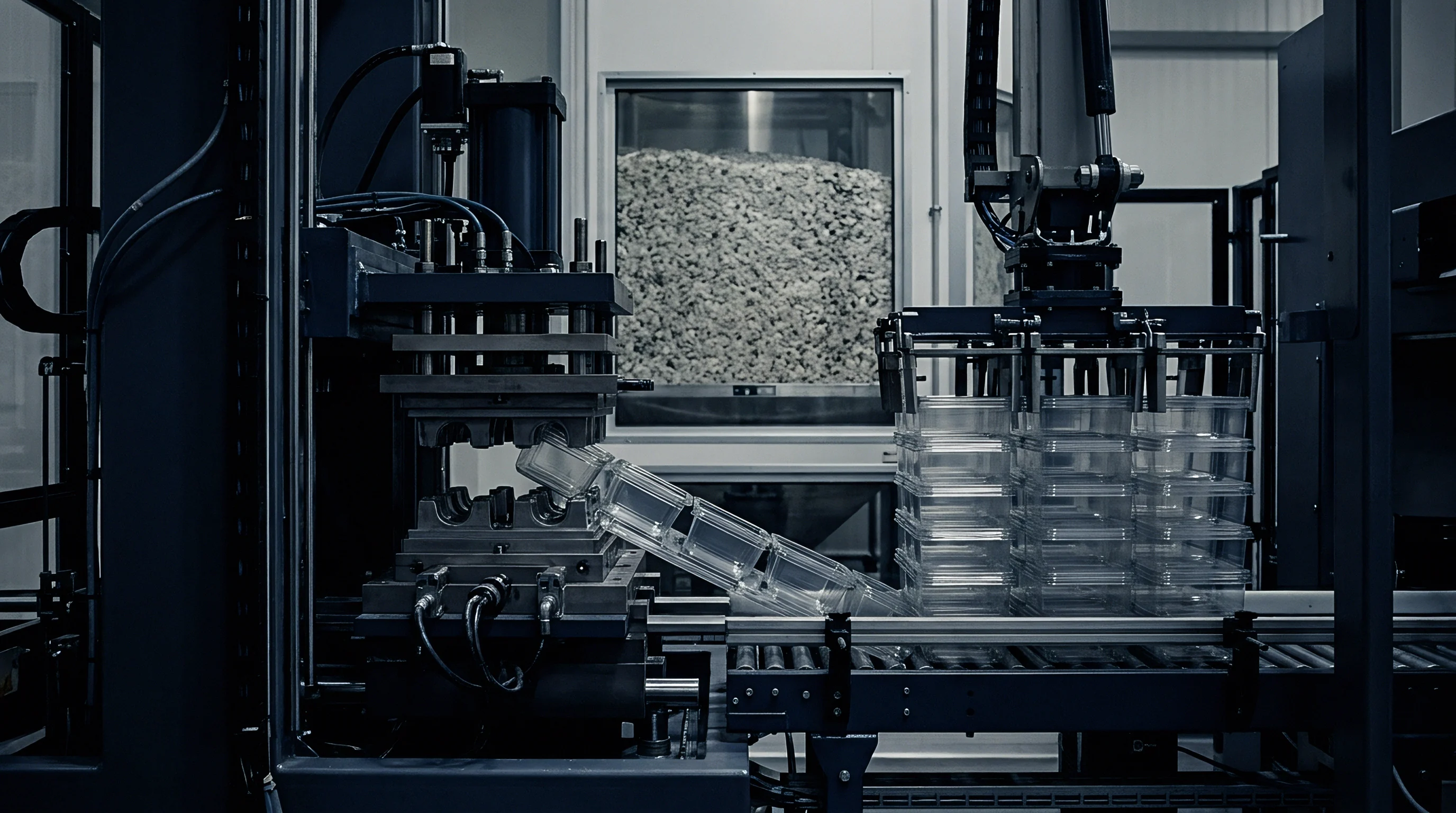
The operational sequence of mechanical plug assist involves tightly synchronized stages across fractions of a second:
- Initial Web Engagement occurs when the plug impacts the pre-heated sheet at nine hundred millimeters per second, inducing instantaneous compressive and flexural stress fields across the sheet thickness.
- Transient Plug Penetration advances the plug downward through eighty percent of the cavity depth, causing shear slip along the plug flanks and extensional thinning across the unsupported web spans.
- Pneumatic Blow Initiation triggers when pressure sensors confirm plug stroke completion, injecting five bar of compressed air to peel the polymer away from the plug surface and drive it onto water-cooled aluminium walls.
- Plug Retraction Velocity accelerates the assist tool upward at up to two meters per second to avoid contacting expanding bubbles, preventing vacuum collapse before final boundary freezing.
Tooling vendors often claim that altering plug surface roughness from Ra 1.6 to Ra 0.4 micrometers eliminates the requirement for viscoelastic material modeling by stabilizing sheet slippage across varying sheet lots.
Solver
Translating differential tube formulations into commercial explicit and implicit finite element codes presents substantial numerical hurdles. In explicit dynamic solvers like LS-DYNA or Abaqus Explicit, incorporating a non-linear viscoelastic user material subroutine requires updating the conformation tensor at every single time increment. The Weissenberg number, defined as the product of the characteristic polymer relaxation time and the macroscopic deformation rate, frequently exceeds fifty in the localized pinch zones between the plug radius and the mould cavity clamp ring.
At these elevated values, standard displacement-based finite element formulations suffer from numerical instabilities, artificial mesh entanglement, and catastrophic time-step collapse.
Explicit integration bypasses matrix inversion stalls.

Should Explicit Solvers Enforce Tube Stretch Limits?
Implicit solvers balance residual forces via Newton-Raphson iterations, solving the global stiffness matrix directly. When polymer chains approach their finite extensibility limit, represented by the ratio of maximum contour length to equilibrium contour length, the tangent modulus stiffens asymptotically. This sharp non-linearity causes the Newton-Raphson iteration loop to oscillate endlessly, demanding severe time-step cuts that stall simulations.
Explicit solvers circumvent global stiffness matrix inversions by integrating equations of motion directly through central difference schemes. However, explicit schemes remain conditionally stable. The stable time increment depends on the dilatational wave speed through the soft polymer elements, calculated from the element characteristic length divided by the acoustic sound speed.
During plug impact, element distortion reduces characteristic lengths down to fractions of a micrometer, forcing stable time increments below ten nanoseconds. Artificial damping mechanisms and mass scaling must be applied judiciously. Artificially increasing material density by a factor of ten thousand to inflate the stable time step introduces unphysical inertial forces, creating artificial shock waves that ripple through the soft sheet and corrupt the calculated stress fields.
Kinetic energy in a valid high-speed thermoforming simulation must remain below five percent of total internal strain energy throughout the forming stroke.
Consider a representative commercial packaging simulation involving a deep-draw polypropylene drink cup formed at thirty cycles per minute. The operational scenario involves a multi-cavity tool producing fifty thousand units per shift. The sheet material is a 1.2-millimeter homopolymer polypropylene sheet with a density of 905 kilograms per cubic meter, heated to a core temperature of 158 degrees Celsius and a surface temperature of 163 degrees Celsius.
The forming tool possesses a cavity depth of 120 millimeters, a top aperture diameter of 80 millimeters, and a base diameter of 55 millimeters, driven by a syntactic foam plug moving at 1100 millimeters per second.
| Mass Scaling Factor | Stable Time Step | Total CPU Time | Kinetic to Internal Energy Ratio | Predicted Bottom Corner Gauge |
|---|---|---|---|---|
| 1.0 (No Scaling) | 1.2 x 10^-8 s | 94.2 hours | 0.8% | 0.211 mm |
| 10.0 | 3.8 x 10^-8 s | 29.8 hours | 1.9% | 0.209 mm |
| 100.0 | 1.2 x 10^-7 s | 9.5 hours | 4.4% | 0.204 mm |
| 1,000.0 | 3.8 x 10^-7 s | 3.1 hours | 14.8% | 0.162 mm |
| 10,000.0 | 1.2 x 10^-6 s | 1.0 hours | 38.2% | 0.118 mm |
| Conditions: Axisymmetric 4-node reduced integration shell elements; sheet initial gauge 1.2 mm; plug velocity 1.1 m/s; mass scaling threshold set to avoid inertial distortion. | ||||
Sheet sag alters contact timing.
The data demonstrates that setting mass scaling to one thousand times accelerates computational execution to three hours, but the resulting fictitious inertia thins the calculated corner thickness to 0.162 millimeters, a twenty-three percent deviation from the unscaled baseline of 0.211 millimeters. An engineering team evaluating this simulation would incorrectly conclude that the sheet stock is insufficient, recommending an unneeded shift to a 1.4-millimeter initial sheet gauge. In high-volume packaging converting ten million pounds of resin annually, adding 0.2 millimeters of unnecessary sheet gauge inflates raw material costs by over four hundred thousand dollars across a single tooling program.
Similar computational mechanics govern the rapid expansion of naval acoustic damping tiles and explosive blast containment bladders, where elastomeric polyurea coatings experience strain rates exceeding one thousand reciprocal seconds under sudden hydrodynamic loading. In those applications as in thermoforming, ignoring the finite extensibility limits of the entangled macromolecular chains produces erroneous stress concentrations and falsely predicts premature material rupture.
Tool steel draws heat instantly.
Contact algorithms present the second significant numerical obstacle. Standard node-to-surface penalty formulations frequently permit soft polymer shell nodes to penetrate the rigid elements of the plug or mould corner during high-velocity contact transitions. Implementing segment-based contact algorithms with viscous damping dissipates localized contact chatter.
The friction formulation requires temperature-dependent Coulomb coefficients that switch smoothly between static sticking behavior when the polymer drops below its crystallization point and dynamic sliding behavior when the polymer remains molten above 155 degrees Celsius.
Mesh distortion in Lagrangian formulations necessitates continuous adaptive remeshing. As the plug stretches the initial flat element grid into deep vertical draws, aspect ratios degrade from 1:1 up to 25:1. Severe aspect ratio degradation induces shear locking in solid elements and hour-glassing in reduced-integration shell elements.
Arbitrary Lagrangian-Eulerian formulations allow the computational grid to move independently of material points, smoothing the mesh distortion while preserving accurate material boundaries and non-linear tube orientation tensor histories.
A simulation showing kinetic energy surging past internal strain energy during plug motion represents numerical noise rather than physical deformation.
Thickness
Final part dimensions, barrier performance, and structural crush resistance depend entirely on the final cross-sectional material distribution achieved across the container geometry. Packaging engineers inspect thermoformed containers by sectioning samples along the primary axis of symmetry and measuring wall profiles with magnetic Hall-effect thickness gauges or optical comparators at five-millimeter vertical intervals. In barrier food packaging utilizing coextruded polypropylene, ethylene vinyl alcohol, and polypropylene multilayer structures, maintaining minimum continuous EVOH thickness prevents premature product oxidation and shelf-life failure.
Stretching thins the bottom corners.
Yield occurs before complete plug descent.
When tube constitutive models are integrated correctly within the finite element solver, the simulation accurately captures the non-uniform drawing dynamics of the multilayer sandwich. EVOH possesses a substantially higher glass transition temperature and lower rupture elongation than polypropylene. As the mechanical plug draws the sandwich down, the stiffer internal barrier core undergoes necking if local strain rates generate extensional stresses exceeding its yield limit.
Multi-mode Rolie-Poly simulations capture the exact onset of localized thinning bands, enabling tool designers to optimize the plug nose radius and corner transitions before cutting production cavities.
Pre-stretch redistributes the thickest polymer stock.
Tool trials validate simulation precision through strict statistical capability evaluations. Process engineers run twenty consecutive thermoforming cycles under locked temperature, plug speed, and vacuum timing parameters, measuring twelve critical dimensions per container across all mould cavities. Achieving a process capability index greater than 1.67 on critical corner wall thicknesses confirms that the combined effect of sheet thermal variation, machine indexing jitter, and plug assist friction resides within acceptable commercial tolerances.
- Flange Width Stability depends on the mechanical clamping frame grip pressure and sheet indexing accuracy, maintaining flange dimensions within plus or minus 0.15 millimeters under DIN 16742 tolerance group TG6.
- Sidewall Taper Uniformity dictates denesting performance on automated filling lines, requiring wall thickness variation along vertical profiles to remain within eight percent of nominal drawing specifications.
- Base Corner Radius Gauge represents the thinnest structural region of the formed cup, where minimum allowable wall thickness must not drop below 0.20 millimeters to sustain top-load pallet stacking weights.
- Trim Line Register ensures punch tools shear clean perimeter cuts relative to the container draw axis, avoiding irregular edge burrs that jam downstream packaging heat-sealing stations.
Cooling locks in residual stresses.
DIN 16742 clause 5.2 establishes that dimensional tolerances for thermoformed plastic parts apply only after internal cooling stresses have relaxed at standard laboratory temperatures for twenty-four hours, shifting final acceptance inspections from press-side ejector stations to climate-controlled metrology benches.