Correlating Melt Flow Rate to Intrinsic Viscosity Loss in Reactive Extrusion Processing
Melt flow rate increases nonlinearly as intrinsic viscosity drops; establishing zero-shear viscosity calibrations converts high-shear extrusion data reliably.


Mechanics
Polymer backbone degradation during continuous extrusion processes alters the relationship between solution-based molecular measurements and melt rheology. Chain scission alters physical behavior. In reactive extrusion operations, such as the controlled visbreaking of polypropylene using organic peroxides or the thermal-hydrolytic degradation of polyethylene terephthalate, polymer chains cleavage reduces the weight-average molecular weight (Mw).
This molecular weight drop reduces entanglements in the liquid state, causing a sharp drop in zero-shear melt viscosity (η0). Intrinsic viscosity ( ) serves as a direct thermodynamic measure of a polymer chain’s hydrodynamic volume in a dilute solution, remaining largely independent of shear stress. High-shear extrusion flow through an orifice or capillary die reflects bulk non-Newtonian flow behavior, where shear thinning masks subtle changes in molecular structure.
The fundamental divergence between melt flow rate (MFR) and intrinsic viscosity (IV) stems from the shear rate experienced during measurement. Melt viscosity drops rapidly. Standard melt index testing subjects the polymer melt to non-zero shear stresses, driving polymer chains into aligned, non-entangled configurations.
Solution viscometry evaluates isolated, unentangled polymer coils resting in a solvent at zero shear stress. When chemical additives like peroxides, chain extenders, or moisture promote chain scission or branching inside an extruder barrel, the polydispersity index (PDI = Mw / Mn) shifts dynamically. A narrowing of the molecular weight distribution increases the melt flow rate at a faster rate than the corresponding drop in intrinsic viscosity because high-molecular-weight tails dominate zero-shear viscosity and non-Newtonian shear responses differently.
Condensation polymers like polyethylene terephthalate (PET) and polyamide 66 (PA66) undergo reversible equilibrium reactions during thermal processing. Water present in concentrations above fifty parts per million cleaves ester or amide linkages at processing temperatures above 270 °C. Hydrolytic degradation reduces intrinsic viscosity while exponentially increasing melt flow. In polyolefins like polypropylene, free radicals generated by organic peroxides attack tertiary carbon atoms, triggering beta-scission.
This systematic cleavage shortens long polymer chains, narrowing the molecular weight distribution. Understanding the chemical mechanism driving molecular weight loss allows engineers to determine whether single-point melt flow index values can reliably replace labor-intensive solution viscometry for inline quality control.
Higher melt temperatures compress the relaxation spectrum, rendering uncorrected capillary flow figures artificially high compared to actual solution chain length measurements.
Equations
Linking volumetric melt discharge rates to solution viscometry requires transforming single-point shear measurements into zero-shear viscosity estimates. Intrinsic viscosity correlates with weight-average molecular weight through the empirical Mark-Houwink-Sakurada relationship, expressed as:
= K · Mva
The constants K and a depend strictly on the polymer type, solvent system, and testing temperature. The mark-houwink exponent a typically ranges between 0.5 for theta solvents and 0.8 for good solvents. Molecular weight relates directly to zero-shear viscosity (η0) through the classical Berry and Fox-Flory power law for entangled polymer melts above the critical entanglement molecular weight (Mc):
η0 = Kb · Mw3.4
Because melt flow rate measures mass flow through a specified die under a fixed weight load, it provides an inverse index of melt viscosity at a specific shear stress. Capillary shear induces thinning. Standard melt flow index equipment operates under non-Newtonian shear conditions where the apparent shear rate varies continuously.
Converting standard melt flow rate measurements into intrinsic viscosity requires correcting for non-Newtonian behavior using power-law fluid mechanics or the Carreau-Yasuda model:
η(γ) = η0 left fracn-1a
Here, λ represents the relaxation time parameter, n is the power-law index describing shear thinning, and a controls the transition zone between Newtonian and shear-thinning regions. By measuring the shear rate at the wall of a melt index die, processing engineers establish direct mathematical transformations between MFR and zero-shear viscosity, enabling accurate conversion to intrinsic viscosity values.
Capillary Shear Corrections
Determining absolute viscosity from standard melt flow barrels requires applying the Rabinowitsch correction factor to account for non-parabolic velocity profiles inside the capillary die. Standard melt index dies feature an internal diameter of 2.095 mm and a length of 8.000 mm, yielding an aspect ratio (L/D) of roughly 3.82. This short die length generates significant entrance and exit pressure losses, known as Bagley end effects.
Uncorrected melt flow figures overstate apparent shear rate and understate true melt viscosity. To build precise correlations with intrinsic viscosity, compounders run multi-length capillary die measurements or establish empirical conversion polynomials calibrated against reference lots.
| Polymer Matrix | MFR Condition (ISO 1133) | Capillary Shear Rate (s⁻¹) | Solvent System (ISO 1628) | Mark-Houwink K (mL/g) | Mark-Houwink exponent (a) |
|---|---|---|---|---|---|
| Polyethylene Terephthalate (PET) | 275 °C / 2.16 kg | 15 to 45 | Phenol / 1,2-Dichlorobenzene (50/50) | 0.0210 | 0.82 |
| Polypropylene Homopolymer (PP) | 230 °C / 2.16 kg | 20 to 80 | Decahydronaphthalene (135 °C) | 0.0190 | 0.74 |
| Polyamide 66 (PA66) | 275 °C / 0.325 kg | 10 to 30 | 96% Concentrated Sulfuric Acid | 0.0115 | 0.67 |
| Polylactic Acid (PLA) | 190 °C / 2.16 kg | 12 to 35 | Chloroform (30 °C) | 0.0153 | 0.72 |
| Solvent system constants measured under temperature conditions specified in ISO 1628 parts 2 through 5. | |||||
Direct mathematical translation between high-shear melt index tests and solution viscosity breaks down when specific structural changes alter polymer flow characteristics. Rheological anomalies frequently compromise single-point conversion accuracy.
- Broadening Polydispersity Index increases shear thinning behavior, causing melt flow rates to rise without an equivalent drop in solution-measured intrinsic viscosity.
- Long Chain Branching increases zero-shear viscosity while accelerating shear thinning under extrusion stress, disrupting linear power-law assumptions.
- Fillers and Reinforcements obstruct capillary die flow through physical wall slip and particle orientation, rendering solution viscometry impossible without hazardous filtration steps.
- Additive Volatilization creates vapor bubbles within the test barrel, artificially inflating mass discharge measurements during high-temperature melt testing.
A virgin PET resin exhibiting an intrinsic viscosity of 0.80 dL/g measured in phenol/dichlorobenzene at 25 °C demonstrates a standard melt flow rate of 12.5 g/10 min at 275 °C under a 2.16 kg test load.
Research continues to question whether non-linear chain branching induced during reactive modification invalidates standard power-law exponent conversions across broad polydispersity indices.
Bench
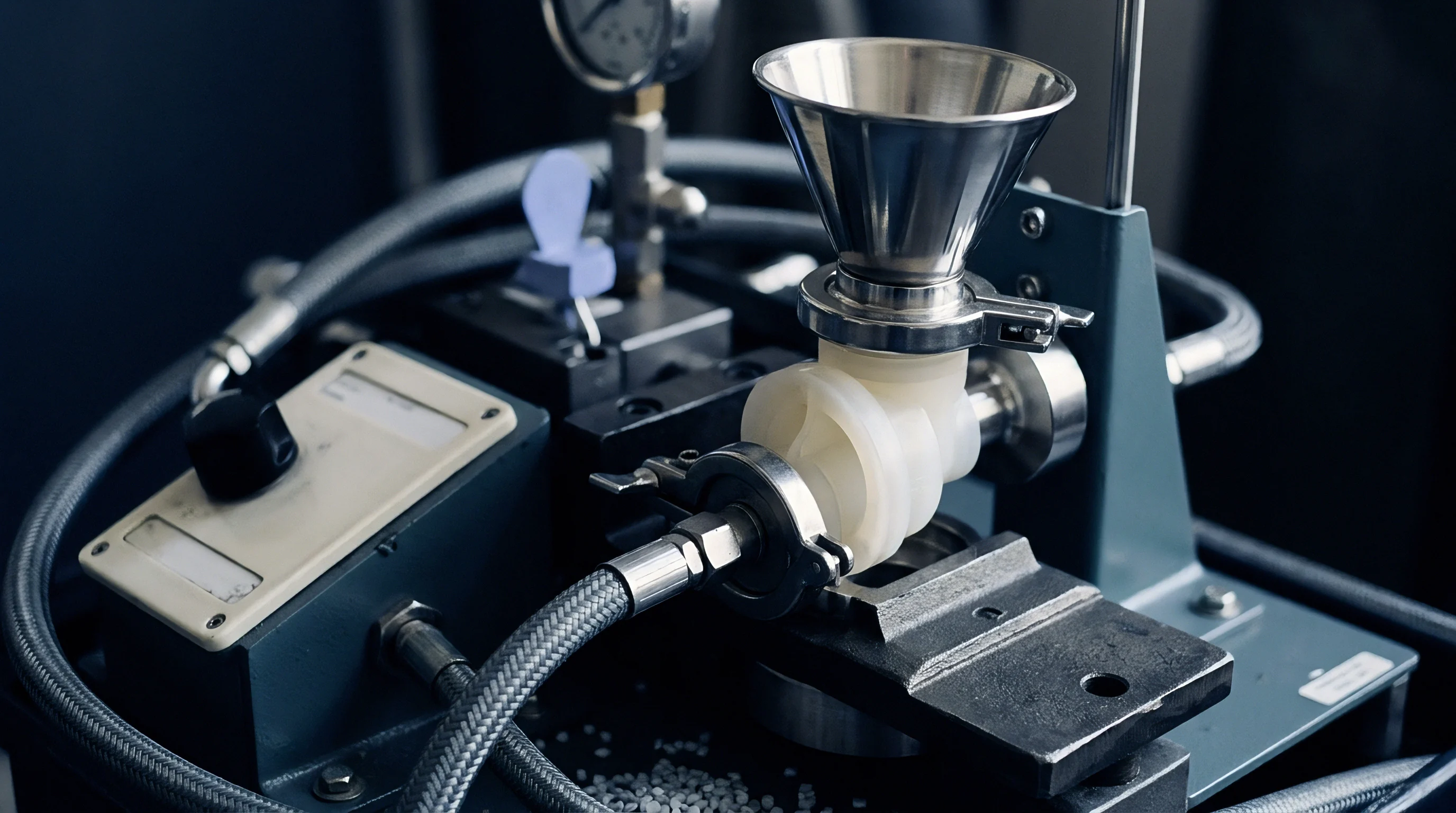
Analytical verification of molecular weight degradation relies on two distinct measurement disciplines. Intrinsic viscosity testing utilizes glass capillary viscometers, such as Ubbelohde or Cannon-Fenske tubes, submerged in precise liquid baths maintained within 0.01 °C of target limits. Solvent safety considerations make solution testing costly and time-consuming.
Dissolving PET requires toxic phenol and tetrachloroethane mixtures, while PA66 demands concentrated sulfuric acid or formic acid. Dissolution protocols require elevated temperatures that run the risk of inducing thermal degradation during sample preparation if thermal stabilizers are omitted. Solution viscometry measures the efflux time of pure solvent (t0) against polymer solutions of varying concentrations (t), calculating relative viscosity (ηr = t / t0), specific viscosity (ηsp = ηr – 1), and extrapolating to zero concentration to isolate intrinsic viscosity.
Melt flow rate indexers offer rapid, solvent-free quality control directly on the compounding floor. ISO 1133 Procedure A measures extruded mass manually over specified time intervals, whereas Procedure B utilizes automated piston displacement sensors to record volumetric flow rate (MVR). Because MVR incorporates melt density at processing temperature, it correlates directly with non-shear-corrected melt viscosity.
Moisture accelerates backbone cleavage. Testing hygroscopic polymers like PET or Polyamide requires strict drying protocols before filling the heating barrel. A moisture concentration exceeding 50 ppm in a PET sample induces severe hydrolytic scission during the mandatory six-minute thermal preheat cycle of ISO 1133, causing apparent melt flow rates to spike by over two hundred percent.

Does Melt Flow Rate Predict Intrinsic Viscosity Loss Accurately?
Relying exclusively on melt flow testing to track intrinsic viscosity loss delivers high repeatability only within tightly defined polymer grades. When reactive additives alter the molecular weight distribution, single-point melt flow measurements introduce systematic errors. Melt flow tests capture flow resistance at a single shear stress level, missing shifts in zero-shear viscosity caused by selective low-molecular-weight chain cleavage.
Combining high-pressure capillary rheometry across a dynamic shear rate range (from 10 to 10,000 s⁻¹) provides complete flow curves that bridge the gap between solution capillary viscometry and single-point factory melt indexers.
Determining the correct laboratory method demands evaluating sample preparation constraints, chemical safety infrastructure, operational turnover speed, and required analytical precision.
- Dissolution Resistance Analysis confirms whether crosslinked gel fractions prevent complete solvent dissolution during solution viscometry testing.
- Thermal Stability Screening establishes maximum allowable barrel residence times before thermal scission alters melt index test validity.
- Moisture Sensitivity Verification sets strict desiccant drying parameters to keep sample moisture below critical hydrolysis thresholds during melt testing.
- Shear Rate Range Matching aligns capillary rheometer piston velocities with actual twin-screw die wall shear stresses.
Supply contracts specifying maximum allowable IV loss during extrusion mandate dry resin preconditioning to below 30 ppm moisture per ASTM D6980 guidelines.
Standardizing compounding specifications on melt index tests without drying verification leads directly to rejected railcars and uncompensated scrap generation at downstream injection molding facilities.

Barrel
Reactive extrusion operations in co-rotating twin-screw equipment depend on controlled chemical reaction kinetics within specific screw zones. Peroxides split polymer backbones. In polyolefin visbreaking, dialkyl peroxides like 2,5-dimethyl-2,5-di(tert-butylperoxy)hexane decompose thermally in the melting zone, generating alkoxy radicals.
These radicals extract hydrogen from polypropylene backbones, forming macroradicals that undergo immediate beta-scission. The chemical reaction rate depends heavily on thermal melt history and screw speed distribution. High temperatures accelerate decomposition.
If peroxide dispersion occurs late in the extruder length, unreacted initiator exits the die, causing continued degradation during melt index capillary testing.
Residence time distribution (RTD) dictates the extent of chain length reduction in reactive processing. A wide residence time distribution produces localized variations in peroxide concentration, resulting in inhomogeneous chain scission and broad molecular weight distributions. Screw elements configured with aggressive reverse-paddling blocks increase local shear and mixing, accelerating chemical dispersion while elevating melt temperature through viscous shear dissipation.
Dynamic temperature spikes lower melt viscosity independently of chemical degradation, complicating inline rheological monitoring. Extrusion engineers deploy online capillary rheometers mounted directly to adapter blocks to capture real-time slit-die flow data, bypassing manual sample collection.
Accurate inline monitoring of reactive melt streams requires precise sampling protocols to isolate chemical degradation from post-extrusion thermal breakdown.
- Purge the twin-screw extruder with non-reactive resin to establish baseline pressure and torque stability across all heating zones.
- Calibrate chemical dosing pumps gravimetrically to ensure precise liquid peroxide feed rates relative to total polymer throughput.
- Diverts melt stream through a temperature-controlled bypass valve into an online capillary die maintained at target melt temperature.
- Quench extruded strand samples immediately in liquid nitrogen to halt residual free-radical chemical reactions.
- Desiccate quenched samples inside a vacuum oven at 80 °C for four hours prior to off-line solution viscometry verification.
Uniform peroxide dispersion across high-shear mixing zones ensures consistent chain scission without expanding the molecular weight distribution.
Resin vendors frequently attribute elevated melt discharge numbers to feeder calibration drift rather than chemical backbone cleavage.

Modeling
A quantitative transformation model demonstrates how controlled visbreaking alters melt flow rate and intrinsic viscosity in polypropylene homopolymer. Rheometers require stable melts. Assume an initial virgin polypropylene resin with a standard melt flow rate of 2.0 g/10 min (230 °C / 2.16 kg) and an initial intrinsic viscosity of 2.45 dL/g measured in decahydronaphthalene at 135 °C. The target compound requires an elevated melt flow rate of 25.0 g/10 min for high-speed thin-wall injection molding.
Organic peroxide dosing drives the chemical chain scission reaction inside a 40 mm co-rotating twin-screw extruder operating at 400 rpm with a barrel melt temperature profile ranging from 190 °C to 230 °C.
Empirical calibration data links MFR shifts directly to weight-average molecular weight drops through an inverse power law: Mw = Kmfr · (MFR)-α. For polypropylene homopolymer, the exponent α empirically measures approximately 0.28 under standard 2.16 kg test conditions. Intrinsic viscosity relates to Mw through the Mark-Houwink equation using constants K = 0.0190 mL/g and a = 0.74.
Applying these relationships converts melt index increases into projected intrinsic viscosity losses across varying chemical peroxide loading levels.
| Peroxide Dose (ppm) | MFR (230°C/2.16kg) | Calculated Zero-Shear Viscosity (Pa·s) | Estimated Mw (g/mol) | Calculated IV (dL/g) | IV Loss (%) |
|---|---|---|---|---|---|
| 0 | 2.0 | 14,500 | 385,000 | 2.45 | 0.0 |
| 250 | 5.5 | 5,800 | 292,000 | 2.02 | 17.5 |
| 500 | 11.0 | 2,900 | 231,000 | 1.71 | 30.2 |
| 750 | 18.5 | 1,720 | 192,000 | 1.50 | 38.8 |
| 1000 | 25.0 | 1,250 | 172,000 | 1.39 | 43.3 |
| 1500 | 42.0 | 740 | 143,000 | 1.22 | 50.2 |
The mathematical model illustrates the non-linear relationship between flow index expansion and intrinsic viscosity decline. Doubling the melt flow rate from 2.0 to 5.5 g/10 min results in a 17.5 percent drop in intrinsic viscosity. Elevating the melt flow rate from 25.0 to 42.0 g/10 min requires substantial molecular degradation, yet yields only an additional 6.9 percent decline in intrinsic viscosity.
Degradation alters material values. High-shear melt flow index testing exhibits elevated analytical sensitivity at low molecular weights, whereas solution viscometry provides superior resolution for high-molecular-weight structural changes.
Single-point melt index testing provides exponential sensitivity to chain scission at low molecular weights where solution viscometry curves flatten.
Incorporating ISO 1133 Condition H testing mandates into supply agreements establishes actionable upper limits on allowable melt flow drift prior to shipment release.

Valuation
Commercial resin specifications enforce strict upper and lower limits on acceptable flow index variation to guarantee part yield. Off-spec resin increases scrap. A compounding facility buying virgin railcars of recycled PET flake faces substantial landed-cost exposure if incoming intrinsic viscosity varies by more than 0.03 dL/g.
Downstream bottle-preform molding dies require strict melt viscosity limits to prevent flash formation or gate freeze-off. Yield losses reduce margin. Refiners sell base resins based on broad MFR bands, leaving compounders responsible for tight flow matching using reactive additives.
Uncontrolled flow wrecks tools.
Contractual framework specifications protect material purchasers by establishing clear price deduction schedules linked to certified laboratory test values. When a reactive compounder ships modified polyolefins, buyers evaluate lot certificates of analysis (COA) against agreed-upon melt flow limits. Rejection thresholds often kick in when melt index values drift beyond ten percent of nominal targets.
If a 25 g/10 min target resin arrives with a tested MFR of 31 g/10 min, the corresponding loss in intrinsic viscosity compromises mechanical impact strength, risking field failures in injection-molded parts.
| MFR Deviation from Target | Equivalent IV Shift (dL/g) | Mechanical Impact Loss (%) | Commercial Action | Landed Cost Adjustment |
|---|---|---|---|---|
| Within ± 5% | < ± 0.02 | < 2% | Full Acceptance | Contract Baseline ($0/tonne) |
| + 6% to + 12% | – 0.03 to – 0.05 | 5% to 8% | Conditional Use | 3% Price Discount / Tonne |
| + 13% to + 20% | – 0.06 to – 0.09 | 12% to 20% | Technical Audit | 8% Price Discount / Tonne |
| > + 20% | > – 0.10 | > 25% | Lot Rejection | Full Return / Supplier Pays Freight |
Specifying material purchases for high-performance reactive compounding requires precise technical terminology inside procurement contracts.
- Dual Method Qualification Clauses mandate reporting both ISO 1133 melt volumetric flow rate and ISO 1628 solution intrinsic viscosity on all certificates of analysis.
- Pre-Shipment Moisture Limits establish maximum allowable water content upon arrival at the processing silo.
- Retained Sample Hold Protocols require compounders to archive production retain samples for ninety days to facilitate independent re-testing during warranty disputes.
- Rheological Tolerance Bands define specific upper and lower MFR thresholds beyond which automatic financial deductions apply.
Procurement teams line up purchasing specifications with physical process capabilities to prevent financial loss from off-spec resin lots. Linking melt flow rate shifts to intrinsic viscosity loss provides the technical baseline required to enforce material quality standards, balance supplier pricing formulas, and ensure consistent mechanical performance across demanding downstream applications.