
Recycled Polyolefin Food Contact Compliance and Migration Testing
Recycled polyolefin food contact compliance demands verified decontamination challenge testing, targeted specific migration analysis, and lot-specific declarations.
Recycled polyolefin food contact compliance demands verified decontamination challenge testing, targeted specific migration analysis, and lot-specific declarations.

Establishing technical parity requires Bland-Altman limits of agreement, documented recovery corrections, and verified ISO 17025 split-sample validation runs.

NIAS quantification in multi-layer barrier laminates demands structural alert screening down to 0.15 micrograms per kilogram food contact threshold.

Annex III assigns simulants by food chemistry, demanding vegetable oil or qualified solvent substitutes whenever plastics touch free surface fats.

Uncharacterized cyclic oligomers in rHDPE trigger conservative Cramer Class III toxicological limits that conventional single-layer packaging cannot meet.

Differentiating native polyolefin oligomers from petroleum hydrocarbons requires coupled LC-GC-FID and GCxGC-TOF-MS deconvolution to prevent false recalls.

Dynamic post-column infusion calibrates electrospray matrix suppression distributions, aligning extractable quantification across divergent laboratory platforms.

Mass spectrometry screening quantifies non-intentionally added polyolefin migrants, converting raw chemical spectra into defensible food contact compliance dossiers.

High-tension roll winding generates multi-megapascal radial stress that accelerates solid-state NIAS diffusion across polymer contacts, peaking near the core.

Dynamic temperature spikes during thermoforming and hot-fill accelerate NIAS diffusion by thinning functional barriers and increasing polymer chain mobility.

Mechanical recycling creates low-molecular-weight degradation products whose migration into food simulants requires batch verification and challenge-tested barriers.

Validating GC-MS workflows for postconsumer polyolefin migrants requires matrix-matched calibration, accurate mass deconvolution, and response-factor adjusted screening.

Quantify polyolefin saturated oligomers using capillary GC-FID integration calibrated against n-alkanes after silica cleanup to isolate non-polar migrateables.

Determining non target screening thresholds requires deriving analytical detection limits from toxicological thresholds divided by GC and LC response uncertainty factors.

High resolution mass spectrometry quantifies recycled packaging contaminants through matrix-matched response factors and structural threshold exposure modeling.
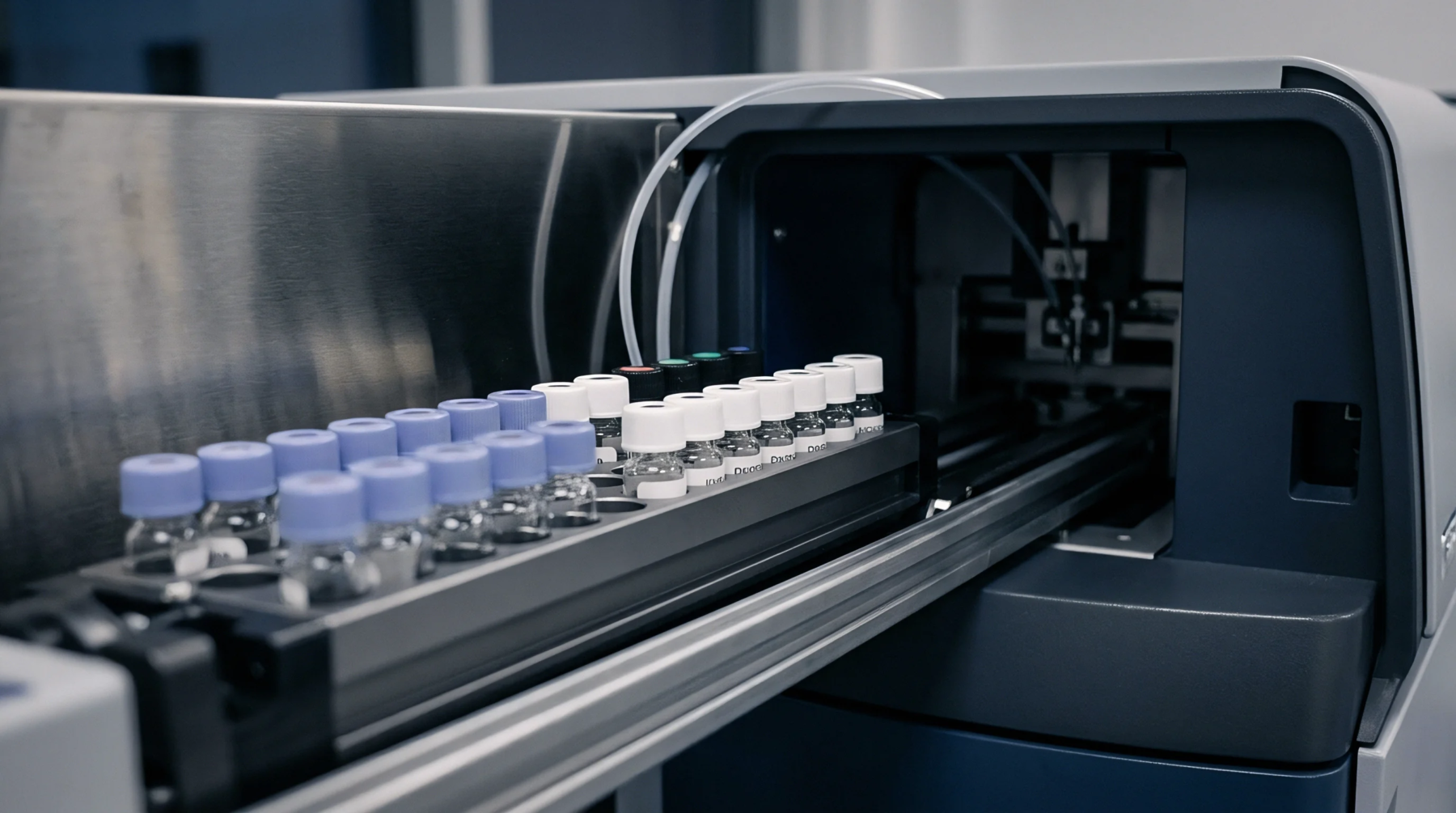
Dynamic matrix correction recalibrates uncharacterized polyolefin migrant peak areas against co-extracted simulant lipids to prevent underreporting migration limits.
Resolve proprietary food packaging data barriers through third-party escrow clearance, functional barrier diffusion modeling, and non-targeted screening.

Compliance files require measuring migration against specific limits, adjusting for dual-use direct food additive allowances, and verifying raw material data.

Dual use additive management demands specific identity flow from resin compounders to food packers to satisfy direct food additive maximum limits.
Polyolefin migration dossiers require dual GC-MS and LC-HRMS non-target screening backed by class-specific surrogate quantification to clear customs audits.

Ultra-trace isomeric mixtures in recycled pyrolysis oil require GC-MS resolution and Cramer Class toxicological screening to defend food-contact compliance.

Non-Fickian swelling in post-consumer polyolefins accelerates NIAS release under fatty simulant contact, requiring substitute extraction verification.

Polyolefin migration compliance requires selecting food simulants based on polarity and fat content while accounting for matrix swelling and thermal limits.

High-resolution mass spectrometry screening paired with surrogate semi-quantification establishes food-contact compliance for post-consumer polyolefins.

Polyolefin oligomeric saturated hydrocarbon compliance demands LC-GC-FID isolation, epoxidation cleanup, and fractionated TTC thresholding backed by batch testing.

Polyolefin oligomer interferences in recycled resins require epoxidation and LC-GC-FID separation to quantify MOSH and MOAH accurately below regulatory thresholds.

Verifying food contact reports against resin specifications requires matching batch numbers, validating simulants, and recalculating surface contact ratios.

Recycled plastic food contact compliance requires rigorous surrogate challenge testing, non-target NIAS screening, and lot-traced migration verification.

Surrogate calibration of cyclic polyolefin oligomers requires response factor correction to prevent massive quantification errors in food simulant compliance testing.

Standardized food simulant selection for polyolefins depends on food solubility, polymer swelling factors, and mandatory thermal contact windows.
Expertise is a utility, not a secret. sentiention™ publishes its working knowledge as open reference: intelligence layer covering the materials it sources, the markets it enters, and the reference that serves both.