Resolving Proprietary Chemical Identity Transfer Barriers in Downstream Food Packaging Compliance Dossiers
Resolve proprietary food packaging data barriers through third-party escrow clearance, functional barrier diffusion modeling, and non-targeted screening.


Impasse
Downstream converters and brand owners face severe legal exposure when upstream raw material suppliers treat food-contact chemical additives as Confidential Business Information. Articles 15 and 16 of Regulation (EC) Number 1935/2004 together with Annex IV of Regulation (EU) Number 10/2011 mandate that declarations of compliance list all substances subject to specific migration limits, dual-use food additives, and non-intentionally added substances. Upstream chemical synthesis houses frequently refuse to transmit exact chemical names, Chemical Abstracts Service registry numbers, or weight fractions to preserve intellectual property.
Converters receive truncated compliance statements asserting generic compliance without the quantitative identity data needed to calculate worst-case migration or establish targeted laboratory testing protocols.
This withholding creates a complete breakdown in the regulatory supply chain. The converter placing the finished article on the market holds strict legal liability for the entire packaging construction. Enforcement authorities in Germany, Switzerland, and Italy inspect the complete analytical dossier rather than accepting general statements of suitability at border points or retail audits.
When an official inquiry demands the specific migration limit evaluation for an undisclosed slip agent or photoinitiator, generic compliance certificates fail immediate legal review.

Regulatory Mandates Colliding with Trade Secrets
European Union harmonized legislation treats the Declaration of Compliance as an operational engineering summary backed by a comprehensive supporting dossier. Annex IV to Regulation (EU) Number 10/2011 explicitly lists the required contents of this document, including adequate information on substances with restrictions under Annex I or Annex II. Specialty chemical producers protect proprietary synthesis routes, stabilizer packages, and polymeric catalysts from reverse engineering by competitors.
The commercial interest in confidentiality directly conflicts with downstream legal transparency requirements.
United States Food and Drug Administration provisions under Title 21 of the Code of Federal Regulations exhibit parallel tensions. Indirect food additives regulated under 21 CFR Parts 174 through 178 require downstream confirmation of extraction limits and dietary concentrations. Converters assembling multilayer flexible laminates require exact formulation percentages to model cumulative dietary intake.
When masterbatch compounders withhold the precise identity of synthetic antioxidants, the downstream packager cannot file an effective Food Contact Notification or defend a pre-market clearance threshold.
| Material Stream | Concealed Chemistry Component | Regulatory Obligation at Risk | Downstream Compliance Consequence |
|---|---|---|---|
| Polyurethane Adhesives | Aromatic isocyanate prepolymers | EU 10/2011 Annex I Primary Aromatic Amine Limit | Inability to verify 0.002 mg/kg individual amine limit |
| Barrier Printing Inks | Photoinitiators and synergists | Swiss Ordinance Annex 10 Listed Evaluated Limits | Failure to screen for set-off migration during reel storage |
| Slip Masterbatches | Secondary amides and erucamide fractions | Dual-use additive disclosure under Regulation 1333/2008 | Undisclosed direct food additive migration into dry foodstuffs |
| Polyolefin Resins | Alkylphenolic process stabilizers | Specific Migration Limit under Simulant D2 testing | Omission of targeted GC-MS calibration against degradation products |

The Information Gap in Declarations of Compliance
A supplier certificate stating that a resin contains only authorized starting substances does not furnish compliance verification. Without quantitative disclosure of the substance identity, the converter cannot verify whether the migration of the substance complies with its specific limit under intended conditions of use. Contact conditions spanning ten days at forty degrees Celsius in vegetable oil extract entirely different quantities of additives than short-term aqueous exposure.
The converter remains legally blind to the calculation parameters.
This friction worsens across multi-tier supply networks. A converter buying a laminated pouch procures polymer films from an extruder, solventless adhesives from a chemical formulator, and functional barrier coatings from a third party. The extruder relies on declarations from resin compounders who in turn source proprietary masterbatches.
Information loss compounds at every transaction interface. The final compliance file collapses into an empty chain of mutual disclaimers.
Suppliers routinely assert that raw formulation secrecy represents their foundational trade right and downstream converters must rely on broad factory assurances rather than structural molecular disclosures.

Seam
Multilayer laminate architectures separate chemical formulations by physical substrate boundaries. Under Article 13 of Regulation (EU) Number 10/2011, a functional barrier prevents the migration of unlisted and non-authorized substances from outer layers into food through the contact layer. The functional barrier concept permits the use of unlisted chemical species behind the barrier layer provided their migration remains below 0.01 milligrams per kilogram in food or food simulants.
This physical separation provides an engineering route to resolve proprietary identity barriers.
Under Article 13 of Regulation 10/2011, an unlisted proprietary substance behind a validated functional barrier requires migration verification below 0.01 milligrams per kilogram in all designated food simulants.
Barrier efficacy depends on polymer morphology, layer thickness, temperature, and contact duration. Ethylene vinyl alcohol copolymers, oriented polyamide films, and silicon oxide coatings retard small molecule diffusion at room temperature. High-temperature retort processes at one hundred twenty-one degrees Celsius for two hours accelerate molecular transit through polymer matrices.
When proprietary adhesives sit behind a thin polyethylene film, the functional barrier can fail during thermal sterilization.

Functional Barrier Verification behind Adhesive Interfaces
Adhesive layers present acute compliance verification challenges in flexible packaging seams. Polyurethane systems formulated with aromatic diisocyanates, including toluene diisocyanate and methylene diphenyl diisocyanate, hydrolyze in the presence of moisture to form primary aromatic amines. Regulation (EU) 2020/1245 sets the detection limit for individual unlisted primary aromatic amines at 0.002 milligrams per kilogram of food simulant.
If the adhesive formulator conceals the specific isocyanate blend, the converter cannot execute targeted liquid chromatography with tandem mass spectrometry to verify amine clearance.
Verifying a functional barrier without formulation disclosure requires worst-case barrier breakthrough calculations. Piringer diffusion models calculate the specific migration value of an unlisted additive based on molecular weight, polymer matrix diffusion coefficients, contact area, and temperature history. The calculations require an assigned molecular weight.
When the supplier conceals the molecular weight, mathematical modeling defaults to an assumed small molecule weight of one hundred Daltons to yield the most conservative diffusion rate. This assumption often overestimates migration, triggering unnecessary analytical rejections.

Can Mathematical Diffusion Modeling Bridge Data Deficits?
Converters apply numerical migration modeling according to validated European standard methods to bypass formulation secrecy. If the supplier provides the maximum initial concentration in the dry layer alongside the minimum molecular weight without naming the chemical structure, diffusion equations can establish a mathematical ceiling on food migration. The resulting migration ceiling demonstrates compliance below the 0.01 milligram per kilogram threshold regardless of the specific functional groups involved.
- Initial substance concentration defines the maximum theoretical mass of the proprietary additive available for diffusion per unit area of packaging laminate.
- Polymer diffusion coefficient reflects the relative resistance of the barrier substrate to penetrant transport at designated thermal processing conditions.
- Partition coefficient values govern the thermodynamic equilibrium distribution of the migrant between the polymer contact layer and the contacting food simulant.
- Activation energy parameters dictate the temperature dependence of diffusion coefficients across hot-fill, pasteurization, and extended room-temperature shelf life cycles.
Laminate thickness varies across manufacturing lots. Processing variations change diffusion rates. Barrier layers with non-uniform thickness compromise mathematical predictions.
Packaging materials showing physical deformation during sealing demand direct testing over theoretical calculations.
A functional barrier holds validity only within the precise thermal and chemical envelope defined by the packaging qualification test.


Escrow
Qualified third-party intermediaries provide a proven administrative structure for resolving proprietary chemical disclosure deadlocks. In this operational model, the chemical formulator discloses the full formulation, reaction chemistry, and non-intentionally added substance profiling directly to an independent, accredited toxicological laboratory under a strict bilateral non-disclosure agreement. The intermediary evaluates the formulation against regulatory positive lists and toxicological limits without revealing proprietary chemical structures to the downstream converter.
The third-party evaluator issues a formalized Compliance Assessment Certificate directly to the converter. This certificate explicitly states whether the specific raw material meets the migration limits of the target market based on defined processing parameters, surface-to-volume contact ratios, and food types. The upstream supplier retains full intellectual property protection while the downstream converter receives an audited, verifiable file for the technical dossier.

Third Party Toxicological Clearing Mechanisms
Independent toxicologists review proprietary formulations against established safety thresholds. In the European Union, unlisted substances migrating below 0.01 milligrams per kilogram must not exhibit carcinogenic, mutagenic, or reprotoxic Class 1A or 1B properties under Regulation (EC) Number 1272/2008. The third-party evaluator executes Quantitative Structure-Activity Relationship models, such as Derek Nexus and Sarah Nexus, on the confidential chemical structures to verify the absence of toxicological structural alerts.
The resulting summary document confirms safety compliance to the converter while keeping exact chemical structures hidden.
A third-party evaluation certificate binds downstream application compliance to an exact contact ratio of six square decimeters per kilogram of simulant at forty degrees Celsius for ten days.
The United States regulatory framework manages this separation through Food Master Files submitted directly to the Food and Drug Administration. The upstream supplier deposits formulation data, manufacturing methods, and toxicological studies directly into an agency repository. The downstream packager references the supplier’s Food Master File number in their Food Contact Notification or pre-market clearance submission.
FDA reviewers cross-examine the proprietary data directly, removing the need for converter exposure to raw chemical data.

Trustee Evaluation under Non Disclosure Agreements
Executing an effective technical escrow requires clearly defined boundaries in the tripartite agreement between supplier, converter, and testing institute. The legal instrument must define the permissible scope of data verification, the liability of the independent laboratory for incorrect clearance, and the analytical methods used for migration verification. Generic non-disclosure agreements lack the specific operational provisions required for food-contact compliance dossiers.
- Formulation disclosure involves transmission of one hundred percent of raw material inputs, catalyst residues, solvent impurities, and known degradation routes directly to the certified testing body.
- Toxicological clearance requires toxicologists to review chemical structures against Annex I of Regulation 10/2011, the REACH Candidate List, and the Cramer classification rules for structural alerts.
- Migration scenario modeling establishes the maximum allowable usage levels in the finished laminate based on standard food simulant exposure ratios and temperature profiles.
- Statement issuance generates an unredacted certificate of conformity confirming regulatory compliance under specified conditions while withholding structural formulas and registry identifiers from the commercial purchaser.
Escrow contracts define operational consequences. The standard verification clause mandates that the upstream supplier immediately notify the third-party trustee of any raw material source change, catalyst modification, or synthesis process alteration, rendering the downstream compliance certificate void upon unnotified process shifts.


Simulant
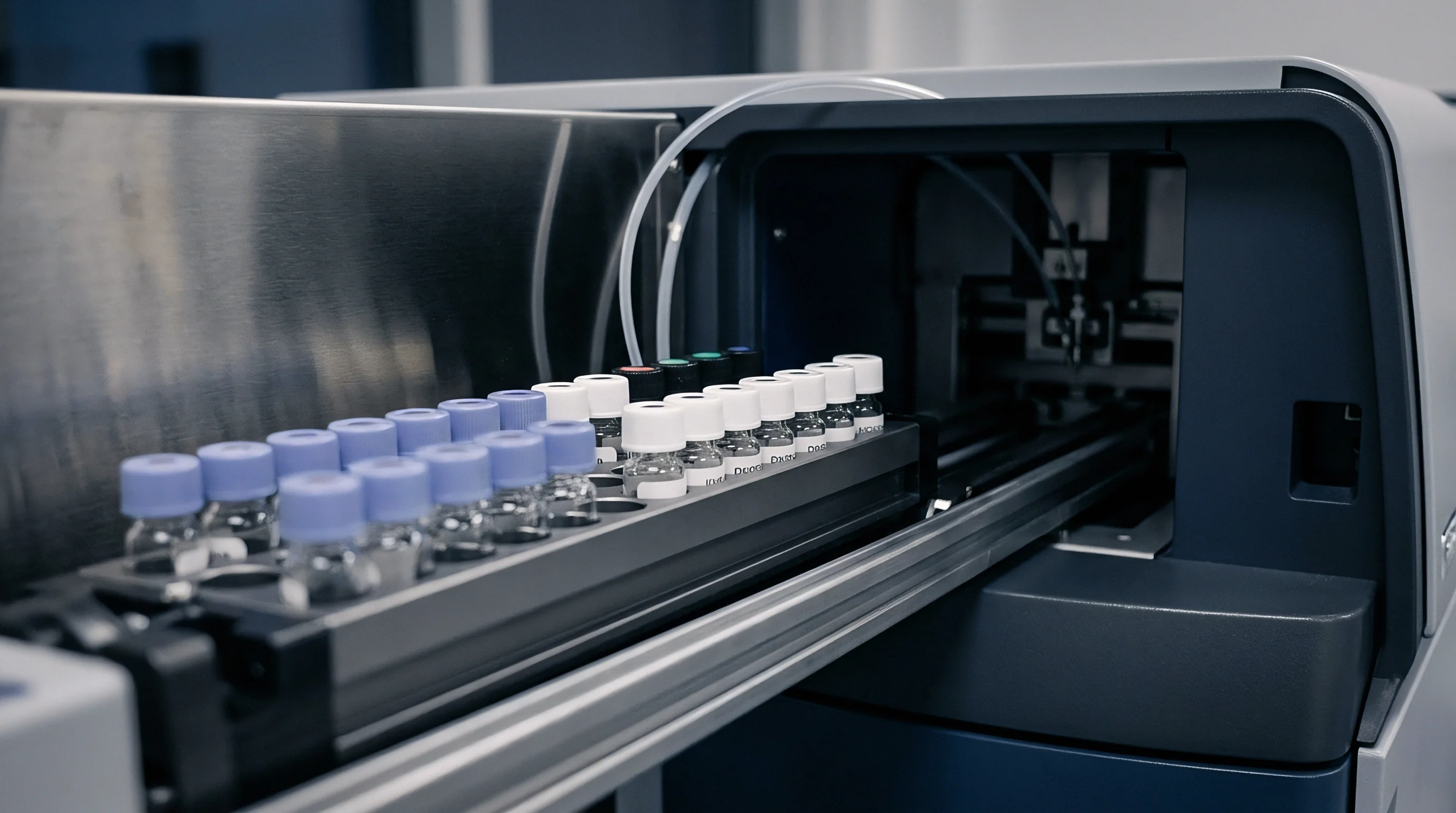
Analytical laboratory screening provides an empirical method to verify packaging safety when chemical identity disclosure cannot be obtained. Testing facilities subject finished packaging materials to worst-case food simulants under standardized temperature and time conditions prescribed by EN 1186 and EN 13130. Simulant A (ten percent ethanol), Simulant B (three percent acetic acid), Simulant D1 (fifty percent ethanol), Simulant D2 (rectified olive oil or synthetic triglycerides), and Simulant E (poly(2,6-diphenyl-p-phenylene oxide), known as Tenax) extract migrating chemical species directly from the food-contact surface.
Gas chromatography coupled with high-resolution mass spectrometry and liquid chromatography coupled with quadrupole time-of-flight mass spectrometry detect both volatile and non-volatile migrating species. When proprietary compounds migrate into simulants, spectra are matched against mass spectral libraries, including NIST and Wiley registries. If spectral matches remain ambiguous, the analytical chemist quantifies the unknown peak against an internal standard to establish a semi-quantitative migration concentration.

Non Targeted Screening Protocol for Unknown Migrants
Non-targeted screening protocols identify non-intentionally added substances and undisclosed proprietary additives. Laboratories introduce deuterated internal standards, such as d10-benzophenone or 13C-labeled migration surrogates, at known concentrations to calculate response factors. Chromatographic peaks exceeding the analytical evaluation threshold demand toxicological assessment.
The Analytical Evaluation Threshold depends on the target toxicological limit and the analytical sensitivity of the instrument. For an unlisted substance lacking structural identification, European and international risk assessment bodies apply the Threshold of Toxicological Concern concept. Substances without structural alerts for genotoxicity fall under Cramer Class III, requiring migration into food to remain below ninety micrograms per person per day.
Assuming standard consumption of one kilogram of food packaged in six square decimeters of material, the corresponding migration limit equals 0.01 milligrams per kilogram.
| Simulant Media | Test Condition Code | Exposure Time and Temperature | Target Analytical Detection Limit | Assigned Screening Threshold |
|---|---|---|---|---|
| Simulant A (10% Ethanol) | OM2 | 10 days at 40°C | 0.001 mg/kg | 0.010 mg/kg (Functional Barrier Limit) |
| Simulant B (3% Acetic Acid) | OM3 | 2 hours at 70°C | 0.002 mg/kg | 0.002 mg/kg (Primary Aromatic Amines) |
| Simulant D2 (Vegetable Oil) | OM5 | 2 hours at 100°C | 0.005 mg/kg | 0.050 mg/kg (Cramer Class I Threshold) |
| Simulant E (Tenax) | OM6 | 4 hours at 100°C | 0.001 mg/kg | 0.010 mg/kg (Low Molecular NIAS) |
| Analytical evaluation thresholds calculated assuming a surface-to-volume ratio of 6 dm² per 1 kg of packaged food. | ||||

May Toxicological Thresholds Substitute for Positive Identification?
Risk assessors dispute whether the Threshold of Toxicological Concern can clear unknown migrants without structural confirmation. If a chromatographic peak represents an uncharacterized substance, the presence of genotoxic structural alerts cannot be excluded by mass spectrometry alone. Genotoxic carcinogens without positive identification fall under the strict threshold of 0.00015 milligrams per person per day, equivalent to a packaging migration level of 0.00005 milligrams per kilogram.
Analytical limits of detection for standard high-resolution instruments cannot reach this boundary in oily food matrices.
When mass spectrometry fails to identify a migrating peak present above 0.00005 milligrams per kilogram, the packaging article cannot achieve definitive toxicological clearance under pure empirical screening. The analytical report flags the signal as an uncharacterized substance. The compliance dossier remains incomplete.
Untargeted screening requires extensive instrument run time. High-resolution mass spectrometry libraries lack coverage for complex proprietary polymers. Sample matrix interferences obscure low-level peaks.
Semi-quantification introduces response factor errors up to a factor of ten.
Relying on empirical analytical screening without upstream formulation data increases testing costs, delays product distribution schedules, and risks immediate container impoundment at the port of entry when customs laboratories detect uncharacterized peaks above baseline limits.


Recourse
Purchasing packaging materials containing proprietary chemical formulations requires defensive commercial structuring. Standard commercial purchase terms that disclaim fitness for a particular purpose or limit supplier liability to invoice value fail to protect converters from regulatory recall liabilities. Converters must implement specialized compliance and warranty riders that legally align documentary disclosure obligations with financial exposure.
A contract clause that fails to bind the supplier to complete formulation transparency during regulatory agency audits transfers the entire cost of a border rejection to the downstream importer.
Supply agreements must incorporate explicit indemnity provisions covering product withdrawals, inventory destruction, and administrative fines resulting from undisclosed chemical restrictions. When an upstream additive contains an unnotified substance subject to an Annex I specific migration limit, the resulting border rejection imposes direct economic losses on the downstream brand owner. Contractual clauses must establish that failure to disclose restricted substances constitutes a material breach of warranty.

Contractual Allocation of Regulatory Enforcement Liabilities
Legal remedies require clear definitions of compliance non-conformity. The agreement must establish that a material defect includes documentary non-compliance, such as an incomplete supporting dossier or an unverified Declaration of Compliance under Regulation (EC) Number 1935/2004. If the upstream supplier refuses to provide chemical identity data to the converter or an agreed third-party escrow trustee, the commercial agreement must permit order cancellation without financial penalty.
- Documentary compliance warranties require the upstream seller to deliver fully detailed supporting dossiers directly to designated enforcement authorities upon formal written request within ten working days.
- Change notification covenants bind the manufacturer to provide ninety days advance written notice before altering catalysts, raw material origins, or synthesis pathways.
- Indemnification provisions cover all testing expenses, recall execution costs, and customs impoundment charges caused by unlisted chemical migrants exceeding statutory thresholds.
- Escrow participation mandates require raw material producers to fund independent third-party toxicological evaluations when proprietary trade secrets prevent direct structural disclosure.

Audit Rights for Upstream Formulation Records
Direct verification requires qualified audit provisions. Supply agreements should grant the converter the right to appoint an independent certified auditor to inspect the supplier’s Good Manufacturing Practice systems under Regulation (EC) Number 2023/2006. The auditor reviews internal batch records, raw material purity specifications, and non-intentionally added substance control procedures on-site without revealing formulation recipes to the commercial competitor.
Auditing raw material facilities ensures that production processes match the analytical claims in the technical file. Physical inspections verify whether recycling streams introduce legacy additives or heavy metals into the virgin polymer matrix. Traceability records must prove that the lot delivered to the converter corresponds exactly to the formulation tested in the compliance file.
What legal mechanism will balance national enforcement transparency requirements against multinational chemical trade secret protections as analytical detection limits approach parts per trillion?