Polyolefin Recycling Stream Contaminant Screening for Food Contact Compliance
Polyolefin food contact compliance demands high-vacuum decontamination, multi-mode mass spectrometry screening, and validated functional barriers.


Feedstock

Source Control across Postconsumer Sorting Lines
Mechanical recycling of polyolefins introduces chemical diversity that virgin resin synthesis never encounters. Polyethylene and polypropylene recovered from municipal solid waste carry residues from previous fills, thermal breakdown products from conversion cycles, volatile aroma compounds, printing inks, and cross-contaminating industrial polymers. European Union regulatory standards under Regulation (EU) 2022/2026 demand ninety-five percent source control from food contact origins for mechanical streams intended for direct contact packaging.
Meeting this threshold requires automated optical sorting running near-infrared spectroscopy and high-speed pneumatic ejection systems operating on rigid container sorting lines.
Municipal postconsumer recovery streams without dedicated deposit-return infrastructure rarely achieve this purity level on unwashed flake. Cross-contamination from motor oil containers, household pesticide bottles, industrial cleaners, and cosmetics packaging deposits non-food additives directly into the polyolefin bulk. Low molecular weight organics dissolve into the amorphous domains of low-density polyethylene and isotactic polypropylene during post-consumer storage periods.
The resulting absorbed contaminants resist superficial surfactant washing and caustic attrition rinsing at eighty degrees Celsius.
Flake sorters running short-wave infrared and visual cameras separate clear high-density polyethylene milk bottles from pigmented detergent containers. Color sorting removes heavy printing inks and surface masterbatches. Flake sorting fails to detect deep-matrix chemical migrants absorbed into the polymer backbone.
Unsorted natural polyolefin flake fractions carry volatile organic loads exceeding five hundred milligrams per kilogram. The conversion process demands aggressive mechanical and thermal decontamination steps to lower this load prior to conversion into final articles.
A supplier often claims that source control audits alone provide sufficient food contact safety for rigid natural streams. This stance collapses during mass spectrometric screening of the converted articles.


Decontamination
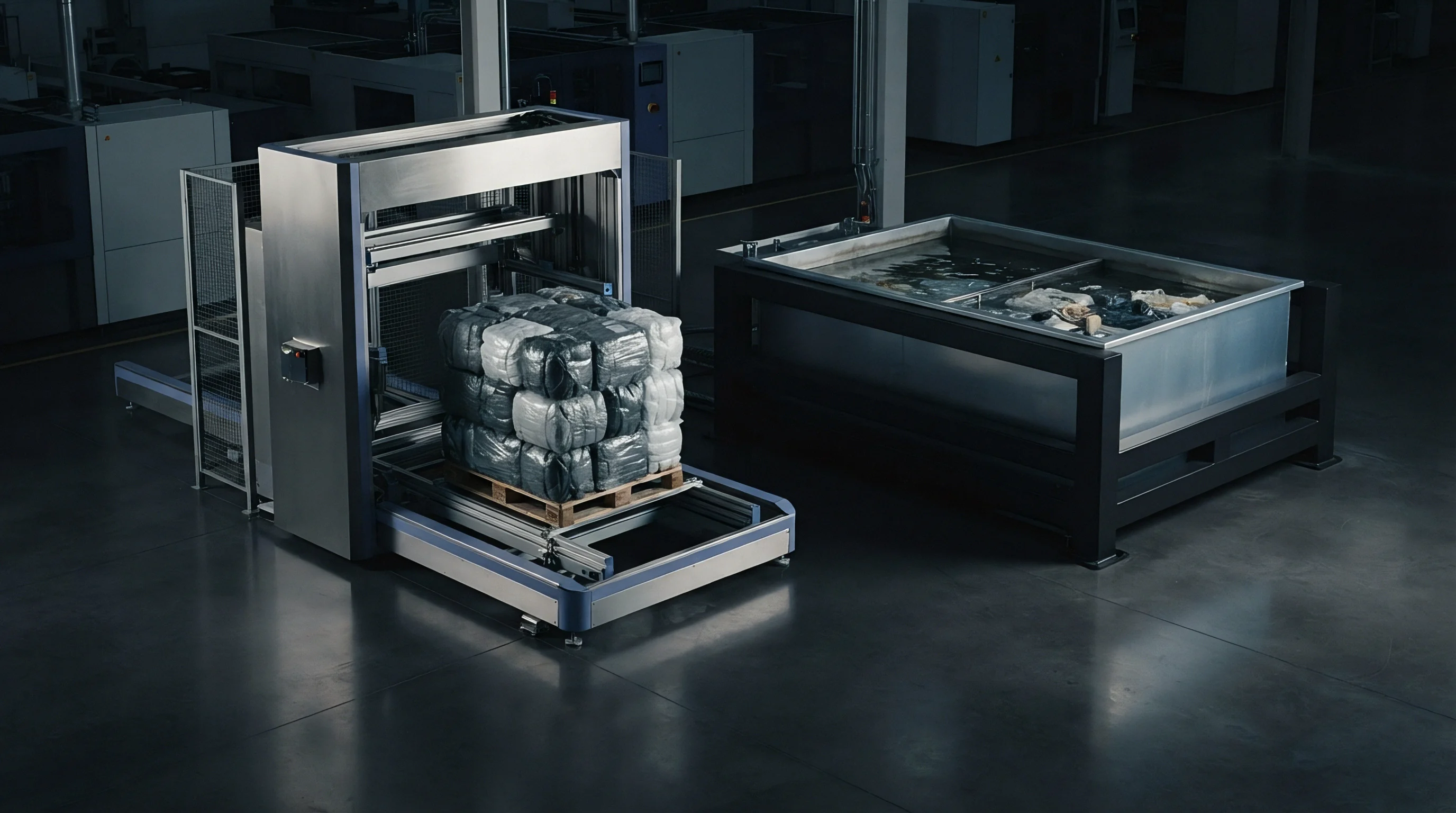
Diffusion Kinetics during Solid State Stripping
Polyolefins display open macromolecular spacing compared to dense aromatic polyesters. The diffusion coefficient of organic molecules through polyethylene exceeds that of polyethylene terephthalate by up to three orders of magnitude at identical temperatures. Contaminants diffuse deeper into the bulk phase during the original service life, requiring severe thermodynamic conditions for extraction during mechanical reclamation.
Stripping lines run high-vacuum degassing extruders coupled with secondary solid-state purging vessels operating beneath polymer melting points.
Volatile organic compounds migrate toward polymer pellet surfaces along a chemical potential gradient governed by Fickian diffusion equations. Raising the process temperature inside the vacuum reactor increases the diffusion coefficient, accelerating mass transport outward into the gas phase. Polypropylene softens near one hundred and forty degrees Celsius, restricting operating thermal envelopes.
Running vacuum levels below two millibars for residence times between four and twelve hours strips light volatiles while sparing the resin from excessive thermal degradation.
A stripping process operating at two millibars and one hundred and thirty degrees Celsius achieves ninety-nine percent reduction of toluene challenge surrogates over eight hours of residence time.
Secondary challenges arise from the thermal oxidation of tertiary carbon atoms on the polypropylene backbone. Repeated processing splits polymer chains, generating secondary radicals that react with atmospheric oxygen to form volatile aldehydes, ketones, and carboxylic acids. Decontamination equipment extracts legacy chemical contaminants while generating new thermal degradation byproducts within the same processing window.
Balancing vacuum depth, purge gas flow, and screw shear prevents process-induced non-intentionally added substances from exceeding toxicological thresholds of concern.

Surrogate Challenge Testing Protocols
Demonstrating decontamination efficiency requires structured surrogate challenge testing administered according to criteria published by the European Food Safety Authority and the United States Food and Drug Administration. Virgin resin feeds receive intentional spikes of model contaminants representing diverse physical chemistries: non-volatile polar compounds, volatile polar solvents, volatile apolar organics, and high molecular weight apolar hydrocarbons. Gas chromatography coupled with mass spectrometry measures the concentration of these spiked model compounds before and after the decontamination run.
| Surrogate Chemical | Chemical Category | Initial Spike (mg/kg) | Post-Treatment (mg/kg) | Extraction Efficiency (%) |
|---|---|---|---|---|
| Toluene | Volatile Apolar | 450 | 0.8 | 99.82 |
| Chlorobenzene | Volatile Semi-Polar | 380 | 1.2 | 99.68 |
| Phenylcyclohexane | Semi-Volatile Apolar | 290 | 4.1 | 98.58 |
| Benzophenone | Non-Volatile Polar | 520 | 18.5 | 96.44 |
| Methyl Stearate | Non-Volatile Apolar | 610 | 28.0 | 95.40 |
Extraction efficiency drops significantly for heavy, non-volatile compounds characterized by molecular weights exceeding three hundred Daltons. High molecular weight migrants remain lodged in the polyolefin matrix, escaping vacuum extraction and persisting into the pelletized output. These lingering fractions define the specific migration risks encountered when finished packaging contacts aqueous, acidic, or fatty food products.
The processing window narrows when handling blended post-consumer polyolefins containing both linear low-density polyethylene and polypropylene fractions. Polyethylene softens at lower temperatures, causing agglomeration inside solid-state stripping columns when operators attempt to run temperatures sufficient to volatilize semi-volatile plasticizers. Lowering reactor temperatures to prevent pellet clumping reduces overall decontamination efficiency, leaving legacy industrial additives intact inside the pelletized material.
Failing to strip non-volatile migrants leaves the finished package exposed to rapid solvent extraction upon contact with lipid-rich foods, terminating product distribution rights across regulated jurisdictions.


Chromatography
Volatile and Semi-Volatile Separation Workflows
Screening post-consumer recyclates requires paired gas chromatography configurations to map the wide distribution of residual contaminants. Static headspace gas chromatography coupled with flame ionization detection and mass spectrometry identifies highly volatile organic compounds boiling below one hundred and fifty degrees Celsius. Headspace sampling incubates milled polymer samples at one hundred and twenty degrees Celsius inside sealed vials for forty-five minutes, driving light process solvents, limonene, and monomer degradation fragments into the gas phase.
Semi-volatile organic compounds require exhaustive solvent extraction followed by liquid injection gas chromatography paired with high-resolution time-of-flight mass spectrometry. Dichloromethane or hexane extraction under pressurized fluid extraction conditions leaches absorbed additives, processing aids, photoinitiators, and oligomeric hydrocarbons out of the polymer matrix over several hours. The liquid extract undergoes concentration under a dry nitrogen stream prior to chromatographic injection on non-polar capillary columns.
Electron ionization fragmentation spectra match unknown peaks against commercial mass spectral libraries. Accurate mass determination across quadrupole time-of-flight analyzers permits empirical formula calculation for unlisted peaks lacking library matches. Non-target screening separates industrial plasticizers, legacy flame retardants, and pesticide traces from the broad background of aliphatic polyolefin oligomers normally generated during resin synthesis.
European Union Regulation 10/2011 Annex II sets a detection limit verification threshold of 0.01 milligrams per kilogram for unlisted non-intentionally added substances migrating into food simulants.
Polyolefin matrices release homologous series of linear and branched alkanes, alkenes, and alkyl benzenes collectively termed polyolefin oligomeric saturated hydrocarbons and polyolefin oligomeric unsaturated hydrocarbons. These structural components form dense chromatographic humps that obscure low-concentration target contaminants. Resolving trace contaminants hidden beneath oligomeric interference requires multi-dimensional gas chromatography, which routes select column fractions through a secondary column coated with a distinct stationary phase.

Liquid Chromatography for Non-Volatile Migrants
High molecular weight compounds, thermal antioxidants, hindered amine light stabilizers, and polar transformation products fail to volatilize inside gas chromatography injection ports. Characterizing these species demands ultra-high performance liquid chromatography paired with electrospray ionization high-resolution mass spectrometry. Reverse-phase C18 columns running gradient water-acetonitrile-isopropanol mobile phases separate high-mass molecules extracted from the plastic.
Electrospray ionization in positive and negative switching modes ionizes polar migrants, including oxidized additives like tris(2,4-di-tert-butylphenyl)phosphate and degraded Irganox 1010 derivatives. Tandem mass spectrometry breaks selected precursor ions via collision-induced dissociation, producing diagnostic fragment ions that reveal structural backbones. This pathway identifies unauthorized degradation products, synthetic dyes, and printing ink photoinitiators present in consumer waste streams.
Polypropylene degradation routes yield tertiary alcohols, hydroperoxides, and complex carboxylic acids during repeated service and reclamation cycles. Liquid chromatography isolates these transformation products from the primary additive package, quantifying chemical aging across successive recycling loops. High-resolution mass spectrometry measures exact masses within five parts per million mass error, enabling unambiguous assignment of elemental formulas to unknown non-intentionally added substances.
Quantifying non-target contaminants presents analytical friction due to the absence of authentic chemical reference standards for novel degradation products. Chemists address this gap by calculating semi-quantitative concentrations using response factors derived from structurally related internal standards like deuterated benzophenone or 2-hydroxy-4-octyloxybenzophenone. This quantification uncertainty propagates into dietary exposure calculations, altering regulatory risk assessments for converted consumer food packages.
An operator might assume that non-targeted chromatographic sweeps capture every hazardous migrant, yet blind spots remain for non-ionizing chemicals and bound heavy elements.


Toxicology

Applying Thresholds of Toxicological Concern
Unidentified non-intentionally added substances detected via high-resolution spectrometry must clear toxicological safety hurdles before the host resin enters food contact applications. The Threshold of Toxicological Concern concept establishes conservative human exposure limits for chemical substances lacking compound-specific in vivo toxicity data. Compounds classify into Cramer Classes I, II, or III based on chemical structure, functional groups, and known metabolic pathways analyzed through automated decision tree algorithms.
Cramer Class III encompasses complex chemical structures, reactive functional groups, and substances lacking predictable detoxification routes, setting an intake limit of ninety micrograms per person per day. Applying standard exposure assumptions for packaging—one kilogram of food consumed per day by a sixty-kilogram individual—translates this toxicological boundary into a maximum migration limit of 0.015 milligrams per kilogram in food. Substances demonstrating structural alerts for genotoxicity drop to a protective Threshold of Toxicological Concern limit of 0.15 micrograms per person per day, equivalent to a migration ceiling of 0.00025 milligrams per kilogram.
Packaging operations must suspend commercial resin lot releases whenever mass spectrometry flags an uncharacterized migrant bearing genotoxic structural alerts above the 0.00025 milligram per kilogram analytical threshold.
Screening post-consumer recyclate extracts routinely surfaces hundreds of unique non-intentionally added substances present below five parts per billion. Conducting comprehensive animal feeding studies for each trace compound is economically and logistically unfeasible for recycling plant operators. Chemical risk assessment relies on high-resolution mass spectrometry matching against genotoxicity databases coupled with in vitro bioassays.
Bacterial reverse mutation assays and micronucleus tests evaluate total extract mutagenicity, confirming that untargeted trace contaminants induce no collective cellular DNA damage.

Mineral Oil Hydrocarbon Speciation and Safety Bands
Mechanical recycling lines collecting municipal waste accumulate mineral oil hydrocarbons originating from offset printing inks, newsprint migration, machine lubricants, and packaging adhesives. Analysis separates these compounds into mineral oil saturated hydrocarbons and mineral oil aromatic hydrocarbons using coupled online liquid chromatography-gas chromatography with flame ionization detection. Saturated fractions accumulate in human fat tissues and lymph nodes, while aromatic fractions containing three to seven condensed rings exhibit mutagenic and carcinogenic risks.
| Chemical Classification | Representative Toxicological Concern | Screening Detection Limit (mg/kg) | Actionable Migration Ceiling (mg/kg) | Analytical Technique |
|---|---|---|---|---|
| Cramer Class I | Simple Chemical Structure | 0.0500 | 0.3000 | Headspace GC-MS |
| Cramer Class III | Complex Multi-Functional | 0.0050 | 0.0150 | Liquid Injection GC-MS |
| Genotoxic Alerts | DNA-Reactive Structures | 0.0001 | 0.00025 | UHPLC-HRMS |
| MOSH (C16 to C35) | Bioaccumulation in Tissues | 0.5000 | 2.0000 | Online LC-GC-FID |
| MOAH (3 to 7 Rings) | Carcinogenicity / Mutagenicity | 0.1000 | 0.5000 | Online LC-GC-FID |
European packaging safety authorities maintain zero-tolerance baselines for detectable mineral oil aromatic hydrocarbons with genotoxic profiles in food contact articles. When online liquid chromatography-gas chromatography reveals mineral oil aromatic hydrocarbons in post-consumer polyolefin flakes above 0.5 milligrams per kilogram, packaging engineers deploy coextruded functional barriers or divert the resin lot to non-food applications. Virgin polyolefin core layers capped by functional polyethylene layers must demonstrate impenetrable mass transport over full retail shelf life durations.
Mineral oil saturated hydrocarbons between carbon chain lengths sixteen and thirty-five trigger secondary analytical scrutiny due to biological half-life accumulation risks. Recycled high-density polyethylene milk crate streams exhibit saturated hydrocarbon background levels of several hundred milligrams per kilogram. These levels originate from label hot-melt glues and wax additives compounding across multiple recycling loops.
Screening assays map the carbon number distribution profile to differentiate safe high-mass microcrystalline waxes from hazardous low-mass mineral oils.
Under international manufacturing standards, testing laboratories must report raw chromatograms alongside baseline integration limits to verify that mineral oil hump quantification excludes legitimate polyolefin oligomers.

Barrier
Functional Barrier Thickness and Diffusion Modeling
Direct contact between mechanically recycled polyolefins and moist or fatty food products introduces compliance barriers under Article 3 of Regulation (EC) 1935/2004. Packaging manufacturers navigate this challenge by designing multi-layer structures incorporating internal virgin polymer layers acting as functional barriers. The functional barrier prevents chemical migrants originating from the middle recycled core from migrating across the packaging interface into the food matrix during commercial distribution.
Mathematical migration modeling governed by numerical solutions to Fick’s second law of diffusion calculates contaminant transport profiles through layered polymer walls. Transport rates depend upon temperature, storage duration, polymer matrix morphology, initial contaminant loading, partition coefficients between layers, and the individual diffusion coefficient of each migrant. Polyolefins possess higher diffusion coefficients than rigid barrier polymers like ethylene vinyl alcohol, requiring substantial virgin layer thicknesses to contain light organic migrants over extended shelf lives.
Evaluating multi-layer container designs demands calculating the breakthrough time for specific model contaminants under ambient and elevated temperatures. Breakthrough represents the precise time interval required for a chemical migrant located in the buried recyclate core to diffuse through the virgin inner layer and register in the contact zone at toxicologically relevant concentrations. Packaging designs that lower virgin layer thickness to reduce material costs risk premature migrant breakthrough, invalidating the food safety dossier.

Are Polyolefin Layers Sufficient for Functional Barrier Isolation?
Polyolefin resins display significant free volume within their amorphous phases at room temperature, which sits above their glass transition points. Virgin low-density polyethylene features a glass transition temperature near minus one hundred and twenty degrees Celsius, keeping the polymer chains mobile and flexible under normal storage conditions. This dynamic molecular mobility permits low molecular weight organic contaminants to diffuse through virgin polyethylene layers at rapid rates.
A virgin high-density polyethylene contact layer measuring twenty-five micrometers fails to contain volatile contaminants like limonene, toluene, or mineral oil aromatic hydrocarbons over six months of ambient food contact. Fatty foods and oil-in-water emulsions plasticize the contact surface, accelerating diffusion kinetics across the interphase boundary. Virgin polyolefins alone function as partial migration retarders rather than absolute chemical barriers.
True functional barrier execution in polyolefin-based packaging demands dedicated polar barrier materials or thick structural sections engineered through rigorous testing.
- Ethylene Vinyl Alcohol Core provides absolute gas and organic migrant isolation when positioned between virgin polyolefin food-contact skins and external post-consumer recyclate structural layers, maintaining structural barrier performance beneath seventy percent relative humidity levels.
- High-Density Polyethylene Overlays require minimum wall thicknesses exceeding one hundred and fifty micrometers to delay medium-mass organic migrant breakthrough beyond typical retail storage lives when applied over mechanically decontaminated post-consumer polyolefins contacting dry foodstuffs.
- Silicon Oxide Deposition Coatings deposited on the food-contact surface of polyolefins halt small-molecule migration but display mechanical micro-cracking risks under container drop impacts, bending stress, and ambient thermal expansion cycles.
Evaluating migration dynamics demands verifying layer thickness uniformity across thermoformed corners, deep-drawn bottle necks, and mold pinch points. Local wall thinning reduces the diffusion path length, accelerating contaminant transport into localized food volumes. Processing facilities execute continuous inline optical thickness measurements to verify that functional barrier thicknesses meet validated containment specifications across all physical dimensions of the manufactured container.
When engineering teams miscalculate the relationship between storage temperatures and diffusion coefficients, chemical migrants penetrate the inner contact layer, contaminating the packaged goods and triggering compulsory supply recalls.

Assay
Standardized Migration Testing Conditions
Validating the compliance of finished packaging articles containing recycled polyolefins demands standardized migration tests defined under European standard EN 1186 and testing regulation Regulation (EU) 10/2011. Testing requires exposing converted articles to chemical food simulants under controlled time and temperature regimes that reflect worst-case commercial distribution scenarios. Analytical chemists measure overall migration limits to ensure packaging materials release no more than ten milligrams of total substances per square decimeter of food-contact area.
Specific migration limits protect consumers against distinct hazardous compounds identified during chromatographic screening. Testing protocols deploy simulant A (ten percent ethanol) for aqueous foods, simulant B (three percent acetic acid) for acidic foods, and simulant D2 (rectified olive oil or vegetable oil fatty acid mixtures) for lipid-rich matrices. Simulant E (poly(2,6-diphenyl-p-phenylene oxide), known commercially as Tenax) acts as the standardized dry food simulant, absorbing volatile and semi-volatile migrants via gas-phase partition across elevated thermal exposure cycles.
Testing parameters correspond to projected distribution conditions. Contact condition OM2 specifies ten days of simulant exposure at forty degrees Celsius, representing ambient storage lifetimes exceeding thirty days. Condition OM5 specifies two hours of reflux at one hundred degrees Celsius or equivalent thermal exposure for hot-fill packaging.
Packaging containing post-consumer polyolefins frequently releases oligomers that swell or dissolve within fatty food simulant D2, complicating gravimetric overall migration measurements and requiring secondary solvent extraction corrections.

Comparative Analytical Assay Methodologies
Screening programs rely on complementary analytical techniques to identify volatile, semi-volatile, non-volatile, and elemental contaminants present in mechanically recovered streams. The selected testing configuration must deliver high detection sensitivity while managing polymer matrix interference and operational instrument maintenance.
| Assay Methodology | Primary Target Contaminants | Mass Range (Da) | Matrix Interference | Quantification Limit |
|---|---|---|---|---|
| Headspace GC-MS | Volatiles, Solvents, Limonene | 30 to 250 | Low | 0.01 to 0.1 mg/kg |
| Liquid Injection GC-TOF-MS | Semi-Volatiles, Plasticizers, MOSH | 50 to 800 | High (Oligomer Hump) | 0.005 to 0.05 mg/kg |
| UHPLC-ESI-HRMS | Antioxidants, Polar NIAS, Dyes | 100 to 2000 | Medium | 0.0001 to 0.01 mg/kg |
| Online LC-GC-FID | MOSH, MOAH Fractions | 150 to 1000 | High (Wax Interference) | 0.1 to 0.5 mg/kg |
| ICP-MS | Heavy Metals, Catalyst Residues | 7 to 238 | Low (Post-Digestion) | 0.001 to 0.01 mg/kg |
Inductively coupled plasma mass spectrometry resolves elemental contaminants after microwave-assisted nitric acid digestion of the polyolefin resin. Postconsumer municipal waste streams accumulate legacy heavy metals including lead, cadmium, and hexavalent chromium originating from discarded industrial pigments and plastic stabilizers. Regulators enforce a combined concentration ceiling of one hundred milligrams per kilogram for heavy metals under European packaging environmental standards, demanding routine elemental checks alongside organic screening.
Liquid injection gas chromatography requires continuous maintenance when processing polyolefin extracts. Non-volatile polymer fractions deposit in the inlet liner and on the front of the analytical column, inducing chromatographic band broadening and peak tailing. Technicians install deactivated pre-columns and backflush mechanisms to prevent high-mass resin fragments from fouling sensitive ionization sources during uninterrupted high-throughput testing campaigns.
A supplier may present a compliant migration report generated on virgin natural resin, arguing that the results clear the entire recycled polyolefin product line. Quality managers must reject these claims, commissioning new batch-specific testing on the converted material.


Governance
The Supporting Dossier and Traceability Verification
Placing food-contact articles derived from recycled polyolefins on international markets requires assembling an uncompromised regulatory compliance dossier. The Declaration of Conformity acts as the formal legal representation of safety, but it carries zero legal validity unless supported by auditable technical records. Article 16 of Regulation (EC) 1935/2004 instructs packaging producers to maintain accessible technical dossiers showing supporting analytical tests, raw material safety data sheets, and batch production logs.
Auditors verify the traceability chain linking the finished container back to the specific recycling plant decontamination run and incoming flake bale deliveries. Good Manufacturing Practice requirements under Regulation (EC) 2023/2006 establish quality assurance systems that record process parameters throughout daily conversion runs. Operating facilities must maintain real-time telemetry logs tracking vacuum reactor pressure, decontamination residence times, extrusion melt temperatures, and inline melt-filter differential pressures.
- Process Telemetry Validation confirms that the recycling decontamination unit ran within qualified vacuum and temperature operational envelopes throughout the entire production window for the targeted resin lot, preventing undocumented parameter drift.
- Analytical Verification Matching links the specific resin lot identifier on the customs bill of lading directly to mass spectrometry screening reports and overall migration clearance certificates delivered by an accredited testing laboratory.
- Dual-Use Additive Disclosure details all chemical processing aids that act as authorized direct food additives inside packaged food products, allowing food packaging operations to ensure that cumulative migration limits remain uncompromised.
- Non-Intentionally Added Substance Risk Evaluation provides written toxicological justifications, structural Threshold of Toxicological Concern allocations, and bioassay clearance data for all trace chemical migrants detected above the 0.01 milligram per kilogram threshold.
Declarations of Conformity must clearly state the boundaries of the compliance evaluation. The document must define authorized contact conditions, maximum storage durations, allowable temperature ranges, food simulant compatibility, and packaging surface-area-to-volume assumptions. Using a declaration evaluated solely for ambient dry-food contact to distribute oily condiments at elevated pasteurization temperatures breaks compliance chains, exposing distributors to immediate border rejections and commercial fines.

Supply Agreements and Rejection Mechanics
Commercial contracts governing postconsumer polyolefin delivery must contain clear, objective quality metrics that trigger automatic lot rejections. Relying on generic commercial grades creates commercial disputes when laboratories identify non-compliant migrants in delivered resin. Procurement contracts must bind pellet suppliers to explicit chemical purity standards, including maximum limonene thresholds, mineral oil aromatic hydrocarbon concentration caps, and complete absence of genotoxic structural alerts.
Purchasing agreements define lot sampling procedures executed immediately upon delivery of bulk shipping containers. Quality inspection personnel pull core samples across multiple container heights, homogenizing the material prior to rapid screening via headspace gas chromatography. If volatile organic compound screening identifies anomalous peaks or elevated postconsumer markers exceeding negotiated limits, receiving teams isolate the shipment and halt payment processing pending full mass spectrometric analysis.
Contracts specify financial liability when a delivered polyolefin lot fails secondary migration testing or triggers product recalls due to chemical contamination. Supply clauses allocate all testing costs, disposal fees, warehouse holding charges, and downstream product replacement damages to the recycling facility that issued the non-compliant material certificate. Strict contractual indemnification shields brand owners and packaging converters from regulatory penalties and commercial losses caused by fraudulent or careless supplier compliance declarations.
A supplier will occasionally argue that trace chemical non-compliances are unavoidable artifacts of mechanical processing that a buyer must accept under municipal circular economy goals. Procurement teams counter this claim by upholding standard commercial purchase terms: chemical purity requirements for food contact packaging remain binding regardless of polymer origins.