Extrusion Die Optimization for Recycled Polyethylene Processing Stability
Extrusion die geometry optimization for recycled polyethylene extends land ratios to twenty to one and stages filtration to damp melt pressure surges.


Surge
Recycled polyethylene streams exhibit pronounced melt pressure fluctuations due to lot-to-lot molecular mass variations. Post-consumer resins collected from rigid packaging or flexible films contain mixed polyolefin fractions, cross-linked gel structures, and residual low-density contaminants. These impurities alter the non-Newtonian flow behavior inside flat film dies, pipe heads, and profile extrusion tooling.
When low-density fractions or residual linear low-density components mingle with rigid high-density polyethylene recyclate, the zero-shear viscosity of the melt shifts abruptly. Pressure drops across the channel.
Feedstock contaminants shift viscosity. Standard virgin high-density polyethylene features a narrow molecular weight distribution that maintains predictable shear-thinning characteristics under steady extrude rates. Recycled polyethylene exhibits a broad, often bimodal molecular weight distribution resulting from mechanical degradation and thermal history during prior processing steps.
Chain scission reduces average molecular weight, while thermal oxidation generates long-chain branching or cross-linking. These molecular alterations disrupt the steady-state shear profile within the extrusion die manifold.
Melt flow rate variation exceeding 0.4 g/10 min under ISO 1133 Condition D at 190 degrees Celsius and 2.16 kg destabilizes extrudate pressure within the land channel.

Melt Rheology of Recycled Polyethylene Blends
Post-consumer resins contain mixed polyolefin fractions that alter non-Newtonian flow behavior during extrusion. The apparent viscosity of post-consumer polyethylene decreases less rapidly at high shear rates than virgin resin when high levels of cross-linked material are present. Conversely, heavily degraded recyclates with severe chain scission suffer rapid viscosity drops under moderate shear.
This discrepancy leads to localized velocity variations across the die width. Polymer melts near channel walls experience extreme shear stress, while core flow regions move as elastic plugs.
Chain branching elevates melt elasticity. The storage modulus measured via rotational rheology at 190 degrees Celsius reveals elevated elastic recovery in recycled streams compared to virgin homopolymers. High elastic recovery forces the polymer melt to expand upon exiting the channel boundaries.
This phenomenon creates gauge instability, surface sharkskin defects, and parabolic flow front distortion across flat sheet dies.
- Melt Elasticity Variance drives uneven post-extrusion swell at the channel discharge, causing wall thickness drift in blow-molded containers and corrugated pipes.
- Viscous Dissipation Spikes occur in narrow die channels, overheating degraded polymer fractions and releasing volatile organic compounds during production.
- Non-Uniform Velocity Profiles across flat sheet dies yield thick film edges and thin central zones, forcing downstream orientation equipment out of operating windows.
- Intermittent Pressure Oscillations at the die entry induce wall slip, yielding periodic surface defects known as stick-slip melt fracture.

Shear Rate Variation across Recycled Fractions
High-density fractions recovered from blow-molded bottles exhibit lower melt flow indexes than low-density film fractions. When compounders blend post-consumer detergent bottles with post-industrial film scrap, the composite material displays shear-dependent phase separation. At low shear rates inside the coat-hanger manifold, the high-viscosity component dominates flow resistance.
Inside high-shear land regions, low-viscosity fractions migrate toward the metallic boundary walls.
Wall shear stress limits determine the onset of surface melt fracture. Virgin high-density polyethylene typically reaches critical shear stress between 0.10 and 0.14 MPa at 190 degrees Celsius. Recycled polyethylene grades contaminated with broad molecular mass tails reach critical shear stress at values as low as 0.07 MPa.
Operating an extrusion die above this lower threshold produces microscopic surface tears on the extruded profile. Unchecked pressure fluctuations accelerate internal mechanical wear on die land surfaces, requiring premature tooling replacement and producing off-spec sheet that fails tensile elongation standards.


Land
Channel dimensions within the die channel dictate the relaxation time available to oriented polymer chains. Virgin polyethylenes typically process effectively through die lands with length-to-gap ratios ranging between 10:1 and 15:1. Recycled high-density polyethylene requires land length-to-gap ratios between 20:1 and 25:1 to damp stored elastic strain before discharge.
Extending the parallel land section provides the polymer melt sufficient residence time under uniform shear to relieve normal stresses generated during manifold contraction.
Die swelling alters profile wall thickness. Melt pressure drops continuously along the parallel land zone. When recycled feedstock exhibits batch-to-batch melt flow rate changes from 0.3 g/10 min to 0.8 g/10 min under ISO 1133 testing at 190 degrees Celsius with a 2.16 kg load, fixed land dimensions produce shifting die exit pressures.
Higher exit pressure increases extrudate swell, altering profile geometry after cooling.

Geometric Ratios for Damping Elastic Recovery
Extrudate swelling downstream of the exit slit reflects the magnitude of elastic strain stored during channel entry. The ratio of land length to channel height governs the decay rate of primary normal stress differences. For recycled polyethylene compounds containing up to 50 percent post-consumer material, extending the parallel land zone reduces swell ratios from 1.6 to less than 1.25.
Narrow gaps increase wall stress.
Extrusions operating with insufficient land lengths display severe gauge variations across the profile width. The shear rate at the land wall correlates directly with throughput volumetric rate and land gap dimensions. Calculating wall shear rate for non-Newtonian polymer melts involves applying the Weissenberg-Rabinowitsch correction factor to account for shear-thinning indices ranging from 0.25 to 0.40 in recycled grades.
| Polymer Grade Type | MFR Range (190°C / 2.16 kg) | Recommended L/H Ratio | Max Entry Taper Angle | Critical Shear Stress Limit |
|---|---|---|---|---|
| Virgin HDPE Blow Molding | 0.30 – 0.45 g/10 min | 12:1 to 15:1 | 60 degrees | 0.12 MPa |
| 50% PCR-HDPE Bottle Flake Blend | 0.35 – 0.60 g/10 min | 18:1 to 20:1 | 45 degrees | 0.09 MPa |
| 100% PCR-HDPE Rigids Stream | 0.25 – 0.80 g/10 min | 22:1 to 25:1 | 30 degrees | 0.07 MPa |
| PCR-LDPE/LLDPE Film Scrap | 0.80 – 1.50 g/10 min | 15:1 to 18:1 | 40 degrees | 0.10 MPa |

Entrance Pressure Losses and Die Taper Angles
Abrupt contraction zones force polymer chains into rapid extensional deformation, raising entry pressure drop. Applying the Bagley correction method reveals that recycled polyethylene resins generate entrance pressure losses up to 40 percent higher than virgin counterpart resins of equivalent melt flow index. High entrance pressure loss correlates directly with vortex formation in the transition corners of the die manifold.
Vortex accumulation causes long residence times for trapped resin fractions. Thermal degradation inside stagnant vortices forms oxidized gels that detach periodically, contaminating the main melt flow. Replacing sharp 60-degree manifold transition angles with streamlined 30-degree shallow entry tapers suppresses vortex growth and stabilizes the entrance pressure gradient.
- Measure baseline apparent melt viscosity using capillary rheometry across shear rates from 10 to 1000 s-1 according to ISO 11443.
- Calculate entry pressure loss using multi-length capillary dies to construct Bagley correction plots for the specific recycled polyethylene blend.
- Determine maximum allowable wall shear stress to avoid melt fracture onset based on extrudate surface inspection.
- Dimension the parallel land gap based on target part wall thickness while factoring in calculated extrudate swell ratios.
- Extend parallel land length until channel residence time equals at least three times the longest material relaxation time identified via rheology.
Consider a blown film die application running a post-consumer linear low-density polyethylene blend with an melt flow index of 0.9 g/10 min at 190 degrees Celsius under a 2.16 kg test load. The line operates at an extrusion output generating a apparent shear rate of 650 s-1 at the die exit. Standard die geometry with an L/H ratio of 10:1 yields exit wall shear stress of 0.11 MPa, exceeding the measured critical shear stress threshold of 0.08 MPa for this recyclate lot.
The line exhibits severe sharkskin surface roughness. Redesigning the die insert to expand the L/H ratio to 20:1 drops entry pressure losses, dampens normal stresses, and reduces exit shear stress to 0.065 MPa at identical throughput rates. The surface defect disappears completely without lowering extruder output.
A longer land zone absorbs feedstock viscosity swings without transmitting pressure spikes to the exit orifice.

Lip
Thermal distribution at the final discharge boundary dictates wall shear stress and local film thickness. Die exit components require localized thermal controls to prevent edge cooling and minimize melt viscosity gradients across flat sheet or film profiles. Temperature variations as small as 2 degrees Celsius across the lip face alter localized melt flow rates by 5 to 8 percent in recycled high-density polyethylene compounds.
Thermal gradients across the die body alter local melt viscosity faster than mechanical deckle adjustments compensate for gauge imbalance.

Thermal Profiling across Exit Channels
Electric cartridge heaters installed near the discharge orifice provide localized caloric input to offset viscous shear heating. In recycled polyethylene extrusion, shear heating generates thermal hot spots near narrow land zones, locally lowering viscosity. If heat removal or input lacks fine zoning, central melt zones run hot while outer edges cool down rapidly.
Thermal control demands precise zones. Heat zones spaced no further than 100 mm apart along flat sheet tools allow operators to trim local temperatures. Raising edge lip temperatures slightly lowers local wall shear stress, delaying the onset of edge melt fracture during high-output processing runs.

Deckle Adjustment and Mechanical Gauge Balance
Internal edge restriction bars limit melt spreading across flat sheet tools to control profile width. When processing post-consumer recyclates, internal deckling systems collect oxidized polymer degradation products behind the deckle rod faces. Stagnant zones form rapidly due to broad molecular mass components in recyclate lots.
Deckle adjustments shift edge profiles. External lip adjustment bolts utilize differential threads to flex the top lip steel locally, adjusting the exit gap by fractions of a millimeter. Recycled polyethylene with fluctuating elasticity responds non-linearly to lip gap adjustment.
Opening a lip bolt to relieve a thin section reduces local shear rate, causing local extrudate swell to increase, occasionally worsening the thin gauge defect. Tooling suppliers often claim that broad gauge variations stem entirely from feedstock density contamination rather than mechanical thermal deflection within the die block.


Screen
Melt filtration units upstream of the die inlet capture un-melted gel particles and solid contamination. Recycled polyethylene feedstock contains aluminum specks, paper fibers, cross-linked rubbers, and high-melting polyolefin contaminants such as polypropylene contamination in polyethylene packaging streams. Without effective filtration, solid particulate blocks internal die channels and scores land surfaces.
Filtration backpressure shifts extrusion throughput. Fine mesh screen packs generate substantial flow resistance. As screen packs collect debris during a production shift, pressure upstream of the breaker plate rises while downstream die pressure remains constant or drops, altering extruder screw mixing efficiency and melt temperature balance.

Filtration Backpressure and Shear Dissipation
Contaminant accumulation on fine woven wire meshes increases head pressure upstream of the breaker plate. Rising pressure increases screw backflow and residence time inside the extruder barrel. Increased residence time under elevated shear induces additional thermal degradation in post-consumer polyethylene, degrading physical properties of the end product.
Pellet moisture induces interior voiding. Processing un-dried or poorly washed recycled polyethylene releases steam bubbles at die exit pressures below water vapor pressure. Maintaining stable upstream pressure via continuous hydraulic screen changers prevents low-pressure void formation inside the primary die manifold.
| Filtration Level | Mesh Layer Layout | Target Contaminant Size | Clean Delta-P at 190°C | Max Changeover Delta-P |
|---|---|---|---|---|
| Coarse Pre-Filtration | 20 / 40 / 20 mesh | Greater than 400 microns | 1.5 to 2.5 MPa | 5.0 MPa |
| Standard Packaging Grade | 30 / 60 / 80 / 30 mesh | 180 to 250 microns | 3.0 to 4.5 MPa | 10.0 MPa |
| Fine Technical Film Grade | 40 / 100 / 200 / 40 mesh | 75 to 100 microns | 6.0 to 8.5 MPa | 15.0 MPa |
| Ultra-Fine Blow Molding | 60 / 150 / 325 / 60 mesh | Less than 45 microns | 9.0 to 12.0 MPa | 20.0 MPa |
Breaker Plate Flow Distribution and Gel Retention
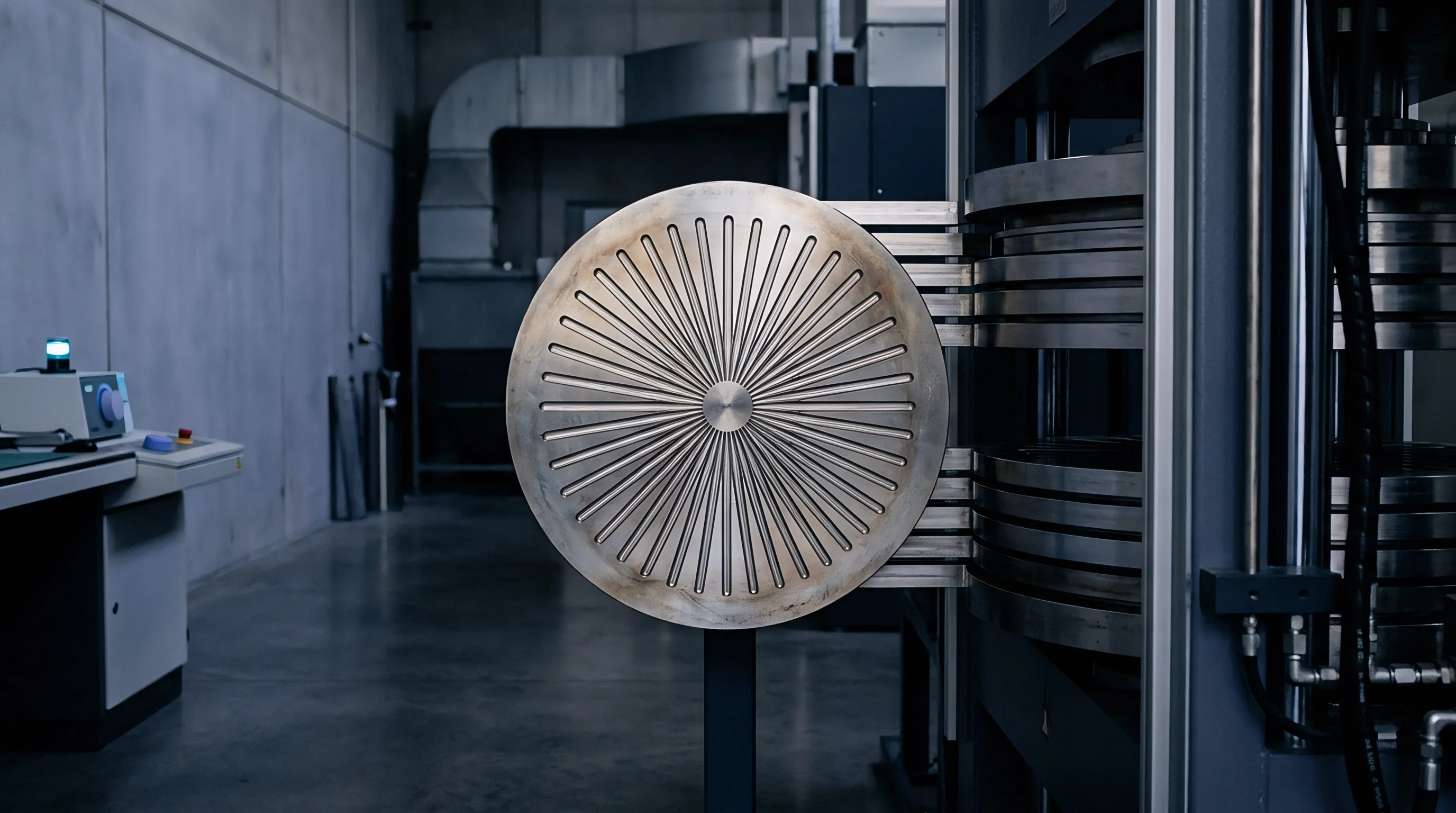
Perforated steel discs transform rotating extruder screw discharge into a parallel linear flow stream. The breaker plate supports screen pack wire meshes against extreme melt pressures reaching 25 MPa. Standard circular hole patterns in conventional breaker plates generate line mark memory in elastic recycled polyethylene melts.
Streamlined breaker plates featuring countersunk holes reduce stagnant dead zones where degraded polymer collects. Retaining degraded gel structures upstream prevents structural weakness in final extruded profiles. Replacing manual screen changers with continuous dual-bolt or sliding-plate screen changers maintains steady head pressure within positive 5 percent parameters.
Specification of ISO 1183 Method A density tolerances within 0.003 g/cm3 restricts die swell variance across batch transitions.
- Continuous Melt Filtration Systems eliminate pressure dips during screen indexing, protecting sensitive die land geometry from thermal shock.
- Differential Pressure Transducers installed upstream and downstream of the filtration unit provide automated signaling for filter screen changeovers.
- Breaker Plate Land Widths must feature polished transition chamfers to prevent polymer stagnation and thermal degradation during long production runs.
- Screen Mesh Compatibility Verification ensures high-weave wire screens resist mechanical compaction under 20 MPa operating pressures.
Quality purchase contracts for high-fraction recycled resin include standard clauses governing maximum allowables for non-melting contaminants. Specifying maximum particulate limits according to ISO 22314 ensures incoming pellet lots will not blind fine screen packs within operating cycles shorter than eight hours.

Margin
Processing instabilites in post-consumer resin extrusions directly degrade delivered profit per metric ton. When die geometry fails to damp feedstock melt flow rate fluctuations, finished products exhibit wall thickness variation exceeding allowable tolerance bands. Extruders must consume excess material to guarantee minimum wall thickness specifications across off-gauge production runs.
Gauge uniformity dictates final yield. Over-indexing part weight by five percent to compensate for wall thickness variation consumes financial margins on thin-margin recycled packaging products. Premium die geometry designs featuring optimized land ratios and thermal zoning recover initial capital investments through raw material savings within months.

Scrap Rate Financials in Fluctuation Streams
Off-gauge extruded sheet and unstable blown film generate regrind volume that consumes plant re-melt capacity. Thermal history accumulates each time polyethylene passes through an extruder screw, degrading antioxidants and shortening polymer chains. Reprocessing internal scrap lowers the physical properties of future production lots.
Excessive shear induces molecular degradation. Scrap rates exceeding 3 percent on high-speed extrusion lines alter landed cost calculations per good unit. Downstream conversion efficiency drops when sheet profiles suffer from edge waviness or thickness gauge bands, causing jam-ups in automated thermoforming or container filling lines.

Tolerance Boundaries for Landed Polyethylene Blends
Purchasing contracts for recycled pellets establish explicit melt flow index ranges tied to incoming lot testing. When feedstock vendors deliver lots displaying melt flow rate variances outside negotiated boundaries, die adjustments reach mechanical limits. Machine operators spend production hours altering lip gaps and heater settings rather than maintaining fixed line speeds.
Extrudate thickness dictates cooling time. Thick gauge bands force operators to slow down line speeds to allow complete crystallization before winding or stacking. A ten percent reduction in line speed to accommodate die pressure instabilities directly inflates energy and labor overhead costs per converted kilogram of recycled resin.
Can real-time melt pressure feedback loops combined with active servo-driven lip adjustment completely eliminate the need for strict feedstock density sorting in post-consumer polyolefin recycling operations?