Capillary Rheometry Testing for Recycled Polyolefin Molding
Capillary rheometry predicts polyolefin mold filling by measuring viscosity and extrudate swell across true cavity shear rates from 1,000 to 50,000 reciprocal seconds.


Velocity

Shear Rates across Injection Molding Cavities
Standard single-point Melt Flow Rate testing under ISO 1133 or ASTM D1238 subjects polymer melts to low shear rates, typically between 1 and 10 reciprocal seconds. Injection molding tools force post-consumer recycled polyolefins through nozzles, runners, and thin gates at shear rates ranging from 1,000 to over 50,000 reciprocal seconds. At these elevated rates, non-Newtonian polyolefin melts undergo extreme shear thinning.
Capillary rheometry measures this true processing behavior across the full shear spectrum encountered during mold filling.
Recycled polypropylene and polyethylene lots possess complex molecular weight distributions caused by repeated thermal processing, mechanical shearing, and variable feedstock sources. Two post-consumer resin lots exhibiting an identical Melt Mass-Flow Rate of 12 grams per 10 minutes at 230 degrees Celsius under a 2.16 kilogram load can display divergence in apparent viscosity when forced through a narrow runner at high velocity. Chain scission reduces long-chain tangles, lowering viscosity at high shear rates, while cross-linked contaminants or high molecular weight fractions increase flow resistance under severe constriction.
At a shear rate of 5,000 reciprocal seconds and 230 degrees Celsius, post-consumer polypropylene exhibits an apparent viscosity 34 percent lower than its single-point melt flow index indicates.
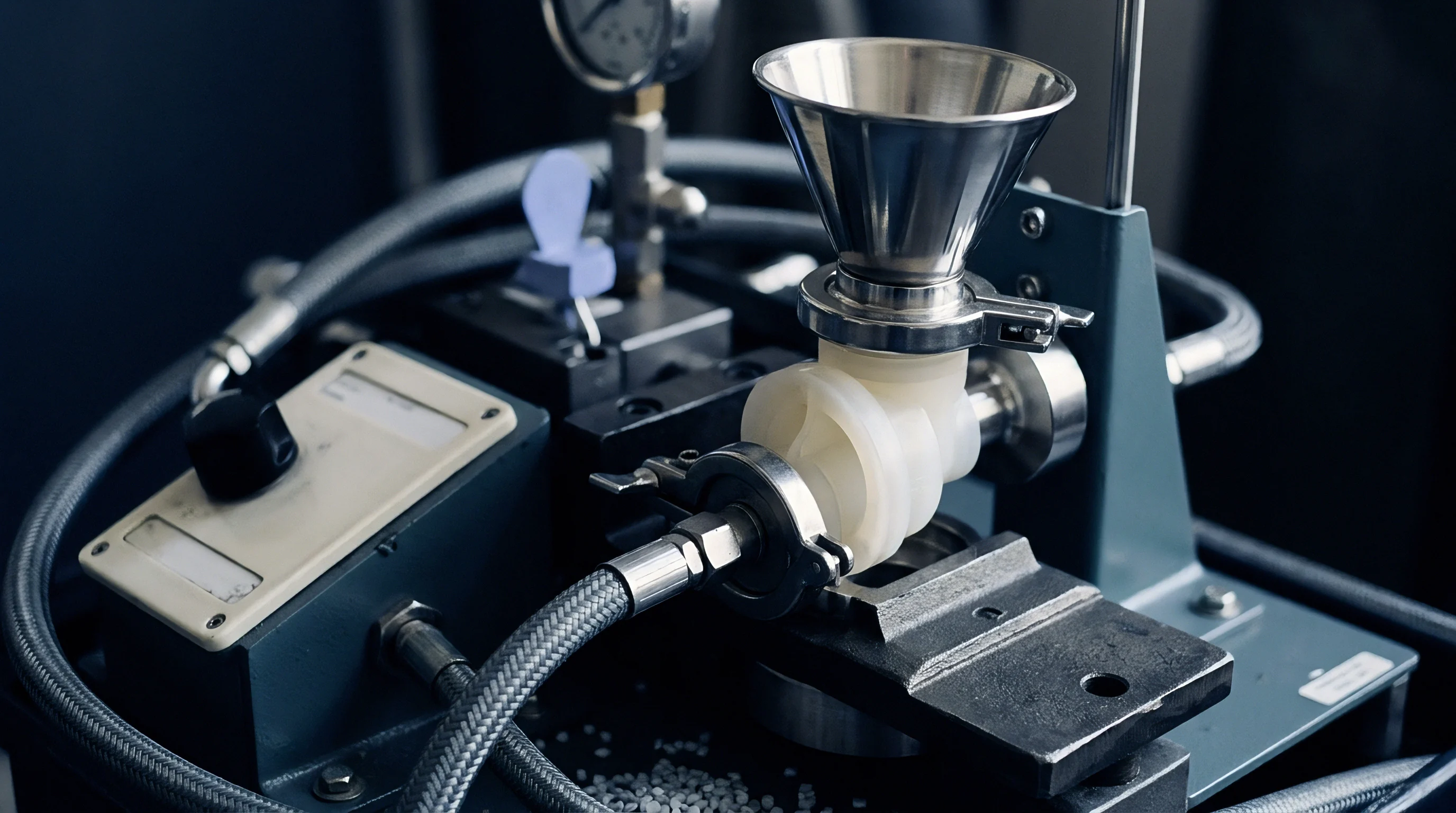
Capillary rheometer barrels maintain controlled temperatures while a precision piston drives melt through a tungsten carbide die at predetermined piston speeds. True shear rate calculations account for the non-Newtonian velocity profile across the capillary bore. Uncorrected shear rate assumes a parabolic velocity profile typical of Newtonian fluids, introducing significant error into recycled polyolefin rheograms.
Applying the Rabinowitsch correction adjusts the nominal shear rate to reflect actual wall shear stress, providing accurate viscosity data for mold flow simulation software.
High molecular weight tail fractions dominate elastic response at lower speeds, whereas shorter degraded chains dominate flow resistance when injection velocities accelerate. Measuring apparent viscosity across four decades of shear rate isolates structural variance that standard quality control passes over.
| Polymer Grade | MFR (230°C/2.16kg) | Viscosity at 100 s⁻¹ | Viscosity at 1,000 s⁻¹ | Viscosity at 10,000 s⁻¹ | Power-Law Index (n) |
|---|---|---|---|---|---|
| Virgin Copolymer PP | 12.0 | 450 | 110 | 28 | 0.36 |
| Post-Consumer PP (Lot A) | 12.1 | 380 | 85 | 19 | 0.29 |
| Post-Consumer PP (Lot B) | 11.8 | 520 | 135 | 34 | 0.41 |
| Recycled HDPE/PP Blend (80/20) | 8.5 | 610 | 140 | 31 | 0.31 |
Wall slip distorts capillary measurements when testing recycled polyolefins containing waxes, processing aids, or residual low-density fractions. Standard capillary calculations assume zero velocity at the die boundary wall. Low molecular weight species and lubricant additives migrate to the wall surface under pressure, creating a thin lubricated layer that causes the bulk polymer to slide rather than shear.
Measuring pressure drop across dies of identical length-to-diameter ratio but varying bore diameters quantifies this slip velocity, allowing engineers to separate true fluid deformation from wall sliding.
Whether wall slip during testing reflects actual cavity wall behavior inside polished tool steel molds remains a subject of ongoing rheological research.


Orifice

Capillary Geometry and Bagley Correction Mechanics
Pressure losses inside a capillary rheometer barrel occur in three distinct zones: the entrance contraction, the fully developed capillary channel, and the exit discharge. Contraction of the polymer stream from the wide barrel bore into a narrow capillary orifice generates massive extensional deformation and pressure losses. Ignoring this entrance pressure drop leads to severe overestimation of wall shear stress and apparent viscosity.
Accurately determining true shear stress requires applying the Bagley correction, which utilizes tests run through multiple capillary dies of differing lengths. Testing a recycled polyolefin batch through a minimum of three dies with length-to-diameter ratios of 10:1, 20:1, and 30:1 at constant shear rates generates a linear pressure plot. Extrapolating the measured pressure drop to a theoretical die length of zero yields the entrance pressure loss attributable entirely to convergent flow elasticity.
Recycled polyolefin lots containing elastomeric impact modifiers or residual cross-linked particles display exceptionally high entrance pressure drops. High extensional viscosity at the orifice entrance increases energy losses during injection molding, demanding higher hydraulic pressures to fill cavities than predicted by simple channel flow models. High-precision testing employs a zero-length orifice die, often called a slit or pinhole die, running simultaneously in a twin-bore capillary rheometer to measure entrance pressure in a single piston stroke.
Extensional flow through restricted geometry exposes structural degradation in recycled polyolefins. Linear low-density polyethylene fractions exhibit distinct strain-hardening behavior in extension, whereas degraded polypropylene chains show rapid strain-softening. Die orifice geometry must maintain strict dimensional tolerances, as minor mechanical wear or scratch damage inside tungsten carbide capillaries shifts calculated shear rates outside acceptable error margins.
A capillary die length-to-diameter ratio below sixteen to one introduces excessive entrance correction errors when testing heterogeneous post-consumer resins.

Plunger

Barrel Thermal History and Sample Loading Protocols
Thermal stability inside the capillary rheometer barrel dictates measurement repeatability for post-consumer compounds. Recycled polyolefins contain residual thermal stabilizers, secondary antioxidants, and varied processing histories. Exposing a test sample to high barrel temperatures over extended residence times induces thermal-oxidative degradation or further cross-linking during the bench test itself.
- Purge the rheometer barrel with a high-viscosity virgin polyolefin cleanout resin at 210 degrees Celsius to remove residual oxidized degraded polymer from previous test runs.
- Clean the barrel bore wall using a brass wire brush attached to an electric drive, followed by lint-free cotton patches dipped in high-temperature silicone solvent until patches emerge clean.
- Insert the selected tungsten carbide capillary die into the barrel base and secure the retaining nut using a calibrated torque wrench set to 25 Newton-meters.
- Set barrel heating zones to target temperature and allow a thirty-minute soak period to ensure complete thermal equilibrium across the barrel block and pressure transducers.
- Weigh 30 grams of dried recycled polyolefin pellets, checking that moisture content measures below 0.05 percent by weight using a coulometric Karl Fischer titrator.
- Pack the sample into the barrel in four incremental charges, tamping each charge firmly with a brass packing rod to expel trapped air pockets.
- Lower the drive rod until the tip rests on the upper sample surface, applying a pre-load force of 50 Newtons to compress the melt bed.
- Allow a pre-heat dwell time of exactly six minutes before initiating the pre-programmed piston speed sequence.
Moisture trapped inside hygroscopic contaminants, such as residual paper fiber or polar polymer impurities like PET and polyamide present in post-consumer polyolefin streams, vaporizes inside the sealed barrel. Steam bubble formation alters melt compressibility, generating artificial pressure fluctuations on the transducer signals. Volatile organic compounds from degraded additives generate similar pressure noise, requiring strict pre-drying protocols regardless of polyolefin hydrophobic nature.
Extended residence inside a heated barrel alters the molecular structure of post-consumer polyolefins long before the test stroke completes.
Piston speed accuracy directly dictates shear rate validity. Modern capillary rheometers utilize servo-electric drive systems capable of maintaining constant plunger velocities down to 0.0001 millimeters per second. At extremely low piston speeds, thermal wall effects and heat transfer back into the unheated upper barrel zone alter melt temperature profiles.
At high speed, friction heating within the narrow die orifice elevates melt temperature beyond set parameters, causing artificial viscous thinning. Transducer selection must match expected pressure ranges to maintain signal-to-noise ratios above one hundred to one.
Conducting capillary tests without strict pre-drying and standardized dwell timing yields viscosity curves that reflect testing thermal history rather than raw resin quality, causing false rejections or catastrophic line failures during molding production runs.

Expansion

Extrudate Swell and Elastic Recovery Mechanisms
Polymer chains exiting a capillary die experience sudden stress relaxation, converting stored elastic energy into physical dimensional expansion. Extrudate swell, also termed die swell, measures the ratio of cooled strand diameter to capillary orifice diameter. High die swell indicates high melt elasticity, driven by high molecular weight fractions, long-chain branching, or broad molecular weight distribution within post-consumer polyolefin compounds.
Elastic recovery directly impacts injection molding part quality, mold filling patterns, and dimensional tolerances. Heavy post-consumer recycling streams often blend high-density polyethylene into polypropylene to boost impact strength. These immiscible polyolefin blends exhibit phase-separated morphologies that store significant elastic energy under high shear, resulting in erratic die swell during gate passage.
| Material Formulation | Testing Temp (°C) | Capillary L/D | Swell Ratio (B) | First Normal Stress (N₁) |
|---|---|---|---|---|
| Virgin Injection Grade PP | 230 | 30:1 | 1.18 | 42 |
| Post-Consumer PP (Crushed Containers) | 230 | 30:1 | 1.34 | 68 |
| Recycled HDPE (Rigid Packaging Stream) | 190 | 30:1 | 1.45 | 85 |
| PCR PP/HDPE Blend (90/10) | 230 | 30:1 | 1.52 | 98 |
Laser micrometer systems mounted below the capillary outlet measure extrudate diameter continuously as a function of shear rate and barrel position. Short dies produce high extrudate swell because short residence time within the capillary channel prevents polymer chains from fully relaxing before exit. Long dies allow internal stress relaxation, reducing observed swelling ratios.
Quantifying extrudate swell across varying shear rates identifies batch-to-batch variation in elastomeric content and chain branching that simple flow rate numbers completely miss.
- Gate Hesitation and Jetting occurs when excessive melt elasticity causes the entering polymer stream to swell rapidly upon leaving the tool gate, snaking across open cavity space instead of forming an expanding laminar flow front.
- Severe Mold Flash appears when low-viscosity high-swell recycled fractions force tool parting lines open under peak packing pressures.
- Differential Part Shrinkage results from non-uniform elastic recovery along flow paths, causing warp and dimensional instability in long-thin structural parts.
- Surface Melt Fracture manifests as sharkskin or gross melt fracture on molded parts when wall shear stress exceeds critical structural limits at gate exits.
Unexpected part distortion is often attributed to tool cooling variation when unmeasured elastic swell recovery is actually driving dimensional change in the cavity.
Disparity

When Does Single Point Melt Flow Fail Polyolefin Molders?
Melt Flow Rate testing under ISO 1133 measures mass extruded through a standard orifice over ten minutes under a constant deadweight load. A single load condition evaluates viscosity at only one fixed shear stress point, typically corresponding to shear rates below 10 reciprocal seconds. Injection molding processes operate deep within the shear-thinning regime, far removed from the low-shear plateau measured by gravity-driven extruders.
Two post-consumer polyolefin lots can display identical single-point Melt Flow Rate values while possessing radically different shear viscosity curves across operational injection speeds. Non-linear viscosity curves cross over as shear rates increase. Lot A may possess higher zero-shear viscosity than Lot B due to high molecular weight tail presence, yielding a lower Melt Flow Rate number.
Under high shear rates inside a cold runner, Lot A shears thin rapidly, achieving a lower viscosity than Lot B at 5,000 reciprocal seconds.
High-shear capillary rheometry maps the entire viscosity transfer function across five orders of magnitude. Characterizing the power-law index, zero-shear viscosity, and transition shear rate provides the complete rheological signature required for finite-element mold filling analysis. Relying solely on Melt Flow Rate datasheets forces molders to adjust injection pressure profiles empirically for every incoming lot, driving up scrap rates and extending setup times.
Compliance under ISO 11443 method A binds the compounder to a dual-orifice Bagley correction that eliminates entrance pressure errors from reported shear viscosity curves.
Contaminant presence severely distorts single-point test validity. Fine particulate matter, cross-linked gels, and inorganic fillers accumulate in the entry zone of standard melt indexer dies, partially clogging the orifice during the ten-minute test window. This artificial flow restriction lowers the reported Melt Flow Rate figure, presenting the resin as a stiffer, higher molecular weight grade than it actually is.
In high-speed capillary rheometry, high piston forces push past minor particulate blockages, revealing true matrix viscosity while identifying high-shear pressure spikes caused by hard particulate contamination.
| Parameter | Melt Flow Indexer (ISO 1133) | High-Pressure Capillary Rheometer (ISO 11443) |
|---|---|---|
| Primary Shear Rate Range | 1 s⁻¹ to 15 s⁻¹ | 10 s⁻¹ to 100,000 s⁻¹ |
| Deformation Type | Uncontrolled shear force | Controlled strain rate / controlled stress |
| Correction Capabilities | None | Bagley (entrance) and Rabinowitsch (wall profile) |
| Elasticity Measurement | Manual cut-and-weigh swell (inaccurate) | Real-time laser extrudate swell / entrance pressure drop |
| Sensitivity to Contaminants | Orifice clogging skews low rate readings | High-shear transient force spikes isolate gel fraction |
| Process Correlation | Correlates to resin compression and sag | Correlates to runner drop, gate pressure, and fill time |
Consider a compounder producing a 40-tonne batch of post-consumer polypropylene intended for thin-wall packaging containers. Assume the target injection pressure limit on the molder machine is 180 Megapascals at a cavity shear rate of 8,000 reciprocal seconds. Datasheet qualification using only ISO 1133 shows an acceptable Melt Flow Rate of 25 grams per 10 minutes.
Subsequent capillary testing under ISO 11443 at 230 degrees Celsius reveals an apparent viscosity of 45 Pascal-seconds at 8,000 reciprocal seconds, compared to the baseline virgin resin viscosity of 32 Pascal-seconds at the same shear rate.
Injecting this batch under fixed machine parameters requires hydraulic pressure exceeding tool safety limits, triggering short shots on 12 percent of production cycles. At a delivered compound price of 1,250 Euros per tonne and an injection molding machine operating cost of 95 Euros per hour, running unverified material generates 6,000 Euros in scrap and downtime losses within a single shift. Capillary rheometry testing catches the viscosity deviation before the compound leaves the recycling plant.
A purchase contract incorporating ISO 11443 capillary rheometry data mandates that apparent viscosity across 1,000 to 10,000 reciprocal seconds remains within a plus-or-minus eight percent band around agreed reference curves, legally replacing single-point melt flow metrics for high-speed molding grade qualifications.


Discipline
Commercial Specifications and Lot Acceptance Metrics
Incorporating capillary rheometry criteria into resin supply agreements shifts quality enforcement upstream to the compounder floor. Buyers specifying post-consumer polyolefins face continuous feed variability driven by seasonal collection shifts, sorting efficiency changes, and feedstock source changes. Establishing rigorous rheological acceptance bands protects molding operations against silent formulation drift.
Standard commercial specifications must define precise test conditions, including die geometry, temperature profile, shear rate range, and correction algorithms applied. Quoting high-shear viscosity numbers without specifying Bagley and Rabinowitsch corrections renders data legally non-binding during supply disputes.
- Viscosity Window Clause specifies that apparent shear viscosity across 500 to 5,000 reciprocal seconds at 230 degrees Celsius shall not deviate by more than six percent from the qualified master reference curve established under ISO 11443.
- Extrudate Swell Limit Clause establishes a maximum allowable extrudate swell ratio of 1.35 when tested through a 20:1 L/D capillary die at 2,000 reciprocal seconds, preventing gate jetting and flash defects.
- Thermal Stability Index Clause mandates that apparent viscosity measured after twelve minutes of barrel residence time at test temperature shall remain within five percent of the value measured at six minutes residence time.
- Contaminant Pressure Transient Clause defines maximum allowable pressure signal variance during constant-speed plunger displacement, rejecting lots displaying force spikes indicative of cross-linked gels or particulate matter.
Quality assurance protocols require testing a representative composite sample from every 20-tonne lot prior to silo loading. Sampling procedure must follow ISO 11648 standards, taking incremental core samples across bulk packaging containers to account for particle size segregation during transit.
Integrating automated capillary rheometer testing into incoming inspection reduces mold setup times, eliminates trial-and-error processing adjustments, and enforces commercial accountability across post-consumer polyolefin supply chains.