Capillary Rheology Qualification Protocols for High Strain Extrusion Regrind
Twin-bore capillary testing at 1,000 to 10,000 s⁻¹ qualifies high-strain regrind by isolating entrance losses, true wall slip, and elastic die swell shifts.

Geometry
Incoming inspection of high molecular weight polyethylene and polypropylene extrusion scrap faces an immediate laboratory hurdle: standard melt flow indexers operating under ISO 1133 Procedure A or ASTM D1238 at 2.16 kg or 5 kg apply shear rates rarely exceeding 50 reciprocal seconds. High-speed pipe corrugation, thin-wall profile extrusion, and blown film tooling routinely subject the polymer melt to apparent shear rates between 1,000 and 10,000 reciprocal seconds within the die land. Measuring reprocessed regrind exclusively through single-point melt mass-flow rate conceals thermal degradation, chain branching alterations, and gel contamination that emerge only under severe shear deformation.
The raw melt flow index deceives. A reprocessed fractional-melt high density polyethylene lot displaying an acceptable 0.35 g/10 min at 190 degrees Celsius under 2.16 kg can exhibit severe shear-thinning failure and pressure spikes when forced through a profile calibration head. Chain scission generated during prior thermal passes reduces weight-average molecular weight while cross-linking or high molecular weight tail formation alters the polydispersity index.
Capillary rheometry conducted in accordance with ISO 11443 and ASTM D3835 provides the multi-decade flow curves required to qualify these scrap fractions before compounding lines accept them into production.
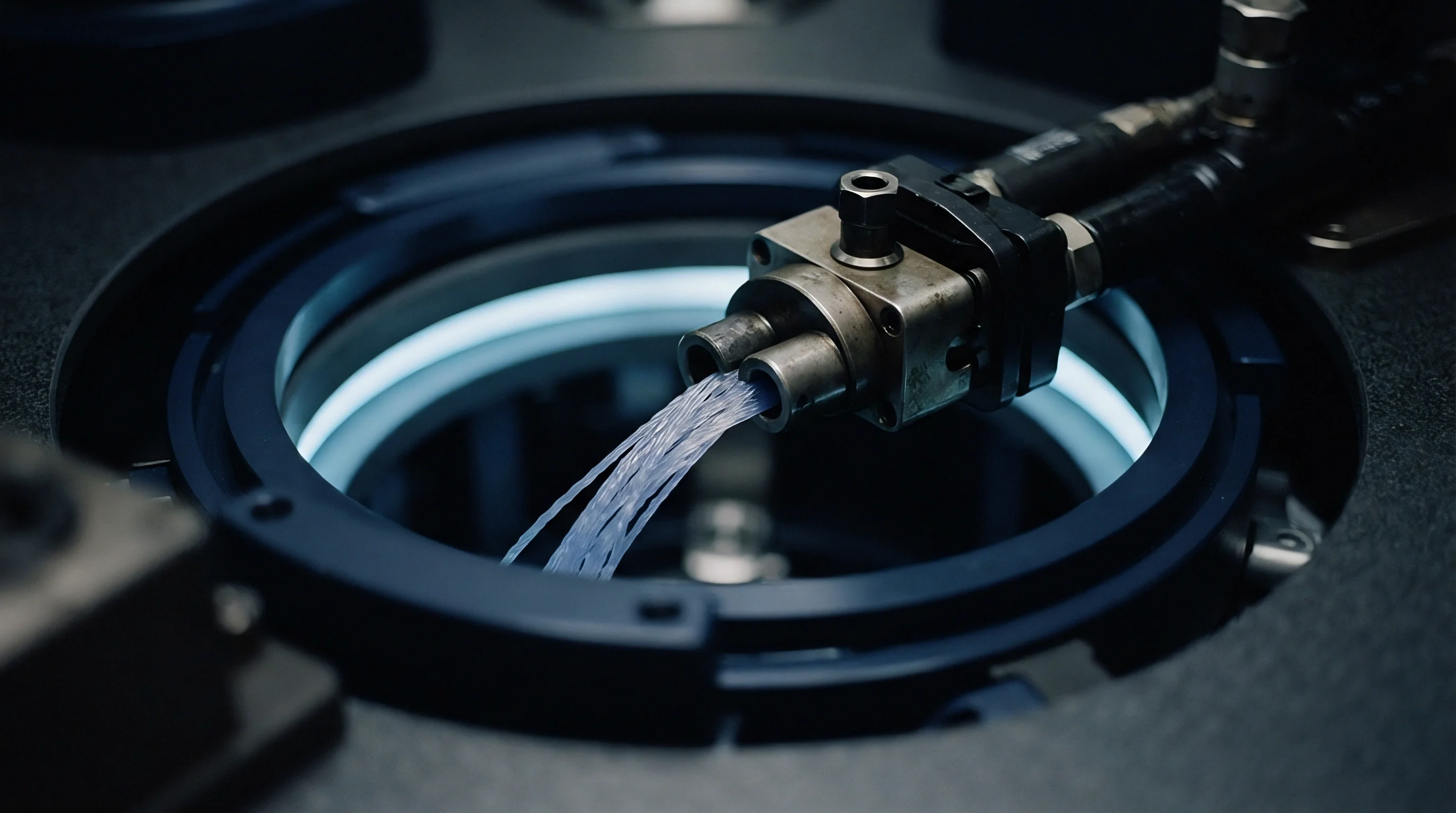
A capillary rheometer forces molten polymer through precision tungsten carbide dies of fixed length-to-diameter ratios at controlled piston velocities. Barrel temperature regulation within 0.1 degrees Celsius maintains isothermal conditions across the test reservoir. Twin-bore rheometer configurations measure pressure drops across both an orifice die with an effective length approaching zero millimeters and a long die with a length-to-diameter ratio of sixteen, twenty, or thirty to one.
High shear thins the polymer chains. Piston speed programming steps the shear rate through five hundred, one thousand, two thousand five hundred, five thousand, and ten thousand reciprocal seconds. Pressure transducers record the surge.
ASTM D3835 test runs at 190 degrees Celsius using a zero-length orifice die isolate entrance pressure drop from steady shear dissipation.
Extracting true viscosity values from raw pressure data demands mathematical corrections that account for non-Newtonian flow profiles and die entrance phenomena. Uncorrected data skews true shear viscosity. Molten thermoplastics entering a constricted die orifice undergo converging flow, generating substantial extensional deformation and an associated entrance pressure loss.
Neglecting this entrance loss leads to an overestimation of true shear stress along the die wall.
- Bagley correction execution subtracts the entrance and exit pressure drops by plotting total driving pressure against die length-to-diameter ratios across multiple capillary dies.
- Weissenberg-Rabinowitsch correction protocol adjusts apparent wall shear rate to account for shear-thinning non-Newtonian velocity profiles typical of broad molecular weight distribution polyolefins.
- Hagenbach kinetic energy subtraction eliminates inertial pressure losses generated during extreme piston travel rates through narrow capillary bores.
Short dies exaggerate end effects. When processing high-strain regrind lots, the Bagley entrance pressure drop serves as an indirect measurement of melt elasticity. Lots with identical low-shear viscosity curves routinely separate under entrance pressure analysis.
Secondary processors often argue that minor shifts in zero-shear viscosity remain manageable through barrel temperature adjustments, ignoring how high-shear entrance pressures overload extruder thrust bearings.


Swell
Elastic memory within extruded parisons and profiles dictates part wall thickness, corner definition, and sizing tank vacuum stability. When polymer chains undergo high-rate deformation within the capillary channel, molecular coils stretch along streamlines. Upon exiting the die restraint into ambient air or water, these oriented macromolecules snap back toward random thermodynamic coils, creating extrudate diameter expansion relative to the die bore diameter.
Degraded chains lose elastic recovery.
Mechanical recycling cycles subject resins to repeat thermo-mechanical histories that alter molecular weight distribution and degrade long-chain branching. In fractional-melt high density polyethylene used for high-strain corrugated drainage pipe, repeated thermal exposure breaks down the ultra-high molecular weight fraction responsible for melt strength. Capillary extrudate swell testing measures the ratio of solidified or cooled strand diameter to capillary die diameter, utilizing optical laser micrometer arrays positioned between five and twenty millimeters below the die exit plane.

Can Entrance Pressure Drops Reveal Regrind Blending?
Entrance pressure losses scale directly with the first normal stress difference in converging flow zones. Virgin extrusion grade polyethylenes exhibit high entrance pressure drops and high die swell ratios because entangled high molecular weight networks store mechanical work elastically during die entry. Reprocessed regrind containing thermal scission fragments exhibits steep drops in elastic energy storage, producing lower swell ratios under matching shear stress.
Capillary testing exposes the shift.
Contamination in flake lots introduces opposite anomalies. Post-consumer regrind contaminated with cross-linked fractions or polypropylene fractions within a polyethylene base creates elastic heterogeneity. The presence of five percent polypropylene contamination inside high density polyethylene increases the extrudate swell unpredictability by inducing interfacial slip between phase-separated domains.
| Virgin to Regrind Ratio | MFR at 190°C / 2.16 kg (g/10 min) | True Viscosity at 1,000 s⁻¹ (Pa·s) | Bagley Entrance Loss (MPa) | Die Swell Ratio (Boresize 1 mm) | Critical Shear Stress (MPa) |
|---|---|---|---|---|---|
| 100% Prime Blow Molding Grade | 0.32 | 440 | 8.2 | 1.58 | 0.28 |
| 85% Prime / 15% In-House Regrind | 0.34 | 425 | 7.9 | 1.54 | 0.27 |
| 70% Prime / 30% Post-Industrial Scrap | 0.41 | 380 | 6.4 | 1.41 | 0.23 |
| 50% Prime / 50% Post-Industrial Scrap | 0.52 | 315 | 4.8 | 1.26 | 0.19 |
| 100% Reprocessed Commercial Flake | 0.78 | 220 | 3.1 | 1.12 | 0.14 |
Laser measurement of extrudate strand diameters reveals transient relaxations that single-point factory tests miss entirely. At an apparent shear rate of 2,500 reciprocal seconds, virgin blow molding polyethylene expands to 1.58 times the die diameter. The commercial regrind flake expands to only 1.12 times the bore diameter, creating parison sag and blowouts during downstream tooling expansion cycles.
Die swell ratios drop toward unity as cumulative thermal history scissions the long polymer chains responsible for elastic memory.
Extrudate distortion begins at the land. In continuous profile lines running profile calibrations, this shortfall in die swell alters vacuum calibration tank contact. Profiles pull away from calibrator walls, causing uneven cooling rates, severe geometric ovality, and structural failure under standard ring stiffness testing.
Melt elasticity controls profile contact during sizing.
Slip
Apparent shear stress across a capillary wall increases with piston speed until reaching an operational boundary where the polymer melt detaches from the metallic tool boundary. Wall shear stress drives the defect. In virgin resins with uniform molecular architectures, polymer adhesion to tungsten carbide or chrome-plated tool walls remains predictable.
High-strain extrusion regrind containing residual processing aids, fatty acid lubricants, and degraded low molecular weight waxes exhibits early boundary layer failure.
Wall slippage breaks the classical no-slip boundary condition underlying Poiseuille flow calculations. Mooney analysis quantifies this slip velocity by running identical reprocessed formulations through capillary dies sharing identical length-to-diameter ratios while possessing distinct bore diameters: typically 0.5 mm, 1.0 mm, and 2.0 mm. Plotting apparent shear rate against the reciprocal of capillary diameter at fixed shear stress yields a straight line whose slope defines double the wall slip velocity.

Does True Wall Shear Rate Predict Profile Tearing?
Shorter polymer chains slip faster. Degraded low molecular weight fractions migrate toward high-shear die wall zones via stress-induced diffusion, forming a lubricated boundary layer. This localized layer decouples bulk core flow from wall drag, masking real changes in bulk melt strength.
When extrusion dies operate at wall shear stresses above 0.15 megapascals, sudden slippage causes severe stick-slip oscillations, manifest as surface sharkskin or macroscopic gross melt fracture.
- Sharkskin surface haze arises from high tensile stresses focused at the die exit lip where the polymer skin accelerates rapidly from wall stagnation to the extrudate core velocity.
- Stick-slip pressure fluctuations develop when shear stress alternates between static adherence and dynamic slip conditions, producing cyclical barrel pressure variations.
- Gross melt fracture helices emerge from entrance vortex instabilities inside the die converging cone, twisting extrudate profiles before calibrator entry.
- Additive plate-out segregation occurs when shear fields force migrated stearates and residual calcium carbonates out of solution, coating calibration surfaces with abrasive debris.
Tolerances collapse during profile calibration. Unstable wall slip generates cyclic variations in line backpressure, causing wall thickness fluctuations along the extruded strand. A supplier shipping unwashed industrial scrap often claims that standard fluoropolymer processing aids remedy all profile tearing issues.
Whether fluoropolymer masterbatch additions mask deep molecular scission without restoring transverse tensile strength in finished pipes remains a persistent technical conflict across compounding facilities.

Audit
Securing uniform processability across multi-container lots of reprocessed pellets mandates rigorous incoming verification protocols that operate prior to silo discharge. Standard sampling plans operating under ISO 2859-1 General Inspection Level II require ten core samples per 20-tonne truckload, blended into a composite inspection batch. Lab results protect the extruder barrel.
The qualification sequence establishes pass-fail criteria derived from a three-point capillary rheology dossier rather than single-point melt index sheets. Incoming inspection protocols must establish tight acceptance windows on both true shear viscosity and entrance pressure drop at operational extrusion rates. A delivery exhibiting true viscosity divergence greater than eight percent at 2,500 reciprocal seconds triggers automated lot quarantine.
Twin-bore capillary units running automated Bagley and Rabinowitsch corrections generate qualification datasets within twenty minutes per run. Nitrogen purging inside the barrel reservoir prevents oxidative degradation during the pre-heat soak cycle. Solid test pellets enter the heated barrel, where a five-minute dwell time achieves thermal equilibrium without inducing thermal decomposition.
A lot clearance certificate lacking twin-bore pressure data leaves the compounder exposed to downstream pipe burst liabilities under ISO 1167 hydrostatic tests.
Verification protocols mandate documentary verification alongside physical rheometry. Compounders blending post-industrial or post-consumer regrind into structural applications supply certificates of analysis that tie specific resin lots to verified thermal histories and filtration mesh levels. Screen changer pack specifications must match the rheometer orifice tolerances to catch micro-gels that disrupt high-strain capillary dies.
- Certificate of analysis verification cross-checks declared melt mass-flow rates against three-point capillary viscosity curves generated at 500, 2,500, and 5,000 reciprocal seconds under ISO 11443.
- Moisture titration verification quantifies residual volatile content via Karl Fischer oven titration under ISO 15512 to eliminate steam venting voids during high-rate shear processing.
- Differential scanning calorimetry verification scans melting enthalpy under ISO 11357-3 to detect incompatible polymer contamination down to 0.5 percent by mass.
- Ash content measurement verifies inorganic filler and pigment loading via calcination at 600 degrees Celsius under ISO 3451-1 to prevent capillary die bore abrasion.
Commercial agreements govern these physical boundaries through purchase specification annexes. Standard contract clauses dictate that shipments failing high-shear viscosity tolerance bands undergo immediate return at seller expense, nullifying supplier terms that restrict material warranties solely to low-shear ASTM D1238 data sheets.

Margin
Procuring reprocessed extrusion polymers represents an ongoing financial balance between discounted resin purchase prices and line operational scrap costs. Clean virgin HDPE blow molding and profile extrusion grades maintain market pricing near 1,280 dollars per metric tonne delivered. Post-industrial regrind fractions trade between 780 and 920 dollars per metric tonne, promising raw material cost reductions exceeding twenty-five percent.
Off-spec resin consumes operating profit.
Realized processing margins depend entirely on production line yields. High-strain extrusion profiles running at three hundred meters per hour generate rapid scrap accumulations when melt instabilities strike. Tooling shutdown, barrel purging, and die disassembly consume labor hours and resin inventory.
A processing facility running unverified scrap lots risks catastrophic tool jamming when degraded gel fractions block narrow die gaps.
| Feedstock Configuration | Pellet Cost ($/Tonne) | Capillary Testing Overhead ($/Tonne) | Extrusion Line Scrap Rate (%) | Calibrator Purge Downtime (hr/lot) | Finished Part Net Cost ($/Tonne) |
|---|---|---|---|---|---|
| 100% Prime Virgin Copolymer | 1,280 | 0 | 1.8% | 0.5 | 1,335 |
| 80% Prime / 20% Unscreened Flake | 1,180 | 0 | 7.4% | 4.2 | 1,348 |
| 80% Prime / 20% Qualified Regrind | 1,192 | 12 | 2.4% | 1.0 | 1,262 |
| 50% Prime / 50% Qualified Regrind | 1,060 | 14 | 3.6% | 1.8 | 1,142 |
| 100% Reprocessed Unqualified Scrap | 850 | 0 | 16.5% | 11.5 | 1,195 |
Incorporating incoming capillary rheology audits introduces a testing overhead of twelve to fourteen dollars per metric tonne of purchased regrind. This testing overhead amortizes lab capital equipment and technician labor over bulk procurement volumes. Implementing this qualification step cuts production line scrap rates from 7.4 percent down to 2.4 percent on twenty percent regrind lines, preserving twenty dollars per tonne in net conversion margins.
A twelve-dollar testing fee per tonne avoids eight thousand dollars in profile line downtime across a single operating shift.
Ignoring capillary shear evaluation while pushing regrind fractions toward fifty percent causes production lines to suffer severe wall tearing, frequent sizing tank vacuum collapses, and continuous thickness rejections that convert anticipated raw material savings into catastrophic floor scrap and customer warranty rejections.