Capillary Rheometry Corrections and Mooney Wall Slip Analysis for Polyolefin Blends
Capillary rheometry requires Bagley and Rabinowitsch-Weissenberg corrections alongside Mooney wall slip analysis to prevent polyolefin blend die miscalculations.

Entry
Pressure drop measurements obtained during capillary extrusion reflect the combined resistance of fully developed viscous flow inside the die channel and localized convergence effects at the die inlet. When molten polyolefin blends pass from a large-diameter barrel into a narrow capillary orifice, the abrupt contraction accelerates the polymer stream, generating strong extensional deformation alongside shear forces. This geometric transition stores elastic energy within the entangled polymer chains and dissipates energy through viscous heat generation.
Standard rheometer pressure transducers sit upstream in the barrel cavity, recording the total system pressure rather than the true pressure gradient within the die land length. Raw capillary data that fails to isolate entrance and exit pressure losses drastically overestimates the shear stress operating at the capillary wall.
Die pressure drops vary. Deconvoluting the entrance energy loss from the steady-state capillary channel pressure drop requires the application of the Bagley correction. This empirical method utilizes a series of dies possessing identical capillary orifice diameters but varying land length-to-diameter ratios.
By plotting the total measured extrusion pressure against the length-to-diameter ratio at a constant apparent shear rate, a linear trendline emerges. Extrapolating this line back to a theoretical length-to-diameter ratio of zero isolates the Bagley end-correction pressure loss. Subtracting this entrance value from total system pressure yields the true wall shear stress needed for accurate rheological characterization.
The Bagley end-correction pressure for a forty percent high-density polyethylene and sixty percent polypropylene compound reaches 4.2 MPa at a shear rate of 1,000 reciprocal seconds under 190 °C melt conditions.
Polyolefin blends exhibit entrance pressure losses that depend strongly on phase co-continuity, long-chain branching, and interfacial tension between constituent polymers. Linear low-density polyethylene contains uniform short-chain branches that generate modest extensional resistance during die entry contraction. High-pressure low-density polyethylene carries dense long-chain branching that produces pronounced strain-hardening in extensional flow, escalating the Bagley end-correction pressure.
In immiscible polyolefin compounds, droplets of the dispersed phase deform into elongated threads within the entry contraction zone. This phase stretching absorbs additional mechanical work, creating a non-linear elevation in end-pressure losses as the apparent shear rate increases.
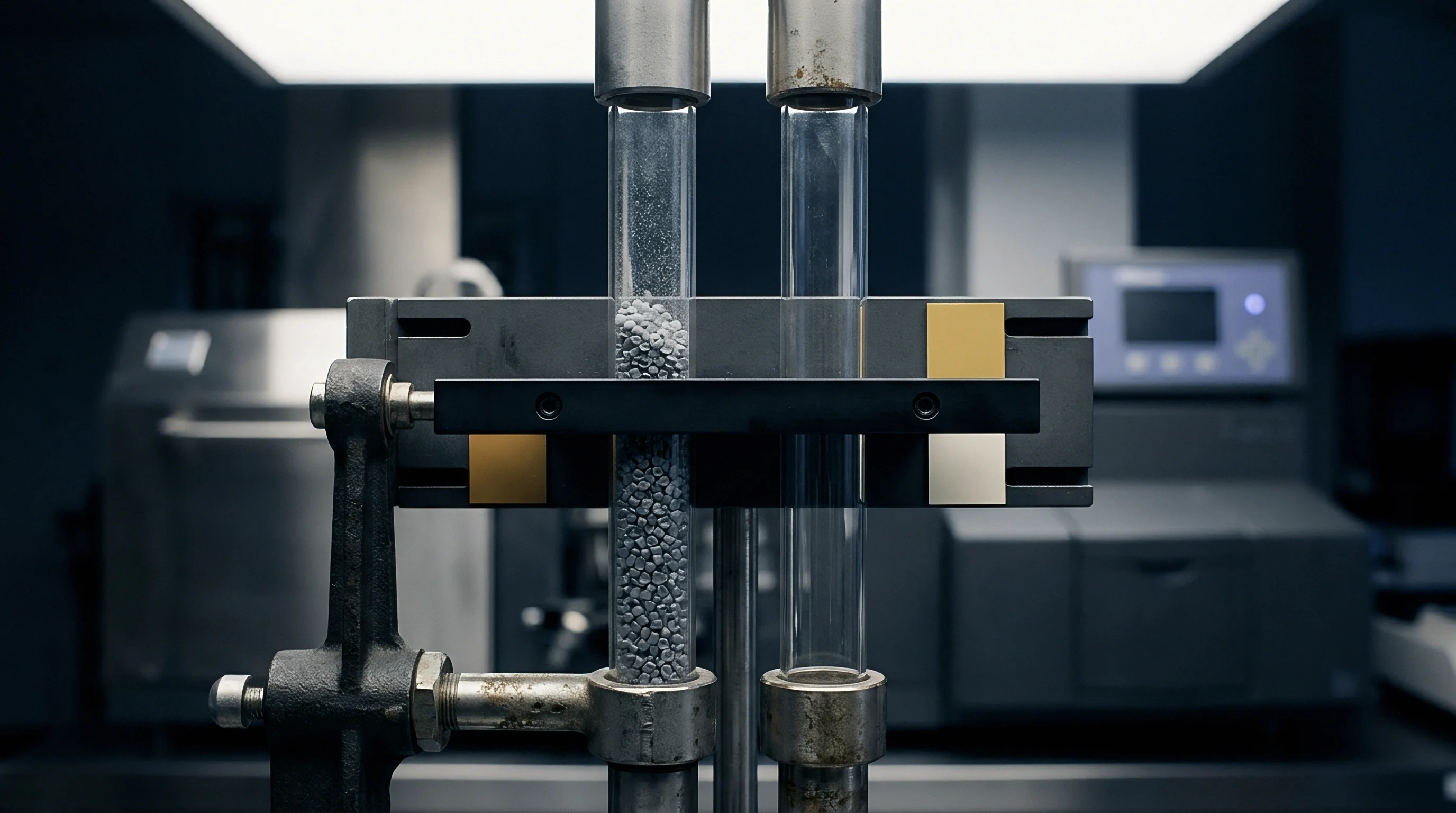
Entrance pressure losses remain significant. Multi-bore capillary rheometers accelerate the data collection process by capturing raw pressure data across three distinct die geometries simultaneously during a single piston stroke. The laboratory executes the Bagley correction through a systematic sequence of operations.
- Mount capillary dies sharing an identical internal orifice diameter of 1.0 mm but carrying length-to-diameter ratios of 10, 20, and 30 into adjacent barrel channels.
- Thermalize the capillary rheometer barrel and die block at the target extrusion temperature for twenty minutes to eliminate internal thermal gradients.
- Pack polyolefin blend pellets into the barrel bores, deploying a pre-conditioning purge stroke to evacuate entrapped air bubbles from the melt column.
- Drive the rheometer pistons down at incremental speed steps to impose matching apparent shear rates across all active capillary channels.
- Record steady-state pressure signals from the upstream transducers once hydraulic equilibrium establishes at each programmed shear rate stage.
- Construct the Bagley extrapolation plot by mapping total pressure against die length-to-diameter ratio for every shear rate interval.
- Calculate the corrected wall shear stress by dividing the pressure-line slope by four.
Neglecting the Bagley correction in polyolefin blend processing corrupts downstream die design calculations, leading engineers to over-specify barrel pressures and select undersized motor drives that stall under actual plant production rates.

Velocity
Shear rate determinations inside a circular capillary tube rely initially on the assumption of a parabolic profile characteristic of Newtonian fluids. Polyolefin melts depart significantly from Newtonian behavior, exhibiting pronounced shear-thinning characteristics at industrial processing temperatures. As the shear rate rises, entanglements between polyolefin chains disengage faster than thermal motion can re-establish them.
This structural breakdown flattens the velocity distribution across the capillary bore, producing a plug-like flow core in the center flanked by steep velocity gradients adjacent to the die wall. Apparent shear rates calculated strictly from volumetric flow rate formulas severely understate the true strain rate experienced by the polymer melt at the wall boundary.
Shear rate gradients stay steep. Evaluating the true shear rate at the capillary boundary requires the Rabinowitsch-Weissenberg correction. This mathematical transform accounts for fluid non-Newtonian behavior by introducing a correction factor derived from the slope of the corrected wall shear stress plotted against the apparent shear rate on logarithmic axes.
The slope represents the power-law index of the polyolefin blend at a given deformation state. Multiplying the apparent shear rate by the Rabinowitsch-Weissenberg factor converts the nominal flow variable into the true wall shear rate, establishing an accurate relationship between stress and deformation in non-linear fluid mechanics.
Uniform logarithmic power-law slopes indicate steady molecular entanglement structures across the tested shear range.
Polyolefin blend compositions directly alter the magnitude of the Rabinowitsch-Weissenberg correction factor. Broad molecular weight distributions broaden the shear-thinning transition zone, causing the power-law index to drop rapidly at lower shear rates than narrow molecular weight distribution metallocene resins. Blending polypropylene with linear low-density polyethylene produces phase-separated morphologies that accentuate non-Newtonian response curves.
At low shear rates, the compound behaves like a viscous matrix carrying dispersed domains, but under high shear stresses, the dispersed phase deforms into parallel layers that slide over one another, accelerating the drop in pseudoplastic index.
| Polyolefin Resin Grade | Test Temperature (°C) | Apparent Shear Rate (s⁻¹) | Power-Law Index (n) | Correction Factor (b) | True Wall Shear Rate (s⁻¹) |
|---|---|---|---|---|---|
| Homopolymer PP (MFR 3.0) | 230 | 500 | 0.32 | 1.53 | 765 |
| LLDPE / Hexene (MI 1.0) | 190 | 500 | 0.45 | 1.31 | 655 |
| HDPE Unimodal (MI 0.3) | 190 | 500 | 0.28 | 1.64 | 820 |
| Post-Consumer PE/PP Blend (70/30) | 200 | 500 | 0.36 | 1.44 | 720 |
| Metallocene LLDPE (MI 2.0) | 190 | 1,000 | 0.58 | 1.18 | 1,180 |
| Data collected using zero-length and 30 mm land dies (1.0 mm bore diameter) following ISO 11443 procedure A methods. Correction factor b equals (3n + 1) divided by 4n. | |||||
Incorrect shear rate corrections propagate directly into production compounding errors. Polymer suppliers frequently assert that a single-point Melt Flow Rate value calculated per ISO 1133 provides sufficient quality control data to predict high-shear extrusion performance in profile die tooling.
Interphase
Extrusion calculations assume that molten polyolefin compounds adhere perfectly to metallic die walls, setting the fluid velocity at the solid boundary precisely to zero. High molecular weight polyolefins, particularly linear low-density polyethylene and immiscible post-consumer blends, violate this non-slip boundary condition above critical shear stress thresholds. Slippage occurs when polymer chains detach from the metal oxide layer of the capillary interior or when a low-viscosity phase segregates to the boundary layer, forming a thin lubrication film.
Under slip conditions, volumetric throughput stems from both bulk viscous deformation and solid-body sliding of the melt core along the boundary layer.
Wall slip alters mass discharge. Resolving slip velocity requires Mooney wall slip analysis, a protocol utilizing capillary dies that share identical length-to-diameter ratios but feature different internal bore radii. If wall slip remains absent, plotting apparent shear rate against the inverse of capillary radius at a fixed wall shear stress produces a horizontal line.
When slippage occurs, this plot yields a positive linear slope. The magnitude of this slope equals four times the wall slip velocity at that specific shear stress level. Subtracting the slip contribution from total volumetric flow isolates the true bulk deformation flow rate of the polyolefin compound.
Fluoropolymer additives migrate outward rapidly. Processing aids tailored for polyolefin blow molding and film extrusion operate by deliberately inducing controlled wall slip. These fluoroelastomer additives possess low surface energy and limited thermodynamic compatibility with polyolefin matrices.
During capillary flow, fluoropolymer droplets migrate radially toward the high-shear region at the wall, coating the steel bore with a microscopic lubricating surface layer. This coating alters the boundary condition, dropping wall shear stress and eliminating surface melt fracture defects like sharkskin. Disentangling true fluid viscosity from processing aid slip mechanics requires systematic Mooney capillary evaluations across multiple die diameters.
- Sharkskin Surface Melt Fracture manifests as high-frequency periodic surface roughness occurring when localized tensile stresses at the die exit exceed the melt strength of the polyolefin boundary layer.
- Gross Melt Fracture emerges as severe helical or irregular distortion across the extruded strand caused by sticky-slip instabilities inside the capillary entry region.
- Phase-Segregated Boundary Lubrication occurs in polyolefin blends when the component possessing lower melt viscosity migrates to the die perimeter under shear gradients.
- Additive Interfacial Phase Separation develops when low-molecular-weight waxes, fatty acid amides, or fluoropolymer processing aids exudate from the bulk matrix onto the capillary wall.
Analyzing Mooney slip lines requires gathering precise flow metrics across variable die radii at consistent wall shear stress levels. The dataset demonstrates how apparent shear rates escalate as die channel dimensions shrink under slipping conditions.
| Wall Shear Stress (kPa) | Capillary Radius (mm) | 1 / Radius (mm⁻¹) | Apparent Shear Rate (s⁻¹) | Derived Slip Velocity (mm/s) |
|---|---|---|---|---|
| 120 | 1.00 | 1.00 | 320 | 0.00 |
| 120 | 0.50 | 2.00 | 321 | 0.00 |
| 160 | 1.00 | 1.00 | 580 | 1.25 |
| 160 | 0.50 | 2.00 | 630 | 1.25 |
| 200 | 1.00 | 1.00 | 910 | 4.50 |
| 200 | 0.50 | 2.00 | 1,090 | 4.50 |
A standard resin purchasing contract enforcing ISO 11443 adherence binds suppliers to deliver capillary rheology data generated on dies possessing smooth land surfaces with root-mean-square roughness below 0.15 micrometers.
How does the addition of heavily filled mineral compounds alter the critical shear stress threshold for boundary slippage in recycled polyolefin streams?


Morphology
Phase architecture inside polyolefin blends evolves continuously under the intense shear stress fields present within capillary rheometer dies. Immiscible combinations, such as polypropylene mixed with polyethylene, exist as multi-phase emulsions in the melt state. In the low-shear environment of the rheometer barrel, the minor phase forms spherical droplets dispersed within the continuous matrix.
As the piston forces the mixture into the capillary land, hydrodynamics drive droplet deformation, stretching spherical domains into elongated fibrils. If the shear rate exceeds interfacial cohesive forces, these fibrils breakup into finer droplets, fundamentally altering the local flow impedance of the fluid stream.
Can Capillary Corrected Viscosity Predict Shear-Induced Phase Inversion in Polyolefin Post-Consumer Recyclate Blends?
Shear-induced phase inversion occurs when high deformation rates force the lower viscosity dispersed phase to form a continuous network around the higher viscosity matrix. In post-consumer polyolefin waste streams carrying variable polypropylene and polyethylene ratios, this transition alters flow viscosity unpredictably. Corrected capillary rheometry detects these structural shifts through slope discontinuities in the wall shear stress versus true shear rate flow curves.
When phase inversion occurs, the apparent power-law index shifts sharply, rendering single-shear corrections invalid across broad operational processing windows.
Viscous dissipation generates localized heat. At shear rates exceeding 2,000 reciprocal seconds, internal friction within high-viscosity polyolefin melts elevates local temperatures along the capillary center line by up to 15 °C above the set barrel temperature. Because polyolefin melt viscosity decreases exponentially with temperature following Arrhenius or Williams-Landel-Ferry relationships, localized thermal softening reduces measured wall shear stress.
Uncorrected thermal dissipation mimics shear-thinning behavior, masking true rheological properties and leading compounders to miscalculate molecular weight distribution parameters.
Polymer chains align under shear. Repeated processing cycles degrade post-consumer polyolefin blends through chain scission, dropping molecular weight and shifting the rheological onset of shear thinning to higher shear rates. Thermal-oxidative degradation during extrusion depletes primary phenolic antioxidants, causing radical crosslinking in polyethylene fractions or chain scission in polypropylene domains.
Capillary rheometry corrections expose these degradation pathways by tracking variations in Bagley end-pressures, which drop proportionally as elastic chain entanglements break down under mechanical degradation.
Viscous dissipation temperature rises inside small capillary channels mask true structural shear thinning behavior when thermal feedback corrections are omitted.
Purchasing dossiers specifying polyolefin recyclates reference ISO 11443 Annex A, which mandates that reported shear viscosity curves include a maximum allowable calculated temperature rise from viscous heating not exceeding 2.0 °C across the primary measurement range.
Tooling
Translating capillary rheometry corrections into production tool designs bridges the gap between laboratory characterization and factory-floor performance. Extrusion dies for film, pipe, and profile geometries rely on precise wall shear stress profiles to guarantee uniform wall thickness and prevent localized stagnation zones. Applying uncorrected raw capillary data to die flow channel calculations results in incorrect land length determinations, incorrect balancing of manifold channels, and unexpected pressure drops that force line operators to run equipment outside target thermal windows.
Apparent values mislead tooling designers. Accurately sizing industrial die dimensions demands a rigorous decision framework when reviewing resin qualification dossiers for incoming polyolefin compounds.
- Bagley End-Correction Assessment confirms that wall shear stress metrics account for entry pressure drops, preventing under-sizing of die manifold depth and extruder drive torque.
- Rabinowitsch-Weissenberg Rate Verification ensures that true shear rate values guide the calculation of die land length-to-gap ratios for crosshead pipe dies.
- Mooney Wall Slip Characterization identifies the operational shear stress ceiling above which sharkskin melt fracture damages product surface appearance.
- Viscous Dissipation Thermal Mapping validates that high-shear runner channels in injection molds will not overheat temperature-sensitive polyolefin color concentrates.
- Phase Morphology Stability Audits check that shear-induced phase inversion will not cause flow front splitting in complex profile dies.
Verification protocols for resin purchasing dossiers require explicit reporting of geometry specifications, transducer limits, and mathematical correction steps executed during testing.
| Parameter Type | Standard Tolerance | Impact of Non-Compliance | Required Correction Step |
|---|---|---|---|
| Capillary Bore Diameter | ± 0.005 mm | 4% error in shear rate calculations | Optical calibration check |
| Die Land Length (L) | ± 0.010 mm | Direct shift in apparent shear stress | Bagley multi-length plot |
| Entrance Angle (Flat 180°) | ± 0.5 Degrees | Altered vortex formation at die entry | Standardized entrance die entry |
| Pressure Transducer Range | ± 0.5% Full Scale | Signal drift at low shear rates | Multi-point span calibration |
| Barrel Temperature Control | ± 0.2 °C | Viscosity curve shift across spectrum | Isothermal soak protocol |
Pressure transducers require precise calibration. Converting corrected rheometer data into commercial die designs requires matching the operational shear rate of the industrial die land to the corrected capillary measurement window.
Resin specifications that omit Rabinowitsch-Weissenberg true shear rate corrections leave processing engineers vulnerable to unpredicted swell dynamics at the die exit face.