Standardized Threshold of Toxicological Concern Derivation for Unidentified High Molecular Weight Recycled Polyolefin Oligomers
Deriving standardized toxicological concern thresholds for unidentified recycled polyolefin oligomers requires splitting migrated mass at 1000 Daltons and applying Cramer Class III limits to the bioavailable fraction.


Grain
Mechanical recycling of post-consumer polyolefins introduces a complex, highly distributed mass of oligomeric substances that virgin polymer synthesis simply does not produce in comparable patterns. Polyethylene and polypropylene undergo successive thermal-mechanical stress cycles through wash steps, melt filtration, re-pelletization, and final conversion. Thermal degradation causes chain scission alongside radical cross-linking, shifting the molecular weight distribution of the base polymer downward and yielding an unresolved complex mixture of oligomers ranging from two hundred to well beyond two thousand Daltons.
These substances include saturated polyolefin oligomers, unsaturated polyolefin mono-olefins, oxidized degradation species such as aliphatic ketones, alcohols, and carboxylic acids, and branched alkyl fragments. On gas chromatography, this material shows broad chromatographic humps that resist baseline separation into individual molecular structures.
Unidentified polyolefin oligomeric saturated hydrocarbons present a specific toxicological evaluation challenge because conventional gas chromatography-mass spectrometry matching cannot determine their precise chemical structures. Chromatographic humps, frequently termed unresolved complex mixtures, consist of thousands of overlapping isomeric alkyl species. Synthesized polyalphaolefins and mineral oil saturated hydrocarbons exhibit similar chromatographic profiles, yet post-consumer recycled polyolefins carry additional structural diversity caused by residual catalyst fragments, masterbatch carrier waxes, printing ink solvent residues, and thermo-oxidative degradation during consumer use and reprocessing.
When testing food contact materials manufactured from recycled high-density polyethylene or polypropylene, migration extracts routinely yield significant quantified masses within these unresolved chromatographic humps. Standard toxicological evaluation demands structural identification to assign specific migration limits or reference doses. Without structural identification, safety evaluation relies on standardized toxicological threshold frameworks designed specifically for substances of unknown structure.
Tenax migration testing at sixty degrees Celsius for ten days establishes the baseline oligomeric diffusion coefficient across high-density recycled polyethylene structures.
The Threshold of Toxicological Concern framework provides a protocol for evaluating substances present at low concentrations when chemical structure is unknown or toxicological data are absent. Standard application of this framework relies on human exposure thresholds derived from chronic toxicity databases categorized by chemical structure using the Cramer decision tree. Cramer Class I covers simple structures with efficient metabolic pathways and low oral toxicity, carrying a human exposure threshold of eighteen hundred micrograms per person per day.
Cramer Class III covers structures that suggest significant toxicity or lack initial indications of safety, carrying a conservative threshold of ninety micrograms per person per day. High molecular weight oligomers found in recycled polyolefins introduce an essential boundary condition to this evaluation model: systemic toxicity requires absorption across biological membranes. Macromolecules exceeding specific molecular weight thresholds cannot cross the mammalian intestinal epithelium in toxicologically relevant quantities.
Systemic bio-accessibility of aliphatic hydrocarbons drops precipitously as molecular weight rises above five hundred Daltons, reaching virtual zero above one thousand Daltons. The human intestinal mucosal barrier consists of enterocyte cell membranes and tight junctional networks that restrict passive paracellular and transcellular transport of non-polar hydrophobic molecules. Linear and branched alkanes below five hundred Daltons exhibit measurable passive absorption into lymphatic fluid and systemic circulation, where they accumulate in fatty tissues, liver lymph nodes, and spleen.
Oligomers spanning five hundred to one thousand Daltons exhibit limited, molecular-weight-dependent uptake rates. Fractions exceeding one thousand Daltons remain confined to the intestinal lumen, passing through the gastrointestinal tract without systemic bioavailability. Toxicological threshold derivation for unidentified recycled polyolefin oligomers must explicitly account for this molecular weight cut-off to prevent severe over-estimation of systemic exposure hazards.
Virgin resins contain tightly controlled oligomeric fractions generated purely as reaction byproducts of polymerization, whereas recycled polyolefins carry a thermal history of secondary and tertiary degradation compounds. Mechanical extrusion at temperatures between two hundred and two hundred and eighty degrees Celsius breaks polymer backbones via beta-scission, forming terminal alkenes and internal vinylidene groups. Exposure to ambient oxygen during thermal processing generates hydroperoxides that decompose into volatile and semi-volatile oxygenated species.
When these materials come into contact with fatty food simulants or dry food matrices, low and medium molecular weight oligomeric components migrate rapidly driven by chemical potential gradients. The total migrating mass often reaches tens of milligrams per kilogram of food, far exceeding the standard generic migration limits applied to fully identified additives under regional food contact regulations.
Treating unresolved chromatographic humps as inert, fully saturated linear alkanes structurally identical to food-grade paraffin waxes overlooks the degradation products and additives that necessitate toxicological evaluation and migration control.

Filter
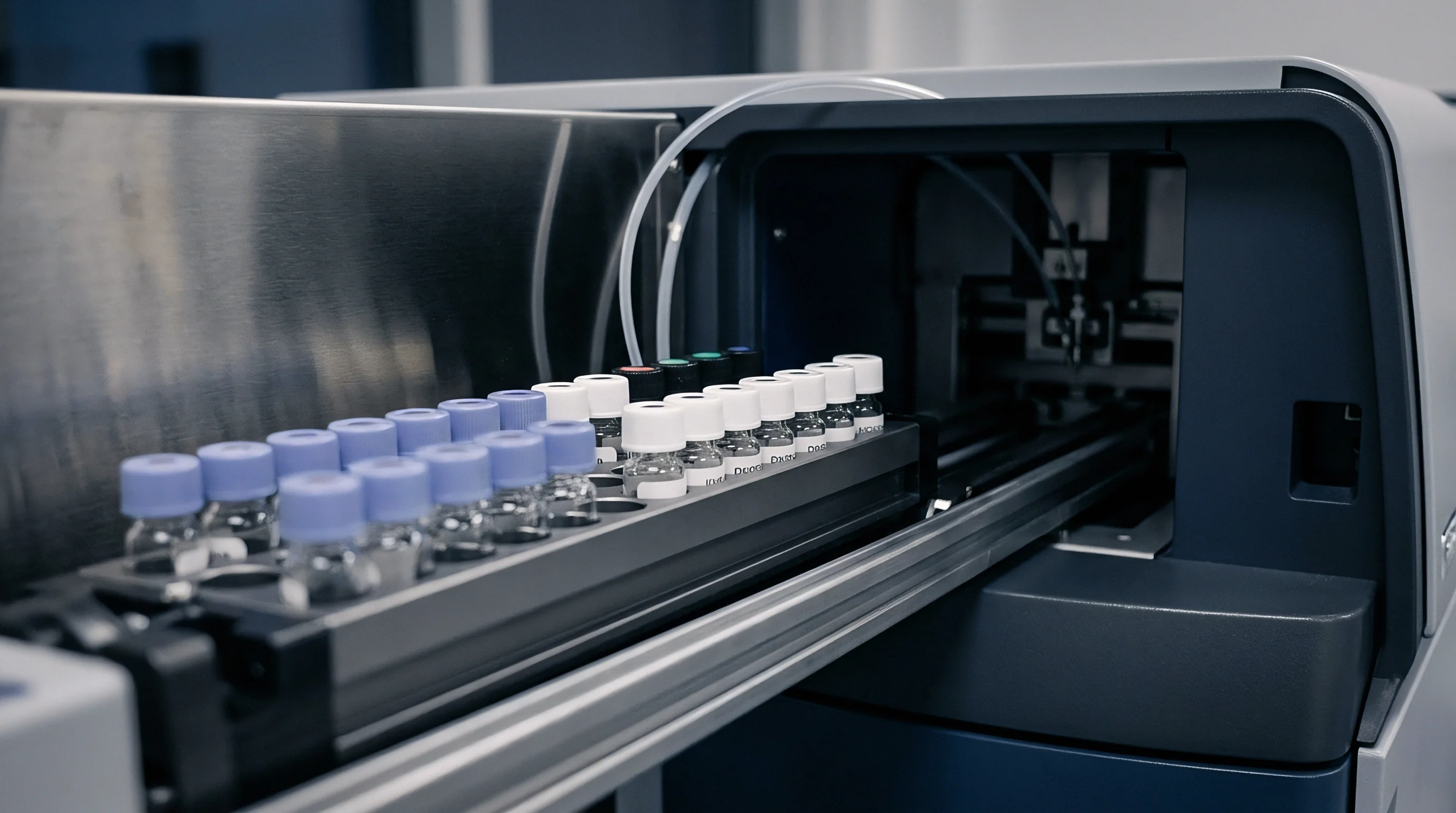
Analytical resolution of unidentified recycled polyolefin oligomers requires a multi-stage chromatographic separation workflow before toxicological thresholds can be applied. Single-dimension gas chromatography with flame ionization detection quantifies total hydrocarbons but fails to separate saturated species from unsaturated or oxygenated compounds. Gas chromatography coupled with mass spectrometry yields uninterpretable electron ionization spectra when hundreds of isomeric peaks co-elute within a single retention time window.
The laboratory must implement comprehensive two-dimensional gas chromatography combined with high-resolution time-of-flight mass spectrometry, or online liquid chromatography linked directly to gas chromatography and flame ionization detection. These hyphenated techniques physically partition the extract into distinct chemical classes prior to volatilization and separation by boiling point.
Saturated oligomers separate cleanly from aromatic and polar degradation products through silver nitrate impregnated silica gel or liquid chromatography columns packed with modified stationary phases. Liquid chromatography first isolates the saturated hydrocarbon fraction, which passes directly to gas chromatography for thermal separation. Olefinic and aromatic species stay on the LC column and elute separately into subsequent GC channels.
High molecular weight components that exceed the volatilization temperature ceiling of standard gas chromatography, typically species above C50 or seven hundred Daltons, remain on the injection port or column head. Gel permeation chromatography, also termed size-exclusion chromatography, provides the essential pre-fractionation step needed to separate the volatile and semi-volatile fractions below one thousand Daltons from non-volatile macromolecules that cannot cross human cellular membranes.
Because oligomer diffusion depends directly on molecular weight, gel permeation chromatography uses porous styrene-divinylbenzene or organo-silica stationary phases optimized for low molecular weight polymer separation. Tetrahydrofuran, toluene, or hot trichlorobenzene serves as the mobile phase. By calibrating the column set with narrow polystyrene or polyolefin standards, the chemist isolates the specific mass fraction migrating below the one thousand Dalton molecular weight threshold.
The mass fraction below one thousand Daltons represents the toxicologically active fraction that demands threshold evaluation. The fraction above one thousand Daltons is quantified separately to confirm complete exclusion from systemic absorption models, satisfying safety requirements without imposing unnecessary restriction on non-bioavailable polymer backbone fractions.
| Analytical Method | Fraction Resolved | Molecular Weight Window | Detection Limit | Primary Chromatographic Limitation |
|---|---|---|---|---|
| LC-GC-FID | Saturated vs Aromatic Hydrocarbons | 150 to 750 Daltons | 0.1 mg/kg resin | Inability to resolve individual isomers within humps |
| GCxGC-TOF-MS | Iso-alkanes, Cyclo-alkanes, Olefins | 100 to 600 Daltons | 0.01 mg/kg resin | Spectral overlap for high molecular weight isomers |
| HT-GPC / SEC | Total Molecular Weight Distribution | 300 to 100,000 Daltons | 1.0 mg/kg resin | Low chromatographic resolution in sub-1000 Da region |
| MALDI-TOF-MS | Intact High Molecular Weight Oligomers | 500 to 10,000 Daltons | 0.05 mg/kg resin | Ionization efficiency variations across structure types |
Mechanical recycling processes generate specific thermal degradation pathways that alter the physical and chemical profile of polyolefin matrices. Chemical profiling of mechanical recyclers across central Europe reveals distinct fingerprints linked directly to melt filtration temperatures and degassing efficiency. Identifying these degradation pathways allows analytical chemists to target specific chemical classes during screening protocols.
- Thermo-oxidative backbone scission generates terminal vinyl unsaturations and short-chain alkyl radicals that recombine into complex branched aliphatic isomers.
- Hydroperoxide decomposition produces middle-chain aliphatic ketones, aldehydes, and primary alcohols that increase extract toxicity relative to pure hydrocarbons.
- Shear-induced mechanochemical degradation breaks high molecular weight polymer chains during twin-screw extrusion, enriching the sub-one-thousand Dalton oligomeric pool.
- Secondary radical recombination forms highly substituted cyclo-alkanes and cross-linked aliphatic structures with unpredictable chromatographic retention behaviors.
Because elevated temperatures accelerate extraction, selecting appropriate contact times and temperatures during food simulant testing dictates whether analytical extracts mirror real-world consumer exposure or cause artificial polymer breakdown. Iso-octane and ninety-five percent ethanol act as aggressive swelling agents on polyolefins, expanding the amorphous polymer matrix and accelerating the diffusion rate of low molecular weight oligomers. Tenax, a porous polymer of poly(2,6-diphenyl-p-phenylene oxide), serves as the standardized simulant for dry foods and high-temperature contact conditions.
The mass of oligomer collected in the simulant must be normalized against the contact surface area and expressed in milligrams per square decimeter or milligrams per kilogram of food simulant.
A persistent analytical challenge arises when quantifying total extractable mass in the sub-one-thousand Dalton region versus the total migrating mass under actual conditions of use. Extractability testing using total immersion in refluxing solvents yields thermodynamic equilibrium limits, whereas migration testing measures kinetic transport controlled by diffusion coefficients and partitioning constants. Safety evaluation rests on actual migration.
When kinetic migration data are unavailable, mathematical diffusion modeling based on the Piringer equation provides conservative estimates of migration potential. The model uses polymer density, molecular weight of the migrant, and temperature-dependent diffusion parameters to calculate upper-bound migration values for unidentified polyolefin oligomers.
Establishing verified recovery factors for unidentified oligomeric humps remains an analytical hurdle when pure reference standards for isomeric polyolefin species do not exist commercially.


Calculus
Deriving a standardized Threshold of Toxicological Concern for unidentified high molecular weight recycled polyolefin oligomers requires synthesizing chemical structure classifications, toxicological exposure baselines, and bio-accessibility parameters into a decision matrix. Traditional TTC workflows assign structural alerts based on known chemical structures. For unidentified oligomeric humps where individual structures are unresolved, toxicological evaluation assumes a worst-case chemical classification unless structural screening proves the absence of high-potency toxicophores.
Carcinogenic compounds, organophosphates, and heavy metals represent high-potency toxicophores that carry exceptionally low exposure thresholds. Polyolefin chemistry and recycling process parameters rule out organophosphates and heavy metals within hydrocarbon fractions, but potential DNA-reactive mutagens must be addressed explicitly.
DNA-reactive mutagens carry a standardized threshold of one point five micrograms per person per day, corresponding to a nominal concentration of zero point zero zero two five milligrams per kilogram of food based on a standard daily consumption of one kilogram of packaged food. Applying this threshold across the entire mass of an unidentified polyolefin oligomer hump would render virtually all recycled polyolefin resins non-compliant, as total oligomer migration routinely exceeds zero point five milligrams per kilogram of food. To resolve this constraint, high-resolution mass spectrometry screening and bacterial reverse mutation assays, such as the Salmonella typhimurium Ames test, must demonstrate that the isolated oligomer fraction contains no alkylating agents, structural alerts for genotoxicity, or aromatic mutagens.
Once genotoxicity is empirically excluded, the oligomer mixture transitions from the genotoxic threshold tier to the Cramer structural class thresholds.
How Do High Molecular Weight Oligomers Exceed Traditional Thresholds?
Because unresolved chromatographic humps require mathematical thresholds, saturated linear and branched polyolefin oligomers containing no functional groups fall structurally into Cramer Class I under standard rules due to their simple metabolic conversion pathways via omega-oxidation to fatty acids. Cramer Class I assigns an oral intake threshold of eighteen hundred micrograms per person per day, which equates to three milligrams per kilogram of food for a sixty kilogram adult consuming one kilogram of food daily. However, recycled polyolefins contain oxidized species, branched isomers, and cyclo-aliphatic structures formed during thermal reprocessing.
These oxidized and cyclic species lack verified structural identity, obligating the toxicologist to assign the conservative Cramer Class III threshold of ninety micrograms per person per day, equivalent to zero point one five milligrams per kilogram of food.
Toxicological derivation integrates molecular weight distribution data to refine the operational exposure threshold. The total migrating oligomer mass is divided into two distinct toxicological pools: the low molecular weight sub-one-thousand Dalton fraction and the high molecular weight extra-one-thousand Dalton fraction. The sub-one-thousand Dalton fraction is evaluated directly against the Cramer Class III threshold of zero point one five milligrams per kilogram of food.
The extra-one-thousand Dalton fraction, lacking systemic bioavailability, is exempted from systemic toxicological thresholds and evaluated strictly for local gastrointestinal tract irritative effects. Local gastrointestinal toxicity for inert hydrocarbon polymers occurs only at exceptionally high oral doses, establishing a non-systemic safety limit orders of magnitude higher than systemic thresholds.
Systemic bio-accessibility drops to zero above one thousand Daltons, removing high molecular weight oligomers from systemic Cramer Class thresholds.
Deriving the unified safe concentration limit in food relies on a multi-step mathematical procedure that combines chromatographic integration, molecular weight splitting, and Cramer Class application.
- Quantify the total migrating hydrocarbon mass in the food simulant extract using liquid chromatography gas chromatography flame ionization detection.
- Determine the precise mass fraction below one thousand Daltons using calibrated high-temperature gel permeation chromatography.
- Screen the isolated sub-one-thousand Dalton fraction for genotoxic structural alerts using high-resolution mass spectrometry and an Ames mutagenicity assay.
- Calculate the maximum allowable sub-one-thousand Dalton migration concentration using the Cramer Class III human exposure limit of ninety micrograms per person per day.
- Verify that the total calculated daily exposure from the sub-one-thousand Dalton fraction remains below the Cramer Class III limit when scaled for food contact packaging consumption scenarios.
A shipment of recycled polypropylene pellets was held after gas chromatography revealed an unresolved complex mixture exceeding thirty milligrams per kilogram. The initial datasheet claimed full food-contact compliance based on virgin resin standards. Subsequent size-exclusion chromatography proved that eighty-eight percent of the migrating mass exceeded twelve hundred Daltons, bringing the systemically active sub-one-thousand Dalton fraction below the Cramer Class III threshold of zero point one five milligrams per kilogram of food.
| TTC Evaluation Tier | Structural Assumption / Criterion | Human Intake Limit (µg/person/day) | Food Concentration Limit (mg/kg food) | Required Verification Standard |
|---|---|---|---|---|
| Genotoxic / DNA-Reactive | Unscreened extract containing structural alerts | 1.5 | 0.0025 | HRMS screening and Ames Test (OECD 471) |
| Cramer Class III | Unidentified sub-1000 Da oxidized/branched oligomers | 90.0 | 0.1500 | LC-GC-FID quantification of sub-1000 Da mass |
| Cramer Class I | Fully characterized linear/branched saturated alkane oligomers | 1800.0 | 3.0000 | Spectroscopic proof of complete saturation and lack of functional groups |
| Non-Bioavailable High MW | Oligomers exceeding 1000 Daltons molecular weight | 50000.0 | 83.3300 | HT-GPC calibration confirming MW > 1000 Da boundary |
Applying toxicological thresholds requires scaling for specific packaging applications. A standard infant formula container exhibits a higher surface-area-to-volume exposure ratio per kilogram of body weight than a bulk storage drum for adult food products. Regulatory default assumptions prescribe a standardized ratio of six square decimeters of packaging material contacting one kilogram of food.
For infant exposure scenarios, body-weight scaling factors increase conservative safety margins tenfold, reducing the allowable concentration of unidentified sub-one-thousand Dalton polyolefin oligomers in infant food to fifteen micrograms per kilogram. Toxicological clearance dossiers must document the intended food contact demographic alongside physical food simulant test data.
When analytical testing indicates that sub-one-thousand Dalton oligomer migration exceeds the Cramer Class III threshold, resin refiners must implement decontamination steps to strip volatile and semi-volatile fractions. Vacuum devolatilization during twin-screw extrusion removes low molecular weight oligomers up to C25 or three hundred and fifty Daltons. Deep vacuum stripping at elevated melt temperatures under nitrogen sparging extends oligomer removal up to five hundred Daltons, systematically shifting the molecular weight distribution of the remaining oligomeric pool into the non-bioavailable region above one thousand Daltons.
This processing intervention directly reduces the systemically active migrant mass, restoring compliance under standardized TTC derivation protocols.
Extensive structural branching in polyolefin oligomers reduces biological degradation rates without increasing systemic absorption potential beyond established molecular weight cut-offs.

Contact
Verification of toxicological concern thresholds for unidentified recycled polyolefin oligomers depends entirely on the design of migration testing. Regulatory frameworks dictate specific food simulants to mimic the extraction behavior of real foods. Ethanol ten percent volume by volume represents aqueous foods, acetic acid three percent mass by volume represents acidic foods, ethanol fifty percent volume by volume represents oil-in-water emulsions, and vegetable oil, iso-octane, or modified polyphenylene oxide represent fatty foods.
Polyolefins are non-polar hydrocarbon polymers that exhibit minimal interaction with aqueous or acidic simulants. Consequently, oligomer migration occurs almost exclusively into fatty food simulants. Selecting the appropriate fatty food simulant and exposure condition governs the scientific validity of the resulting analytical data.
Lacking functional handles, polyolefins exhibit migration kinetics governed primarily by migrant diffusion through the amorphous regions of the polymer network and partitioning at the polymer-food interface. Diffusion coefficients in polyolefins are high compared to rigid polymers like polyethylene terephthalate or polycarbonate. Low molecular weight oligomers migrate rapidly at ambient room temperatures, reaching thermodynamic equilibrium within standard shelf-life durations.
Testing protocols must accelerate this diffusion process without altering the physical state of the polymer matrix. Exceeding the glass transition or melting temperature of the polymer during migration testing induces artificial matrix collapse or swelling, artificially elevating oligomer extraction and invalidating compliance calculations.
Standardized test conditions prescribed under European Union Regulation 10/2011 define specific time and temperature combinations designed to represent worst-case foreseeable contact scenarios. Ten days at forty degrees Celsius models long-term storage at ambient conditions. Ten days at sixty degrees Celsius models intermediate thermal treatment or prolonged shelf life above room temperature.
High-temperature applications, such as microwave heating or hot-filling, require short exposure durations at elevated temperatures, such as two hours at one hundred and seventy-five degrees Celsius using Tenax. Testing with liquid fatty simulants like olive oil or vegetable oil presents substantial analytical difficulty because the simulant itself consists of triglycerides that interfere with gas chromatographic analysis of polyolefin oligomers. Solvent extraction of the simulant transfers massive fatty acid matrix peaks that obscure the unidentified polyolefin oligomer hump.
To overcome matrix interference from vegetable oils, substitute simulants such as iso-octane and ninety-five percent ethanol are deployed under defined equivalence conditions. Iso-octane testing performed for two days at twenty degrees Celsius or two days at forty degrees Celsius simulates long-term contact with fatty foods. Ninety-five percent ethanol testing for ten days at sixty degrees Celsius models aggressive extraction conditions.
However, iso-octane induces significant swelling in polyolefin matrices, particularly low-density polyethylene and polypropylene. Swelling expands the free volume between polymer chains, increasing the diffusion coefficient of oligomers by up to two orders of magnitude. When using substitute simulants, analytical reports must state whether measured oligomer values reflect true equilibrium migration or swollen solvent extraction artifacts.
Substitute simulants like iso-octane induce swelling in low-density polyolefins, elevating measured oligomer diffusion rates beyond actual food contact values.
Evaluating migration reports demands systematic audit of test design and laboratory accreditation, tracing every chromatographic signal back to its extraction yield through a structured qualification framework.
- Simulant Compatibility Verification establishes that the selected simulant matches the physical properties of the intended food contact surface without causing excessive structural dissolution of the polyolefin substrate.
- Temperature-Time Mapping confirms that testing conditions accurately represent real-world shelf-life thermal stress without exceeding the thermal distortion limit of the polyolefin resin.
- Internal Standard Recovery Calibration requires adding deuterated aliphatic hydrocarbon internal standards across the target retention time window to quantify extraction recovery efficiency.
- Sub-1000 Dalton Fraction Isolation validates that size-exclusion chromatography cleanly splits the migrated mass into bioavailable and non-bioavailable fractions prior to toxicological comparison.
- Genotoxicity Screening Integration ensures that extracts evaluated against Cramer Class III thresholds carry negative mutagenicity results from verified bacterial reverse mutation assays.
Mathematical diffusion modeling using the Piringer model provides a recognized alternative to physical migration testing, particularly during resin development phases. The model calculates the upper-bound migration value based on the initial concentration of the migrant in the polymer, the molecular weight of the migrant, the contact temperature, contact duration, polymer density, and a polymer-specific diffusion parameter denoted as A-prime. Polymer density directly influences the diffusion parameter: high-density polyethylene exhibits an A-prime value of thirteen, whereas polypropylene exhibits an A-prime value of fifteen point five, reflecting its higher free volume and faster migrant transport kinetics.
For unidentified oligomeric humps, diffusion modeling must use the lowest molecular weight detected within the chromatographic hump, typically two hundred Daltons, to calculate conservative upper-bound migration figures for the entire sub-one-thousand Dalton mass fraction.
| Contact Application | Standardized Simulant | Test Duration & Temperature | Polymer Swelling Impact | Primary Kinetic Mechanism |
|---|---|---|---|---|
| Ambient Long-Term Storage (>30 days) | 3% Acetic Acid / 10% Ethanol | 10 days at 40°C | Negligible matrix swell | Fickian diffusion limited by matrix density |
| Fatty Food Ambient Storage | Iso-octane (Substitute) | 2 days at 20°C | Moderate matrix expansion | Accelerated diffusion via solvent absorption |
| Hot-Fill / High Temperature | Tenax (MPPO) | 2 hours at 175°C | Zero swelling, high thermal desorption | Vapor-phase volatility and surface adsorption |
| Refrigerated Storage with Fatty Layer | 95% Ethanol (Substitute) | 10 days at 60°C | High matrix swell in LDPE/PP | Convection-enhanced matrix leaching |
Because post-consumer resins demand continuous batch testing, commercial supply contracts for recycled polyolefins in food packaging must incorporate explicit testing frequency rules. Relying on an annual test report from a single resin lot exposes the buyer to catastrophic compliance failure, as post-consumer feedstocks fluctuate in oligomeric density and non-intentionally added substance profiles between production runs. Quality control protocols mandate batch-level screening using rapid thermal desorption gas chromatography flame ionization detection to track total volatile and semi-volatile hydrocarbon content against established baseline limits before releasing material for container conversion.
The supply agreement stipulated that all delivered recycled polyolefin resin batches must demonstrate compliance with Regulation (EU) 10/2011 Annex I limits, specifically proving that the sub-one-thousand Dalton migrating fraction into fatty food simulant D2 does not exceed zero point one five milligrams per kilogram of food under test condition OM3.

Proof
Demonstrating compliance for unidentified high molecular weight recycled polyolefin oligomers requires a comprehensive technical dossier that connects analytical laboratory reports to legally binding regulatory declarations. Under European Union Regulation 2022/1616 on recycled plastic materials and articles intended to come into contact with food, and Regulation 10/2011, declarations of conformity must carry explicit, verifiable evidence covering all non-intentionally added substances and oligomeric migration fractions. A declaration that merely asserts compliance without providing supporting toxicological derivation data and batch-level analytical verification fails legal scrutiny during regulatory audits or border enforcement inspections.
The technical compliance dossier forms the evidentiary foundation of the Declaration of Conformity. The dossier must trace the resin from the post-consumer feedstock origin through the decontamination process, conversion steps, and final food contact application. Regulatory auditors reject declarations that cite generic virgin polymer compliance for post-consumer material.
Supporting documentation must include full method validation parameters, limits of detection, limits of quantification, gel permeation chromatography molecular weight distribution profiles, and written toxicological justifications for applied threshold limits. When relying on the Threshold of Toxicological Concern framework, the dossier must contain documented proof that genotoxicity structural alerts were evaluated and ruled out through verified bioassays or high-resolution mass spectrometry screening.
Maintaining clean analytical baselines prevents false alerts as international regulatory enforcement authorities actively inspect imported food packaging for unidentified oligomer migration in recycled polyolefin structures. Border rejections, product recalls, and customs holds trigger massive financial losses, including port demurrage fees, inventory write-downs, brand equity destruction, and mandatory product withdrawals. Importers and brand owners bear ultimate legal responsibility for placing non-compliant food contact materials on the market.
Relying solely on a supplier statement without auditing the underlying test reports and toxicological derivation models exposes buying organizations to severe strict-liability financial penalties.
| Regulatory Jurisdiction | Governing Standard | Oligomer Compliance Mechanism | Mandatory Dossier File Component | Enforcement Non-Compliance Consequence |
|---|---|---|---|---|
| European Union | EU 10/2011 & EU 2022/1616 | TTC Cramer III ( | LC-GC-FID reports, Ames test, HT-GPC profiles, DoC | Immediate market recall, destruction of lot, criminal liability |
| United States | FDA 21 CFR & TOR Process | Threshold of Regulation (0.5 ppb daily exposure limit) | Migration data in iso-octane, toxicological safety assessment | FDA Warning Letter, import refusal, border seizure |
| China | GB 4806.1 & GB 4806.6 | General safety requirement and NIAS risk evaluation | Migration testing in 50% ethanol and olive oil, safety evaluation dossier | Customs rejection, mandatory administrative fines, market ban |
| Mercosur | GMC Res. No 02/12 & 32/07 | Positive list compliance and overall migration limits | Overall and specific migration test certificates | Port entry denial, commercial license suspension |
With border authorities inspecting import documentation, financial risk modeling reveals the commercial cost of compliance failure relative to the operational expense of rigorous verification. Running a complete analytical protocol, including LC-GC-FID, HT-GPC fraction separation, Ames genotoxicity testing, and toxicological dossier derivation, represents a fixed investment per resin qualification line. Conversely, a single product recall resulting from migrating oligomers exceeding safety thresholds incurs costs orders of magnitude higher, including reverse logistics fees, public relations management, regulatory fines, and legal defense costs.
Sourcing practices that integrate analytical verification directly into procurement contracts convert regulatory exposure into a controlled operational cost.
Because laboratory test reports expire whenever resin parameters shift, a declaration of conformity remains valid only as long as the underlying manufacturing process, post-consumer feedstock composition, and extrusion parameters remain unchanged. Any modification to the decontamination technology, melt filtration mesh size, process temperature profile, or additive masterbatch formulation requires re-evaluating the oligomer profile and updating the technical dossier. Sourcing organizations must establish contractual change-notification clauses that obligate resin suppliers to declare process alterations immediately, triggering automatic re-testing and re-derivation of toxicological threshold compliance files.
Contractual procurement specifications for recycled polyolefins must explicitly define the analytical verification protocol for unidentified oligomers. Purchasing terms must establish that resin lots delivering sub-one-thousand Dalton oligomer migration in excess of zero point one five milligrams per kilogram of food into fatty food simulants will be rejected at the supplier expense. Furthermore, contracts must mandate that suppliers provide full chromatographic data files, not merely executive summary statements, allowing independent audit by internal compliance engineers.
Establishing these strict analytical boundaries protects the buying organization, secures regulatory clearance, and maintains the integrity of food contact packaging placed on global markets.
Establishing standardized toxicological concern thresholds for unidentified high molecular weight recycled polyolefin oligomers bridges the gap between advanced analytical chemistry and legal market placement. By isolating non-bioavailable macromolecules above one thousand Daltons, screening sub-one-thousand Dalton fractions for genotoxicity, and applying conservative Cramer Class III exposure limits to unresolved chromatographic humps, the industry maintains rigorous consumer protection while enabling sustainable polyolefin recycling. The technical compliance file, backed by accredited laboratory testing and lot-level traceability, provides the unassailable proof required to satisfy international regulatory authorities, protect brand reputation, and ensure commercial success across global supply chains.