Melt Transesterification Kinetics in Binary Polyhydroxyalkanoate Polylactic Acid Extrusion Alloys
Controlling melt transesterification kinetics in PHA/PLA alloys via mid-barrel quenching stabilizes melt flow rate and prevents molecular weight collapse.

Exchange
Direct ester interchange between polyhydroxyalkanoate and polylactic acid chains in the molten state alters the final backbone topology without requiring synthetic monomer feedstocks. High-temperature processing initiates nucleophilic attack by terminal hydroxyl groups onto internal ester carbonyl carbons along adjacent chains. Interfacial transesterification proceeds through three simultaneous chemical pathways: alcoholysis driven by hydroxyl end-groups, acidolysis initiated by carboxyl terminals, and mid-chain ester-ester transesterification.
Direct ester-ester exchange dominates above 185 °C when catalyst residues from primary synthesis remain unneutralized. The kinetic rate constant for uncatalyzed ester interchange in poly(3-hydroxybutyrate-co-3-hydroxyvalerate) and polylactic acid binary blends ranges from 0.012 to 0.048 kg/(mol·s) at 190 °C, accelerating rapidly as melt temperatures cross the 200 °C threshold.
The progression of transesterification converts an initial physical blend into a compatibilized network of diblock and triblock copolymers before ultimate random sequence distribution occurs. Initial transesterification generates block copolymers at the polymer-polymer interface, lowering interfacial tension from an uncompatibilized value of approximately 4.5 mN/m down to less than 0.8 mN/m. Extended reaction times degrade the crystalline sequence length of both species.
Polyhydroxyalkanoate domains require minimum uninterrupted sequence lengths of 12 to 15 hydroxybutyrate units to fold into stable lamellae. Polylactic acid segments demand sequence lengths exceeding 20 L-lactide units to preserve a melting point above 165 °C. Prolonged melt residence times randomize these sequence distributions, destroying the semi-crystalline morphology required for thermal stability under load.
| Processing Temperature (°C) | Interchange Rate Constant (kg/mol·s) | Apparent Activation Energy (kJ/mol) | Flory-Huggins Interaction Parameter | Dominant Reaction Product |
|---|---|---|---|---|
| 175 | 0.004 | 112.5 | 0.142 | Physical immiscible blend |
| 190 | 0.018 | 110.8 | 0.085 | Block copolymer in-situ synthesis |
| 205 | 0.062 | 109.2 | 0.021 | Multi-block microphase alloy |
| 220 | 0.195 | 108.1 | -0.015 | Randomized amorphous copolymer |
Reaction kinetics follow a pseudo-second-order model dependent on the instantaneous concentration of reactive chain ends and ester linkage density. Thermal cleavage of polyhydroxyalkanoate through beta-elimination generates crotonic acid end-groups and fresh carboxyl terminals, accelerating acidolysis pathways while dropping the overall weight-average molecular weight. Activation energy for transesterification in un-catalyzed binary systems sits between 105 and 115 kJ/mol.
Residual stannous octoate originating from commercial polylactic acid polymerization depresses this activation energy barrier to 78 kJ/mol. Uncontrolled catalyst residues yield erratic kinetic rates inside the extruder, rendering melt viscosity highly unpredictable across successive material lots.
Transesterification rate constants in un-catalyzed binary polyhydroxyalkanoate polylactic acid alloys scale from 0.004 kg/mol·s at 175 °C to 0.195 kg/mol·s at 220 °C under standard processing conditions.
Molecular weight distributions broaden significantly during early stage ester interchange before narrowing as random equilibration approaches. Polydispersity index values rise from an initial 1.8 in virgin resin components to over 3.2 during the formation of high-molecular-weight block structures, eventually dropping below 2.1 when random scission and redistribution reach chemical equilibrium. The balance between compatibilizing block formation and molecular weight loss dictates the ultimate mechanical utility of the extruded alloy.
High conversion rates reduce overall molecular weight below the critical entanglement limit of polylactic acid, registered at roughly 9,000 g/mol, causing severe mechanical embrittlement.
Mismanaging transesterification kinetics during reactive extrusion results in a complete loss of thermal resistance, dropping part heat deflection temperatures from 62 °C down to below ambient room temperature while causing unpredictable melt yield strength collapse inside production molds.
Transit
Conveying molten polyhydroxyalkanoate and polylactic acid through a co-rotating twin-screw extruder forces a coupling between chemical reaction rates and mechanical fluid transport. Residence time distribution inside the barrel dictates the final conversion degree of transesterification. A narrow residence time distribution yields uniform block copolymer content, whereas broad distribution curves create localized zones of fully randomized low-molecular-weight oligomers alongside unreacted immiscible polymer pockets.
Twin-screw configurations designed for reactive ester exchange utilize dedicated high-shear kneading blocks to break droplet domains, maximizing interfacial surface area for transesterification while minimizing peak barrel heating.
Shear fields accelerate mass transfer of reactive chain ends across phase boundaries. Viscous dissipation inside tightly flighted kneading elements raises localized melt temperatures 15 °C above set barrel temperatures. This temperature surge elevates the local transesterification rate constant by a factor of three relative to static conveying zones.
Shear rates between 400 s⁻¹ and 800 s⁻¹ reduce domain sizes of dispersed polyhydroxyalkanoate down to sub-micron dimensions, expanding the interfacial boundary area where ester interchange takes place. Excessive shear fields above 1200 s⁻¹ trigger mechanical chain scission, accelerating thermal degradation and shifting the kinetic pathway toward irreversible molecular weight loss.
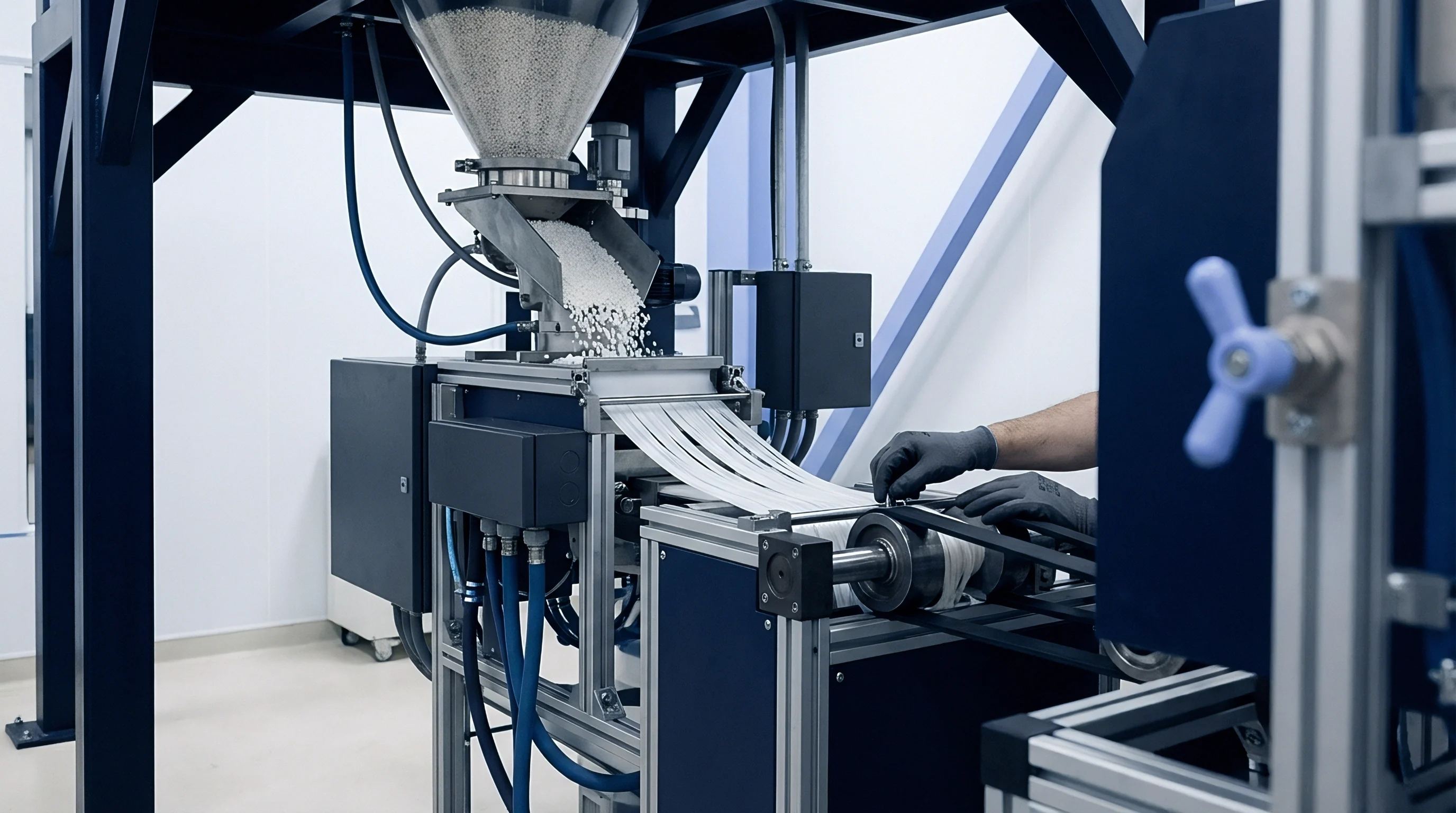
Extruder Screw Element Configuration and Residence Time Impact
Specific mechanical energy input must be strictly regulated to control the conversion window. Compounders balance mechanical mixing energy against barrel thermal zone profiles to prevent runaway degradation of the heat-sensitive polyhydroxyalkanoate phase. Twin-screw extruders operating at length-to-diameter ratios of 44:1 or 48:1 isolate phase mixing from chemical stabilization.
- Initial Melting Zone applies low-shear forward conveying elements at 170 °C to prevent premature thermal cleavage before complete fluxing of both components occurs.
- High-Shear Reactive Block incorporates neutral and 45-degree reverse kneading discs to generate high interfacial area while maintaining melt temperatures precisely at 195 °C.
- Distributive Mixing Section utilizes slotted tooth mixers to distribute dynamic block copolymers throughout the matrix without generating excessive localized shear heating.
- Degassing Vacuum Vent Zone pulls a minimum vacuum of 0.08 MPa to extract volatile crotonic acid and moisture, arresting hydrolytic back-reactions during transit.
Take a 500 kg/hr compounding line operating an L/D 48:1 twin-screw extruder at 350 rpm with a 70/30 ratio of PLA to PHBV. Assume virgin PLA entering at an initial weight-average molecular weight of 165,000 g/mol and PHBV at 380,000 g/mol, carrying a total residual moisture content of 180 ppm. At a specific mechanical energy input of 0.24 kWh/kg and a mean residence time of 42 seconds, viscous heat generation elevates the melt temperature from a set 190 °C to an actual 208 °C within the kneading zones.
Under these operating parameters, transesterification yields a 4.2 percent block copolymer content, maintaining a final weight-average molecular weight of 128,000 g/mol with an melt flow rate shift from 8.5 g/10 min up to 14.2 g/10 min measured at 190 °C under a 2.16 kg load. Increasing residence time to 68 seconds at the same energy input pushes ester interchange into complete sequence randomization, dropping the weight-average molecular weight to 74,000 g/mol and increasing the melt flow rate to 48.0 g/10 min, rendering the material unprocessable for injection molding applications.
The spatial variation of temperature across the screw flight profile leaves open the question of whether localized temperature spikes inside high-shear kneading blocks contribute more to transesterification progress than total residence time within lower-shear conveying elements.

Phase
Morphological state transitions in polyhydroxyalkanoate polylactic acid alloys trace the structural path from coarse phase-separated blends to compatibilized alloys. Unmodified binary blends display a distinct island-sea morphology driven by high thermodynamic immiscibility between the components. Interfacial transesterification generates block copolymers right at the phase boundary, acting as in-situ surfactants that lower interfacial tension and suppress domain coalescence.
As ester interchange proceeds, the average number-average domain diameter of the dispersed phase drops from 4.8 µm down to less than 250 nm, producing a co-continuous phase distribution at lower volume fractions than predicted by classic melt viscosity ratios.
Glass transition behavior provides definitive physical evidence of transesterification progress. Uncompatibilized physical blends exhibit two unshifted, independent glass transition temperatures corresponding to pure polyhydroxyalkanoate (typically near 0 °C to 5 °C for PHBV) and pure polylactic acid (around 58 °C to 62 °C). Progressive transesterification shifts these two thermal transitions inward toward one another.
A single, intermediate glass transition temperature signals the formation of a homogeneous, fully randomized amorphous melt phase. Complete convergence of glass transition temperatures indicates extensive sequence randomization, which eliminates phase separation but destroys the primary crystallization capability of both parent polymers.
ISO 11357-2 differential scanning calorimetry confirms phase compatibilization when the glass transition temperatures of polylactic acid and polyhydroxyalkanoate converge inward by more than 12 °C relative to virgin homopolymer baselines.
Melt rheology registers phase transformations through changes in viscoelastic parameters across dynamic frequency sweeps. Uncompatibilized binary melt blends exhibit pronounced elastic responses at low frequencies, caused by phase domain relaxation of the dispersed droplets. As transesterification replaces discrete droplets with interpenetrating networks or microphases, this low-frequency rheological shoulder disappears.
Zero-shear melt viscosity decreases systematically as reaction conversion proceeds, reflecting both the loss of high-molecular-weight homopolymer fractions and the reduction of phase domain boundary resistance.
- Gross Phase Separation occurs when transesterification progress falls below 0.5 percent conversion, leading to severe delamination under tensile shear loading in molded parts.
- Domain Coalescence Under Shear manifests in processing zones where interfacial block copolymer concentration is insufficient to resist dynamic droplet collision and merging.
- Matrix Viscosity Collapse develops when transesterification kinetics outpace molecular weight preservation, causing melt strength loss and flash formation at tool parting lines.
- Amorphous Phase Lockdown emerges from excessive ester interchange, completely suppressing cold crystallization and extending mold cooling cycles beyond commercial viability.
Melt viscosity loss tracks transesterification extent far faster than solid-state modulus shifts.

Quench
Controlling transesterification reactions requires rapid chemical deactivation of catalytic species before the polymer melt leaves the compounding die. Residual organometallic catalysts, particularly tin, titanium, and aluminum compounds left behind from lactide ring-opening polymerization, continue to drive ester exchange during secondary shaping operations if left un-quenched. Deactivators function by chelating catalyst metallic centers or precipitating them into inactive mineral salts.
Phosphite esters, acidic phosphate esters, and mono-stearyl diacid phosphates serve as primary quenchers in bio-based polyester compounding operations, operating at addition levels between 0.05 and 0.30 weight percent.
Inhibitor addition timing determines whether an alloy maintains structural blockiness or converts entirely into an amorphous random material. Introducing catalyst quenchers mid-barrel via liquid injection or side-feeder masterbatches arrests transesterification at the optimal block copolymer threshold. Delayed quenching allows reaction kinetics to run uncontrolled through the die zone and melt filtration systems, leading to severe lot-to-lot property variance.
Over-dosing acidic phosphite quenchers triggers secondary hydrolytic degradation pathways if incoming resin moisture exceeds 100 ppm, counteracting the chemical stabilization objective.
| Deactivator Type | Target Catalyst Species | Effective Concentration (wt%) | MFR Drift Rate at 190 °C (%/min) | Thermal Stability Limit (°C) |
|---|---|---|---|---|
| Un-quenched Control | Residual Stannous Octoate | 0.000 | + 8.4 | 185 |
| Mono-stearyl Phosphate | Tin / Titanium Alkoxides | 0.120 | + 0.3 | 230 |
| Tris(nonylphenyl) Phosphite | Organotins / Free Radicals | 0.250 | + 1.1 | 210 |
| Pyrophosphoric Acid | Transition Metal Traces | 0.080 | + 0.1 | 240 |
Inhibitor efficiency relies heavily on dispersion quality within short residence time windows. Chemical quenchers must distribute uniformly throughout the melt within 5 to 10 seconds of downstream introduction to stop catalytic transesterification instantly. Insufficient distributive mixing leaves un-quenched melt pockets that continue to undergo ester exchange, producing localized viscosity drops that manifest as jetting or flow marks during injection molding.
Masterbatch delivery systems using low-melting polyester carriers ensure rapid melting and homogeneous dispersion of high-melting solid phosphite additives.
Resin suppliers occasionally attribute wide melt flow rate variations across incoming pellet lots to acceptable thermal history variations, masking the presence of un-neutralized active polymerization catalysts that re-ignite transesterification during secondary converting runs.

Benchmark
Analytical verification of transesterification metrics requires testing protocols capable of distinguishing physical blending from true chemical interchange. Proton Nuclear Magnetic Resonance (1H NMR) spectroscopy provides direct quantification of blockiness degree and average sequence length. Carbonyl carbon resonances situated between 169.0 ppm and 170.5 ppm in 13C NMR spectra resolve specific diad and triad sequences, identifying PLA-PLA, PLA-PHA, and PHA-PHA ester couples.
The blockiness degree ratio B, calculated from experimental diad frequencies relative to theoretical random distribution baselines, defines whether an alloy sits as a physical mixture (B = 0), a block copolymer ($0
Rheological verification via steady-state and dynamic oscillatory shear testing tracks real-time chemical reaction rates inside compounding operations. Thermal stability protocols run under ISO 1133-1 Condition T at 190 °C with a 2.16 kg test mass measure melt volume-flow rate change over extended dwell times. A stable, properly quenched alloy maintains an MFR change of less than 5 percent across a 20-minute thermal dwell.
Unstable or un-quenched systems display exponential MFR increases exceeding 50 percent over the same duration, indicating active transesterification accompanied by thermal scission.
- Sampling Protocol requires extracting fresh pellets directly from sealed aluminum foil barrier bags, transferring them to a vacuum desiccator within 120 seconds of sample opening.
- Moisture Content Verification uses Karl Fischer coulometric titration according to ISO 15512 Method B, rejecting any material batch registering moisture above 100 ppm prior to rheological testing.
- Isothermal Melt Stability Run evaluates complex viscosity stability at 190 °C using a 25 mm parallel plate geometry set at a 1.0 mm gap under a constant 1.0 percent strain at 1.0 Hz frequency for 1800 seconds.
- Sequence Length Calculation extracts specific 1H NMR peak integral areas corresponding to the methine protons of polylactic acid (5.15 ppm) and polyhydroxyalkanoate (5.25 ppm) to compute precise block sequence values.
Differential Scanning Calorimetry according to ISO 11357-3 tracks enthalpy changes associated with cold crystallization and double melting peaks. Physical blends show unshifted melting endotherms for both components, whereas transesterified alloys exhibit significant melting point depression. Polylactic acid melting peaks shift downward from 175 °C to below 155 °C as ester exchange disrupts perfect crystal lamellar thickness.
This melting point depression correlates directly with transesterification conversion degrees, serving as a rapid quality control metric for compound verification before tool loading.
Purchase specifications must incorporate ISO 1133-1 melt volume-flow rate stability criteria limiting MFR drift to a maximum of 0.5 cm³/10 min over a 15-minute dwell at 190 °C under 2.16 kg load to ensure downstream process consistency.
Quality contracts for reactive bio-polyester alloys specifying an ISO 1133 melt volume-flow rate stability clause with maximum allowable drift thresholds under 5 percent over a 15-minute dwell at 190 °C automatically invalidate supplier lot deliveries exhibiting un-quenched kinetic activity, shifting all financial exposure for tool cleaning and machine downtime back to the compounder.

Cost
Controlling melt transesterification kinetics directly governs the landed financial viability of binary polyhydroxyalkanoate polylactic acid alloys. Raw material price spreads between polylactic acid (typically 2.10 to 2.60 USD/kg) and polyhydroxyalkanoate resins (ranging from 4.80 to 6.50 USD/kg) force compounding formulations toward PLA-rich compositions. Reactive extrusion adding 0.15 weight percent catalyst quencher packages increases raw compound costs by roughly 0.08 USD/kg, but reduces scrap rates during downstream injection molding from 14 percent down to less than 1.8 percent.
Transesterification control yields consistent melt strength, preventing wall thickness variations and short shots in complex thin-wall tooling.
Regrind utilization limits are dictated almost entirely by transesterification history. Un-quenched alloys undergoing multiple heat histories in sprues and runners suffer cumulative ester interchange, driving melt flow rates out of processing specification within two recycling loops. Properly quenched alloys preserve molecular weight distributions, permitting up to 20 percent regrind re-introduction without triggering thermal deflection failures or mold flash.
The financial penalty of un-quenched transesterification manifests in degraded thermal performance, dropping part heat deflection under load (ISO 75-2 Method A, 1.80 MPa) and exposing converters to structural field failures in high-temperature packaging applications.
| Alloy Transesterification Extent | Additive Package Cost (USD/kg) | Max Allowable Regrind Fraction (%) | Molding Scrap Rate (%) | Landed Net Part Cost (USD/Unit) |
|---|---|---|---|---|
| Un-compatibilized Physical Blend | 0.00 | 0 | 18.5 | 0.485 |
| Controlled Blockiness (Optimized) | 0.11 | 20 | 1.5 | 0.392 |
| Over-Transesterified (Randomized) | 0.04 | 5 | 12.2 | 0.458 |
| Over-Quenched (High Residual Acid) | 0.18 | 10 | 8.4 | 0.435 |
Customs classification and tariff lines depend on chemical structure modifications achieved during extrusion. Standard binary physical blends enter international commerce under primary biopolymer tariff lines carrying standard import duties. Transesterification that fundamentally alters chemical composition into synthetic block or random copolymers can shift classification to chemical derivatives under alternative HS code categories (such as HS 3907.90 for modified polyesters versus HS 3913.90 for unmodified natural polymers).
Incorrect tariff classification driven by unverified chemical transformation extents creates exposure to retroactive duty adjustments, compliance fines, and shipping holds at port entry docks.
The financial ledger for high-volume bio-polyester components balances initial resin formulation expenses directly against mold cycle times and scrap recovery rates. Precision kinetic control during reactive extrusion stabilizes the melt processing window, eliminating lot-to-lot molding adjustments and protecting the converter against catastrophic molecular weight collapse during processing. Compounders who skip chemical quenchers save fractional additive costs per kilogram while incurring substantial scrap liabilities, warranty claims, and duty audit risks at international transport hubs.