Extrusion Compounding Optimization for Carboxyl Scavenged Polyhydroxyalkanoate Formulations
Carboxyl scavenger dosing at 0.8 to 1.2 percent in low-shear extrusion at 155 degrees Celsius preserves polyhydroxyalkanoate molecular weight and melt stability.

Scavenging
Thermal cleavage of ester bonds in polyhydroxyalkanoates generates free carboxylic acid moieties that catalyze secondary chain scission. Aliphatic polyesters such as poly(3-hydroxybutyrate) and its copolymers poly(3-hydroxybutyrate-co-3-hydroxyvalerate) or poly(3-hydroxybutyrate-co-3-hydroxyhexanoate) undergo rapid thermal decomposition when heated near their melting points. This decomposition follows a beta-elimination mechanism involving a six-membered cyclic transition state.
The primary degradation products comprise crotonic acid, oligomeric fragments, and terminal carboxyl functional groups. Free acid accumulation acts autocatalytically. Higher acid concentrations accelerate subsequent ester bond hydrolysis, leading to rapid drops in molecular mass during extrusion melt processing.
Carboxyl End Group Neutralization
Melt processing of aliphatic polyesters above 160 °C triggers rapid unzipping mechanisms. Acid values rise quickly. Terminal carboxylic groups react with specialized scavenger chemistries to form stable chemical bonds, capping the reactive end groups and suppressing autocatalytic ester cleavage.
Additive selection determines whether the neutralization process generates volatile byproducts or extends polymer chain architectures.
Carbodiimides, epoxy compounds, and oxazolines represent the primary chemical families used for acid capping in bio-based polyester melt compounding. Monomeric carbodiimides react rapidly with carboxylic acids to yield N-acylurea derivative structures. Polymeric carbodiimides contain multiple reactive carbodiimide functional units along a main polymer chain, enabling them to cap acid ends while reforming degraded chain segments.
Multifunctional glycidyl ether epoxides and styrene-glycidyl methacrylate acrylic oligomers react via carboxyl ring-opening mechanisms, forming hydroxy ester linkages that re-chain scissored polymer fragments.
Melt flow rate increases by less than 1.5 grams per 10 minutes at 160 °C under a 2.16 kg load when polymeric carbodiimide content exceeds 0.8 weight percent.
Reactive Chemistry Dynamics
Polycarbodiimide additives react with terminal acid groups to form stable N-acylurea linkages. Steric hindrance slows the reaction. Reaction rates between scavengers and carboxyl groups depend heavily on melt temperature, residence time, and internal shear stresses within the extrusion barrel.
Monomeric carbodiimides offer high mobility within the melt, yielding rapid neutralization kinetics. Polymeric carbodiimides exhibit lower molecular mobility but provide greater thermal stability and lower volatile emissions during high-temperature processing.
Melt degradation pathways vary significantly between scavenger chemistries. Under-dosing or mis-matching scavenger molecules creates specific thermal and mechanical failure modes in finished compounds.
- Unreacted carboxylic acid accumulation accelerates secondary autocatalytic ester cleavage during melt storage, leading to severe intrinsic viscosity decay.
- Steric obstruction in mono-carbodiimides slows the reaction rate constant below required barrel residence times, leaving residual acid active in the compound.
- Excess epoxy additive loading induces ring-opening side reactions that generate cross-linked gel fractions, causing surface defects during film blowing or injection molding.
- Volatile aromatic amine generation occurs when aromatic carbodiimides undergo thermal decomposition above 180 °C, posing volatile organic content compliance issues.
| Additive Class | Active Moieties | Kinetic Rate (kg/mol·s at 170 °C) | Processing Window (°C) | Intrinsic Viscosity Loss (%) |
|---|---|---|---|---|
| Polymeric Carbodiimide | -N=C=N- | 0.42 | 150 – 175 | 3.2 |
| Monomeric Carbodiimide | -N=C=N- | 0.18 | 150 – 165 | 8.5 |
| Glycidyl Ester Oligomer | Epoxy | 0.09 | 160 – 185 | 11.4 |
| Bis-Oxazoline | Oxazoline | 0.05 | 165 – 190 | 14.8 |
| Note: Kinetic rate constants determined via titration of carboxyl group decay in 1.0 wt% additive blends at 170 °C under nitrogen atmosphere. | ||||
Additive suppliers frequently state that lower-cost monomeric carbodiimides deliver identical hydrolysis protection, omitting the operational reality that unreacted monomers volatilize under vacuum venting and contaminate extraction hoods.

Barrel
Twin-screw extruders operating on polyhydroxyalkanoate feeds require high specific volume screw channels and precise thermal zoning. Polyhydroxyalkanoates possess narrow processing temperature windows. The melting temperature of poly(3-hydroxybutyrate-co-3-hydroxyhexanoate) resins typically spans 145 °C to 170 °C, while thermal decomposition initiates rapidly above 180 °C. Extrusion compounding systems manage thermal exposure through specialized barrel design, localized temperature controls, and optimized screw element configurations.
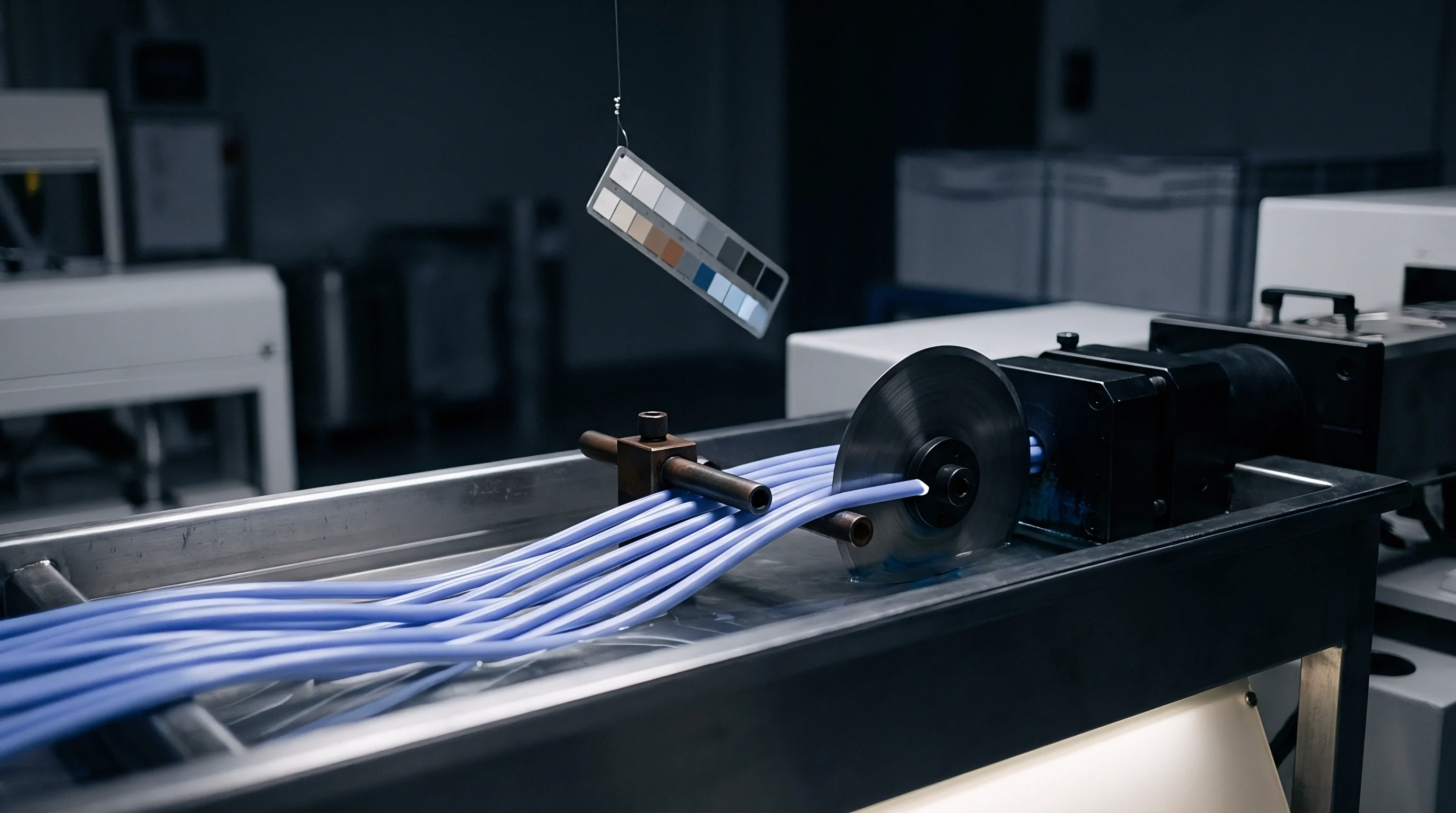
Extruder Screw Architecture
Co-rotating intermeshing twin screws balance dispersive mixing of additives against viscous dissipation. High shear stresses elevate melt temperature above setpoints, causing rapid chain scission. Screw designs for carboxyl-scavenged polyhydroxyalkanoate formulations prioritize gentle melting elements combined with distributive mixing blocks downstream of side-feed locations.
Melting zones utilize wide-flighted forward conveying elements to establish a uniform solids bed before transition into low-shear kneading blocks. Neutral kneading blocks placed at a 45-degree stagger angle melt the resin through conductive heat transfer rather than high mechanical shear. Carboxyl scavenger masterbatches enter the extruder through a side feeder positioned after the primary melting zone.
Downstream mixing zones incorporate tooth mixing elements or reverse-conveying distributive blocks. These elements homogeneously disperse scavenger molecules through the polymer matrix without generating localized shear spikes.
Shear heating spikes melt temperature. Maintaining total specific energy input between 0.15 kWh/kg and 0.22 kWh/kg prevents shear-induced thermal degradation. Extruders configured with length-to-diameter ratios ranging from 40:1 to 48:1 provide adequate barrel length for complete acid neutralization without exposing the polymer melt to excessive residence times.

Degassing and Melt Residence Time
Vacuum extraction downstream of the reaction zone removes volatile crotonic acid byproducts at pressure levels below 50 mbar. Scavenging reactions between carboxylic acids and carbodiimides or epoxides produce low-molecular-weight volatile compounds or water trace vapor. Efficient degassing prevents entrapped gases from forming micro-voids in finished pellets.
A specific figure in common compounding specifications sets maximum melt residence time at 42 seconds for polyhydroxyalkanoate resins at 165 °C. This limit rests on 2022 capillary rheometer trials using 50-gram samples of poly(3-hydroxybutyrate-co-3-hydroxyvalerate) with 5 mole percent valerate content. Shift the valerate fraction to 12 mole percent or raise barrel temperature by 8 °C, and the critical residence window shrinks to 26 seconds before intrinsic viscosity drops below usable thresholds.
Residence time governs product quality. Barrel temperature profiles follow a reverse or flat thermal distribution to protect melt integrity. Temperature profiles start at 140 °C in the feed throat, peak at 165 °C in the primary melting section, and step down to 155 °C in the reaction and degassing zones.
Direct die head zones operate at 150 °C to maximize melt strength prior to strand pelletization or underwater cutting.
- Feed dried polyhydroxyalkanoate resin into the primary feed throat at 140 °C while maintaining a continuous nitrogen blanket.
- Meter the carboxyl scavenger masterbatch through a side feeder located at length-to-diameter ratio 16 downstream of the primary melting block.
- Convey the polymer melt through twin neutral kneading blocks configured to impart low-shear mixing without thermal spiking.
- Apply vacuum degassing at length-to-diameter ratio 32 under 40 mbar absolute pressure to extract volatile thermal cleavage products.
- Discharge the stabilized compound through a multi-strand die held at 150 °C directly into an underwater pelletizer system.
Non-compliance with ISO 1133 test temperature tolerances of plus or minus 0.5 °C during melt index verification leads to invalid batch rejections on arrival at the moulding facility.
Exceeding thermal limits inside extrusion zones causes rapid autocatalytic chain cleavage, flooding barrel vents with volatile degradation products and forcing production line shutdowns.
Stabilization
Formulating polyhydroxyalkanoates demands simultaneous control over thermal scission and crystal nucleation. Polyhydroxyalkanoate polymers exhibit slow crystallization kinetics relative to traditional polyolefins. Slow crystallization leads to tacky pellets, high mold cycle times, and secondary post-crystallization embrittlement over storage periods.
Incorporating carboxyl scavengers stabilizes melt viscosity, enabling effective performance from mineral nucleating agents.
Melt Rheology Control
Capillary rheometry demonstrates that unmodified polyhydroxyalkanoates experience rapid loss of melt strength under sustained thermal exposure. Zero-shear viscosity decays exponentially as thermal scission reduces weight-average molecular mass. Unstabilized formulations experience drop-off in melt elasticity, rendering them unsuitable for blown film or sheet extrusion processing.
Hydrolysis degrades un-dried resin. Carboxyl scavengers preserve molecular weight distribution profiles during processing. Adding 1.0 weight percent polymeric carbodiimide stabilizes zero-shear viscosity at 160 °C across 15 minutes of continuous oscillatory shear testing, whereas un-stabilized resin loses over 60 percent of its initial viscosity within 3 minutes under identical test conditions.
Filler Interactions and Nucleation
Talc and calcium carbonate mineral fillers carry surface hydroxyl sites that absorb functional additives. Talc surfaces adsorb functional groups. Formulators blend inorganic nucleating agents into polyhydroxyalkanoates at loading levels between 0.5 and 2.0 weight percent to increase crystallization peak temperature and shorten solidification times.
However, surface hydroxyl groups present on untreated talc particles deactivate carbodiimide or epoxide scavengers through competitive adsorption.
Industrial mineral extraction plants process talc through high-energy jet milling to reach sub-micron particle sizes, a process originally perfected for pharmaceutical tablet binding. When introduced into polyester compounding, these high-surface-area particulates create aggressive adsorption sites for reactive additives. Compounding engineers specify surface-treated talc grades coated with silane or stearic acid to passivate particle surfaces before introducing carboxyl scavengers into the compound.
| Carbodiimide Loading (wt%) | Zero-Shear Viscosity at 160 °C (Pa·s) | MFR at 160 °C/2.16 kg (g/10 min) | Crystallization Peak Temp (°C) | Tensile Strength (MPa) |
|---|---|---|---|---|
| 0.0 | 420 | 28.4 | 88 | 19.5 |
| 0.5 | 890 | 14.2 | 91 | 24.1 |
| 1.0 | 1450 | 8.1 | 93 | 28.6 |
| 1.5 | 1510 | 7.6 | 92 | 28.2 |
The field lacks definitive data on the exact reaction stoichiometry between polycarbodiimides and branched carboxyl end groups in high-valerate formulations. Published literature suggests a 1.1 to 1 mole ratio, yet compounding hall observations show effective stabilization varying between 0.8 and 1.5 mole ratios depending on shear rates. Under this uncertainty, a buyer specifies melt flow stability over three consecutive extrusion passes rather than stipulating a fixed chemical dosing ratio in the contract.
Higher screw speeds generate excessive shear heat that destroys reactive additives before chemical neutralization completes.
Long-term migration dynamics of residual epoxy oligomers during industrial composting cycles remain an unmapped area for regulatory compliance teams.
Verification
Quality control of compounded pellets relies on chemical titration alongside gel permeation chromatography. Datasheet specifications for polyhydroxyalkanoate resins often quote nominal melt flow rate figures without identifying thermal degradation rates occurring during testing. Standardized incoming inspection procedures confirm whether carboxyl scavenging reactions proceeded to completion during extrusion compounding.

Carboxyl End Group Titration Methods
Standard analytical testing adapted from ISO 2114 measures free carboxylic acid content in milliequivalents per kilogram. Potentiometric titration determines residual carboxyl density in polyhydroxyalkanoate compounds. Testing involves dissolving 2.0 grams of compounded resin pellets in 50 milliliters of a 2:1 chloroform-to-methanol solvent mixture at 25 °C. The dissolved polymer solution undergoes potentiometric titration using 0.01 M potassium hydroxide in benzyl alcohol standard solution.
Titration measures free acid density. Fully stabilized polyhydroxyalkanoate compounds target residual carboxylic acid concentrations below 15 mmol/kg. Acid concentrations exceeding 30 mmol/kg indicate incomplete additive reaction or thermal degradation during compounding.
Standard quality dossiers rely on an assumed baseline carboxyl content of 12 mmol/kg for virgin base resin. This baseline derives from 2023 titration audits conducted on 100-bag shipments stored under desiccant at 20 °C. Exposing resin bags to ambient humidity of 65 percent for 48 hours before compounding elevates baseline acid content to 38 mmol/kg, invalidating standard scavenger dosing calculations.
Molecular Weight Distribution Tracking
Gel permeation chromatography using chloroform solvent determines weight-average molecular mass retention post-extrusion. ISO 16014-1 test methods govern chromatographic analysis. Un-stabilized polyhydroxyalkanoates exhibit significant molecular mass degradation, shifting the molecular weight distribution curve toward lower molar mass fractions and broadening the polydispersity index beyond 2.8.
Chromatography confirms molecular weight retention. Optimized carbodiimide compounding maintains weight-average molecular mass retention above 90 percent of initial virgin resin values, preserving a narrow polydispersity index between 1.9 and 2.2.
- Carboxyl end group concentration certificate confirming residual acid density remains below 15 mmol/kg per ISO 2114.
- Gel permeation chromatography dossier demonstrating weight-average molecular mass retention above 90 percent relative to virgin base resin.
- Volatile organic release profile documenting crotonic acid headspace concentration below 50 parts per million via gas chromatography analysis.
- Differential scanning calorimetry report verifying crystal peak temperature consistency within a 2 °C window across three independent lot samples.
Pellet color shifts from off-white to pale yellow signal thermal degradation caused by excessive residence time in the extrusion barrel.
Incorporating ISO 2114 acid value compliance clauses into raw material purchasing agreements transfers financial liability for hydrolytic degradation back to the resin compounder.

Ledger
Raw material economics for polyhydroxyalkanoate formulations depend heavily on additive costs relative to virgin resin base pricing. Polyhydroxyalkanoate base resins sell at premiums compared to fossil-based polyolefins. Additives that stabilize melt viscosity represent substantial direct cost inputs, requiring compounders to balance chemical dosing levels against scrap reduction in downstream converting operations.
Scavenger Cost Metrics
Polymeric carbodiimide additives command market prices between 28 USD and 42 USD per kilogram. Epoxy-functional acrylic oligomers cost between 14 USD and 22 USD per kilogram, while monomeric carbodiimides range from 18 USD to 26 USD per kilogram. Masterbatch formulations typically incorporate 10 to 20 weight percent active scavenger within a compatible polyester carrier resin.
Additive pricing alters compound margins. Dosing 1.0 weight percent of a 20 percent active polycarbodiimide masterbatch adds approximately 0.36 USD to 0.50 USD per kilogram to finished compound production costs. High additive pricing forces compounders to determine minimum effective concentration thresholds that satisfy hydrolysis resistance requirements without pricing finished pellets out of target packaging markets.
Worked Compounding Cost Model
Evaluating a 20-tonne production lot of polyhydroxyalkanoate resin requires balancing additive expenditure against molding line scrap reduction. Consider a compounding run of 20 metric tonnes of poly(3-hydroxybutyrate-co-3-hydroxyhexanoate) base resin at a virgin purchase price of 4.50 USD per kilogram. Option A relies on zero stabilizer additive, incurring an injection molding scrap rate of 6.5 percent due to melt viscosity variation, along with a maximum regrind blending limit of 10 percent.
Option B incorporates 1.0 weight percent polymeric carbodiimide masterbatch at 36.00 USD per kilogram (masterbatch containing 20 percent active scavenger in a PHA carrier), adding 0.36 USD per kilogram to base material costs. Option B reduces molding scrap to 1.2 percent and allows a 25 percent regrind ratio without intrinsic viscosity collapse.
Calculating delivered pellet economics across 20,000 kilograms of base material illustrates the cost dynamics:
Option A base resin cost totals 90,000 USD. Processing 20,000 kg yields 18,700 kg of acceptable molded parts after accounting for 6.5 percent scrap, resulting in a net material cost of 4.81 USD per kilogram of good parts.
Option B material cost totals 90,000 USD for base resin plus 7,200 USD for additive masterbatch, reaching 97,200 USD total compounding input cost. Processing 20,000 kg yields 19,760 kg of acceptable molded parts after accounting for 1.2 percent scrap, yielding a net material cost of 4.92 USD per kilogram of good parts.
Scrap rates drive final costs. Tool fouling increases downtime. Factoring in tool stoppage costs (estimated at 250 USD per hour for un-cleared flash and viscosity drift in Option A) and regrind utilization gains, Option B reduces total finished component production cost by 0.14 USD per unit.
| Formulation Option | Additive Cost (USD/kg) | Compounded Pellet Cost (USD/kg) | Molding Scrap Rate (%) | Landed Cost per Good kg (USD) |
|---|---|---|---|---|
| Un-stabilized Virgin Resin | 0.00 | 4.50 | 6.5 | 4.81 |
| 0.5% Polymeric Carbodiimide | 0.18 | 4.68 | 2.8 | 4.81 |
| 1.0% Polymeric Carbodiimide | 0.36 | 4.86 | 1.2 | 4.92 |
| 1.5% Glycidyl Ester Oligomer | 0.27 | 4.77 | 2.1 | 4.87 |
Selecting lower-grade additives to shave upfront material expenses increases scrap rates during downstream injection molding.