Determining Masterbatch Letdown Ratios for Recycled Polyethylene Compounds
Determining masterbatch letdown ratios for recycled polyethylene requires MFR matching, antioxidant depletion testing, and gravimetric dosing adjustments.


Rheology
Melt flow rate shifts in post-consumer recycled polyethylene dictate how much additive or color masterbatch an extruder actually needs. Virgin high-density polyethylene runs predictably at letdown ratios between 1.0 percent and 3.0 percent because resin viscosity and molecular weight distribution stay within tight bounds. Recycled lots, by contrast, carry wide viscosity swings caused by mixed feedstocks and thermo-mechanical degradation.
Repeated thermal cycles break down polymer backbones, driving melt flow rates from a virgin baseline of 0.8 grams per 10 minutes past 2.5 grams per 10 minutes at 190 degrees Celsius under a 2.16 kilogram load. That drop in melt viscosity shortens barrel residence times and bleeds off extruder backpressure, which impairs pigment breakdown and leaves additive levels uneven across the finished profile.
Compensating for this fluidizing effect requires adjusting the masterbatch letdown ratio upward. A high melt flow rate matrix demands a higher dosage of solid masterbatch to hold target color opacity and UV stabilization. If host resin viscosity drops below that of the carrier, the concentrate pellets resist breakdown in the screw flights, leaving the extrudate prone to color streaking, inconsistent tint strength, and early tensile failure.
Calibrating letdown rates directly against incoming lot melt flow rates keeps additive delivery stable despite feedstock volatility.
Melt flow rate testing under ISO 1133 at 190 degrees Celsius with a 2.16 kilogram load yields an average MFR increase of 40 percent in post-consumer high-density polyethylene after three thermal cycles.
Setting dosing parameters on a compounding line begins with characterising the incoming recyclate’s melt index. Melt flow rate figures derived under ISO 1133 or ASTM D1238 form the baseline for these calculations, but comparison samples require identical test conditions: 190 degrees Celsius at 2.16 kilograms for standard low-density and linear low-density polyethylene, or 5.0 kilograms for high-density pipe and blow-molding grades. Checking a 2.16 kilogram reading against a 5.0 kilogram figure distorts the viscosity profile enough to skew masterbatch calculations completely.
| Polymer Grade Type | Test Condition (ISO 1133) | Baseline MFR (g/10 min) | Degraded rPE MFR (g/10 min) | Target Letdown Multiplier |
|---|---|---|---|---|
| rHDPE Extrusion Blow Molding | 190°C / 2.16 kg | 0.35 to 0.55 | 0.90 to 1.40 | 1.15x Base LDR |
| rHDPE Injection Molding | 190°C / 2.16 kg | 4.00 to 7.00 | 10.00 to 16.00 | 1.30x Base LDR |
| rLLDPE Blown Film | 190°C / 2.16 kg | 0.80 to 1.20 | 1.60 to 2.80 | 1.25x Base LDR |
| rLDPE General Purpose | 190°C / 2.16 kg | 2.00 to 3.00 | 4.50 to 7.50 | 1.20x Base LDR |
Dispersion depends on the viscosity spread between host recyclate and carrier resin. When a host polymer flows at 12.0 grams per 10 minutes against a carrier rated at 2.0 grams per 10 minutes, the screw generates too little shear to shear apart the dense concentrate pellets. Much of the carrier passes through intact, forming visible unmelted gel specks in blown film or molded parts.
Compounders handle this gap either by nudging the letdown ratio up while adding high-shear mixing elements along the screw profile, or by switching to a masterbatch formulated on a higher-flow carrier.
Decoupling intrinsic chain scission from post-industrial crosslinking when setting letdown targets across blended streams remains an ongoing challenge on commercial recycling lines.


Matrix
Carrier resin selection determines whether an additive pack blends cleanly into recycled polyethylene or segregates into weak phase domains as the melt cools. Commercial masterbatches commonly use prime virgin linear low-density polyethylene (LLDPE) or low-density polyethylene (LDPE) carriers for their broad processing windows and melt strength. Dosing these into post-consumer high-density polyethylene (rHDPE) inevitably introduces lower-density material into the rigid matrix.
At letdown rates between 1.0 and 2.0 percent, the small fraction of LLDPE barely shifts compound density. But when heavy contamination or weak tint strength forces letdowns up to 4.0 to 6.0 percent, the carrier volume begins to drag down both density and flexural modulus.

Carrier Polymer Flow Matching Dynamics
Melt indices must match closely to prevent phase separation during extrusion, particularly with fractional-melt recycled high-density resins that respond sharply to shear. If a masterbatch built on a 20 grams per 10 minutes low-density carrier enters a recycled high-density host flowing at 0.5 grams per 10 minutes, the carrier melts early in Zone 1. That thin fluid films over screw flights and slips along barrel walls, keeping the stiffer host pellets from experiencing the shear needed for thorough homogenization.
This wall lubrication isolates active ingredients like primary antioxidants and UV stabilizers, trapping them in the low-density carrier phase rather than dispersing them through the surrounding high-density matrix where oxidation takes place. Maintaining phase homogeneity and structural properties generally requires keeping the carrier’s melt flow rate within 1.5 to 2.5 times that of the host recyclate.

Thermal Degradation and Primary Antioxidant Depletion
Thermal histories deplete the stabilization package originally present in post-consumer resin. Having already weathered an initial service life and at least one pelletizing run, recyclate carries hydroperoxides that dissociate into free radicals under extrusion temperatures and shear, triggering secondary auto-oxidation. Off-the-shelf masterbatches formulated for virgin polymers carry only minimal antioxidant loadings ~ typically 0.05 to 0.15 weight percent ~ just enough to protect the concentrate during its own manufacture.
Degraded post-consumer lots call for functional masterbatches fortified with higher loadings of primary hindered phenols (like Irganox 1010) and secondary phosphites (such as Irgafos 168). Elevating the letdown ratio on a combined color and stabilizer concentrate offsets depleted stabilizer reserves in the feed. Pinning down that adjustment requires establishing the baseline Oxidation Induction Time (OIT) of incoming lots using Differential Scanning Calorimetry under ISO 11357-6.
- Interfacial Delamination occurs when high-molecular-weight host chains reject incompatible carrier resin as the melt crystallizes, creating micro-voids that cut notched Izod impact values.
- Pigment Agglomeration happens when insufficient shear leaves organic pigment aggregates unbroken, showing up as visible specks and erratic light transmission in finished sheet.
- Die Bleed Out occurs when an overly fluid carrier phase separates under die pressure, collecting at the lip and charring into hard specks that tear blown film bubbles.
- Thermal Splay results from moisture boiling off hygroscopic carrier additives in the hot melt, generating silver streaks across injection-molded surfaces.
High melt flow carrier resins disperse pigments efficiently while lowering the tensile impact strength of recycled compounds.
Mismatched carriers and uncorrected additive levels undermine environmental stress crack resistance (ESCR) when tested under ASTM D1693. Low-molecular-weight carrier fractions tend to migrate toward lamellar grain boundaries, accelerating surfactant-induced cracking under stress. Formulators setting letdown targets for industrial packaging must therefore balance required color intensity against the embrittlement caused by carrying too much foreign resin into the blend.
Selecting the wrong carrier polymer risks interfacial shear failure, leaving entire production lots of extrusion blow-molded containers unable to pass standard drop-impact tests.


Feed
Dosing accuracy deteriorates quickly once regrind bulk density drifts more than ten percent over a production shift. Washed post-consumer flake arrives with irregular edges, curved shards, and variable packing fractions. While prime pellets pack consistently near 550 grams per liter, regrind flake typically ranges from 240 to 420 grams per liter depending on shredder screen sizes and flake geometry.

Bulk Density Instability in Flake Processing
Flake packs inconsistently inside feed hoppers, especially after pneumatic conveying. Volumetric dosing units meter material purely by screw speed, relying on a constant mass per flight volume. If incoming flake bulk density falls by 20 percent, the feed throat receives 20 percent less base resin mass per revolution, while the masterbatch feeder keeps metering dense concentrate pellets at an unchanged pace.
The effective letdown ratio spikes from a 2.0 percent target to an actual 2.5 percent, running up masterbatch consumption and feeding surplus carrier into the melt.
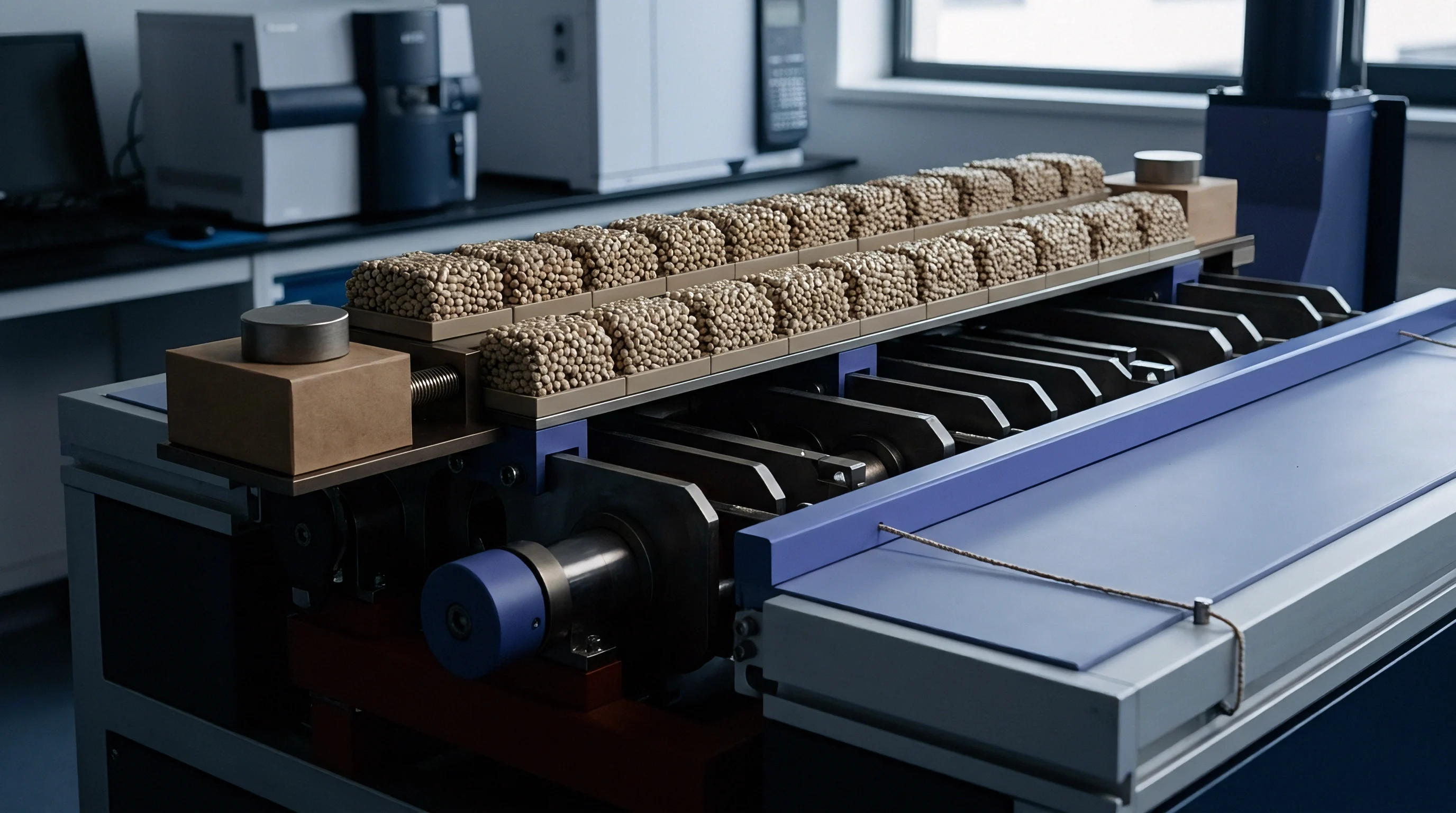
Loss-in-weight gravimetric feeders avoid these density-driven errors by tracking hopper weight continuously and throttling motor speeds against real-time mass flow. Measuring loss-in-weight on both the base flake and masterbatch lines locks the letdown ratio to its setpoint regardless of how loosely the flake packs.
Gravimetric Calibration for Regrind Mixtures
Loss-in-weight units rely on load cells beneath the hopper to measure mass loss over time. Structural vibration from nearby machinery, bridging in the throat, and electrostatic charges on dry flake can distort that signal. Clinging flakes shift weight away from the load cells, generating false tare readings that lead the controller to miscalculate delivery rates.
- Isolate the feeder hopper from frame vibration using flexible silicone throat bellows and elastomeric pads under the load cell plate.
- Ground pneumatic transfer lines and hopper shells to disperse electrostatic charges that promote flake bridging and signal noise.
- Configure the feeder controller with a 5-second rolling average to filter short-term weight spikes from throat surges.
- Calibrate controller gain settings against ten consecutive 30-second catch-and-weigh samples run with the specific recycled lot.
- Slave the masterbatch feeder drive directly to the primary throat’s gravimetric signal, with alarm thresholds set at 3.0 percent mass variance.
Contracts specifying ISO 9001 compliance for incoming compound streams mandate automated gravimetric feed records to validate letdown accuracy during raw material lot changes.
Bridging in the main feed throat cuts resin flow while the masterbatch feeder continues to turn. Without interlocks tying the drives together, solid concentrate floods empty screw flights, plugging barrier zones and generating off-color scrap that takes hours to purge.
Color shading variations stem either from unannounced pigment changes in the masterbatch or from uncalibrated volumetric feed throats handling uneven regrind geometry.


Arithmetic
Setting a final letdown percentage on recycled polyethylene means balancing required additive levels against whatever stabilizer remains in the feed. Virgin resins follow simple linear mass balances, but recyclate requires accounting for prior degradation, additive concentration in the carrier, and target mechanical or optical specs. The basic formula establishes the weight fraction of masterbatch (LDRfinal) needed in the total formulation.

Determining Active Additive Letdown Fractions
Target performance dictates the active chemical concentration needed in the melt. When handling post-consumer polyethylene with degraded residual stabilizer, the processor calculates the net additive deficit before fixing the letdown rate. That calculation hinges on active additive concentration in the masterbatch (CMB), target concentration in the compound (Ctarget), and residual concentration already present in the incoming lot (Crecycled).
Base letdown percentages follow a direct mass-balance relationship:
LDRbase = left( fracCtarget – CrecycledCMB right) × 100
For a 40-tonne lot of post-consumer rHDPE showing a baseline melt flow rate of 1.8 grams per 10 minutes (190 degrees Celsius / 2.16 kilograms) and an Oxidation Induction Time (OITrecycled) of 8 minutes, reaching a specified 30 minutes (OITtarget) requires supplemental stabilization. If the candidate masterbatch contains 10.0 weight percent active hindered phenol/phosphite blend (CMB = 10.0%) and each 1.0 percent letdown provides 12 minutes of OIT capacity under standard conditions:
Ctarget – Crecycled = 30 min – 8 min = 22 min required increase
Required Active Additive Mass Fraction = frac22 min12 min per percent = 1.833% active equivalence
LDRbase = left( frac1.833%10.0% right) × 100 = 18.33% functional masterbatch blend
Dosing masterbatch at 18.33 percent would introduce far too much carrier resin, softening the high-density matrix. Sourcing must specify a higher-potency concentrate carrying 25.0 weight percent active stabilizer instead. Recalculating with this concentrated masterbatch gives:
LDRadjusted = left( frac1.833%25.0% right) × 100 = 7.33% functional letdown ratio

What Shear History Alters Masterbatch Dosing?
Mechanical work repeatedly shortens high-molecular-weight polymer chains. Shorter chains generate less viscous dissipation in the barrel, lowering the shear available to melt and disperse stiff concentrate pellets. To counteract this drop in mixing intensity across high melt flow recyclate lots, compounding setups apply a Shear Correction Factor (Sf) between 1.10 and 1.30 to the calculated base letdown.
| Incoming rPE MFR (g/10 min) | Residual OIT (Minutes) | Masterbatch Active Conc. (%) | Base Calculated LDR (%) | Shear-Adjusted LDR (Sf = 1.15) |
|---|---|---|---|---|
| 0.80 to 1.20 | 15.0 | 15.0 | 2.00 | 2.30 |
| 1.21 to 2.50 | 10.0 | 15.0 | 2.67 | 3.07 |
| 2.51 to 4.50 | 5.0 | 20.0 | 2.50 | 2.88 |
| 4.51 to 8.00 | 2.0 | 25.0 | 2.24 | 2.58 |
Applying a shear factor guards against under-dosing when processing degraded feedstocks. When incoming material varies significantly across containers within a single lot, the gravimetric feeder is set to the shear-adjusted ratio calculated from the highest MFR sample in the batch.
Phenolic antioxidant depletion in post-consumer polyethylene correlates directly with processing history and ambient outdoor exposure during the initial product lifespan.
Higher letdowns directly increase formulation costs. Introducing 3.5 percent of a specialty antioxidant concentrate priced at 4.20 Euros per kilogram into post-consumer rHDPE costing 0.95 Euros per kilogram adds 0.147 Euros per kilogram to the raw material bill. Formulation targets must balance stabilization against cost to avoid over-specifying expensive additive packages.
Concentrates based on high melt flow carriers often require cooler barrel temperatures near the feed throat to keep the screw from slipping.


Verification
Testing finished compound verifies whether letdown adjustments met color and mechanical criteria. Certificate of Analysis (CoA) checks protect buyers from latent failures tied to uncalibrated feeding or poor additive dispersion ~ defects that tend to show up months later as cracked containers or surface embrittlement from outdoor exposure.

Analytical Quality Control Test Standards
Standard test methods define release criteria for incoming material lots. Inorganic filler loadings, carbon black levels, and pigment addition are verified via furnace ash testing under ISO 3451-1 or ASTM D5630. Burning a 5-gram sample at 600 degrees Celsius in a muffle furnace volatilizes the polyethylene matrix and organic components, isolating mineral residues like calcium carbonate or talc.
If ash content drifts more than 0.5 weight percent from target, the letdown was either miscalculated or the feeder wandered during the run.
Spectrophotometric color evaluations under ISO 7724 or ASTM D2244 measure appearance in the CIE L a b coordinate system. In masterbatch-colored recycled polyethylene, overall color variance (Δ E ) is typically held within 1.5 units of the approved standard. A Δ E above 2.0 generally signals fluctuating masterbatch feed, thermal yellowing in the host polymer, or contamination in the post-consumer feedstock.
| Physical Property | Test Method | Standard Test Condition | Acceptable Variance Window |
|---|---|---|---|
| Ash / Filler Content | ISO 3451-1 Method A | 600°C, 30 min in Muffle Furnace | Target ± 0.50 wt% |
| Density | ISO 1183-1 Method A | 23°C, Immersion Pycnometer | Target ± 0.003 g/cm³ |
| Color Accuracy (Δ E ) | ISO 7724-2 | D65 Illuminant, 10° Observer Angle | $Delta E^ |
| Tensile Yield Strength | ISO 527-2 Specimen 1A | 50 mm/min crosshead speed | Target ± 5.0 MPa |
| Oxidation Induction Time | ISO 11357-6 | 200°C, Pure O2 atmosphere | Minimum 25.0 Minutes |

Commercial Purchase Specifications and Reject Criteria
Procurement contracts outline acceptable tolerance bands for density and ash. Documentation should tie masterbatch letdown compliance directly to formal lot acceptance, requiring compounders to provide gravimetric dosing logs alongside standard laboratory CoAs for any shipment over 10 metric tonnes.
- Certified Melt Flow Index Records tracking incoming base recyclate MFR against finished compound MFR according to ISO 1133.
- Differential Scanning Calorimetry Reports documenting baseline Oxidation Induction Time measured at 200 degrees Celsius in pure oxygen.
- Furnace Ash Content Certificates verifying that mineral filler remains within 0.5 weight percent of contractual targets.
- Spectrophotometric Color Metrics recording CIE L a b values and total delta E variation against the approved reference plaque.
- Tensile Yield Strength Values evaluated per ISO 527-2 at 50 millimeters per minute crosshead speed to confirm tensile performance.
Missing contractual thresholds triggers commercial claim provisions. If a supplier ships off-color or degraded rHDPE because of an inadequate letdown ratio, the buyer claims damages covering resin replacement and scrap processing costs. Enforcing analytical acceptance limits obliges compounders to keep gravimetric dosing systems tightly calibrated across the run.
Adding ASTM D790 flexural modulus requirements to raw material agreements places the financial risk of improper masterbatch letdowns squarely on the compounder.