Determining Food Simulants for Recycled Polyolefin Specific Migration Testing
Determining food simulants for recycled polyolefin migration requires matching contaminant polarity to lipophilic or aqueous media while preventing solvent swelling distortion.

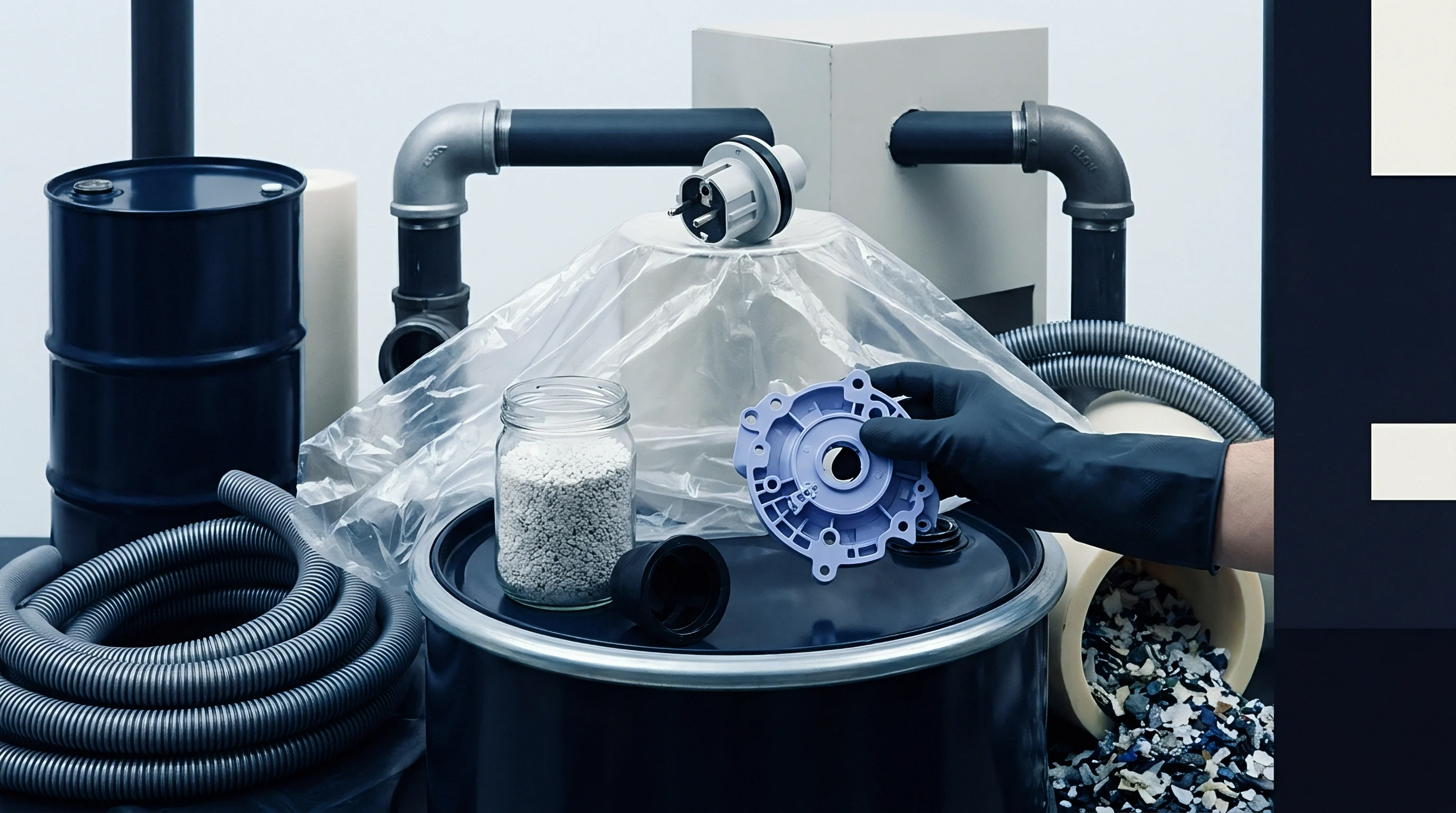
Target

Food Matrix Matching for Recycled High Density Polyethylene and Polypropylene
Specific migration testing measures the mass of chemical substances transferring from contact materials into food. For recycled polyolefins like rHDPE and rPP, selecting an appropriate food simulant depends on the physicochemical properties of both the volatile migrants and the food matrix. Regulatory standards, including EU Regulation 10/2011, specify chemical media to represent actual foodstuffs: Simulant A (10 percent ethanol by volume) for aqueous media; Simulant B (3 percent acetic acid w/v) for acidic foods below pH 4.5; Simulant C (20 percent ethanol) for low-proof alcoholic products; Simulant D1 (50 percent ethanol) for dairy, milk, and alcoholic beverages over 20 percent strength; Simulant D2 (vegetable oil, usually refined olive or sunflower oil) for fatty foods; and Simulant E (modified polyphenylene oxide, marketed as Tenax) for dry media.
Mechanical recycling streams introduce complex non-intentionally added substances (NIAS) into post-consumer polyolefins. Recovered packaging often contains degraded antioxidants, oxidation byproducts such as aldehydes and ketones, residual detergents, fragrances, and non-food contaminants. Non-polar organic species ~ including mineral oil saturated hydrocarbons (MOSH), mineral oil aromatic hydrocarbons (MOAH), and low molecular weight oligomers ~ partition readily into lipophilic matrices.
Standard testing of rHDPE or rPP intended for aqueous or acidic contact with Simulants A or B frequently misses these non-polar migrants due to their low water solubility. For fatty food contact, Simulant D2 remains the mandatory regulatory benchmark, even though vegetable oil introduces substantial chromatographic interference when measuring non-polar migrants down at low ppm levels.
Fatty simulants and organic solvents cause recycled polypropylene and high-density polyethylene to swell. That swelling alters the polymer’s internal diffusion coefficient and accelerates impurity migration far past what occurs during normal shelf life. Selecting an improper simulant either underestimates hazardous substance transfer or invalidates a compliance file through solvent-driven matrix breakdown.
While testing facilities often default to standardized food assignments, recycled polyolefin dossiers require simulant choices tailored to worst-case migration kinetics. If an article touches diverse food categories, testing spans multiple media ~ typically 3 percent Acetic Acid, 50 percent Ethanol, and Vegetable Oil or an approved substitute.
Simulant D2 exposure at forty degrees Celsius for ten days generates a fivefold increase in low-molecular-weight polyolefin oligomer extraction compared to Simulant C under identical time parameters.

Contaminant Partitioning across Aqueous and Lipophilic Simulants
Thermodynamic migration between a recycled polyolefin matrix and a food simulant is governed by the partition coefficient. Non-polar post-consumer contaminants have high octanol-water partition coefficients, driving them into fatty food simulants rather than aqueous solutions. Alkylphenols, plasticizer residues, and printing ink components bound within the polymer barely migrate during 10 percent ethanol contact, yielding falsely reassuring test values.
Switching to vegetable oil or 95 percent ethanol shifts the equilibrium, releasing elevated levels of volatile NIAS into the liquid phase. Evaluating resin batches therefore requires understanding how specific contaminants split across polar and non-polar phases.
Acidic simulants such as 3 percent acetic acid target inorganic residues, basic degradation compounds, and functional barrier failures. Heavy metal traces ~ including lead, cadmium, and organotins from legacy packaging or non-food waste ~ leach rapidly into acidic media. Caps and closures made from rHDPE routinely undergo 3 percent acetic acid migration testing to confirm compliance with specific migration limits for heavy metals.
Acid exposure can also hydrolyze degraded slip agents or light stabilizers in the recycled resin, creating secondary breakdown products that need chromatographic tracking under controlled time and temperature conditions.
| Food Simulant Designation | Chemical Composition | Target Packaging Food Type | Dominant Recycled Polyolefin Migrants |
|---|---|---|---|
| Simulant A | 10 percent Ethanol (v/v) | Aqueous foods, clear liquids | Polar oxidation products, organic acids |
| Simulant B | 3 percent Acetic Acid (w/v) | Acidic foods (pH below 4.5) | Heavy metals, catalyst residues, amine additives |
| Simulant C | 20 percent Ethanol (v/v) | Alcoholic media up to 20 percent | Short-chain aldehydes, residual monomer traces |
| Simulant D1 | 50 percent Ethanol (v/v) | Dairy, oil-in-water emulsions | Plasticizers, medium-chain esters, fragrance traces |
| Simulant D2 | Vegetable Oil (Olive/Sunflower) | Fatty foods, free fats and oils | MOSH, MOAH, polyolefin oligomers, antioxidants |
| Simulant E | Poly(2,6-diphenyl-p-phenylene oxide) | Dry foods, powders, grains | Volatile organic compounds, degradation products |
| Test conditions governed by European Standard EN 1186 and EN 13130 analytical procedures for specific migration. | |||

Risk Profiles in Simulant Assignment for Post-Consumer Polyolefins
Selecting food simulants systematically prevents testing failures and regulatory exposure during commercialization. Mismatching the simulant to the target food environment distorts analytical data, resulting in false compliance claims or unverified non-intentionally added substance exposure. Evaluating post-consumer polyolefin resin risks involves identifying specific vulnerabilities associated with each simulant class.
- Hydrophilic Mismatch leads to under-detecting hydrophobic migrants like mineral oil aromatic hydrocarbons when using 10 percent ethanol for fatty food applications.
- Solvent Swelling Exposure causes excessive plastic deformation and unrepresentative extraction rates when applying high-concentration ethanol or iso-octane to low-density polyolefin grades.
- Matrix Interference occurs when vegetable oil simulant D2 obscures GC-MS chromatogram peaks of low-molecular-weight polyolefin oligomers below ten milligrams per kilogram.
- Thermal Degradation Volatilization leads to losing volatile post-consumer odor compounds during high-temperature Tenax simulant E evaporative extraction steps.
A sound testing plan balances worst-case extraction against physical polymer stability. Once post-consumer resin reaches the conversion line, testing finished articles with the correct simulant verifies the recycling process itself. Simulant performance must be evaluated directly against known contaminant profiles to avoid blind spots.
Virgin resin behaves predictably, but post-consumer polyolefins require conservative simulant assignments to capture variable recycling contaminants and stand up to regulatory scrutiny.
Simulant selection determines whether a test uncovers non-intentionally added substances or allows non-compliant packaging to pass verification.

Swelling

Solvent-Polymer Interaction Dynamics in Polyolefin Matrices
Polyolefins are semi-crystalline polymers held together by non-polar van der Waals forces along aliphatic chains. Lacking polar functional groups, rHDPE and rPP interact strongly with lipophilic liquids and non-polar solvent blends. When a liquid simulant touches the surface, solvent molecules migrate into the amorphous regions between crystalline lamellae.
This absorption swells the matrix, expanding free volume and lowering the activation energy migrants need to hop between chains, which speeds diffusion straight to the contact surface.
The degree of swelling reflects the solubility parameters of both polymer and simulant. Hildebrand solubility parameters quantify cohesive energy density: polyethylene sits near 16.3 MPa1/2 and polypropylene at roughly 16.6 MPa1/2. Simulant D2 ~ composed of long-chain fatty acid triglycerides ~ has a solubility parameter very close to polyolefins, which drives high absorption.
When substitute solvents like iso-octane (14.3 MPa1/2) or 95 percent ethanol (26.0 MPa1/2) replace vegetable oil, the thermodynamic drive changes completely. Hot iso-octane penetrates polyolefins fast, generating major mass uptake and heavy matrix expansion.
Residual mechanical stress in molded recycled articles accelerates this ingress. Post-consumer resins endure multiple melt cycles that cause chain scission, lower average molecular weight, and disrupt crystallinity relative to virgin polymer. Low-molecular-weight fractions dissolve into aggressive solvents more readily, leaving micro-voids that pull solvent deeper in.
Exposing an rPP container to iso-octane for two days at 60 degrees Celsius can cause solvent uptake above 10 percent by weight, pulling out heavy antioxidants, fragrance compounds, and thermal breakdown products that would otherwise stay trapped under normal storage.
Over-swelling distorts migration kinetics. Diffusion follows Fickian behavior only while the solvent leaves the underlying polymer structure intact. Once severe swelling begins, transport shifts to non-Fickian (Case II or anomalous) kinetics, where the rate of solvent penetration equals or outpaces contaminant diffusion.
In this regime, mathematical models overestimate real-world migration by orders of magnitude. Laboratories have to balance contact time and temperature carefully to maintain analytical sensitivity without triggering structural collapse.

Flory-Huggins Thermodynamics and Diffusion Coefficients
Polymer-solvent interactions are described by the Flory-Huggins interaction parameter, chi. This value reflects the enthalpy of mixing between the polyolefin chains and the simulant. A chi parameter below 0.5 points to strong thermodynamic affinity, resulting in heavy solvent uptake, chain relaxation, and pronounced swelling ~ typical when pairing rHDPE or rPP with fatty simulants or non-polar substitutes.
Conversely, polar media like 3 percent acetic acid or 10 percent ethanol yield high chi values, causing negligible swelling and restricting migration to surface phenomena.
The diffusion coefficient (D) scales exponentially with solvent concentration in the swollen polyolefin matrix. As simulant molecules settle into amorphous regions, their plasticizing effect unlocks chain mobility. For specific post-consumer migrants like Irganox 1010 or Limonene, diffusion rates jump rapidly as solvent content climbs.
Increasing solvent mass fraction from 1 percent to 5 percent in an rHDPE matrix can increase a migrant’s diffusion coefficient by two orders of magnitude at 40 degrees Celsius. Substitute simulant protocols have to account for this acceleration to avoid generating false non-compliance flags.
Temperature further drives swelling and diffusion rates, scaling according to the Arrhenius relationship. Heating a test from 20 degrees Celsius to 60 degrees Celsius increases thermal motion, expands free volume, and accelerates both simulant intake and contaminant release. In recycled resins, higher temperatures can also release volatile degradation products formed during earlier extrusion steps.
Accelerated substitute tests therefore require strict thermal control to prevent thermal history artifacts from skewing the results.
Substitute Simulants and Kinetic Acceleration Ratios
Regulations permit alternative simulants when testing directly in Simulant D2 is impractical due to analytical interference or cost. Iso-octane, 95 percent ethanol, and ethanol-water mixtures are standard substitutes for fatty contact. Iso-octane serves as an aggressive extraction solvent, simulating worst-case fatty contact over compressed timeframes.
Meanwhile, 95 percent ethanol provides a moderately lipophilic environment suited for semi-polar compounds and volatile NIAS. Choosing between them means balancing solvent strength against target test duration and temperature.
Accelerated testing replaces long storage times with short exposures at elevated temperatures. Test conditions from European Standard EN 1186 correlate laboratory conditions with shelf life: for instance, 2 days in iso-octane at 20 degrees Celsius models 10 days in fatty food at 40 degrees Celsius for specific HDPE grades, while 4 hours in 95 percent ethanol at 60 degrees Celsius simulates long-term ambient storage. Setting an accurate acceleration ratio requires baseline validation against vegetable oil to confirm the substitute solvent does not degrade the sample.
Using alternative solvents without checking polymer resistance leads to serious errors. Amorphous or low-crosslink recycled polyolefins can crack or dissolve in hot iso-octane or strong ethanol. Environmental stress cracking occurs when solvents attack molded-in stress points, causing test articles to split.
Once a container fails structurally, simulant reaches non-contact surfaces, distorting area-to-volume calculations and artificially inflating migration numbers. Test specimens must always be inspected for physical damage before and after exposure.
Excessive solvent swelling alters the chemical structure of the sample, invalidating specific migration calculations and leading to immediate regulatory rejection of the compliance file.


Bench

Chromatographic Screening Protocols for Recycled Polyolefins
Testing post-consumer polyolefin migration requires hyphenated chromatography coupled to selective detectors to capture both intentionally added additives and unknown non-intentionally added substances (NIAS). Gas Chromatography-Mass Spectrometry (GC-MS) targets volatile and semi-volatile compounds such as fragrance chemicals, degradation byproducts, and residual solvents. Liquid Chromatography coupled with High-Resolution Mass Spectrometry (LC-HRMS) ~ using Orbitrap or Time-of-Flight systems ~ resolves non-volatile migrants, heavy stabilizers, antioxidants, and polar oligomers.
GC-FID provides quantitative screening for hydrocarbon groups, specifically mineral oil saturated hydrocarbons (MOSH) and aromatic hydrocarbons (MOAH).
Sample clean-up makes or breaks testing accuracy. Simulant extracts need rigorous clean-up steps to separate target migrants from bulk matrix interferences. Aqueous and alcoholic extracts undergo liquid-liquid extraction using dichloromethane or hexane, followed by concentration under nitrogen.
Tenax (Simulant E) requires solvent extraction with diethyl ether or direct thermal desorption into the GC inlet. Simulant D2 (vegetable oil) is the most challenging, requiring high-performance size-exclusion chromatography (HPSEC) or solid-phase extraction (SPE) to strip out triglycerides before injecting non-polar migrants onto the analytical column.
Methods must meet strict regulatory performance criteria. For unlisted or uncharacterized post-consumer migrants, quantification methods must achieve detection limits down to 0.01 milligrams per kilogram of simulant. Calibration curves require matrix-matched standards prepared in the respective simulant to correct for matrix suppression or recovery losses.
Internal standards ~ such as deuterated analogues or structural surrogates ~ are spiked into extracts early to monitor recovery across preparation steps. Analytical precision must demonstrate relative standard deviations below 10 percent at limit concentrations across replicate injections.
Standard test EN 13130-1 requires analytical methods for non-listed substances to achieve a limit of quantitation equal to or lower than 0.01 mg/kg in food simulant.

Analytical Screening and Unknown Compound Identification
Recycled polyolefins contain diverse, unlisted contaminants lacking standard reference materials. These NIAS originate from polymer production side-reactions, thermal degradation during mechanical recycling, or previous consumer use. GC-MS screening uses 70 eV electron ionization to generate mass spectra for comparison against commercial libraries like NIST or Wiley.
When spectral matches are ambiguous, LC-HRMS accurate mass measurements yield empirical formulas, narrowing down structural possibilities for complex degradation products.
Quantifying unknown NIAS without authentic standards is a persistent challenge. Labs quantify unidentified chromatographic peaks against surrogate standards with similar structural features or general internal standards like toluene-d8 and deuterated naphthalene. Expressing migrant levels as surrogate equivalents gives a conservative exposure estimate.
Toxicologists then apply the Threshold of Toxicological Concern (TTC) concept to these surrogate concentrations to decide whether an unknown substance needs full structural hazard profiling or falls safely below the 0.01 mg/kg threshold.
Overall Migration Testing (OMT) measures the total non-volatile mass transferring from packaging into simulants, as defined in European Standard EN 1186. Overall migration limits are fixed at 10 milligrams per square decimeter of contact area, or 60 milligrams per kilogram of simulant. Gravimetric determination involves evaporating the simulant extract to dryness and weighing the residue on an analytical balance reading to 0.1 milligrams.
For recycled polyolefins, OMT provides a gross purity baseline, while specific migration testing focuses on toxicologically relevant substances.
What analytical screening identifies unknown migrant compounds in recycled resins?
Comprehensive testing pairs targeted MS for regulated additives with non-targeted high-resolution profiling for unknown impurities. Extracts run on GC-MS using 5 percent phenyl-methylpolysiloxane columns for semi-volatiles and polar phases for volatile organic acids. Non-volatile components are analyzed via reversed-phase LC-MS with positive and negative electrospray ionization.
Mass accuracy within 5 ppm provides empirical formulas for unidentified peaks, while FID response factors allow quantification of MOSH and MOAH fractions from C10 to C50.
Screening post-consumer material requires separating native degradation products from external contaminants. Polypropylene degradation yields branched alkane oligomers, unsaturated ketones, and tertiary alcohols; polyethylene degradation forms linear alpha-olefins, alkanes, and aldehydes. External contamination appears as limonene, menthol, synthetic musks, industrial solvents, or pesticide residues such as piperonyl butoxide.
Mass spectral libraries catalog these diagnostic signatures, helping analysts assess how effectively a recycling process cleans up the raw flake.
| Substitute Simulant | Test Temperature | Test Exposure Time | Equivalent Standard Simulant D2 Condition |
|---|---|---|---|
| Iso-octane | 20 degrees Celsius | 0.5 to 2 days | 10 days at 40 degrees Celsius |
| Iso-octane | 40 degrees Celsius | 1 to 3 days | 10 days at 60 degrees Celsius |
| Ethanol 95 percent | 40 degrees Celsius | 4 to 10 days | 10 days at 40 degrees Celsius |
| Ethanol 95 percent | 60 degrees Celsius | 2 to 6 hours | 10 days at 60 degrees Celsius |

Sequential Testing Strategy for Recycled Polyolefin Qualification
Qualifying post-consumer polyolefin resins requires a structured laboratory workflow. Moving systematically from raw pellet screening to finished packaging verification controls costs and identifies failures early. The following sequence establishes compliance for food-contact recycled polyolefins:
- Run volatile organic screening via headspace GC-MS on raw post-consumer pellets to establish baseline decontamination performance.
- Perform overall migration testing into 10 percent ethanol and 3 percent acetic acid to verify structural stability and low hydrophilic extractables.
- Execute accelerated substitute screening using iso-octane or 95 percent ethanol to isolate volatile and semi-volatile non-intentionally added substances.
- Quantify targeted specific migrants, including antioxidants, heavy metals, and mineral oil hydrocarbons, using validated chromatographic methods.
- Complete confirmation testing with Food Simulant D2 or Tenax on finished molded articles under real-use time and temperature assignments.
A staged approach prevents faulty assumptions from carrying through to the final compliance dossier. Early screening flags heavy non-volatile contamination or strong off-odors before committing resources to extended oil migration tests. Every step should be documented with raw chromatograms, calibration curves, and recovery metrics, forming the core technical file submitted to regulators or brand clients.
How do chemical detection thresholds impact the final risk classification of unidentified non-intentionally added substances in recycled polyolefins?


Audit

Evaluating Declarations of Conformity and Supporting Dossiers
A Declaration of Conformity (DoC) is the primary legal document confirming a plastic food contact material meets Framework Regulation (EC) 1935/2004 and Regulation (EU) 10/2011. For recycled resins, it must also satisfy Regulation (EU) 2022/1616 on recycled plastic materials and articles. A compliant DoC identifies the resin manufacturer, converter, commercial trade name, and specific decontamination technology used.
Auditors trace this documentation through each processing step, from the flake recycler to the container molder.
Auditing recycled polyolefins requires reviewing the complete technical dossier behind the DoC. That dossier must include raw analytical reports, chain-of-custody documentation, ISO/IEC 17025 laboratory accreditation certificates, and migration modeling calculations. The dossier must detail test conditions ~ simulant, area-to-volume ratio, contact duration, and temperature ~ allowing auditors to confirm that laboratory parameters reflect the packaging’s intended commercial use.
Dossiers often fall short by omitting NIAS assessments or failing to declare dual-use additives like silicon dioxide, calcium silicate, or glycerol monostearate. Because these substances serve as both plastic additives and direct food ingredients, food packers need declared levels to verify overall dietary limits. Technical files that lean solely on virgin resin statements or overlook thermal degradation from re-extrusion fail regulatory audits.
Compliance declarations require explicit listing of dual-use additives and restricted monomers alongside verified specific migration values.

Traceability Mechanisms and Recycled Process Authorization
Under Regulation (EU) 2022/1616, recycled polyolefins must originate from an authorized recycling process or suitable decontamination technology evaluated by EFSA for cleaning efficiency against chemical challenge tests. The technical dossier must state the EFSA opinion number, the process register ID, and operating records ~ temperature, vacuum pressure, and residence time. Without verifiable reactor logs, a batch loses its legal food-contact status regardless of migration test outcomes.
Traceability relies on matching container batch numbers directly to test records and DoC certificates. Because post-consumer input quality shifts, a single migration test from a pilot batch cannot justify ongoing commercial production. Auditors check that resin producers run continuous quality control, including regular testing of incoming flake and outgoing pellets for volatile organics and total halogens.
Functional barrier claims require close scrutiny. When a recycled polyolefin layer sits behind virgin polymer, the virgin layer is sometimes assumed to prevent all contaminant migration. To support this claim, the dossier must provide diffusion modeling or migration data showing that no substance exceeds 0.01 milligrams per kilogram across the product’s shelf life.
If the barrier swells or degrades in lipophilic food simulants, the entire structure becomes non-compliant.
| Compliance Document Element | Mandatory Information Required | Audit Red Flag / Non-Compliance Indicator |
|---|---|---|
| Declaration of Conformity | Resin identification, legal entity, date, regulatory citations | Generic reference to virgin polymer rules without recycling references |
| Recycling Authorization | EFSA opinion number, process register ID, reactor technology | Unregistered decontamination technology or missing process registration |
| Migration Test Report | ISO 17025 accreditation, exact simulant, contact time, temperature | Test report missing simulant identification or executed at wrong ratio |
| NIAS Assessment File | GC-MS/LC-MS screening data, TTC toxicological evaluations | Total absence of NIAS evaluation or reliance on visual inspection |
| Dual-Use Additive List | Chemical name, E-number, specific food limit guidance | Omission of slip agents or antistatic agents used in conversion |

Essential Line Items in a Recycled Polyolefin Compliance File
Building a defensible compliance file requires assembling analytical data alongside production records. Every technical file for a food-contact recycled polyolefin article must include:
- Legal Entity Traceability establishing clear identity of the resin producer, decontamination operator, and final article converter.
- Decontamination Verification Data proving the recycling reactor operated within EFSA-evaluated temperature, vacuum, and residence parameters.
- Analytical Migration Reports delivering quantitative test results for specific migration limits using appropriate food simulants.
- Non-Intentionally Added Substance Profiling documenting volatile screening outcomes and toxicological safety evaluations.
- Intended Use Boundary Conditions defining maximum contact temperature, shelf-life duration, and permissible food types.
Verifying these items ensures legal and technical requirements are met prior to commercial release. Gaps anywhere in the supply chain break traceability and leave brand owners and importers open to enforcement actions. Audits check these records to confirm that safety claims rest on verifiable physical testing.
Supply contracts must mandate that the seller delivers updated migration test reports and a complete supporting technical file matching the specific production lot before final payment release.
Penalty

Enforcement Mechanics, Border Rejections, and Commercial Liability
Failing migration limits or submitting invalid simulant data leads directly to commercial and regulatory penalties. EU market surveillance authorities routinely sample packaging at border points and manufacturing sites. If analysis detects excess mineral oils or unlisted NIAS, regulators issue notifications through the Rapid Alert System for Food and Feed (RASFF), triggering border rejections, mandatory recalls, public notices, and inventory destruction.
Financial fallout quickly spreads beyond inventory loss. Importers and packaging converters carry primary legal responsibility when placing non-compliant articles on the market. While supply contracts often contain indemnity clauses pushing costs back to resin suppliers or recyclers, courts may hold converters and importers jointly liable for recall costs and safety violations if they accepted flawed compliance files without due diligence.
Beyond food safety laws, non-compliant packaging disrupts environmental compliance. Under Extended Producer Responsibility (EPR) programs and national packaging taxes, fees depend on verified recycled content and recyclability. If an audit invalidates a compliance file due to improper simulant testing, the packaging loses its certified food-contact recycled status.
Reclassification triggers higher EPR fees, retroactive tax penalties, and potential liability for misleading environmental claims.
Cost Modeling for Migration Testing and Compliance Verification
Structuring a migration testing program requires balancing analytical depth against lab costs. Complete specific migration testing across multiple simulants alongside non-targeted screening is expensive: a full analytical profile for an rHDPE or rPP article can reach thousands of euros per batch once high-resolution LC-MS, GC-MS, and gravimetric OMT are accounted for.
Cutting testing scope to save money up front often creates larger liabilities later. Using cheap screening methods instead of mandatory simulants lets post-consumer contaminants slip through undetected. When downstream customers or regulators discover non-compliance, the costs of product withdrawals, repackaging, production downtime, and legal defense rapidly overtake the cost of proper validation.
Converters can control costs by grouping container lines into matrix testing strategies. When producing a range of sizes from the same recycled resin grade, testing the thinnest container with the highest surface-area-to-volume ratio in the most aggressive simulant establishes worst-case compliance. That baseline covers heavier or less demanding formats, cutting redundant analytical runs while keeping dossiers fully compliant.
Testing into 10 percent ethanol is sometimes presented as meeting regulatory requirements when recycled high-density polyethylene resin holds general food packaging certification.