Subzero Polypropylene Impact Copolymer Selection for Logistics Crates
Selecting subzero PP impact copolymers demands balancing MFR 12 to 35 with 15 to 22 percent EPR rubber content to survive minus 30 C drop tests.


Rubber

Heterophasic Structure and Sub-Zero Elastomeric Dispersion
Polypropylene homopolymer undergoes a ductile-to-brittle transition near 0°C due to the glass transition temperature of its semi-crystalline matrix. In cold-chain logistics where reusable transport items face dynamic impact at −30°C, unmodified homopolymers fracture catastrophically under minimal energy input. Mitigating sub-zero fragility requires synthesizing a heterophasic copolymer, where an amorphous ethylene-propylene rubber phase disperses within an isotactic polypropylene homopolymer matrix.
Synthesized via multi-reactor sequential gas-phase or slurry polymerization, the continuous matrix delivers structural stiffness while the inclusions arrest micro-crack propagation.
Microstructure control during polymerization dictates mechanical survival in freezing environments. The volume fraction of the elastomeric phase typically ranges between 15% and 25% by weight in high-impact logistics formulations. When a cold crate strikes a concrete floor, stress concentration occurs around the rubber domains.
These inclusions initiate localized crazing and shear yielding in the matrix, absorbing impact energy prior to crack propagation across the structural wall. Ethylene content within the elastomeric copolymer phase ranges from 40% to 60% by weight to depress the glass transition temperature of the inclusion down to −55°C, ensuring elastomeric compliance remains active at extreme operational sub-zero thresholds.
Interfacial adhesion between the homopolymer shell and the elastomeric core prevents premature voiding during high-rate impact deformation.
Rubber domain size governs toughness efficiency. Excessively large rubber droplets exceeding 5 microns act as structural stress concentrators, promoting early failure under flexural loading. Droplets smaller than 0.2 microns fail to initiate shear bands effectively within the matrix.
Optimal mechanical energy dissipation occurs when the numerical mean equivalent diameter of the dispersed phase measures between 0.5 and 1.5 microns. Polymerization catalyst design, specifically electron donor technology in Ziegler-Natta systems, controls the intrinsic viscosity ratio between the elastomeric inclusions and the matrix resin to maintain this dispersion during melt processing.
Melt Viscosity Ratios in Phase Morphology
Viscosity matching between matrix and dispersed elastomer determines final particle morphology in the final molded crate. The intrinsic viscosity of the isolated rubber fraction, measured in decalin at 135°C per ISO 1628-3, dictates phase dispersion under injection shear rates. When the intrinsic viscosity ratio of the elastomeric phase to the matrix phase sits between 1.2 and 1.8, the dispersed phase forms stable spherical domains during compounding and molding.
Deviations outside this window cause phase coalescence or elongated stringer formation, leading to anisotropic mechanical performance and directional weakness along the mold flow path.
| Structural Parameter | Standard Copolymer | High-Impact Logistics Grade | Ultra-Low Temperature Grade |
|---|---|---|---|
| Total Rubber Content (wt%) | 8.0 – 12.0 | 16.0 – 20.0 | 22.0 – 28.0 |
| Ethylene in Rubber Phase (wt%) | 30.0 – 38.0 | 45.0 – 52.0 | 55.0 – 62.0 |
| Rubber Intrinsic Viscosity (dl/g) | 1.5 – 2.0 | 2.3 – 2.8 | 3.0 – 3.5 |
| Mean Rubber Domain Size (µm) | 2.0 – 4.0 | 0.8 – 1.4 | 0.4 – 0.9 |
| Matrix Glass Transition (°C) | 0 to +2 | 0 to +2 | 0 to +2 |
| Elastomer Glass Transition (°C) | -40 to -44 | -48 to -52 | -53 to -57 |
Ethylene content dictates energy absorption. Higher overall ethylene fractions increase impact resistance while reducing flexural modulus. A resin specified with 18% total ethylene provides superior cold drop strength, but the resulting container demonstrates lower top-load stack strength under ambient warehouse conditions.
Resin design for sub-zero logistics crates operates inside this compromise, selecting matrix crystallinity through nucleating agents to restore stiffness lost to high rubber loading.
The structural stability of the elastomer phase remains sensitive to molecular weight distribution width. Broad molecular weight distributions in the matrix phase promote processing fluidization, yet narrow distributions in the elastomeric phase prevent phase inversion during high-shear injection cycles. Molecular characterization via Gel Permeation Chromatography at 160°C in trichlorobenzene confirms that polydispersity indices between 4.5 and 6.0 balance processability with low-temperature ductile retention.
The boundary layer between matrix and rubber domains presents unresolved questions regarding interfacial stress transfer mechanisms under strain rates exceeding 100 reciprocal seconds at sub-zero temperatures.


Cold

Charpy Notched Impact Kinetics at minus Thirty Degrees
Mechanical failure in sub-zero environments occurs when the rate of mechanical deformation outpaces the molecular relaxation speed of the polymer chains. Standard room-temperature Charpy tests per ISO 179-1eA yield optimistic values that fail to predict logistics container survival in cold storage facilities operating at −25°C or in arctic transport conditions reaching −40°C. Testing protocol demands conditioning notched test bars at the specified minimum service temperature for a minimum of six hours prior to impact execution.
Notch sensitivity increases exponentially as temperature falls toward the glass transition temperature of the elastomeric phase. A heterophasic copolymer showing complete ductile failure with continuous hinge bending at +23°C transitions to complete brittle fracture with clean planar separation at −30°C if the elastomeric phase lacks adequate volume or correct ethylene distribution. Brittle fractures initiate at microscopic mold defects, rib intersections, or gate stress concentrations, destroying structural integrity during automated sorting or drop impacts from fork trucks.
Yield stress rises as temperature falls. Matrix rigidity increases under sub-zero conditions, demanding higher kinetic energy input to initiate plastic deformation. If the stress required for yield exceeds the critical crazing stress of the matrix phase, micro-voids expand rapidly into catastrophic macroscopic cracks without absorbing mechanical energy.
| Resin Architecture Type | Melt Flow Rate 230°C / 2.16kg (g/10min) | Flexural Modulus ISO 178 at 23°C (MPa) | Charpy Impact ISO 179-1eA at 23°C (kJ/m²) | Charpy Impact ISO 179-1eA at -30°C (kJ/m²) | Puncture Energy ISO 6603-2 at -30°C (J) |
|---|---|---|---|---|---|
| Standard Homopolymer | 12.0 | 1550 | 3.5 | 1.2 | 2.1 |
| Random Copolymer (4% C2) | 10.0 | 1100 | 6.5 | 1.8 | 4.5 |
| Medium Impact Copolymer | 15.0 | 1300 | 14.0 | 4.5 | 18.0 |
| High Impact Copolymer (Subzero Logistics Grade) | 12.0 | 1150 | 48.0 | 9.5 | 38.0 |
| Super High Impact Copolymer (Reactor Modified) | 3.5 | 980 | 65.0 (No Break) | 14.5 | 52.0 |
| High Flow Subzero Copolymer (Nucleated) | 30.0 | 1250 | 32.0 | 7.2 | 28.0 |
Instrumented drop-weight puncture testing per ISO 6603-2 provides structural insight that unnotched or notched Charpy specimens cannot deliver. By driving a hemispherical striker through a flat molded disc at 4.4 meters per second while recording force-displacement curves at −30°C, testing identifies the exact energy consumed during crack initiation versus crack propagation. Ductile failure modes exhibit a rounded force curve with substantial displacement post-peak force, whereas brittle failures show a sharp vertical drop in load immediately upon reaching peak force.
- Brittle Planar Splitting occurs when matrix stress exceeds critical craze strength before rubber phase micro-yielding engages under high strain rates.
- Hinge Crease Bleaching develops under localized plastic strain where elastomeric domains craze heavily without complete separation of the outer wall section.
- Gate Region Shattering results from high residual mold stress aligned with molecular flow lines near injection points subjected to drop loads.
- Weld Line Decoupling emerges when converging melt fronts fail to entangle rubber phase chains across the interface before thermal solidification occurs.
Dart speed determines failure mode. Increasing impact velocity narrows the ductile-to-brittle transition temperature range, forcing the compounder to increase total elastomer volume or introduce specialized physical modifiers.
An impact copolymer showing Charpy notched values below 7.0 kJ/m² at −30°C yields drop failure rates above 4% in automated cold-storage logistics systems.
Selecting resins for cold-chain crates demands balancing low-temperature impact strength against top-load flexural stiffness. High flexural modulus prevents container sidewall bulge under vertical stacking loads in high-bay warehouses. Increasing flexural modulus from 1000 MPa to 1350 MPa reduces wall deflection by 26%, permitting higher crate stacking heights without palleted loads leaning.
However, high-modulus matrix resins require lower total ethylene content, which depresses sub-zero Charpy values unless advanced nucleating agents generate optimized crystal architectures.
Resins exhibiting high impact energy absorption at sub-zero temperatures reliably survive dynamic corner drops when total rubber content exceeds eighteen percent and intrinsic rubber viscosity remains above two point two deciliters per gram.


Mold
Viscoelastic Rheology and Tool Cavity Filling Dynamics
Logistics crates feature complex thin-wall geometries, perimeter ribbing grids, and integrated corner columns designed to distribute vertical loads. Injection molding these structures requires low melt viscosity to fill flow path-to-wall thickness ratios exceeding 250:1 without causing structural flash or excessive injection pressures. Melt Flow Rate (MFR), measured per ISO 1133 at 230°C under a 2.16 kg load, serves as the primary processing index for resin selection.
Melt flow selection involves severe engineering trade-offs. Resins with an MFR of 30 g/10 min flow easily into complex crate molds, reducing cycle times by up to 15% and lowering machine clamp tonnage needs. However, higher MFR is achieved via lower matrix molecular weight or controlled rheology visbreaking via organic peroxides during extrusion.
Visbreaking cuts long polymer chains, narrowing molecular weight distribution and degrading sub-zero impact performance. High-impact sub-zero grades historically operated at MFR values between 3.5 and 12 g/10 min to preserve ultra-high molecular weight fractions, necessitating high injection pressures and heavy-duty molding presses.
Viscosity drops under higher shear. Polypropylene melt behaves as a non-Newtonian, shear-thinning fluid inside injection channels. High shear rates encountered within runner systems and pin gates temporality depress apparent viscosity, enabling medium-flow resins to fill thin sections.
However, high shear can also induce phase morphology distortion, elongating spherical rubber domains into flat ribbons that offer reduced resistance to crack initiation along the flow direction.
| Crate Design Profile | Nominal Wall (mm) | Flow Length to Wall Ratio | Target MFR 230°C/2.16kg | Gating System Configuration | Weld Line Retained Impact at -20°C (%) |
|---|---|---|---|---|---|
| Heavy-Duty Produce Crate | 3.5 – 4.5 | 120:1 – 160:1 | 3.5 – 8.0 | Direct Hot Sprue or Sub-Gate | 85 – 92 |
| Standard Folding Logistics Crate | 2.2 – 2.8 | 180:1 – 220:1 | 12.0 – 18.0 | Valve Gate Sequential Hot Runner | 75 – 84 |
| Ultra-Thin Automated Warehouse Crate | 1.5 – 2.0 | 250:1 – 320:1 | 25.0 – 35.0 | Multi-Drop Hot Runner Edge Gate | 60 – 72 |
Linear shrinkage alters final dimensions. Heterophasic impact copolymers exhibit differential volumetric shrinkage during crystallization. Matrix regions shrink at rates between 1.2% and 1.8%, while elastomeric inclusions alter local thermal contraction kinetics.
Differential shrinkage across thick rib bases and thin wall panels introduces residual internal stress and warpage, compromising crate interstacking tolerances. Processing parameters must minimize residual stress to preserve sub-zero mechanical strength.
- Melt Temperature Control demands maintaining barrel settings between 210°C and 240°C to prevent thermal degradation of the elastomeric phase while ensuring complete homogenization.
- Injection Speed Profiling requires stepped velocity controls to maintain a uniform melt front speed, avoiding jetting at gates and shear-induced rubber phase separation.
- Packing Pressure Optimization balances cavity volumetric contraction without overpacking gate zones, which creates localized orientation stress and cold embrittlement.
- Mold Wall Temperature Uniformity mandates maintaining core and cavity cooling circuits within 5°C of each other to eliminate thermal gradient warpage across structural panels.

Can Beta Nucleation Improve Low Temperature Toughness without Sacrificing Modulus?
Alpha-phase nucleation using traditional micro-talc or organophosphate salts accelerates crystal growth, raising crystallization temperature from 115°C to over 128°C. This shortens cooling times in the mold and elevates overall matrix flexural modulus. However, alpha-crystals pack tightly into rigid spherulitic structures that offer limited intrinsic ductility at sub-zero temperatures. Beta-phase nucleating agents modify crystallization pathways, converting the matrix into an interlocking micro-porous crystalline network that deforms plastically under mechanical stress.
Beta-nucleated impact copolymers transform sub-zero energy absorption. The introduction of specific beta-nucleators, such as calcium salts of suberic or pimelic acids, forces the polypropylene matrix to crystallize predominately into the hexagonal beta modification. Upon mechanical impact at −30°C, the beta-crystals undergo a stress-induced phase transformation into the denser monoclinic alpha modification.
This solid-state crystal transformation consumes substantial mechanical energy, effectively halting crack tip propagation even when total rubber loading remains low.
Deploying beta-nucleation permits injection molding logistics crates using resins with higher MFR values without suffering cold embrittlement. A beta-nucleated resin with an MFR of 25 g/10 min achieves the low-temperature Charpy performance of an unnucleated MFR 8 grade while maintaining high flexural modulus and fast molding cycles. However, processing window controls must remain tight; exposure to melt temperatures above 240°C destroys beta-nucleant crystal seeds, causing the polymer to revert to standard alpha-crystallization during cooling.
Setting injection pack pressures too low creates internal micro-sink voids at rib intersections that act as notch initiation sites under cold impact loading.

Silo

Incoming Verification and Contamination Control
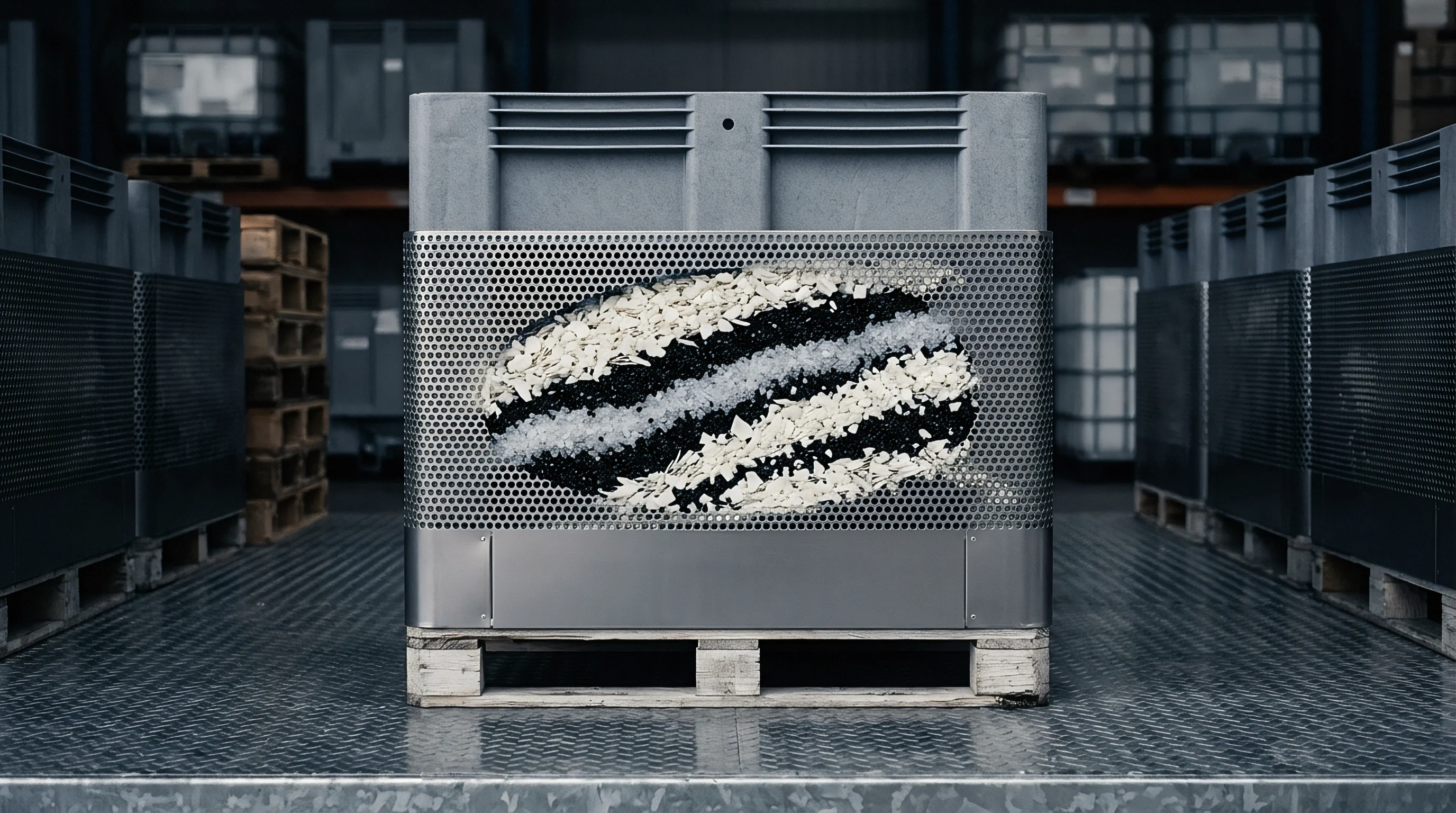
Receiving bulk shipments of polypropylene impact copolymer pellets introduces financial and performance risks. Sub-zero performance cannot be confirmed visually; incoming virgin resin lots must undergo analytical testing prior to discharge into storage silos. A single lot of homopolymer erroneously unloaded into an impact copolymer silo destroys the cold impact capability of thousands of finished logistics crates.
Fourier Transform Infrared Spectroscopy (FTIR) provides rapid lot verification. By quantifying absorbance peaks at 720 cm⁻¹ and 730 cm⁻¹, associated with rock-rock vibrations of ethylene methylene sequences, infrared analytics confirm total ethylene content within fifteen minutes of truck arrival. Differential Scanning Calorimetry (DSC) per ISO 11357-3 further identifies thermal characteristics.
The melting thermogram must exhibit a primary alpha-polypropylene peak near 163°C along with characteristic baseline deflections indicating the rubber phase glass transition temperature between −45°C and −55°C. The presence of polyethylene contamination appears as an secondary melting peak at 125°C to 132°C, signaling potential phase incompatibility that degrades impact resistance.
- Extract primary representative core samples from top, middle, and bottom discharge hatches of the bulk transport container using a stainless steel thief sampler.
- Homogenize individual sub-samples into a unified lot composite inside a sealed, low-humidity sample container.
- Run Melt Flow Rate analysis per ISO 1133 at 230°C under 2.16 kg load to verify viscosity consistency against the grade technical data sheet.
- Perform FTIR spectroscopic analysis to quantify ethylene weight percentage and verify matrix-to-elastomer structural composition.
- Execute micro-injection molding of standard Charpy specimens and condition them at −30°C for six hours prior to destructive testing.
- Issue electronic silo clearance approval only after physical impact and rheological parameters pass specified statistical process limits.

Regrind Fractions and Thermal History Cumulative Damage
Incorporating internal edge-trim or crushed reject crates back into the production stream is standard economic practice. However, repeated extrusion passes induce thermo-mechanical degradation within both matrix and elastomer phases. High shear and elevated temperatures in the injection barrel cause chain scission in matrix polypropylene molecules, driving up the effective melt flow rate while lowering molecular weight.
Matrix chain scission works alongside cross-linking or degradation within the ethylene-propylene rubber phase. Thermal history alters the intrinsic viscosity ratio between matrix and rubber, driving domain coalescence. Dispersed rubber droplets coalesce into large, irregular clusters that fail to initiate micro-crazing under low-temperature impact loading.
Furthermore, secondary processing depletes primary phenolic antioxidants and secondary phosphite stabilizers, leaving the material susceptible to rapid thermo-oxidative breakdown during subsequent service life.
Technical specifications limiting regrind additions to a maximum of fifteen percent preserve original sub-zero Charpy impact values within a five percent tolerance window.
Contamination from non-compatible polymers represents a major structural failure vector in logistics operations. Linear low-density polyethylene (LLDPE) or high-density polyethylene (HDPE) introduced via recycled feedstocks does not automatically blend homogeneously into heterophasic polypropylene. Instead, un-compatibilized polyethylene forms macroscopic phase domains with weak interfacial bond strength.
Under sub-zero dynamic loading, these unbonded interfaces act as sharp internal cracks, causing structural panel failure at impact energies far below design limits.
Suppliers claiming that virgin resin melt flow rate variations within plus or minus fifteen percent of datasheet target have no effect on molded crate sub-zero drop performance ignore molecular weight distribution effects on notch sensitivity.


Specification
Contractual Quality Parameters for Subzero Logistics Crates
Writing an unassailable procurement specification requires establishing quantifiable parameter boundaries tied to standardized test methods rather than generic trade descriptions. Specifications relying on vague terms such as “high-impact copolymer” or “cold-resistant grade” leave logistics buyers exposed to silent grade modifications by compounders seeking cost reductions. Procurement documentation must fix property thresholds under explicit testing conditions.
The core specification framework balances stiffness, processability, and low-temperature energy absorption. Parameter limits should define acceptable ranges for Melt Flow Rate, Flexural Modulus, Charpy Notched Impact at both room temperature and sub-zero service temperature, and Instrumented Fall-Dart Puncture Energy. Defining maximum allowable lot-to-lot variance prevents processing instability and part performance drift during continuous molding runs.
- Melt Flow Rate Target specifies ISO 1133 testing at 230°C/2.16kg with an acceptable variation band not to exceed plus or minus 10% of nominal value.
- Subzero Charpy Notched Energy mandates minimum ISO 179-1eA values at −30°C using type A notch dimensions cut into injection-molded specimens.
- Flexural Modulus Floor establishes minimum ISO 178 three-point bending stiffness measured at 2 millimetric strain rates under 23°C ambient conditions.
- Total Ethylene Content Window sets FTIR spectroscopy boundaries for total monomer composition to prevent matrix softening or rubber phase reduction.
- Maximum Regrind Fraction caps recycled content percentage and restricts regrind origin strictly to verified single-source internal runner systems.

Standardized Test Methods and Sample Conditioning
Test results depend entirely on sample preparation methods and thermal conditioning histories. Injection molding parameter variations alter specimen molecular orientation, crystallinity levels, and internal stress states. Specifications must mandate specimen preparation per ISO 294-1, governing mold temperature, injection velocity, and holding pressures during test bar production.
| Physical Property | Standard Test Method | Test Condition | Minimum Specification Boundary | Maximum Specification Boundary |
|---|---|---|---|---|
| Melt Flow Rate | ISO 1133 | 230°C / 2.16 kg | 10.0 g/10 min | 14.0 g/10 min |
| Density | ISO 1183-1 | 23°C Method A | 0.895 g/cm³ | 0.905 g/cm³ |
| Flexural Modulus | ISO 178 | 23°C, 2 mm/min speed | 1150 MPa | 1300 MPa |
| Tensile Yield Stress | ISO 527-2 | 23°C, 50 mm/min speed | 23.0 MPa | 27.0 MPa |
| Charpy Notched Impact | ISO 179-1eA | +23°C ambient | 35.0 kJ/m² | No Break |
| Charpy Notched Impact | ISO 179-1eA | -30°C conditioned 6h | 8.5 kJ/m² | 14.0 kJ/m² |
| Instrumented Puncture Energy | ISO 6603-2 | -30°C, 4.4 m/s velocity | 32.0 J | 50.0 J |
| Heat Deflection Temp (HDT) | ISO 75-2 | 0.45 MPa Flatwise | 75°C | 85°C |
Specifying conditioning periods prevents premature testing before crystal structural relaxation occurs. Micro-crystalline reorganization continues for up to 48 hours post-molding. Measuring mechanical properties immediately after ejection yields false elevated impact values and lower flexural modulus figures.
Specification rules mandate conditioning all test specimens for a minimum of 24 hours at 23°C and 50% relative humidity per ISO 291 prior to thermal exposure or mechanical destruction.
Failure to meet sub-zero Charpy notched impact thresholds of 8.5 kJ/m² at −30°C triggers immediate rejection of the delivered pellet lot at the supplier’s expense under standard supply contract quality addendums.


Tariff

Monomer Cost Dynamics and Landed Pellet Economics
Polypropylene impact copolymer pricing tracks global steam cracker feedstocks, driven by naphtha cracking economics in Europe and Asia or ethane cracking dynamics in North America. Polymer pricing builds from monomer contract settlements for propylene (C3) and ethylene (C2). Because impact copolymers require multi-reactor synthesis to polymerize the dispersed ethylene-propylene rubber phase, they command a compounding price premium over standard homopolymer grades.
The price spread between homopolymer and high-impact copolymer fluctuates based on ethylene co-monomer demand and reactor capacity availability. In typical market environments, impact copolymers carry a premium of $80 to $180 per metric tonne over injection-grade homopolymer. Specialty sub-zero grades incorporating advanced nucleants or reactor-tailored narrow molecular weight rubber phases incur additional compounding add-ons of $60 to $120 per tonne.
Tariff classifications under Harmonized System (HS) code 3902.30 cover propylene copolymers, exposing cross-border resin shipments to trade duties that alter landed resin costs.
Cold drop failures destroy margins. Evaluating resin purely on price per kilogram ignores the landed cost per good part delivered to the logistics fleet. Higher quality resins with optimized sub-zero impact resistance reduce scrap rates during molding and prevent field failures during logistics operations.
Consider a logistics crate manufacturing run producing 500,000 units annually, with each crate requiring a nominal shot weight of 2.0 kilograms. Selecting resin Option A ~ a standard impact copolymer priced at $1,300 per metric tonne ~ yields a raw material cost of $2.60 per crate. However, due to lower sub-zero Charpy performance (4.5 kJ/m² at −30°C), this grade suffers a 1.8% cold-drop test failure rate during quality audits, along with a 1.2% mold scrap rate from internal stresses causing warpage.
Selecting resin Option B ~ an optimized sub-zero copolymer priced at $1,440 per metric tonne ~ raises the raw material cost to $2.88 per crate. Option B incorporates 20% high-viscosity EPR rubber phase and beta-nucleation, delivering an MFR of 12 g/10 min and a sub-zero Charpy value of 10.5 kJ/m² at −30°C. Option B reduces cold-drop test failure rates down to 0.05% and lowers mold scrap rates to 0.3% through controlled shrinkage kinetics.
| Cost Parameter / Performance Metric | Option A: Standard Impact Grade | Option B: Optimized Subzero Grade |
|---|---|---|
| Delivered Resin Price ($ / Metric Tonne) | $1,300 | $1,440 |
| Part Nominal Weight (kg) | 2.00 | 2.00 |
| Base Resin Cost per Unit ($) | $2.600 | $2.880 |
| Molding Scrap Rate (%) | 1.20% | 0.30% |
| Scrap Cost Impact per Unit ($) | $0.031 | $0.009 |
| Sub-Zero Drop Audit Failure Rate (%) | 1.80% | 0.05% |
| Field Failure Replacement & Admin Penalty per Unit ($) | $0.144 | $0.004 |
| Effective Landed Cost per Good Unit ($) | $2.775 | $2.893 |
| Total Program Manufacturing Cost (500,000 units) | $1,387,500 | $1,446,500 |
| Warranty Claims and Field Liability Exposure ($) | $72,000 | $2,000 |
The arithmetic demonstrates that Option A generates lower nominal production costs. However, incorporating warranty liability, administrative handling of broken field returns, and brand damage from crate failure inside automated cold storage facilities shifts the commercial baseline. Field returns in cold-chain operations involve freight return expenses and lost product contents that dwarf the $0.118 per unit material cost differential.
Landed resin cost calculations must incorporate internal scrap rates, drop-test audit failure costs, and field warranty replacement liabilities to reveal total part economics.
Tooling wear adds secondary processing costs over long production runs. High rubber content resins containing residual micro-talc nucleating agents cause abrasive wear inside hot runner nozzles and gate inserts. Tool steel selection must specify hardened H13 or CPM-9V inserts at high-wear gate locations when running filled or nucleated impact copolymers across multi-cavity crate tools exceeding one million cycles.
Naphtha prices drive monomer costs. Fluctuations in global crude oil and natural gas liquids feedstocks pass directly through monthly monomer contract settlements, altering the price spread between base polyolefins and compounded performance grades. Supply chain managers who lock in long-term resin pricing using monomer-indexed formula contracts hedge against margin erosion while securing the high-performance impact copolymers necessary to guarantee logistics crate survival under sub-zero handling operations.