Determining Extensional Viscosity in Polypropylene Thermoforming Sheet Processing
Determining extensional viscosity via strain-hardening metrics predicts polypropylene sheet sag resistance and prevents wall thinning in deep-draw thermoforming.


Sag
Gravity pulls a preheated polymer matrix downward while suspended across clamp frames prior to mold contact. In polypropylene sheet thermoforming, this catenary deflection alters the local surface area, distorts thermal distribution, and introduces pre-stretching before pneumatic or mechanical forces engage. Polymer chains in standard linear polypropylene (L-PP) lack the entanglements needed to resist continuous gravitational loads at processing temperatures between 155 degrees Celsius and 175 degrees Celsius.
As the sheet hangs in the heating station, the central region thins under self-weight, altering the heat absorption profile across the thickness.
Extensional viscosity governs this deformation regime because the sheet experiences biaxial and planar tension without solid wall boundaries. Unlike injection molding where shear rates exceed ten thousand reciprocal seconds against steel cavity walls, sheet forming operates in an extensional deformation mode at strain rates between 0.1 and 10 reciprocal seconds. Measuring shear flow via Melt Flow Rate (MFR) provides zero data regarding this tension behavior.
A resin with an MFR of 2.0 grams per ten minutes can exhibit extreme catenary drop, while a modified grade with the identical MFR holds a flat profile across a two-meter clamp frame.
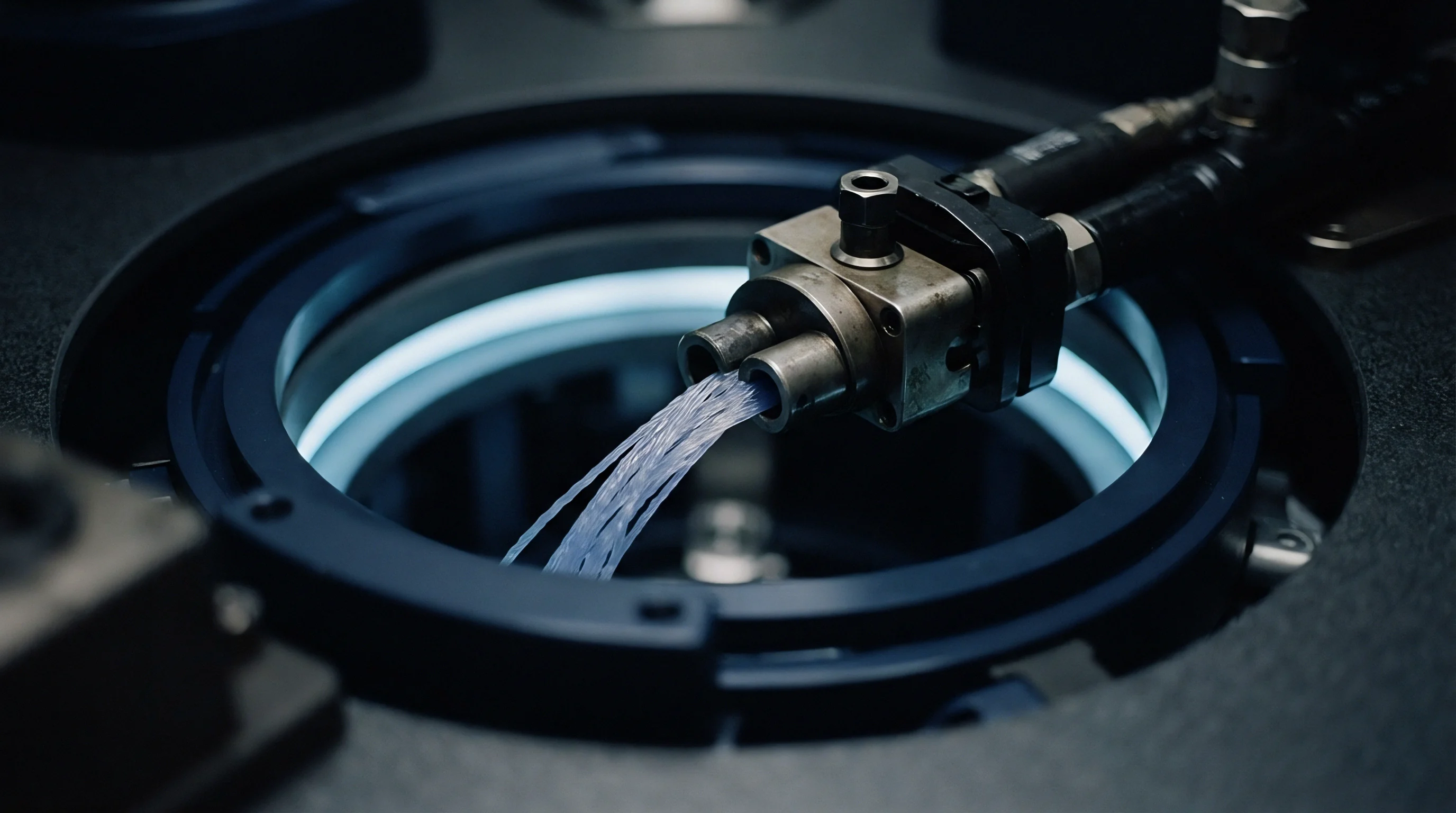
Thermal Softening and Unsupported Sheet Deformation
Heating radiant panels energize the semi-crystalline matrix, melting the alpha-phase monoclinic crystals at approximately 165 degrees Celsius. Upon crystal melting, the storage modulus drops by three orders of magnitude. The material transitions rapidly from a structural solid to a viscoelastic liquid characterized by low melt strength.
The rate of catenary drop accelerates exponentially as core temperature equilibrates with skin temperature.
Temperature control across the sheet thickness dictates the uniformity of this drop. Radiative heaters operating in the medium-wave infrared spectrum penetrate semi-crystalline polypropylene unevenly. Core temperature lags surface temperature by up to 15 degrees Celsius in sheets thicker than three millimeters.
This thermal gradient creates non-uniform extensional resistance through the cross-section, causing outer layers to yield and flow while the core remains semi-solid.
ASTM D638 tensile clamping rules applied to molten sheet fixtures dictate a zero-load hold threshold to prevent premature necking during thermal soaking.

Gravitational Drawdown Mechanics
Planar extension during unsupported heating forces polymer chains to uncoil from their equilibrium random coil configurations. In linear homopolymers, chain disentanglement occurs rapidly under low, sustained tensile stresses. Slower speeds exacerbate sagging.
The uncoiling rate exceeds the relaxation time of the polymer backbone, causing steady resistance to drop continuously as strain accumulates. Sheet gravity pulls downward.
Excessive catenary drop generates three immediate defects upon mold closure. First, the lower portion of the sagged sheet touches the mold floor prematurely, chilling before vacuum application and creating localized heavy spots known as chill marks. Second, the pre-stretched perimeter thins excessively, causing corner blowouts in deep-draw cavities.
Third, unequal distribution of mass leads to uneven wall thickness throughout the final container. Controlling this behavior requires introducing long-chain branching into the polymer backbone, which alters the extensional stress growth function under constant strain rates.
Failure to quantify and manage catenary deflection results in rejected containers due to thin corner walls, excessive web formation between multi-cavity tools, and line stoppages caused by sheet drooping onto heating elements.


Rheometry
Quantifying non-Newtonian flow under uniaxial tension requires instrumentation capable of isolating elongational stresses from shearing forces. Conventional rotational rheometers using cone-and-plate fixtures measure shear viscosity by creating a rotational shear field between rigid boundaries. Under extensional flow, polymer melt is stretched along the stream line without boundary shear, rendering standard rotational geometry unviable.
Specialized characterization techniques measure the transient extensional viscosity growth function as a function of time and strain rate.

Capillary Converging Flow and Cogswell Calculations
Capillary rheometry equipped with zero-length dies provides an indirect method for calculating extensional parameters. Melt flowing from a wide barrel into a narrow orifice undergoes strong extensional acceleration at the entrance region. Pressure losses at this entry neck result from a combination of shear dissipation and extensional work.
By applying the entrance pressure drop model formulated by Cogswell, engineers separate these stress components.
Cogswell analysis assumes that entry pressure loss correlates directly to the average extensional stress, while the strain rate derives from the convergence angle of the melt stream. While capillary methods operate at high throughput speeds and handle aggressive temperature ranges, they generate significant experimental error. The assumption of a purely kinematics-free converging funnel fails to account for die swell history, viscous heating, and non-uniform entry strain distributions.
Capillary techniques serve primarily as screening tools rather than sources of absolute extensional design data.

Rotational Fixture Rheometers and Sentmanat Platforms
Direct measurement of homogeneous uniaxial extensional viscosity utilizes the Sentmanat Extensional Rheometer (SER) fixture mounted within a dual-head rotational rheometer. The SER platform consists of two counter-rotating drums driven by equal and opposite rotational speeds. A rectangular polymer specimen cut from extruded sheet mounts to the drums via mechanical clamps.
As the drums rotate, the specimen stretches at a constant Hencky strain rate, eliminating sample end-effects and shear deformation.
Data output from SER testing captures the transient extensional viscosity curves across strain rates ranging from 0.01 to 20 reciprocal seconds. The test monitors force via a high-resolution transducer as the specimen cross-sectional area decays exponentially. Precise temperature control within an environmental chamber maintains sample homogeneity to within 0.1 degree Celsius.
Polymer chains untangle under tension. Test validity ends when the sample exhibits non-uniform deformation, necking, or ductile fracture across the stretching zone.
| Test Method | Deformation Mode | Strain Rate Range (s⁻¹) | Primary Measurement Output | Limitations in Sheet Processing |
|---|---|---|---|---|
| Sentmanat Extensional Rheometer (SER) | Uniaxial homogeneous extension | 0.01 to 20.0 | Transient extensional viscosity, strain hardening factor | Sample sagging at temperatures exceeding melting point by 20 degrees |
| Cogswell Capillary Analysis | Converging entry flow extension | 10.0 to 1000.0 | Apparent extensional viscosity, entry stress drop | Calculated values overpredict true extensional resistance by up to 40 percent |
| Rheotens Melt Strength Tester | Non-homogeneous drawdown tension | 0.1 to 100.0 | Melt strength force at break, drawability index | Non-uniform strain rate along filament length prevents fundamental viscosity calculation |
| Meissner-Type Rotational Rheometer | Uniaxial homogeneous extension | 0.001 to 1.0 | Steady-state extensional viscosity, stress relaxation | Complex mechanical setup with long thermal equilibration cycles |
Laboratory testing of extensional behavior introduces specific experimental artifacts that degrade data reliability if uncorrected during post-processing.
- Specimen Sagging in SER fixtures occurs when heating low-density or linear polymer samples above their melting point, introducing gravity-driven pre-strain before rotation begins.
- Thermal Non-Uniformity inside the test chamber creates localized hot spots, causing premature strain localization and artificial necking along the gauge length.
- Clamping Slippage at high extension rates permits polymer material to pull out from the counter-rotating drums, producing falsely reduced force readings.
- Brittle Ductile Transition failures occur when testing crystalline grades below their optimal drawing temperature, leading to catastrophic specimen snap rather than uniform flow.
Resin suppliers frequently claim that standard melt flow index values provide sufficient processing guidance, claiming that higher molecular weight grades automatically guarantee adequate melt strength for deep-draw tooling.


Hardening
Structural response during deep-draw stretching depends on the alignment and entanglement density of long polymer chains. When polypropylene sheet undergoes rapid deformation, linear molecules slip past one another with minimal resistance once physical entanglements untangle. Modified polymers containing long-chain branching exhibit a non-linear rise in transient extensional viscosity above the linear viscoelastic envelope.
This phenomenological response, termed strain hardening, acts as a self-healing mechanism during wall thinning.
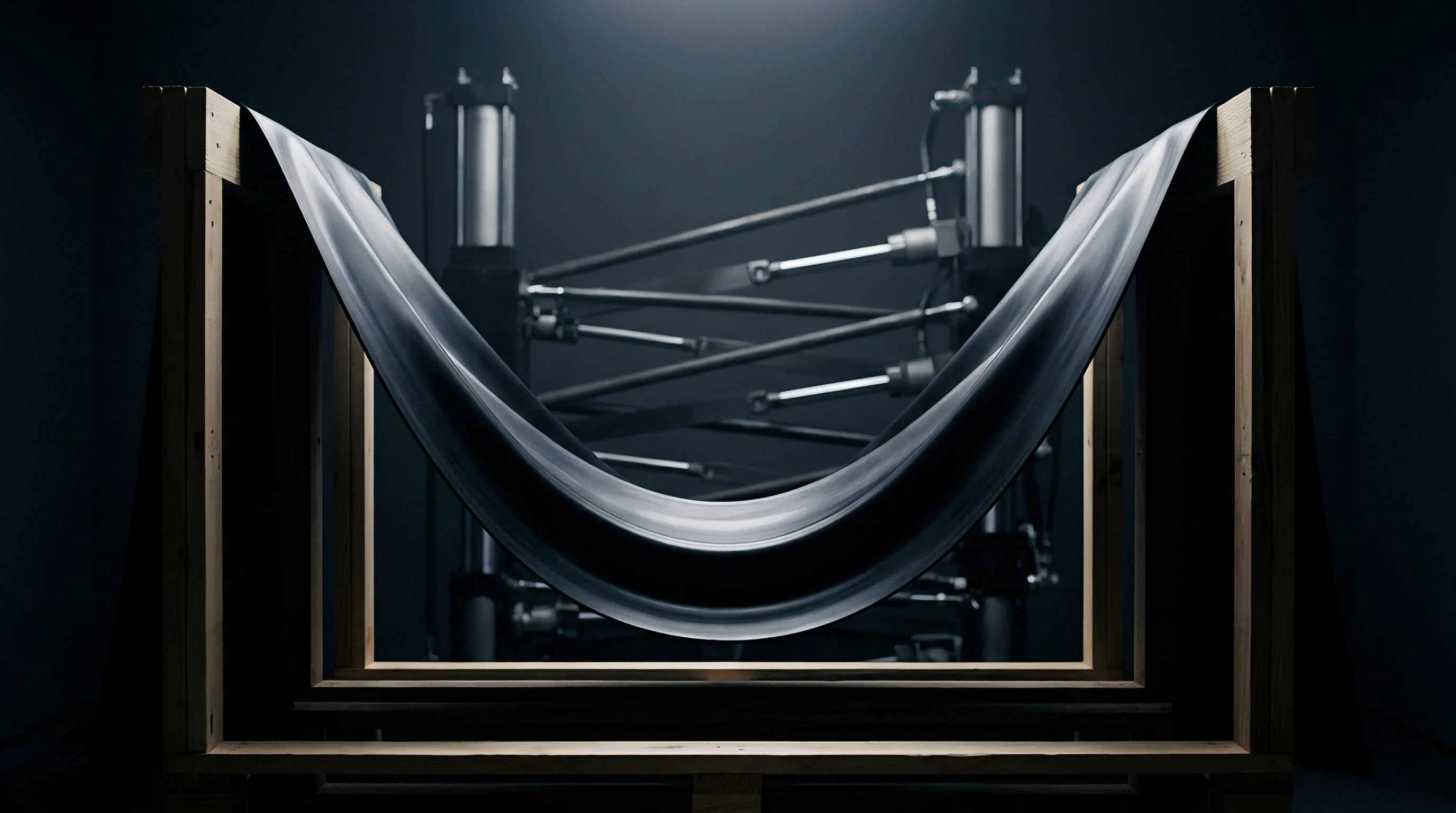
Why Does Standard Melt Flow Rate Fail Thermoforming?
Standard melt index tests measure mass throughput through a specified capillary at a constant temperature under a static load. This index reflects low-shear rate viscosity in a constrained flow channel. Thermoforming deformation involves high-strain unconstrained elongation.
Linear chains slide past easily. A linear polypropylene grade and a long-chain branched polypropylene grade displaying identical Melt Flow Rates of 2.0 grams per ten minutes exhibit wildly divergent behaviors under tension. The linear grade thins rapidly in localized zones, while the branched grade distributes applied stress evenly across the expanding membrane.
Trouton’s ratio defines the proportional relationship between extensional viscosity and shear viscosity in the limit of low deformation rates. For Newtonian fluids, this ratio equals three. In polymer melts undergoing high-strain deformation, shear viscosity thins while extensional viscosity either thins or hardens depending on molecular architecture.
A high Trouton ratio at process-relevant strain rates indicates that the polymer matrix resists localized necking during plug assist stretching.

Molecular Architecture and Long-Chain Branching
Synthesis of High Melt Strength Polypropylene (HMS-PP) introduces long-chain branches onto the linear main chain via electron beam irradiation or reactive extrusion using peroxydicarbonates and multifunctional monomers. Branching creates physical entanglements. These side chains contain molecular weights exceeding the critical entanglement threshold, forcing the chains to act as mechanical anchors during elongation.
Under tension, the backbone stretches until side-branch junction points meet opposition from neighboring entanglements. This geometric constraint requires extra stress to pull branches through the surrounding chain network, manifesting as a sharp upwards curve in the transient extensional viscosity plot. Higher strain rates yield steeper viscosity increases.
Slower speeds exacerbate sagging.
Linear polypropylene grades without molecular branching exhibit rapid localized necking once the elastic limit yields during inflation.
Determining the strain hardening coefficient requires a systematic mathematical reduction of experimental rheological curves.
- Execute Linear Viscoelastic Frequency Sweeps using small-amplitude oscillatory shear rheometry to establish the zero-shear viscosity and relaxation time spectrum of the polymer matrix.
- Calculate Linear Envelope Curves using the Boltzmann superposition principle to plot the theoretical low-strain extensional growth baseline as three times the linear shear stress growth function.
- Perform SER Extensional Sweeps across multiple constant Hencky strain rates from 0.1 to 10 reciprocal seconds under identical test temperatures.
- Extract Peak Extensional Viscosity values at specific Hencky strain levels prior to sample necking or failure.
- Divide Transient Extensional Viscosity by the linear viscoelastic envelope baseline to calculate the dimensionless strain hardening factor at equivalent test times.
Optimal processing windows require a strain hardening factor between two and five; values below two cause uncontrolled localized thinning, while values above five demand excessive plug assist force that can trigger physical part rupture.


Window
Processing boundaries for sheet forming are bounded by the thermal degradation point on the high end and incomplete mold conformity on the low end. Sheet temperature dictates core mobility, while strain rate determines the extensional stress response during plug penetration and inflation. Operating near the lower thermal bound increases required plug forces and residual stresses, leading to post-molding warpage.
Operating near the upper thermal bound collapses the extensional viscosity curve, initiating uncontrolled catenary sag and wall thickness failures.
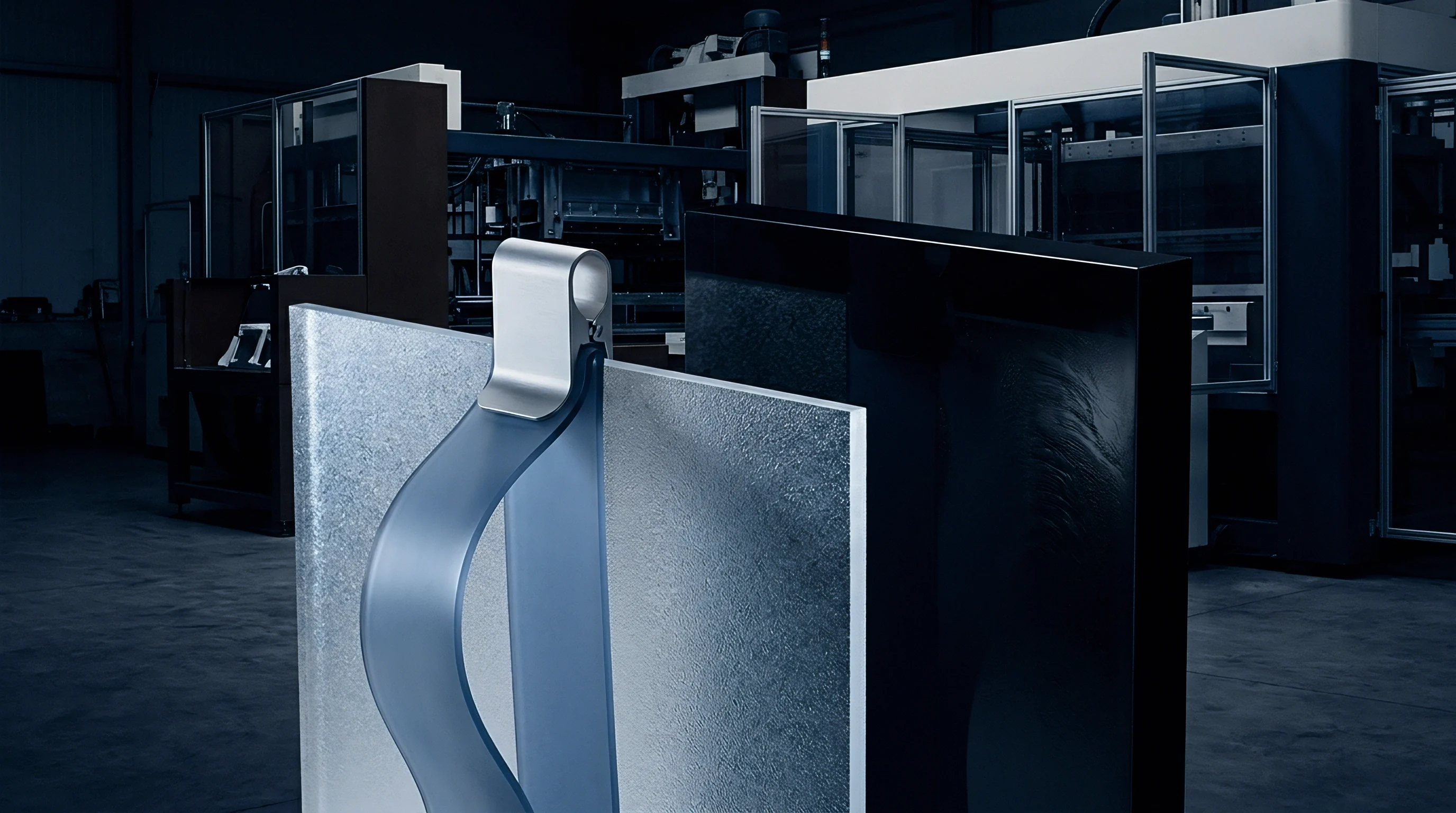
Temperature Distribution across Heavy-Gauge Sheet
Extruded sheet measuring above two millimeters in thickness presents significant internal thermal gradients during pre-heating cycles. Radiative heaters warm the sheet surfaces rapidly, but thermal diffusivity limits heat transfer into the core. If the sheet surface reaches 170 degrees Celsius while the core remains at 150 degrees Celsius, the extensional viscosity varies by more than 50 percent across the thickness profile.
During plug contact, the hot surface layers stretch preferentially, leaving the cooler core un-extended. Temperature gradients destroy consistency. Balancing the heating profile requires multi-zone quartz heaters with independently controlled upper and lower banks set to pulsed heating cycles, permitting thermal equilibration without overheating outer surfaces.

Strain Rate Dependence during Plug-Assist Extension
Plug penetration speeds govern the local Hencky strain rate applied to the molten sheet. Typical servo-driven plug actuators drive into the cavity at speeds ranging from 200 to 1000 millimeters per second. For a container with a 150-millimeter draw depth, these speeds correspond to strain rates between 1.0 and 8.0 reciprocal seconds.
At high strain rates, long-chain branched polypropylene exhibits pronounced strain hardening, increasing local resistance and forcing un-stretched adjacent material into the draw zone. This strain-rate thickening behavior redistributes wall thickness from the container rim down into the base corners. Plug speed alters local strain.
Lowering plug speed shifts deformation into a lower strain-rate regime where extensional viscosity remains low, leading to severe thinning at the first point of plug contact.
| Process Modality | Sheet Thickness Range (mm) | Typical Hencky Strain Rate (s⁻¹) | Target Sheet Core Temperature (°C) | Optimal Extensional Viscosity (kPa·s) |
|---|---|---|---|---|
| Thin-Gauge Packaging (Pneumatic) | 0.35 to 1.20 | 5.0 to 15.0 | 158 to 164 | 120 to 180 |
| Deep-Draw Plug-Assist Container | 1.50 to 3.50 | 1.0 to 6.0 | 162 to 168 | 220 to 350 |
| Heavy-Gauge Industrial Twin-Sheet | 4.00 to 10.00 | 0.1 to 1.0 | 166 to 174 | 400 to 650 |
| Solid-Phase Pressure Forming | 0.80 to 2.50 | 0.5 to 3.0 | 148 to 154 | 800 to 1200 |
High strain rates accelerate thinning when processing linear resins lacking branched structures.
A fourfold increase in planar extensional viscosity at a strain rate of ten per second stabilizes wall thickness variations within three percent across deep-draw containers.
It remains unclear whether online ultrasonic attenuation monitoring can reliably track real-time core sheet temperature and predict local extensional yielding during rapid production cycles without interrupting heater bank indexing.


Dossier
Technical specifications for commercial polypropylene grades frequently rely on single-point shear metrics that mask elongational behavior. Resin manufacturers supply Melt Flow Rate under ISO 1133 or ASTM D1238 standards, alongside density, tensile yield strength, and flexural modulus. These baseline parameters assist in part structural design and extrusion screening but fail to define processability during thermoforming.
Establishing an operational procurement dossier requires specifying rheological metrics that directly reflect extensional performance under shop-floor thermal windows.

Material Certificate Metrics for Quality Assurance
Sourcing raw resin or extruded sheet rolls requires contractual agreements on material qualification protocols. Single-point MFR values vary by plus or minus ten percent within standard lot-acceptance bands without triggering supplier rejections. However, a ten percent shift in MFR can mask a fifty percent collapse in extensional melt strength if molecular weight distribution narrows during resin synthesis.
Quality assurance protocols require multi-point extensional validation on incoming lot samples. Incorporating extensional parameters into raw material certificates forces suppliers to guarantee strain hardening factors and melt strength thresholds. Standard melt index tests fail.
Resin lots failing these criteria exhibit high scrap rates via corner blown-outs, flange distortion, and web formation despite meeting standard density and shear flow targets.
Implementing raw material verification and sheet quality sign-offs involves specific decision gates prior to tool release.
- Establish Baseline Strain Hardening Targets by indexing SER extensional viscosity curves against high-yielding production lots at process-relevant Hencky strain rates.
- Define Melt Strength Acceptance Thresholds using standardized filament draw-down testing to verify minimum peak force values at 190 degrees Celsius.
- Require Gel Count Certification from sheet extruders, ensuring micro-gel impurities do not act as stress concentrators during high-strain extension.
- Audit Recycled Flake Blending Ratios to prevent thermal degradation from reducing long-chain branching content in secondary processing loops.

Process Simulation and Wall Thickness Correlation
Finite element thermoforming simulations utilize constitutive rheological models to predict final container wall thickness distributions. Traditional simulations relying purely on shear viscosity curves (such as Cross or Carreau-Yasuda models) predict excessive uniform draw down, underestimating corner thinning by up to 35 percent. Incorporating extensional data requires viscoelastic constitutive equations such as the K-BKZ (Kaye-Bernstein-Kearsley-Zapas) or MS-MFC (Molecular Stress Function) models.
Accurate input data derived from SER testing allows the simulation engine to model strain hardening behavior during plug engagement and inflation. The software predicts localized stress concentrations, permitting tool designers to optimize plug geometry, plug material thermal conductivity, and mold radii before cutting steel. Data sheets omit extensional curves.
Shear viscosity measurements taken on cone-and-plate geometries fail to predict sheet rupture during rapid plug penetration.
Standard purchase specifications governed by ISO 19069-2 mandate melt mass-flow rate limits but allow suppliers to modify polymerization catalysts without notifying the converter, provided density and tensile properties remain within historical bounds.