Standard Melt Flow Testing Procedures for Polypropylene Quality Control
Polypropylene melt flow quality control demands strict 230 °C and 2.16 kg testing under verified preheat timing to catch processing shifts before moulding.


Barrel
Incoming inspection of polypropylene begins inside a tungsten carbide cylinder heated precisely to 230 degrees Celsius. A standard certificate of analysis cites ASTM D1238 or ISO 1133, yet raw resin bags dropped onto a warehouse staging dock frequently hide twenty percent flow rate swings behind that single printed number. Verification starts by inspecting the bore diameter of 9.550 millimeters and the tungsten carbide die length of 8.000 millimeters under a micrometer.
Polypropylene homopolymer, random copolymer, and impact copolymer behave differently under shear, making thermal equilibrium inside the cylinder the decisive factor in test accuracy.
Polypropylene exhibits pronounced shear-thinning behavior. Under the standard test condition of 230 degrees Celsius and a 2.16 kilogram load, the effective shear rate inside the standard 2.095 millimeter diameter die sits between 10 and 100 reciprocal seconds. Industrial injection moulding machines inject melt at shear rates exceeding 1,000 reciprocal seconds.
The single-point measurement obtained from a standard melt flow indexer cannot predict high-shear mould filling behaviour. It measures the zero-shear plateau and molecular weight averages. Processors handling thin-wall packaging grades with stated melt flow rates of 50 to 100 grams per 10 minutes encounter mould flash or short shots when the incoming resin arrives with an altered molecular weight distribution despite matching the nominal certificate value.
ASTM D1238 Procedure A fixes the nominal die orifice at 2.095 millimeters plus or minus 0.005 millimeters for all commercial polypropylene lots.
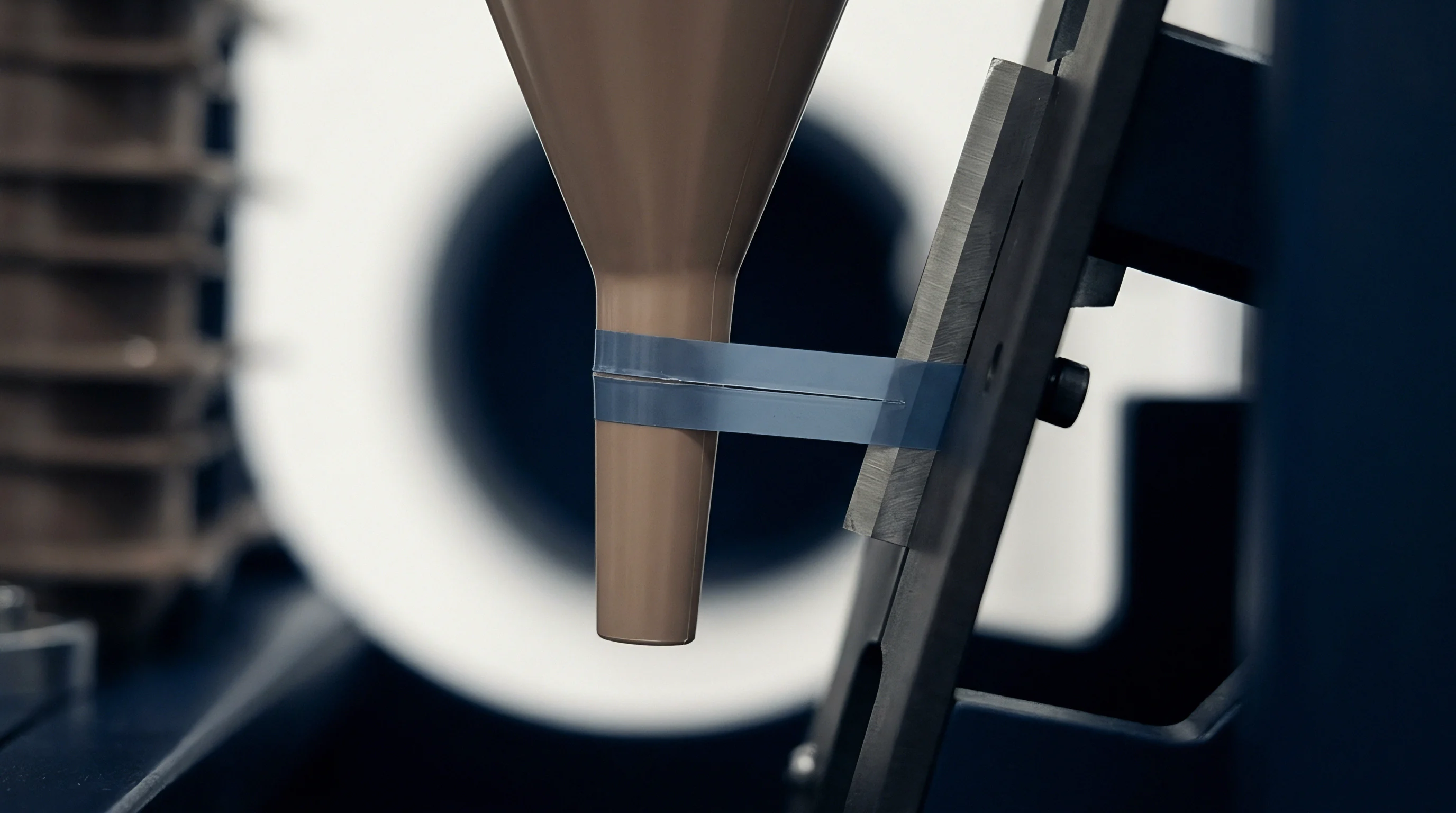
Packing pellets into the cylinder introduces air pockets that distort heat transfer. Trapped oxygen triggers rapid thermal degradation in unstabilized polypropylene chains at 230 degrees Celsius. The test engineer charges 3.0 to 5.0 grams of pellets into the top port using a funnel within forty-five seconds.
Immediate tamping with a packing rod expels entrapped air. The charging phase must terminate before degradation sets in. Once charged, the weighted assembly rests on the resin column to begin the preheat sequence.

Thermal Equilibrium and Charge Compaction
The preheat timer governs thermal consistency across the sample mass. Cold pellets touching the cylinder wall melt instantly, while pellets in the axial core stay solid for three minutes. ISO 1133 specifies a preheat duration of five minutes plus or minus thirty seconds, whereas ASTM D1238 allows a seven-minute preheat sequence.
Deviating from these durations alters the effective temperature of the extrudate. A two-degree drop in melt temperature suppresses the polypropylene flow rate by approximately four percent.
Extruding resin during the preheat cycle empties the reservoir prematurely. Testing laboratories apply a mechanical die stop or an automated orifice plug at the bottom of the cylinder to retain the melt during preheat. For high-flow injection grades exceeding 25 grams per 10 minutes, molten polymer drools past an open orifice under gravity alone.
The plug prevents loss of hydrostatic head before the timer expires. Removing the plug at exactly four minutes and thirty seconds permits thirty seconds of initial purge before recording valid cut intervals.
| Polypropylene Type | Standard Condition | Temperature | Nominal Load | Target Pre-Heat Time |
|---|---|---|---|---|
| Homopolymer (Extrusion Grade) | ISO 1133-1 Condition M | 230 °C | 2.16 kg | 300 seconds |
| Impact Copolymer (Moulding) | ASTM D1238 Condition 230/2.16 | 230 °C | 2.16 kg | 360 seconds |
| Controlled Rheology (Peroxide-Coupled) | ISO 1133-1 Condition M | 230 °C | 2.16 kg | 300 seconds |
| High-Flow Thin Wall Grade | ASTM D1238 Procedure B | 230 °C | 2.16 kg | 300 seconds |
ASTM D1238 Section 10.1 dictates an operational cut-off whenever preheat timing drifts past forty seconds, invalidating the inspection report for commercial settlement.

Cleavage
Polymer chains fracture irreversibly when exposed to thermal, oxidative, or mechanical stress during compounding. Polypropylene degrades exclusively by beta-scission. Peroxides added during controlled-rheology modification cleave long polymer backbones into shorter fragments, narrowing the molecular weight distribution and raising the melt flow rate.
An incoming homopolymer resin specified at 12 grams per 10 minutes that tests at 19 grams per 10 minutes on arrival reveals severe chain fragmentation. This degradation occurs during pelletization or hot-air drying in silo transit.
Oxygen ingress into the heated cylinder accelerates chain termination. Secondary and tertiary carbon atoms along the polypropylene polypropylene backbone form hydroperoxides when exposed to trace oxygen at 230 degrees Celsius. These unstable peroxides decompose into alkoxy radicals, cleaving the main chain.
Unstabilized homopolymer samples left in the test chamber past ten minutes exhibit artificial melt index inflation. The measured extrudate emerges with lower viscosity than the virgin pellet stock.
Stabilization packages mitigate thermal degradation during verification. Primary hindered phenolic antioxidants combine with secondary phosphite processing stabilizers to quench free radicals and decompose hydroperoxides inside the melt chamber. When processors blend post-industrial or post-consumer regrind into prime resin, residual stabilizer concentrations drop.
Incoming lots containing unrecorded scrap degrade rapidly during the preheat dwell. The resulting melt flow rate climbs sharply as testing progresses across successive timed cuts.
How Do Barrel Residues Corrupt Melt Measurements?
Cross-contamination from preceding test runs invalidates incoming resin clearance. High-density polyethylene residues remaining on the cylinder wall melt at 190 degrees Celsius and survive polypropylene testing temperatures, acting as high-viscosity drag components. Clean cylinder surfaces demand mechanical scouring with cotton patches and brass brushes immediately following piston extraction.
Solvents such as decahydronaphthalene dissolve stubborn films, though mechanical swabbing at test temperature remains the floor standard.
- Thermal degradation occurs when unstabilized regrind fragments under prolonged heat, inflating the measured flow index above the specification threshold.
- Cross-contamination takes place when foreign resin residue drags on the piston assembly, creating mechanical friction that artificially lowers the flow reading.
- Additive volatilization emerges when moisture or low-boiling processing aids vaporize into gas bubbles inside the molten core, distorting extrudate mass.
- Pigment agglomeration develops when inorganic color masterbatch particles clog the die entry zone, restricting mass discharge through the orifice.
Scrap fractions change flow properties. Unrecorded regrind additions yield erratic flow profiles across repeat measurements.
Displacement
Volumetric piston tracking provides continuous velocity data throughout the testing stroke. ASTM D1238 Procedure B and ISO 1133-2 utilize digital linear encoders to record piston travel over fixed distances, replacing manual cut-and-weigh techniques. Procedure A relies on manual knife cuts weighed on an analytical balance with 0.1-milligram precision.
Procedure B records the melt volume-flow rate in cubic centimeters per 10 minutes and computes the gravimetric melt flow rate through multiplication with the melt density of polypropylene at 230 degrees Celsius.
Melt density varies across polypropylene formulations. Pure virgin homopolymer exhibits a molten density of 0.7386 grams per cubic centimeter at 230 degrees Celsius. Ethylene-propylene random copolymers carry lower melt densities near 0.7320 grams per cubic centimeter, while heavily filled mineral composites reach densities above 1.1500 grams per cubic centimeter.
Using a generic density factor on talc-filled or calcium carbonate-filled polypropylene corrupts the converted mass flow value. Laboratories inspecting filled grades determine the exact molten density using thermal expansion cells before accepting volumetric indexer outputs.
Molten virgin polypropylene homopolymer requires a conversion density factor of 0.7386 grams per cubic centimeter at 230 degrees Celsius.
Encoder accuracy decides data validity. Optical scales track piston displacement across measurement zones between 6.35 millimeters and 25.40 millimeters. High-flow materials demand narrow measurement spans to complete data acquisition before the piston reaches the lower mechanical travel limit.
Slow-flowing pipe grades with flow rates below 0.5 grams per 10 minutes demand extended travel spans to avoid encoder quantization error. If the piston moves fewer than 5.0 millimeters over the measurement interval, digital rounding errors corrupt the final calculation.
Why Do Volumetric Calculations Overstate High Flow Polypropylene?
Die swell distorts the relationship between volumetric displacement and mass output. Molten polypropylene exiting the die experiences elastic recovery, expanding radially while contracting axially. Highly elastic polymers generate normal stresses that impede flow at the die entrance, causing apparent viscosity increases that automated timers misinterpret.
High-melt-flow resins with narrow molecular weight distributions display negligible die swell, clearing the orifice with minimal entry resistance.
| Test Metric | Procedure A (Gravimetric) | Procedure B (Volumetric) | Procedure C (Half-Length Die) |
|---|---|---|---|
| Primary Output | Mass rate (g/10 min) | Volume rate (cm³/10 min) | Mass rate (scaled) |
| Operator Dependency | High (manual cutting timing) | Low (optical encoder driven) | Low to medium |
| MFR Operating Range | 0.15 to 50 g/10 min | 0.50 to 150 g/10 min | 75 to 300+ g/10 min |
| Melt Density Requirement | Not applicable | Required for gravimetric conversion | Not applicable |
| Calibration Standard | Stopwatch and balance | Linear encoder and timer | Die geometry verification |
Assume an incoming railcar contains forty metric tonnes of an injection moulding grade specified at 35.0 grams per 10 minutes. A technician tests three composite samples via Procedure B using the standard default melt density value of 0.7386 grams per cubic centimeter. The indexer returns an average flow rate of 34.8 grams per 10 minutes.
The shipment receives clearance. The moulder subsequently encounters severe mold flashing across a thirty-two-cavity hot-runner tool.
An audit reveals that the resin supplier incorporated seven percent ethylene-propylene elastomer to boost impact strength, dropping the true melt density to 0.7180 grams per cubic centimeter. Applying the verified density to the recorded volumetric rate reveals an actual mass flow rate of 33.8 grams per 10 minutes. A concurrent manual cut check via Procedure A reveals uncoupled long-chain fractions that suppressed zero-shear viscosity while shearing violently inside the automated barrel.
The resin flowed faster through thin gates than the volumetric test indicated.
The compounding plant technician claimed that automated encoder readings eliminate all human error and provide infallible lot clearance data.

Tolerance
Commercial resin contracts hinge on defined acceptance bands around nominal melt flow rates. The chemical industry standard, ISO 1873-1, organizes polypropylene designations into broad classification bands. A grade classified as nominal 12 grams per 10 minutes falls legally between 9.0 and 15.0 grams per 10 minutes unless the purchasing contract specifies tighter control limits.
Precision moulding operations cannot tolerate a twenty-five percent flow variation across successive production lots. Viscosity swings shift the cavity pressure distribution, inducing sink marks, warping, and dimensional instability.
Incoming inspection procedures define acceptance thresholds tailored to tool geometry. Extrusion blow moulding applications running large automotive ducts demand melt flow rates between 1.5 and 2.2 grams per 10 minutes under 2.16 kilograms. A shift to 2.8 grams per 10 minutes induces severe parison sag, thinning part corners beyond safety limits.
High-speed thin-wall food container lines running thirty-cavity tools demand a flow rate of 65.0 grams per 10 minutes with a hard bilateral tolerance of plus or minus 4.0 grams per 10 minutes. Pellets landing outside this window cause incomplete cavity pack or tooling lockup.
Loose flow bands destroy cavity balance in high-cavity tools.
Statistical process control relies on multiple sampling points across bulk shipments. Railcars carry plastic pellets in four separate compartments, each loaded from distinct compounding run segments. Drawing a single composite sample from the unloading tube conceals batch stratification.
Inspection engineers draw individual samples from top inspection hatches and bottom discharge gates across all compartments.
- Compartment sampling pulls 500-gram portions from each isolated chamber of the bulk railcar or pneumatic silo truck before discharge valves open.
- Moisture verification verifies volatile content remains below 0.05 percent by weight using a loss-on-drying halogen moisture balance at 105 degrees Celsius.
- Specimen drying eliminates surface condensation in a desiccant oven at 80 degrees Celsius for two hours when samples are collected under humid ambient conditions.
- Triplicate testing executes three separate barrel charges under ASTM D1238 conditions to calculate mean flow and standard deviation for the compartment.
- Disposition signoff blocks silo transfer valves until testing confirms that all sampled compartments sit within agreed bilateral control limits.
Rejecting a shipment after transferring pellets into bulk storage silos triggers silo contamination. Evacuating fifty tonnes of off-spec polypropylene from an elevated storage silo costs thousands of dollars in pneumatic transfer fees and devalues prime material into discounted reprocess stock.

Settlement
Resolving commercial disputes between resin converters and petrochemical producers requires documented test verification. A certificate of analysis showing compliance does not prevent tooling failure when incoming inspection reveals out-of-specification flow. Producers protect margins by writing generous tolerance bands into general sales terms.
Buyers protect their landed part costs by attaching rigid technical specifications to purchase orders, naming the specific test method, preheat parameters, and arbitration laboratories.
Commercial specifications dictate financial penalties when flow variations exceed contractual bounds. Sourcing contracts specify that incoming lots drifting beyond ten percent of nominal flow rate trigger price discounts or immediate return freight at the seller expense. Without verified melt flow data collected strictly under ISO 1133 or ASTM D1238 timing rules, the converter loses standing to claim compensation for downtime, mold damage, or rejected parts.
| Application Sector | Target MFR (g/10 min) | Contract Tolerance | Failure Mode Under Deviation |
|---|---|---|---|
| Biaxially Oriented Film (BOP film) | 2.5 to 3.5 | ±0.3 | Web snap, bubble instability |
| Pressure Pipe Extrusion | 0.25 to 0.45 | ±0.08 | Sag, non-uniform wall thickness |
| Automotive Bumper Fascia | 12.0 to 18.0 | ±1.5 | Tiger striping, differential shrinkage |
| Medical Syringe Barrels | 25.0 to 32.0 | ±2.0 | Flash, short shots, dimensional drift |
| Thin-Wall Food Packaging | 60.0 to 100.0 | ±6.0 | Cavity imbalance, ejector pin punch |
Contractual agreements incorporate arbitration clauses specifying third-party laboratory verification. If the internal plant laboratory records an average flow rate of 8.2 grams per 10 minutes against a contracted nominal value of 11.0 grams per 10 minutes, the supplier retains the right to audit internal testing logs. The audit scrutinizes die orifice micrometer records, temperature calibration logs, and analytical balance calibration stickers.
A missing calibration stamp on the indexer thermocouple invalidates the buyer rejection claim.
Testing speed conflicts with analytical rigor during rapid unloading cycles. Production lines demand immediate resin discharge into feed bins, tempting incoming quality inspectors to shorten preheat cycles or test single pellets rather than blended composite lots. This friction leaves the question unresolved: whether rapid single-point volumetric indexers can provide legally defensible incoming lot clearance without forcing converters to hold railcars on demurrage while awaiting full laboratory verification.