Polypropylene Domain Sizing in Recycled Polyethylene Compounds
Fine dispersion of polypropylene inclusions below one micron in recycled polyethylene compounds recovers impact strength without sacrificing tensile modulus.
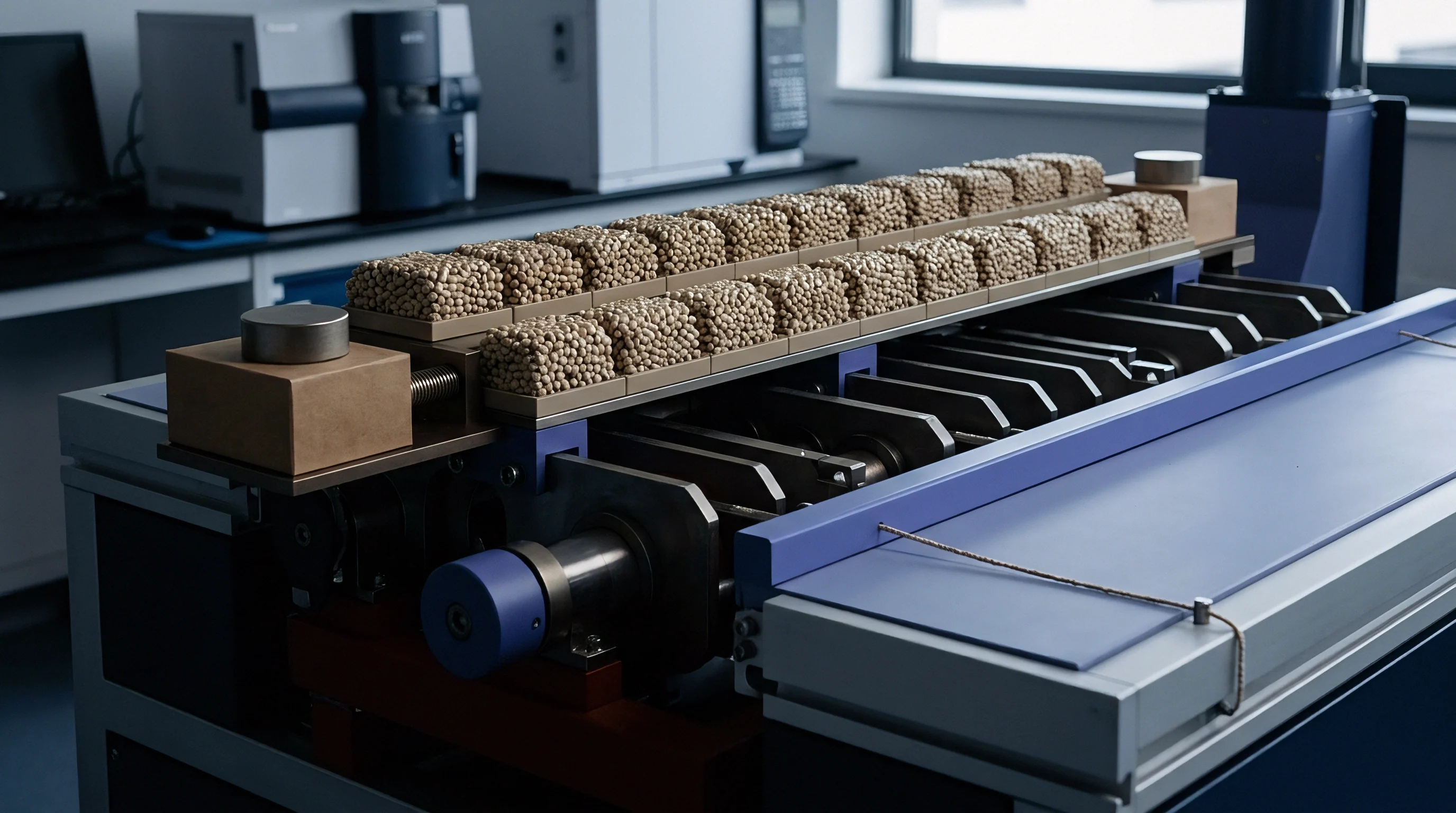

Phase
Post-consumer polyolefin streams extracted from municipal rigid containers contain residual polypropylene fractions ranging between 2% and 12% by weight. Phase separation occurs rapidly. Polyethylene and polypropylene display positive Flory-Huggins interaction parameters, preventing thermodynamic mixing in the melt.
During melt processing, the minor polypropylene fraction isolates into discrete liquid droplet domains distributed throughout the continuous polyethylene matrix. The mechanical behavior of the final solid compound depends on the spatial dimensions and interfacial strength of these dispersed droplets.

Polyolefin Immiscibility in Recycled Feedstocks
Uncompatibilized polyolefin blends form coarse co-continuous or sea-island morphologies depending on volume fraction and melt viscosity ratios. When post-consumer high-density polyethylene containing 8% polypropylene melts inside an extruder, high interfacial tension drives the minor component to minimize surface area by forming spherical domains. Uncompatibilized interfacial tension between high-density polyethylene and polypropylene reaches approximately 3.0 mN/m to 4.5 mN/m at a processing temperature of 200 °C. Large inclusions exceeding five microns in diameter act as severe mechanical defects under applied loads.
Droplet breakup requires shear. Deformation of a minor-phase droplet suspended in a matrix melt depends on the balance between viscous shear forces attempting to distort the droplet and interfacial forces resisting distortion. The dimensionless Capillary number defines this relationship as the product of matrix viscosity, shear rate, and initial droplet radius, divided by the interfacial tension.
When the local Capillary number exceeds a critical threshold, viscous forces overcome interfacial surface tension, forcing the droplet to elongate into a thread that breaks into smaller daughter droplets through Rayleigh-Taylor instabilities.
Uncompatibilized blends with droplet diameters exceeding three microns lose forty percent of their room temperature notched impact strength.

Interfacial Tension and Capillary Breakup Mechanics
The viscosity ratio between minor and major polyolefin phases governs droplet breakup efficiency during compounding. Expressed as the minor phase viscosity divided by the matrix phase viscosity at a specific shear rate, this ratio dictates whether shear flow can deform the droplet. Droplet breakup occurs most efficiently when the viscosity ratio sits between 0.1 and 1.0.
If the polypropylene minor phase exhibits a lower melt flow rate than the surrounding polyethylene matrix, the viscosity ratio rises above 3.8, rendering droplet breakup in pure shear flow impossible regardless of processing energy.
Viscosity ratios dictate morphology. Matching the shear viscosity of incoming post-consumer streams across compounding shear rates ensures consistent domain reduction. Melt flow rates measured under standard conditions of 190 °C / 2.16 kg for polyethylene per ISO 1133 and 230 °C / 2.16 kg for polypropylene provide an initial index, but capillary rheology conducted under ISO 11443 at shear rates between 100 s⁻¹ and 1000 s⁻¹ reveals actual viscosity matching inside the compounding barrel.
| Matrix PE MFR (190 °C / 2.16 kg) | Dispersed PP MFR (230 °C / 2.16 kg) | Viscosity Ratio λ (at 500 s⁻¹) | Equilibrium Domain Size (µm) | Morphological State |
|---|---|---|---|---|
| 0.3 g/10 min | 12.0 g/10 min | 0.08 | 0.4 to 0.8 | Fine Droplets |
| 0.8 g/10 min | 3.0 g/10 min | 0.45 | 0.6 to 1.2 | Sub-Micron Dispersion |
| 2.0 g/10 min | 0.8 g/10 min | 2.10 | 3.5 to 6.0 | Coarse Macro-Domains |
| 7.0 g/10 min | 0.3 g/10 min | 4.20 | 8.0 to 15.0 | Unbroken Islands |
Moulding uncompatibilized compounds containing oversized domain inclusions leads to catastrophic brittle failure during drop-impact testing of finished blow-moulded containers.


Shear
High-intensity compounding twin-screw extruders break minor-component polyolefin domains down through intense extensional flow and local mechanical work. Interfacial energy drives coalescence. Co-rotating twin-screw extruders deploy specialized screw element combinations to generate high deformation fields that smash coarse polypropylene droplets into sub-micron fragments before dynamic coalescence re-agglomerates them inside the melt channel.
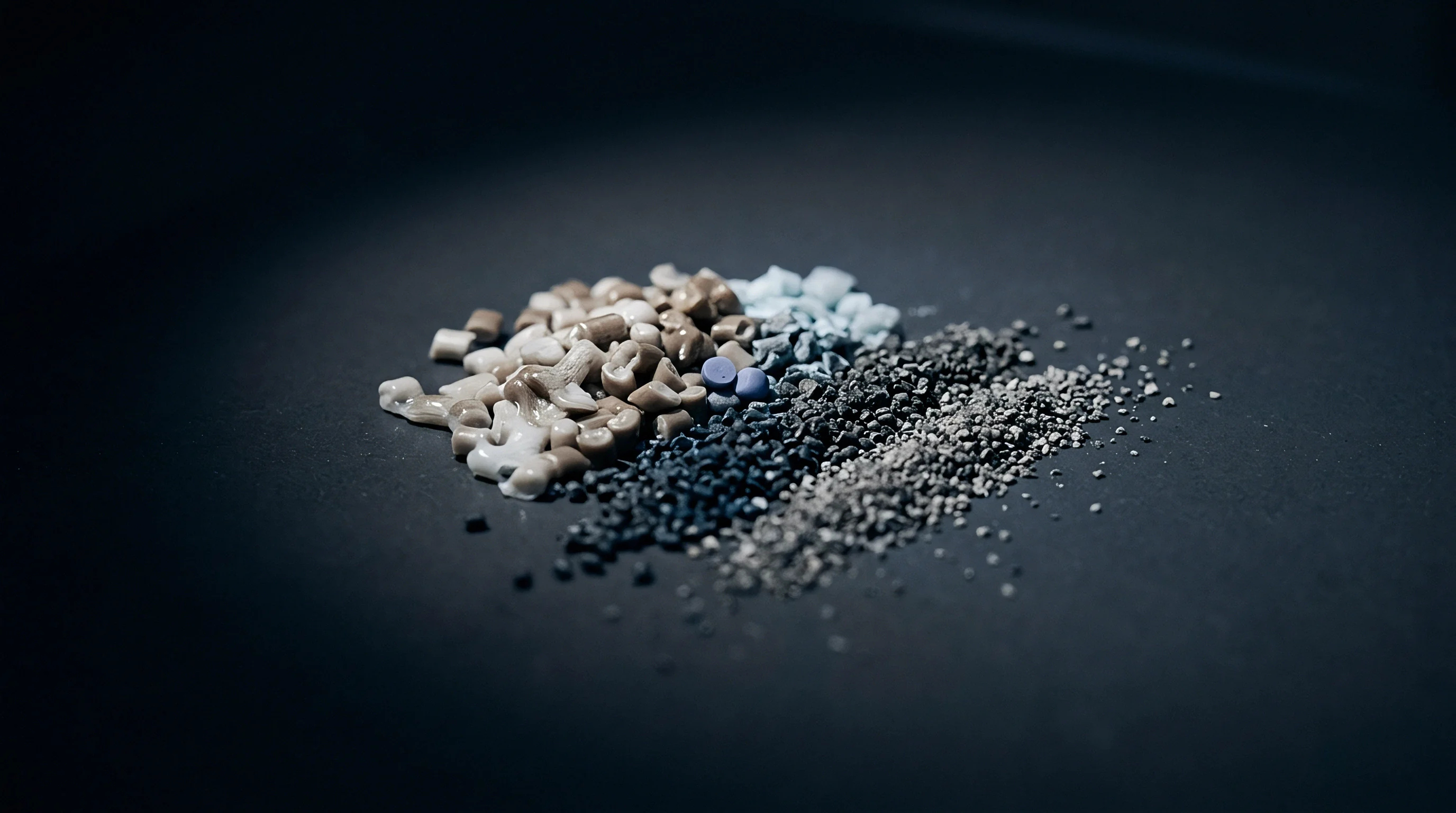
Twin Screw Extruder Screw Profile Configuration
Extrusion screw profile architecture determines the balance between distributive mixing and dispersive mixing. Dispersive mixing requires localized high-stress zones capable of exceeding the critical Capillary number for droplet breakup, whereas distributive mixing reorganizes droplets uniformly across the barrel volume. Kneading blocks configured with 90° staggering angles generate pure extensional flow fields, accelerating droplet elongation compared to simple forward-conveying flighted elements.
Compounding lines processing post-consumer polyolefin flakes utilize a specific mechanical energy input target between 0.24 kWh/kg and 0.32 kWh/kg. Positioning narrow-flighted 45° forward kneading disks upstream of 90° neutral kneading elements establishes an initial melt seal while stretching minor-phase domains into thin filaments. The subsequent neutral kneading section subjects the stretched filaments to peak shear stresses exceeding 40 kPa, triggering immediate thread breakup.
- Feed raw post-consumer high-density polyethylene flake into the primary barrel throat at a calibrated mass rate.
- Introduce pre-blended elastomeric masterbatch into zone four via a side feeder to minimize thermal exposure.
- Apply high energy input through three consecutive blocks of ninety-degree neutral kneading disks.
- Vent volatile degradation byproducts under a vacuum level of minus 0.08 MPa at zone eight.
- Filter particulate contaminants through a dual-bolt continuous screen changer operating at two hundred mesh.

Residence Time and Temperature Windows in Melt Compounding
Excessive thermal exposure inside the compounding barrel degrades polyolefin chains through distinct pathways. Polyethylene undergoes thermo-oxidative cross-linking, decreasing its melt flow rate, while polypropylene suffers chain scission, increasing its melt flow rate rapidly. This divergent degradation alters the viscosity ratio during processing, moving the system away from the optimal viscosity ratio window and causing late-stage domain coalescence.
At a melt temperature of 210 °C and an applied load of 2.16 kg under ISO 1133, a viscosity ratio near unity maximizes droplet dispersion.
Barrel temperature zone regulation requires precise control between 190 °C and 215 °C. Operating melt temperatures above 230 °C lowers matrix shear viscosity excessively. Lower matrix viscosity reduces the shear stress transferred to minor polypropylene droplets, preventing domain refinement despite high screw rotation speeds.
Increasing screw speed without adjusting barrel temperature profiles causes thermal degradation before droplet dispersion reaches equilibrium.


Compatibilization
Interfacial modifiers reduce thermodynamic repulsion between immiscible polyolefin phases by migrating directly to the boundary layer between components. Compatibilizers collect at boundaries. Block copolymers featuring blocks miscible with polyethylene alongside blocks miscible with polypropylene lower interfacial surface tension toward zero mN/m while anchoring the phase boundary against stress-induced delamination.
Interfacial Modifier Selection for Polyolefin Blends
Selecting appropriate block architecture decides whether an additive acts as an effective interfacial modifier or merely functions as an expensive matrix filler. Styrene-ethylene-butylene-styrene block copolymers and olefin block copolymers containing semicrystalline ethylene blocks and amorphous ethylene-octene blocks exhibit high affinity for polyolefin phase boundaries. Sub-micron domain sizing restores ductility.
Adding olefin block copolymers at loadings between 3% and 6% by weight drops interfacial tension from 3.8 mN/m to below 0.7 mN/m. This dramatic drop lowers the critical Capillary number required for droplet breakup, allowing standard extrusion shear rates to reduce polypropylene domain diameters down to 0.4 µm. Surpassing the critical micelle concentration of the compatibilizer leads to block copolymer self-assembly into isolated micelles inside the matrix, providing no additional domain sizing benefit while increasing overall raw material costs.
- Styrene-Ethylene-Butylene-Styrene Copolymers provide high interfacial activity due to midblock poly(ethylene-butylene) solubility in both polyolefin phases.
- Olefin Block Copolymers contain alternating semicrystalline and amorphous segments that co-crystallize with polyethylene chains while anchoring inside polypropylene domains.
- Ethylene-Octene Elastomers lower glass transition temperature and promote matrix shear yielding around minor inclusions.
- Maleic Anhydride Grafted Polyethylenes improve interfacial polar interactions when recycled streams carry trace polar contaminants alongside polypropylene.
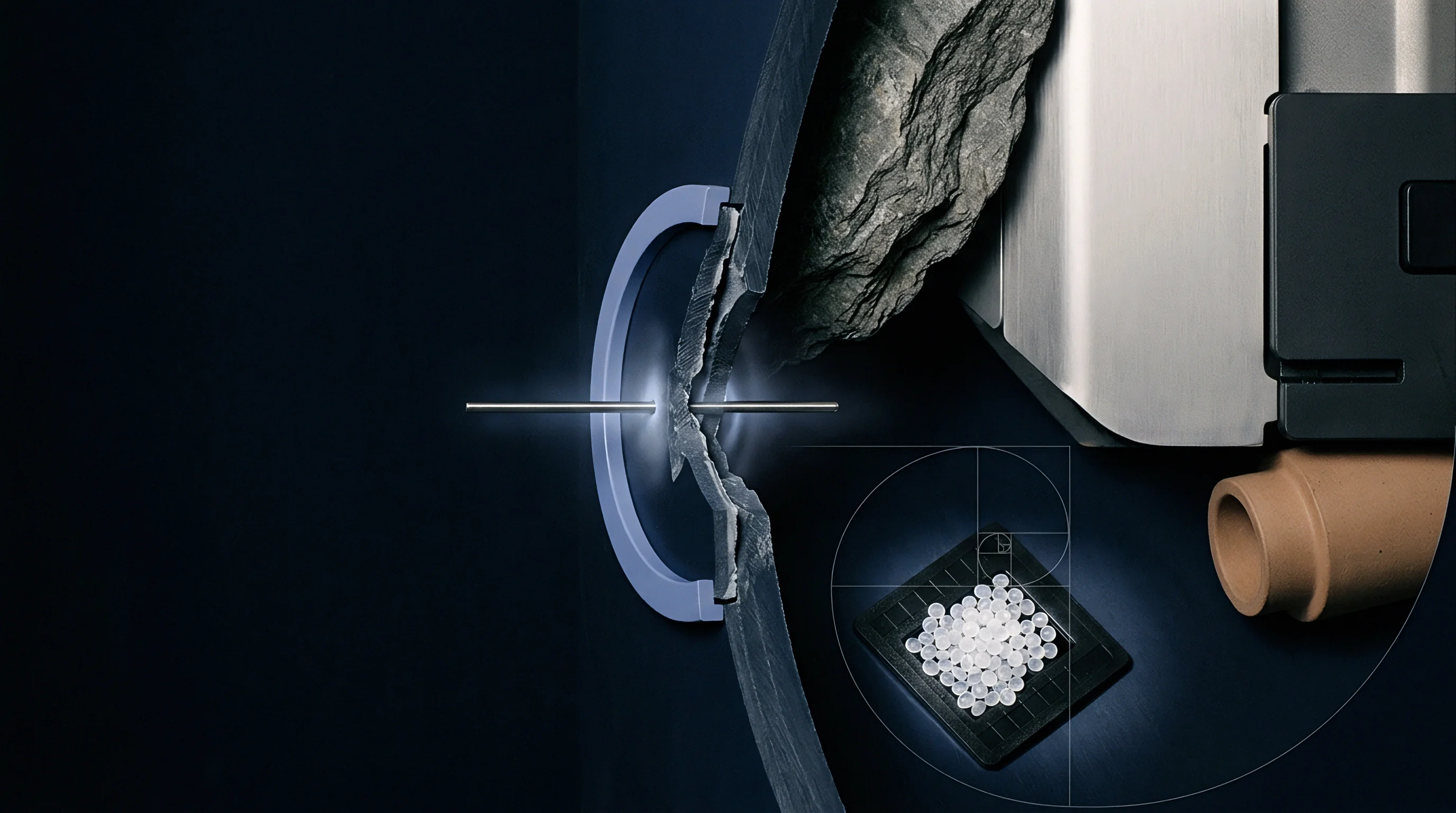
Why Do Sub-Micron Inclusions Prevent Impact Fracture?
Reducing domain diameters below a critical threshold alters the deformation mechanics of the composite material under high-rate impact loading. Large polypropylene domains above three microns initiate sharp micro-cracks under tensile stress because matrix-domain debonding occurs before matrix yielding. Sub-micron domains spaced closely together alter the local stress state, triggering extensive matrix shear yielding and micro-voiding that dissipates fracture energy without propagating catastrophic cracks.
Consider a 5000 kg production lot of recycled high-density polyethylene containing 7% polypropylene by weight. Uncompatibilized compounding yields an average polypropylene domain radius of 1.75 µm. The total volume of polypropylene equals 0.3888 cubic meters.
Assuming spherical morphology, the calculated total interfacial surface area across the lot equals 6.66 x 10^5 square meters. Adding 3.5% weight of an olefin block copolymer reduces the equilibrium domain radius down to 0.30 µm under identical shear compounding. The resulting interfacial area expands to 3.888 x 10^6 square meters, requiring 175 kg of modifier to saturate the expanded interface at a theoretical interfacial coverage density of 0.045 g/m².
| Compatibilizer Type | Loading Rate (wt%) | Mean Domain Size dn (µm) | Notched Izod at 23 °C (kJ/m²) | Tensile Elongation at Break (%) |
|---|---|---|---|---|
| None (Unmodified PCR) | 0.0 | 3.80 | 4.2 | 28 |
| SEBS Copolymer | 3.0 | 0.85 | 14.8 | 185 |
| SEBS Copolymer | 5.0 | 0.42 | 26.5 | 340 |
| Olefin Block Copolymer | 3.0 | 0.65 | 18.2 | 260 |
| Olefin Block Copolymer | 5.0 | 0.35 | 32.0 | 410 |
Standard purchase specifications governing post-consumer polyolefins penalize uncompatibilized lots by reclassifying the shipment to utility grade.
Compounders often claim that increasing total elastomer content above eight percent compensates for poor screw design, ignoring the resulting drop in flexural modulus.

Microscopy
Scanning electron imaging combined with quantitative image analysis reveals the physical dimensions and spatial distribution of minor-phase polyolefin domains. Micrographs present clear structural evidence. Standard optical inspection fails to resolve minor inclusions below two microns, forcing reliance on electron microscopy performed on cryogenically fractured plaque specimens.

Cryogenic Fracture and Solvent Etching Protocols
Specimen preparation determines the accuracy of domain size measurements under electron beams. Submerging test bars in liquid nitrogen at -196 °C for thirty minutes ensures fracture occurs well below the glass transition temperatures of both polyethylene and polypropylene. Cryogenic fracturing produces clean planar surfaces without plastic deformation of domain boundaries.
Solvent etching exposes internal structures.
Selectively extracting the dispersed polypropylene phase enhances contrast during scanning electron microscopy. Immersing fractured specimens in hot xylene at 70 °C for 25 minutes dissolves the amorphous and semicrystalline polypropylene domains at the surface while leaving the cross-linked or higher-melting polyethylene matrix intact. Sputter-coating the etched surface with a 5-nanometer layer of gold-palladium prevents electron beam charging, exposing empty spherical cavities where polypropylene domains previously resided.
- Cryogenic Sample Preparation requires immersing molded plaques in liquid nitrogen for twenty minutes prior to impact fracturing to prevent ductile deformation of domain walls.
- Selective Phase Extraction demands controlled immersion in hot xylene at seventy degrees Celsius to dissolve polypropylene inclusions while preserving matrix cavity geometry.
- Sputter Coating Execution deposits a five-nanometer layer of gold-palladium alloy across the etched surface to eliminate electron beam charging during high-magnification scanning.
- Micrograph Area Selection mandates recording at least ten independent fields of view across the plaque core to yield a minimum sample population of five hundred discrete domain measurements.

Quantitative Image Analysis and Particle Size Distribution
Processing electron micrographs requires software-based edge detection to calculate statistical particle distributions. Image software measures individual domain areas, converting them into equivalent spherical diameters. Evaluating both number-average domain diameter and volume-average domain diameter identifies skewness in the dispersion distribution.
Cavity diameters reflect domain volumes. Image analysis quantifies droplet size. A broad distribution containing a high volume-average diameter relative to the number-average diameter indicates ongoing domain coalescence during processing.
The polydispersity ratio of volume-average to number-average diameter serves as a critical quality metric; values approaching 1.0 signify uniform sub-micron dispersion.
| Test Parameter | Standard Test Method | Analysis Condition | Target Compliance Value | Non-Conformance Risk |
|---|---|---|---|---|
| Polypropylene Fraction | ISO 11357-3 (DSC) | 10 °C/min Heat Rate | 2.0 wt% to 8.0 wt% | Modulus Mismatch |
| Number-Average Size (dn) | ISO 17822 / SEM Image | Cryo-Fracture / Xylene Etch | < 0.80 µm | Brittle Impact Failure |
| Volume-Average Size (dv) | ISO 17822 / SEM Image | 500 Particles Minimum | < 1.20 µm | Stress Concentration |
| Polydispersity (dv / dn) | Statistical Calculation | Ratio Assessment | < 1.50 | Coalescence Instability |
A strict incoming quality limit sets maximum volume-average domain size at one point two microns for automotive exterior application approval.
Contracts specifying ISO 18553 dispersion rating compliance reject incoming pellet lots whenever volume-average domain diameters exceed one point five microns across three consecutive core samples.


Toughness
Impact energy dissipation in modified polyolefin blends relies on craze initiation and shear yielding generated at the interfaces of fine minor-phase droplets. Elastomers absorb fracture energy. Thin interparticle matrix ligaments undergo cooperative shear yielding when minor domains are spaced sufficiently close together.

Notched Izod and Ductile-to-Brittle Transition Temperature
Matrix ligament thickness governs energy dissipation. Wu’s interparticle distance model defines the critical surface-to-surface distance between adjacent droplets below which a matrix transitions from brittle crack propagation to fully ductile shear yielding. For high-density polyethylene matrices, this critical interparticle distance sits at approximately 0.35 µm.
Sub-micron domain sizing forces interparticle distances below this critical threshold even at low polypropylene loading levels.
Cold drop testing reveals brittle voids. Testing notched Charpy impact properties per ISO 179 across temperatures ranging from -30 °C to +23 °C plots the ductile-to-brittle transition curve. Uncompatibilized compounds containing coarse polypropylene inclusions shift the transition temperature upward toward +10 °C, leading to part shatter during cold-weather handling.
Fine domain dispersion maintained below 0.6 µm suppresses the ductile-to-brittle transition temperature down to -25 °C.
Shear yielding prevents crack growth. Sub-micron domain sizing restores ductility across sub-zero operation, widening the thermal window for post-consumer resin deployment in outdoor logistics applications.
Commercial Economics of Domain Size Refinement
Refining domain morphology increases compounding operational expenses but protects finished part yield. Material cost dictates process viability. Sourcing raw post-consumer high-density polyethylene flake costs approximately $980 per tonne.
Adding 4.0% weight of an olefin block copolymer compatibilizer priced at $3,600 per tonne adds $144 per tonne to raw material costs. Operating a high-shear twin-screw compounding line to achieve sub-micron dispersion adds $110 per tonne in energy and processing expenditure, elevating total compounded pellet cost to $1,234 per tonne.
Uncompatibilized post-consumer compounds priced at $1,090 per tonne incur high failure rates during injection molding of thin-wall crates. Internal production data demonstrates that uncompatibilized lots suffer a 14% part rejection rate due to crack propagation during automated drop testing. Compounding with compatibilized sub-micron domain control reduces part rejection rates to 0.4%, saving $168 per tonne in scrap re-handling, tool downtime, and lost throughput.
The reduction in scrap offsets the additive cost, producing net operational savings across high-speed molding operations.
Whether dynamic interphase crystallization under ultra-high cooling rates in thin-wall injection tools limits long-term fatigue resistance remains a subject of active industrial investigation.