Capillary Rheology Protocol Implementation for Polyethylene Extrusion Pellets
Implement multi-point capillary rheology protocols with Bagley and Rabinowitsch corrections to verify high-shear viscosity and prevent extrusion line failure.


Bore
Incoming inspection of polyethylene pellets intended for high-output extrusion lines begins with packing density inside the rheometer test chamber. A laboratory technician measuring resin across extrusion shear rates encounters immediate sample error when pellets bridge against the reservoir wall during loading. Polyethylene granules delivered from bulk transport containers show bulk densities between 0.50 and 0.58 g/cm³, while the molten polymer reaches approximately 0.76 g/cm³ at an extrusion temperature of 190 degrees Celsius.
Charging the heated barrel in loose increments introduces microscopic air pockets along the internal steel cylinder, distorting the apparent rate. Compression tamping using a brass rod expels trapped pockets between charges before thermal equilibration starts.
Thermal stability within the barrel governs the validity of every downstream shear reading. Standard test practice under ASTM D3835 and ISO 11443 prescribes a preheat soak time between five and eight minutes at test temperature. Polyethylene grades stabilized with standard hindered phenol and phosphite packages withstand this thermal window without significant chain alteration.
When thermal preheat extends past twelve minutes in an unpurged barrel, high-density polyethylene resins with low initial melt flow rates begin showing signs of radical cross-linking, which registers as an artificial upward drift in driving pressure. Low-density polyethylene with extensive long-chain branching undergoes thermal chain scission under prolonged residency, dropping melt resistance across subsequent plunger strokes.
ASTM D3835 requires reporting both uncorrected apparent viscosity and Bagley-corrected shear stress to sustain any commercial rejection based on flow divergence.
Moisture content, while less disastrous for polyolefins than for condensation polymers, influences packing consistency. Ambient humidity condensing on chilled pellets inside silo discharge chutes leads to steam vapor formation inside the heated barrel at 190 degrees Celsius. These vapor pockets exit the die as acoustic pops accompanied by instantaneous pressure drops on the load cell.
Installing an inline hopper dryer to hold raw pellets at 60 degrees Celsius for two hours prior to rheometer charging eliminates moisture condensation and stabilizes initial barrel packing.
The sequence of mechanical actions during initial charging determines baseline repeatability across test runs:
- Initial Pellet Increment settles against the bottom die face when tamped under five kilograms of manual force to establish thermal contact.
- Secondary Fill Volume brings the packed molten core to within twenty millimeters of the top land before the driving piston enters the chamber.
- Purge Stroke Displacement advances the piston until molten polymer beads continuously at the exit land, removing air pockets before thermal equilibration.
- Preheat Dwell Period allows the packed polymer core to reach thermal uniformity at the set temperature over five minutes before displacement commences.
When packing steps are rushed or air remains trapped in the barrel, the recorded driving load fluctuates wildly, producing invalid viscosity curves that hide genuine processing differences between incoming pellet lots.


Correction
Raw pressure readings collected from a single capillary die reflect multiple parasitic resistances alongside simple shear flow. Polymer chains entering the narrow die entrance from a wide reservoir undergo rapid extensional acceleration, creating an entrance pressure loss that can exceed thirty percent of total system resistance. A standard 180-degree flat entrance geometry forces viscoelastic polyethylene melts into circulating corner vortices before funneling into the die land.
Measuring flow strictly through an uncorrected single die overstates the shear stress sustained by the polymer melt.
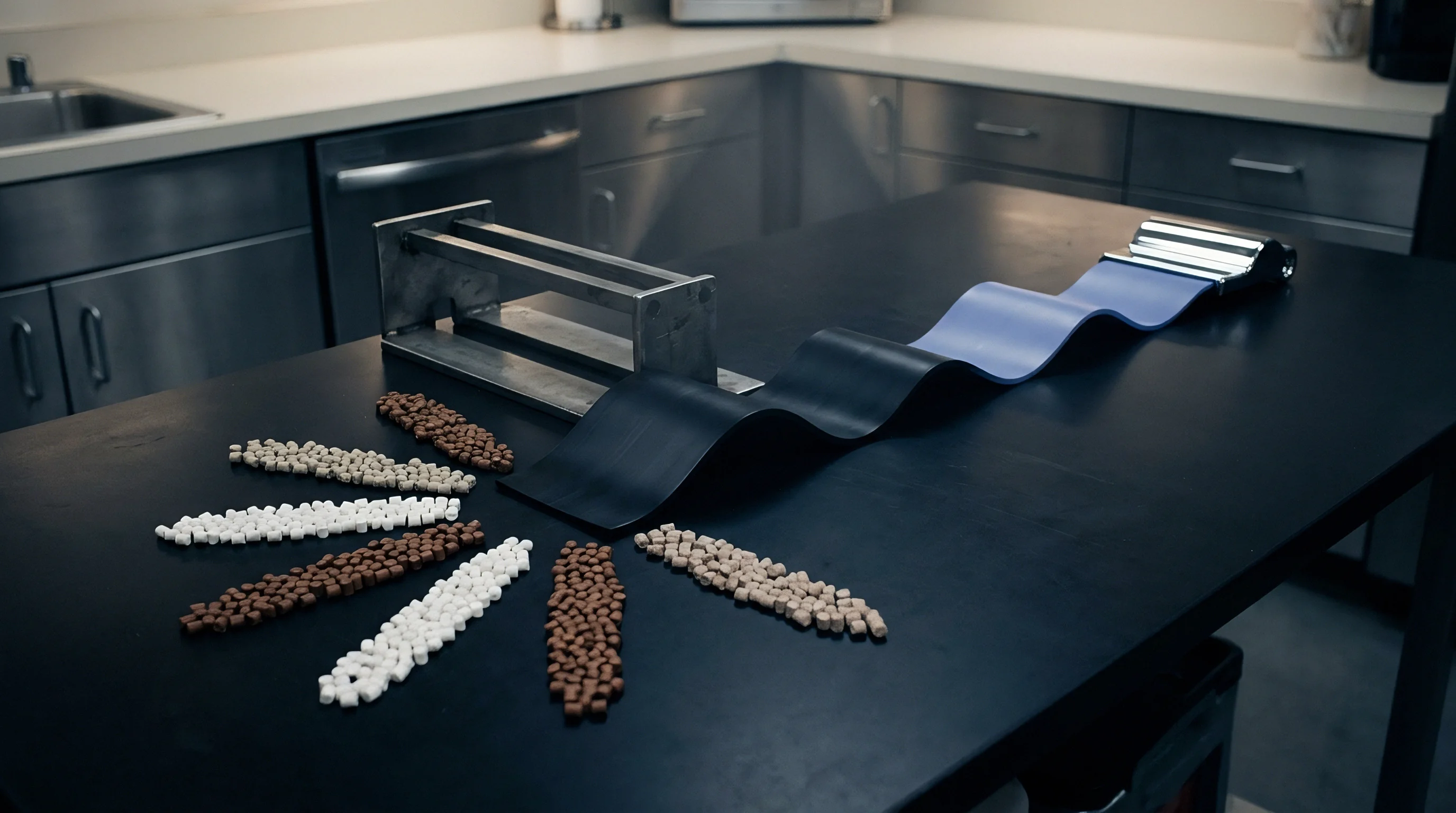
Which Correction Resolves True Capillary Shear Viscosity?
Separating the entrance and exit pressure drops from steady-state wall shear stress requires executing the Bagley correction method. The procedure tests the resin through at least two dies possessing identical diameters yet differing length-to-diameter ratios, typically an orifice die with an L/D of 0.25 alongside capillary dies with L/D ratios of 16 and 30. Plotting total measured pressure against die L/D at fixed apparent shear rates yields linear regression lines whose negative intercepts along the horizontal axis equal the Bagley end correction parameter.
True wall shear stress equals the total pressure minus the entrance pressure loss, divided by four times the capillary length-to-radius ratio.
A bimodal pipe resin displaying an MFR of 0.25 g/10 min at 190 degrees Celsius under 5.0 kg generates an entrance pressure loss of 14.2 MPa across an orifice die at a true shear rate of 2,400 reciprocal seconds.
Twin-bore capillary rheometers accelerate this determination by driving two pistons simultaneously through paired barrels, mounting a zero-length orifice die in one bore and a long capillary die in the adjacent chamber. The differential pressure measured across the twin transducers yields true shear stress in a single test pass, eliminating errors caused by material residence differences across sequential runs. Twin-barrel systems also capture variation in barrel wall friction as the piston moves downward, isolating melt behavior from mechanical resistance.
Non-Newtonian velocity profiles across the capillary diameter introduce a secondary distortion into apparent shear rate values. Newton assumed a parabolic flow profile where shear rate at the wall equals four times the volumetric flow rate divided by pi times the radius cubed. Polyethylene melts are pseudoplastic fluids that shear-thin at typical extrusion rates, flattening the internal velocity profile and increasing the true shear gradient at the wall boundary.
The Rabinowitsch-Weissenberg correction accounts for this shear-thinning behavior by adjusting the apparent shear rate using the slope of true shear stress against apparent shear rate plotted on logarithmic scales.
| Resin Chemistry | Nominal MFR (g/10 min) | Capillary Geometry (L/D) | Apparent Shear Rate (s⁻¹) | Bagley Delta P_e (MPa) | Rabinowitsch Factor | True Viscosity (Pa·s) |
|---|---|---|---|---|---|---|
| Bimodal HDPE Pipe | 0.25 (190 °C / 5.0 kg) | 30 / 1.0 | 1,000 | 12.8 | 1.42 | 412 |
| Bimodal HDPE Pipe | 0.25 (190 °C / 5.0 kg) | 0.25 / 1.0 | 1,000 | 12.8 | 1.42 | 408 |
| Metallocene LLDPE Film | 1.00 (190 °C / 2.16 kg) | 20 / 1.0 | 2,500 | 8.4 | 1.28 | 168 |
| Ziegler-Natta LLDPE Film | 1.00 (190 °C / 2.16 kg) | 20 / 1.0 | 2,500 | 6.9 | 1.34 | 145 |
| Tubular LDPE Coating | 4.50 (190 °C / 2.16 kg) | 16 / 1.0 | 5,000 | 15.1 | 1.55 | 62 |
Rabinowitsch correction factors for broad molecular weight distribution high-density polyethylenes frequently range between 1.35 and 1.60 at commercial processing shear rates, whereas narrow-distribution metallocene resins hover between 1.20 and 1.32. Omitting this step causes the laboratory to understate actual shear rates by twenty to forty percent. While apparent viscosity curves are often presented as sufficient comparative information for incoming qualification, relying on them masks significant entrance elasticity variances between virgin reactors and blended lots.


Rupture
Surface distortion on an extruded profile signals that shear stresses at the metal die boundary have exceeded critical material limits. Linear low-density and high-density polyethylenes exhibit distinct stages of extrudate distortion during capillary rheology evaluation as test speeds ramp through commercial extrusion windows. At wall shear stresses between 0.10 and 0.14 MPa, extrudate exiting the capillary loses optical gloss, developing a fine matte texture termed surface sharkskin.
This defect originates as a periodic tensile rupture at the sharp exit land, where the decelerating surface layer snaps under abrupt stress relaxation.
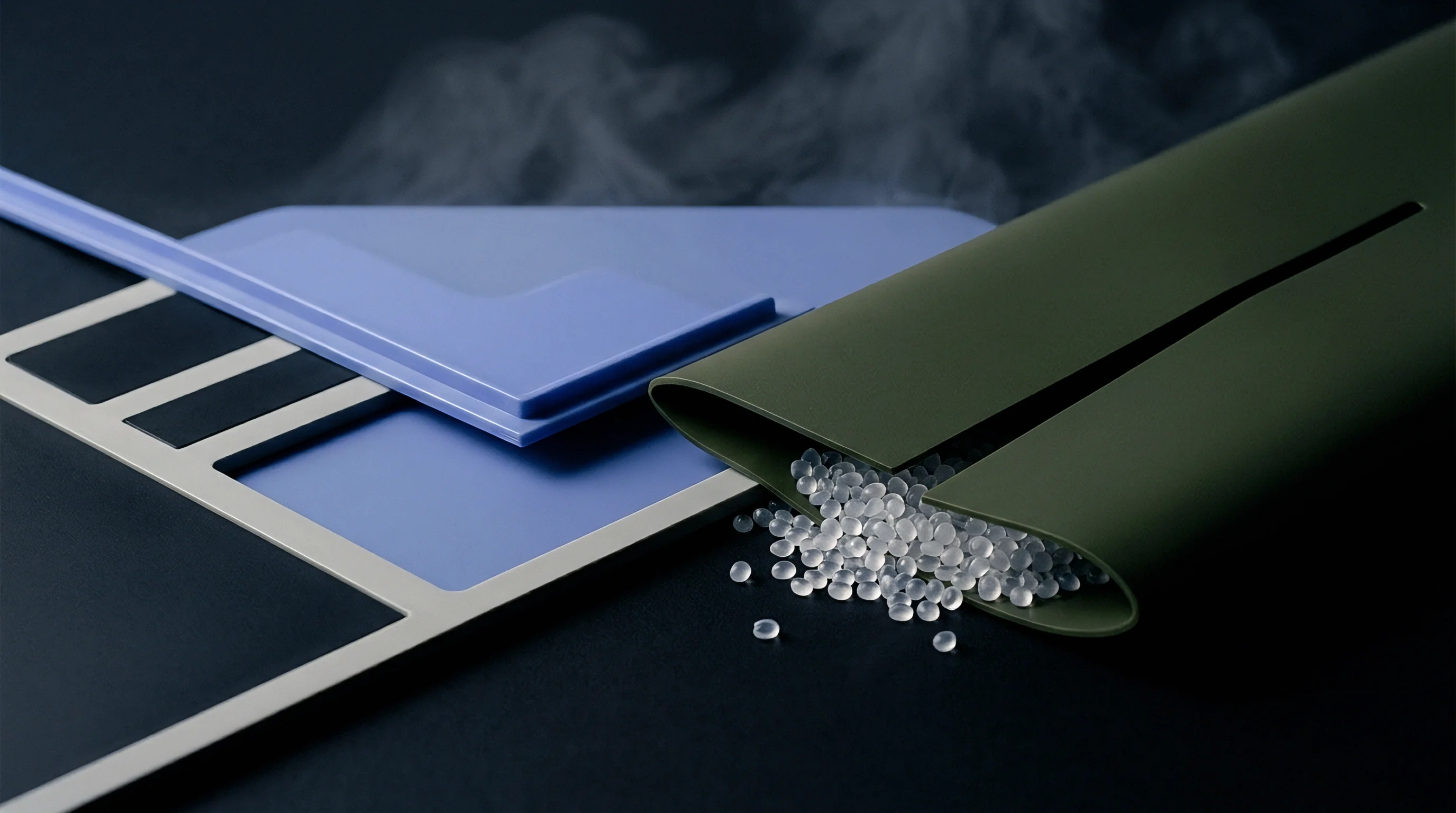
Where Do Wall Stresses Trigger Extrudate Distortion?
Elevating plunger velocity forces linear polyethylene into an unstable transition zone characterized by cyclic pressure fluctuations inside the rheometer barrel. The driving pressure builds to an upper limit, slips abruptly as the polymer layer at the die wall detaches or slips along adhesive boundary sites, and drops to a lower baseline before regaining traction. During this stick-slip regime, the extruded strand presents alternating bands of smooth, glossy surface and rough, distorted sections.
Wider molecular weight distribution softens the onset of gross melt fracture while advancing the threshold of surface matte roughness.
Increasing the shear rate past the oscillating stick-slip window drives the molten stream into continuous wall slip accompanied by gross melt fracture. Entrance flow vortices upstream of the capillary die contract chaotically at stresses above 0.40 MPa, causing complete structural disruption of the emerging strand. The resulting extrudate shows spiraled or irregular corkscrew geometry that completely compromises dimensional tolerance on production extrusion lines.
The progression of flow instabilities manifests across well-defined rheological regimes:
- Loss of Surface Gloss emerges at wall shear stresses approaching 0.10 MPa, leaving microscopic ridges on the extrudate skin.
- Sharkskin Banding develops as exit tensile forces tear the unconstrained surface layer upon clearance from the die land.
- Stick Slip Oscillation creates periodic pressure drops on rheometer transducers as wall adhesion alternates with rapid phase slip.
- Gross Melt Fracture shatters stream uniformity above 0.40 MPa wall stress through entrance vortex collapse upstream of the die.
Testing incoming resins for fluoropolymer processing aid performance relies on measuring the reduction in wall shear stress across identical shear rates. Capillary runs conducted on virgin linear low-density polyethylene display stick-slip instability at rates around 400 s⁻¹, whereas pellets compounded with one thousand parts per million of fluoroelastomer processing aid allow stable extrusion beyond 1,500 s⁻¹ by coating the steel capillary wall with an adhesive slip layer. High shear thinning suppresses gross melt distortion under steady operating temperatures.

Tension
Converging streamlines at the capillary die entrance generate severe uniaxial extension that simple shear viscometry cannot quantify directly. As polymer melts approach the narrow capillary inlet, velocity vectors align rapidly toward the centerline, generating an extensional deformation rate that dominates entrance pressure loss. Cogswell analysis utilizes this entrance pressure drop measured during Bagley evaluations to calculate apparent extensional viscosity and average extensional strain rates.
Polyethylene grades possessing identical melt flow rates under low-load standard testing show radical differences in extensional response when forced through converging dies.
Melt strength testing couples the capillary rheometer barrel with an automated haul-off wheel system that draws down the emerging molten strand until rupture occurs. The capillary piston maintains a steady low shear rate through an orifice die, while motorized counter-rotating wheels pull the descending strand under linearly accelerating velocity. A force transducer positioned along the strand path records tensile force in centinewtons while optical sensors track strand diameter and drawdown speed at break.
| Base Polymer Grade | MFR (190 °C / 2.16 kg) | Density (g/cm³) | Peak Melt Strength (cN) | Draw Speed at Break (mm/s) | Apparent Extensional Viscosity (kPa·s) |
|---|---|---|---|---|---|
| Tubular LDPE (Film Grade) | 0.75 | 0.923 | 18.4 | 120 | 185 |
| Autoclave LDPE (Extrusion Coating) | 4.50 | 0.918 | 6.2 | 450 | 72 |
| Metallocene LLDPE (Blown Film) | 1.00 | 0.918 | 2.8 | 620 | 28 |
| Ziegler-Natta LLDPE (Blown Film) | 1.00 | 0.920 | 3.4 | 540 | 34 |
| Unimodal HDPE (Blow Moulding) | 0.35 | 0.954 | 9.8 | 210 | 94 |
| Bimodal HDPE (Pressure Pipe) | 0.08 (190 °C / 5.0 kg) | 0.949 | 22.5 | 95 | 310 |
Autoclave and tubular low-density polyethylenes show high melt strength due to tree-like long-chain branching architectures that strain-harden under uniaxial stretching. Under sudden tensile acceleration, branched chains entangle and resist thinning, stabilizing blown film bubbles and preventing edge-weave in extrusion coating lines. Linear low-density polyethylene grades, lacking extensive branch networks, display low melt strength and high drawability, elongating uniformly to high draw speeds without strain-hardening.
Extrudate distortion registers as visual defects on finished pipe surfaces long before screw motor torque reaches operational drive limits.
High-density polyethylene resins intended for large-diameter gravity and pressure pipe extrusion depend on elevated melt strength to prevent parison sag during vacuum sizing. When a processor swaps a bimodal pipe resin displaying twenty centinewtons of melt strength for an off-spec lot registering twelve centinewtons, the molten pipe wall sags toward the bottom of the cooling tank, creating severe eccentricity and out-of-round defects. The open question remains whether non-isothermal cooling models can reliably predict draw resonance in high-speed extrusion coating solely from capillary haul-off curves.
Settlement
Standard quality declarations supplied on vendor certificates of analysis present single-point melt flow rates measured at low shear stresses under ISO 1133 or ASTM D1238. A certificate of analysis listing an MFR of 1.0 g/10 min at 190 degrees Celsius under a 2.16-kilogram weight confirms compliance under static dead-weight conditions, yet it fails to describe resin response when shear rates in production extruder dies surpass 3,000 s⁻¹. Pellet lots arriving with identical certificates often show viscosity separations up to forty percent at commercial extrusion rates, driving immediate process instability in high-throughput profile lines.
Purchasing agreements that incorporate capillary rheology protocols protect conversion economics by specifying shear viscosity limits across three operational decades. A robust materials specification establishes apparent and corrected shear viscosity bounds at 100 s⁻¹, 1,000 s⁻¹, and 5,000 s⁻¹ at set extrusion temperatures. When an incoming shipment exhibits acceptable low-shear index values yet diverges outside rheological bounds at 5,000 s⁻¹, plant personnel face unexpected extruder motor over-torquing, elevated die pressure, or melt fracture at normal line speeds.
| Operational Parameter | Qualified Baseline Lot | Substituted Off-Spec Lot | Operational Variance | Scrap Rate Impact | Net Financial Loss per 40-Tonne Lot |
|---|---|---|---|---|---|
| Die Wall Shear Stress at 2,500 s⁻¹ | 0.12 MPa | 0.17 MPa | +41.7% Stress Rise | +4.2% Surface Sharkskin | $2,850 in regrind degradation |
| Entrance Pressure Drop (Delta P_e) | 8.5 MPa | 13.8 MPa | +62.3% Elastic Energy | +2.8% Dimension Gauge Drift | $1,900 in wall gauge reject |
| Extensional Melt Strength | 18.2 cN | 11.4 cN | -37.4% Sag Resistance | +6.5% Pipe Parison Sag | $4,420 in startup off-gauge scrap |
| Critical Shear Rate for Slip | 1,800 s⁻¹ | 950 s⁻¹ | -47.2% Stable Window | +8.0% Stick-Slip Fracture | $5,440 in downgraded tonnage |
Processing an unverified 40-tonne railcar of polyethylene pellets showing severe extensional deficiency increases factory scrap rates through dimensional wall thickness drift and surface rejections. When a converter operates blown film lines at two tonnes per hour with an extrusion conversion margin of 220 dollars per tonne, persistent sharkskin defects force an immediate reduction in line speed by twenty percent, elevating conversion overhead and forfeiting production volume. Incoming capillary qualification detects lot-to-lot structural drift before bulk silos are contaminated with incompatible pellet deliveries.
Commercial contracts referencing ASTM D3835 test procedures provide legal enforceability during formal grade rejection claims. Incorporating specific shear stress thresholds and Bagley entrance pressure tolerances into purchasing terms ensures that shipments diverging by more than eight percent from the approved rheological master profile trigger vendor credits, including freight compensation and silo decontamination fees.