Modeling Non Isothermal Shear Influenced Spherulitic Nucleation Kinetics under Variable Cavity Hydrostatic Compression
Shear alignment and hydrostatic compression lower nucleation barriers, shifting phase change windows and dictating anisotropic volumetric shrinkage in tooling steel.
Coupling
During the filling phase of semi-crystalline polymers, melt temperature drops of two hundred degrees Celsius per second coincide with wall shear rates exceeding ten thousand reciprocal seconds, where flow field alignment lowers activation barriers.
Under quiescent conditions, primary nucleation relies on random thermal fluctuations to form stable critical nuclei. When a semi-crystalline polymer melt such as isotactic polypropylene or polyether ether ketone flows through a narrow runner or thin wall section, long-chain molecules stretch along velocity gradients. This molecular orientation reduces the conformational entropy of the liquid phase, lowering the thermodynamic free energy barrier required to form a crystalline nucleus.
Consequently, the nucleation rate increases by several orders of magnitude compared to static crystallization rates at identical undercooling levels.
Thermomechanical Driving Forces in Non Isothermal Flow
Non-isothermal crystallization during injection molding occurs under steep thermal gradients and rapidly decaying flow fields. As the polymer contacts cold mold cavity walls, a rapid thermal boundary layer forms while high shear rates persist near the solidifying interface. Total nucleation density is a coupled function of local temperature, cooling rate, shear rate, and accumulated flow-induced molecular orientation.
Modeling this behavior requires treating nucleation density as a dynamic variable evolving through space and time, rather than a scalar material property.
Peak nucleation rates in shear-deformed polypropylene melts occur at undercoolings thirty degrees Celsius higher than quiescent crystallization thresholds.
The classical Hoffman-Lauritzen theory describes quiescent growth kinetics based on surface free energy terms. To capture flow-enhanced crystallization, numerical models integrate an activation energy reduction term driven by the first invariant of the finger strain tensor or the local shear stress. Shear stress aligns polymer chains, promoting precursor structures known as row nuclei or threads.
These extended structures act as heterogeneities that trigger dense lateral growth of lamellae, yielding cylindritic or shish-kebab microstructures instead of classic spherical domains.
Mathematical Formulation of Shear Induced Nucleation
Empirical models adapt the Schneider rate equations or the Koscher-Fulchiron kinetic expressions to account for flow history. The effective nucleation rate combines a flow-induced component with a thermal component, where thermal gradients drive spatial heterogeneity.
The mathematical frame tracks accumulated flow deformation using a relaxation time parameter characteristic of the polymer melt. High molecular weight tails within the molecular weight distribution dictate the relaxation kinetics of the oriented state. If the thermal quenching rate exceeds the molecular relaxation rate, orientation is preserved, locking in high nucleation density.
If relaxation occurs faster than heat extraction, oriented precursors dissolve back into an isotropic melt before solid crystals grow. Accurately capturing this dynamic balance demands precise knowledge of the spectrum of relaxation times under high cooling rates.

Stress
Cavity hydraulic conditions alter polymer phase change temperatures during packing and cooling phases, where melt compressibility changes kinetic rate constants.
Hydrostatic pressure compresses the free volume between polymer chains, restricting segmental mobility while simultaneously elevating thermodynamic melting temperatures. For common semi-crystalline resins, the equilibrium melting temperature increases predictably with applied hydrostatic compression. The Clausius-Clapeyron relation governs this shift, where the slope of the melting point increase depends on the ratio of melting enthalpy to the specific volume change during solidification.
Hydrostatic Compression Shift on Melting Kinetics
Rising cavity pressure elevates the effective undercooling experienced by the polymer melt even when the physical temperature remains constant, altering phase transitions within the mold cavity.
When injection molding presses apply packing pressures ranging from forty to one hundred fifty megapascals, the shift in crystallization temperature alters the kinetic driving force. A melt held at two hundred degrees Celsius under ambient pressure crystallizes sluggishly, whereas subjecting that same melt to one hundred megapascals of hydrostatic compression induces rapid crystallization due to the immediate increase in effective undercooling. Kinetic models must re-evaluate undercooling parameters by substituting a pressure-dependent equilibrium melting temperature into the free energy calculations.
The table below summarizes the pressure dependence of equilibrium melting temperatures and crystallization kinetics for standard semi-crystalline processing grades.
| Polymer Family | Melting Point Pressure Coefficient (K per MPa) | Quiescent Undercooling Shift at 80 MPa (K) | Specific Volume Change on Solidification (cm3 per g) |
|---|---|---|---|
| Isotactic Polypropylene (iPP) | 0.24 | 19.2 | 0.095 |
| High Density Polyethylene (HDPE) | 0.20 | 16.0 | 0.120 |
| Polybutylene Terephthalate (PBT) | 0.18 | 14.4 | 0.078 |
| Polyether Ether Ketone (PEEK) | 0.31 | 24.8 | 0.062 |

Sequential Procedure for Integrating Hydrostatic PVT Kinetics
Execution of a pressure-coupled nucleation simulation requires systematic extraction of melt parameters across processing windows. Follow this operational protocol during property evaluation.
- Conduct high-pressure differential scanning calorimetry or pressurized dilatometry to measure crystallization onset across isobaric steps from 0.1 to 150 MPa.
- Fit the Tait equation of state parameters to describe melt compressibility and specific volume evolution through the phase transition regime.
- Calculate the shift factor for equilibrium melting temperature per megapascal of cavity hydrostatic compression.
- Modify the kinetic rate constant using an Arrhenius temperature dependence augmented by a pressure work term.
- Execute melt front filling simulations to map local shear stress histories prior to cavity pressurization.
- Coupled thermodynamic solvers update local nucleation density at each time step during the packing phase.
Neglecting the hydrostatic pressure contribution causes simulations to underestimate crystallization rates near the gate, leading to incorrect predictions of part shrinkage and internal stress states as packing pressure suppresses specific volume loss.
Pressures applied during the holding phase alter crystal polymorph selection. In polypropylene, high hydrostatic pressure stabilizes the dense beta-crystalline phase over standard alpha-spherulites under specific shear states. Beta-phase domains exhibit distinct mechanical toughness and impact properties compared to alpha-phase structures.
Controlling the pressure decay profile in the mold cavity governs the final proportion of these crystal structures across the part cross section.
Pressure transfer efficiency drops rapidly as the freeze front advances inward from cavity walls.

Shell
Cross-sectional microstructural variations in injection molded components arise from competing thermal and mechanical gradients, with oriented chains freezing near wall surfaces.
The solidifying wall section exhibits a distinctly layered structure consisting of an amorphous skin, an oriented intermediate shear layer, and a fine spherulitic core. Each zone reflects a distinct local nucleation regime dominated by differing combinations of shear stress, cooling rate, and hydrostatic pressure. Tool design dictates the relative thickness of these morphology layers.

Morphology Layering across Thin Wall Cavities
The skin layer forms upon initial melt contact with the cold tool surface. Heat extraction rates prevent polymer chains from forming organized spherulites, resulting in low crystalline order or highly oriented amorphous structures while core domains experience lower local shear.
Immediately beneath the skin lies the shear layer, where peak velocity gradients align polymer chains prior to freezing. Here, shear-influenced nucleation kinetics dominate. Row nucleation yields dense arrays of shish-kebab structures aligned parallel to the flow direction.
High nucleus density limits lateral growth, forcing lamellae into thin, highly oriented planar arrays while local cooling rates alter final lamellar thickness.
ISO 20753 specimen testing confirms that shear-layer thickness variations exceeding ten percent across cavity streams generate severe warpage in unreinforced semi-crystalline mouldings.
How Does Hydrostatic Pressure Shift the Shear Threshold?
Hydrostatic compression lowers the critical shear stress required to induce row nucleation. At ambient pressure, high-molecular-weight polypropylene may demand a critical shear stress of zero point one megapascal to transition from spherulitic to shish-kebab morphology. Under eighty megapascals of hydrostatic pressure, the reduced free volume restricts chain mobility, allowing lower shear rates to maintain oriented precursor states long enough to initiate row nucleation.
The list below details common microstructural defects originating from miscalculated nucleation kinetics in thin-wall components.
- Skin-core delamination occurs when extreme shear rates create an abrupt transition between highly oriented shear layers and isotropic core domains, producing weak interphase boundaries.
- Heterogeneous spherulite impingement arises when low nucleation density in slow-cooling core zones allows large crystalline structures to form, creating localized stress concentration sites.
- Birefringence bands develop due to steep gradients in molecular orientation, causing optical distortion and anisotropic refractive index distributions in transparent moldings.
- Uncontrolled polymorph distribution results when pressure decay occurs prematurely, leaving mixed alpha and beta phases that generate internal thermal expansion mismatch stresses.
Core structures freeze under hydrostatic pressure after shear flow ceases. Within this central region, low velocity gradients permit isotropic spherulitic growth. Microstructural characterization requires polarized light microscopy or micro-beam X-ray diffraction to quantify spherulite diameter profiles from outer surface to center line.
Failing to account for flow-enhanced nucleation leads to underestimating part mechanical stiffness, as oriented shear layers possess higher elastic moduli along the flow axis than isotropic spherulitic cores.
Calibration
Mathematical solvers require robust material parameters to solve coupled energy, momentum, and kinetic balance equations, which standard pVT curves miss during transient shear states.
Simulating non-isothermal crystallization under shear and pressure demands fitting advanced kinetic constitutive equations. Solvers integrate modified Avrami-Kolmogorov expressions or Nakamura non-isothermal rate equations to compute relative crystallinity evolution across finite elements.
Constitutive Equations for Dynamic Crystallization Solvers
The Schneider rate equations track non-isothermal crystallization using moments of the crystal size distribution. This approach separates the primary nucleation rate from the crystal growth rate, allowing each term to carry distinct temperature, shear, and pressure dependencies that govern final local nucleation density.
The extended Nakamura equation models non-isothermal kinetics by converting isothermal Avrami data through an integral thermal function. Incorporating flow effects requires modifying the kinetic crystallization parameter using a function of the local shear stress invariant and molecular orientation relaxation time until gate freeze terminates pressure transfer.
| Kinetic Model | Base Form Domain | Shear Coupling Variable | Hydrostatic Pressure Coupling Variable |
|---|---|---|---|
| Extended Avrami-Kolmogorov | Isothermal / Non-isothermal | First invariant of Finger strain tensor | Pressure-dependent equilibrium melting temp |
| Nakamura Integral Model | Non-isothermal continuous cooling | Shear stress invariant and relaxation spectrum | Tait equation specific volume shift |
| Schneider Rate Equations | Dynamic size distribution moments | Specific flow work and precursor density | Clausius-Clapeyron melting shift factor |
| Koscher-Fulchiron Formulation | Shear-dominated transient crystallization | Exponential shear stress factor | Isothermal compressibility factor |

Parameter Fitting Protocol for Kinetic Input Files
Populating commercial injection molding simulation software requires systematically extracting model parameters from specialized laboratory characterization routines.
Material testing relies on rotational rheometry equipped with fast-cooling optics to measure crystallization induction times under controlled shear pulses. Differential scanning calorimetry performed at cooling rates up to two hundred degrees Kelvin per second establishes baseline non-isothermal kinetic parameters. High-pressure cell dilatometry supplies pVT data across the processing temperature window.
Characterization datasets must capture flow-induced nucleation thresholds under cooling rates matching actual cavity conditions.
The checklist below outlines essential parameters required to fully calibrate a pressure- and shear-sensitive crystallization solver.
- Equilibrium melting point pressure derivative establishing the degree of melting temperature elevation per megapascal of cavity hydrostatic pressure.
- Specific flow work threshold defining the minimum mechanical energy input required to trigger row nucleation in the polymer melt.
- Orientation relaxation time spectrum describing how fast shear-induced crystalline precursors dissolve back into isotropic liquid above melting temperatures.
- Heterogeneous nucleation saturation limit governing the maximum possible crystal nucleus density attainable under extreme shear deformation.
- Avrami exponent temperature spectrum capturing changes in crystal growth dimensionality across varying undercooling regimes.
Standard material databases in off-the-shelf simulation tools are often assumed to handle semi-crystalline part warpage accurately without custom flow-induced crystallization testing.

Shrinkage
Volumetric change during melt-to-solid phase transition governs final part dimensions, internal residual stresses, and structural performance, where tool cavity dimensional hold depends directly on density.
Crystalline density significantly exceeds amorphous liquid density in semi-crystalline polymers. Polypropylene experiences a volumetric contraction of up to twelve percent as disordered chains fold into structured crystal lattices. The spatial distribution of spherulitic nucleation kinetics determines whether this volumetric change occurs uniformly or generates localized differential contraction.
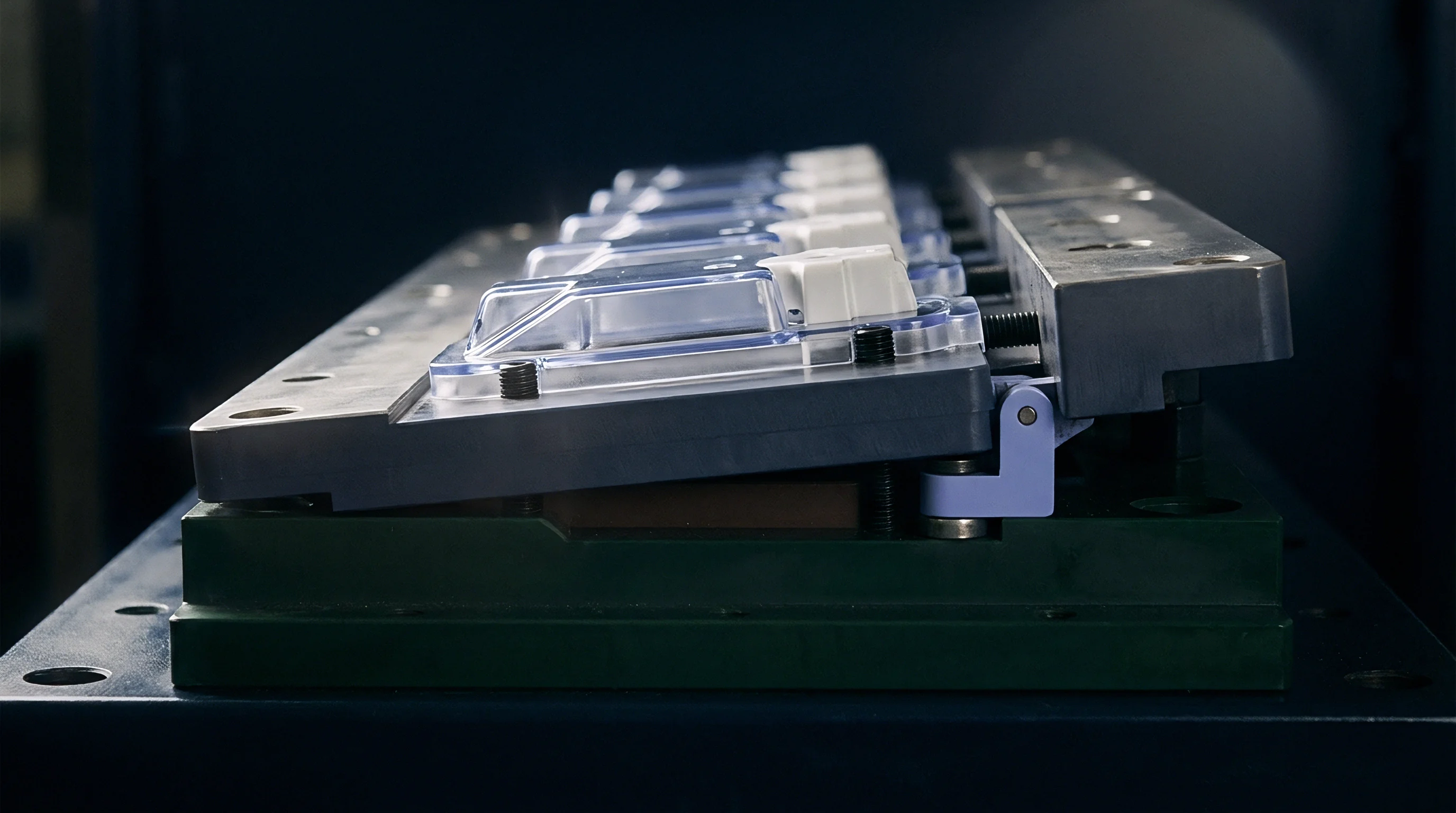
Anisotropic Volumetric Contraction and Structural Tolerance
Oriented shear layers solidify earlier and exhibit smaller longitudinal thermal expansion coefficients than isotropic spherulitic cores. Longitudinal shrinkage along flow direction remains low in highly oriented zones, while transverse contraction remains high, driving overall part warpage.
When packing pressure maintains high hydrostatic compression during core crystallization, volumetric shrinkage drops because polymer chains solidify under reduced specific volume. If pressure drops before core nucleation completes, the core contracts excessively, creating sink marks or internal voids. Precise prediction of cavity pressure decay profiles prevents post-molding dimensional drift.
| Process Cavity Condition | Parallel Shrinkage (%) | Perpendicular Shrinkage (%) | DIN 16742 Tolerance Class Achievable | Warpage Index (mm per 100mm) |
|---|---|---|---|---|
| Low Packing Pressure (30 MPa) | 1.85 | 2.45 | TG7 | 1.20 |
| Optimized Packing Pressure (70 MPa) | 1.35 | 1.55 | TG5 | 0.35 |
| High Packing Pressure with Shear Control (110 MPa) | 1.10 | 1.18 | TG4 | 0.12 |
| Non-Uniform Pressure Decay across Cavity | 1.90 | 1.30 | TG8 | 1.85 |
Cavity Pressure Window Sign-off for Tooling Acceptance
Tool steel dimensions must account for anisotropic microstructural shrinkage derived from coupled kinetic simulation rather than single-value datasheet shrink rates. Standard tooling calculations applying isotropic shrink factors fail to meet tight tolerance specifications in precision automotive or electronic components.
Cavity pressure sensor profiles act as the definitive audit tool during initial mold trials. In-cavity pressure transducers placed near the gate and at the end of fill monitor pressure transfer efficiency. Maintaining hydrostatic compression above forty megapascals until core crystallization finishes eliminates voiding and holds dimensional stability across high-volume production runs.
Predictive microstructural modeling resolves warpage issues prior to cutting tool steel.
Supply agreements specify compliance with DIN 16742 tolerance grades based on verified in-cavity pressure trace stability across twenty consecutive production cycles during tool sign-off.