Meaning
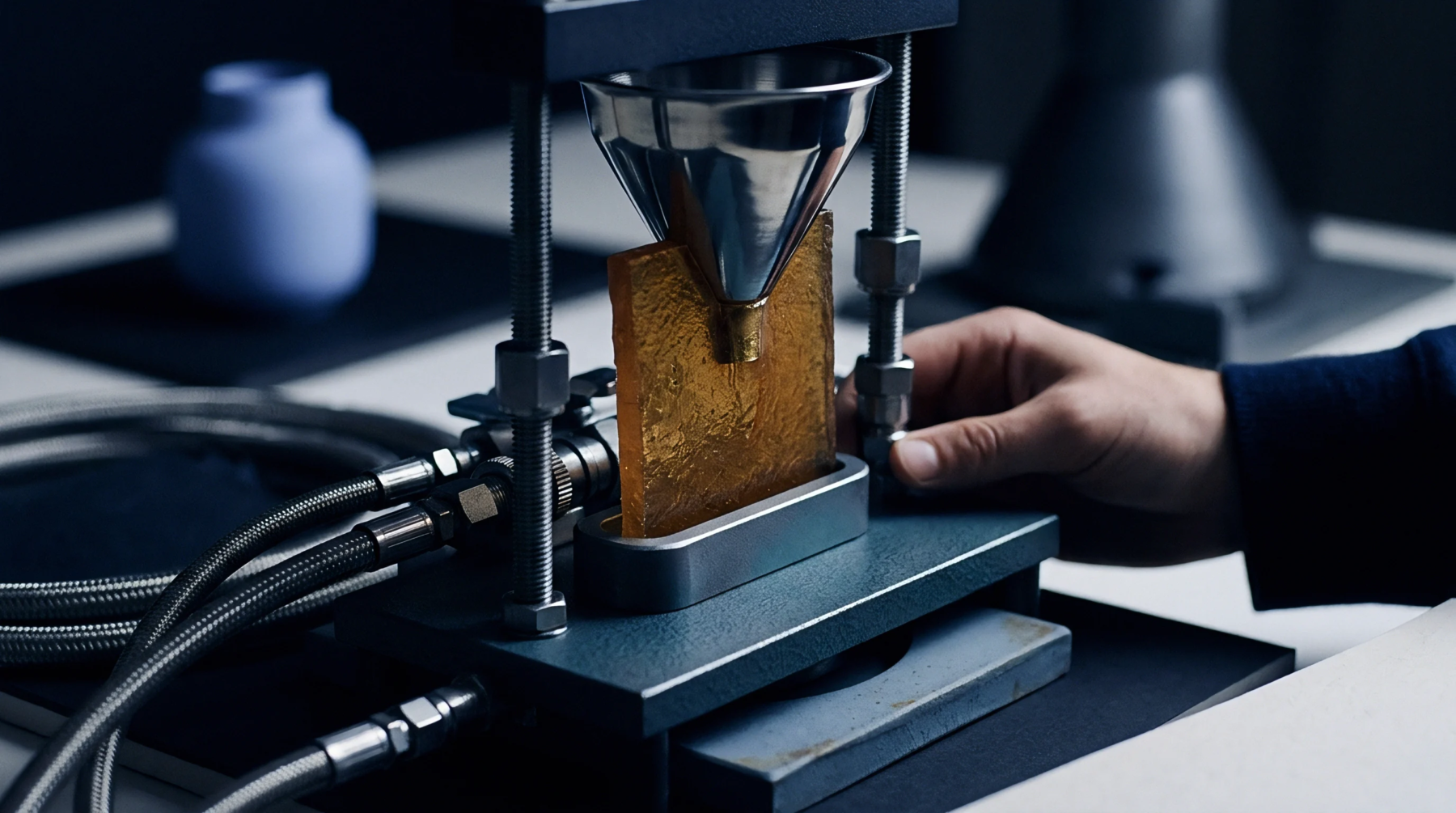
Thermophysical characterization of polymer specific volume under simultaneous variations of hydrostatic pressure and temperature provides equation-of-state data for processing applications. High pressure dilatometry measures the pressure-volume-temperature response of amorphous and semi-crystalline polymers across solid and molten states. The methodology establishes volumetric changes occurring during polymer solidification at pressures reaching several hundred megapascals.
It ceases to apply to ambient-pressure thermal expansion measurements, atmospheric thermomechanical analysis or dynamic mechanical testing under uniaxial load.
Equation Formulation
Piston-die or confining-fluid testing assemblies subject polymer samples to controlled isopiestic or isothermal experimental sweeps. Modern high pressure dilatometry generates empirical matrices to fit the Tait equation of state across processing-relevant cooling intervals. Slower cooling rates allow polymer chains to crystallize at elevated temperatures, shifting the apparent transition temperature upward as pressure rises.
Semi-crystalline resins like polypropylene and polyamide exhibit pronounced volumetric drops at their crystallization boundaries, whereas amorphous polystyrene contracts smoothly along a shallower thermal slope.
Shrinkage Prediction
Computer-aided injection moulding simulations rely on dilatometric curves to calculate pressure-dependent volumetric shrinkage throughout packing phases. Precise equations of state derived from high pressure dilatometry allow mould designers to predict sink mark formation, warpage vectors and internal void probability in thick-walled components. When holding pressure decays before the gate freezes, the molten core undergoes unrestricted volumetric contraction, yielding dimensional deviations.
Inadequate pressure-volume-temperature input data causes severe discrepancies between virtual mould filling predictions and actual part geometry. Moulders optimize holding stage pressure profiles based on these thermodynamic response curves to secure tight part tolerances.
Tooling Compensation
Tool steel cavity dimensions require precise dimensional scaling derived directly from reliable volumetric contraction data. Sourcing resins with identical nominal melt flow rates but divergent high pressure dilatometry profiles leads to out-of-tolerance parts inside existing tooling. Regrind resin containing degraded fractions alters the specific volume response, shifting shrinkage rates away from virgin baseline values.
Cavity pressure sensors provide real-time pressure monitoring, allowing intelligent controllers to alter packing duration in response to thermodynamic shifts. Accurate volumetric data ensures that finished parts eject without binding against deep tool ribs or flashing across parting lines. High pressure dilatometry provides the thermodynamic foundation for cycle optimization in technical mould design.