Gas and Liquid Chromatography High Resolution Workflows for Recycled Polyolefin Migrants
High-resolution GC and LC workflows detect and semi-quantify unknown migrants in recycled polyolefins against toxicological thresholds to ensure food-contact compliance.

Feed
Mechanically recycling high-density polyethylene and polypropylene introduces complex chemical mixtures into the polymer matrix. While sorting operations separate rigid containers from mixed municipal waste, post-consumer bales still carry residues from industrial cleansers, agrochemicals, adhesives, cosmetics, and breakdown products from earlier consumer use. Processing these sorted flakes in single- or twin-screw extruders exposes them to temperatures between 190 degrees Celsius and 260 degrees Celsius, accelerating chain scission, branching, and thermal oxidation along the polyolefin backbone.
Pellet composition varies by collection stream, so recycled resin lots arrive at converting plants with chemical fingerprints that shift between delivery dates ~ creating compliance risks for converters aiming for European Union or United States food-contact approval.
A measured migration ceiling of 0.01 milligrams per kilogram in food simulant defines the analytical detection target for unlisted post-consumer substances under European safety assessments.
Analytical characterization depends on distinguishing total substance presence from actual mass transfer into food. Direct extraction with organic solvents dissolves or swells the polyolefin matrix, releasing low molecular weight oligomers and embedded processing aids into the liquid phase. Migration testing, by contrast, evaluates only substances that partition from the molded container wall into standardized contact media under specific time and temperature conditions.
Council Directive 82/711/EEC and Regulation (EU) 10/2011 set standard exposure windows: ten days at 40 degrees Celsius simulates extended room-temperature storage, while ten days at 60 degrees Celsius accelerates long-term storage testing beyond six months. Testing laboratories use food simulant D1 (fifty volume percent aqueous ethanol) and food simulant D2 (refined vegetable oil) to measure migration into fatty media, where polyolefin-soluble migrants partition most aggressively.

Origin Variability in Post-Consumer Polyolefins
Municipal curbside collection brings together containers with vastly different chemical histories into single post-consumer bales. Polypropylene food tubs end up alongside detergent bottles, printing inks, and household products. Extrusion compounding volatilizes some low-boiling organic fractions, driving off volatile organic compounds below 150 degrees Celsius in vacuum degassing zones, but non-volatile and semi-volatile contaminants stay trapped inside the solidified polyolefin granules.
Subsequent thermoforming or injection molding then subjects the resin to additional heat, producing neo-formed chemical entities known as non-intentionally added substances.
Polyolefin autoxidation begins through free radical pathways. Alkyl radicals react with atmospheric oxygen dissolved in the melt to form peroxy radicals, which pull hydrogen from adjacent polymer chains to yield unstable hydroperoxides. Homolytic cleavage of these hydroperoxides generates alkoxy and hydroxy radicals, driving carbon-carbon chain scission.
This chain reaction creates homologous series of linear aldehydes, alkyl ketones, saturated carboxylic acids, and branched alcohols with carbon numbers from C6 to C30, where contaminated flakes degrade downstream film clarity. Secondary reaction cascades between degraded primary antioxidants, processing slip agents, and print crosslinkers then produce high molecular weight multifunctional adducts that elude conventional targeted analytical detection.

Extraction Contact Design under European Standards
Selecting the proper contact medium determines whether a laboratory finding indicates regulatory non-compliance or harmless intra-polymer retention. Regulators reject test reports that substitute total solvent dissolution for specific migration limits unless mathematical diffusion modeling shows that total transfer stays below the toxicological threshold. EN 1186 outlines standardized test methods for overall migration, using migration cells that isolate the food-contact surface or immersion bags that expose both inner and outer walls to the liquid.
For recycled polyolefins, overall migration into simulant D2 or food simulant E ~ poly(2,6-diphenyl-p-phenylene oxide), sold commercially as Tenax ~ shows whether barrier layer performance or matrix stability meets the overall migration limit of 10 milligrams per square decimeter.
| Simulant Code | Simulant Chemistry | Standard Time | Standard Temperature | Polyolefin Migration Target |
|---|---|---|---|---|
| Simulant A | 10% Ethanol (v/v) aqueous | 10 days | 40 °C | Hydrophilic migrants and short-chain organic acids |
| Simulant B | 3% Acetic acid (w/v) aqueous | 10 days | 40 °C | Basic migrants and amine-based processing aids |
| Simulant D1 | 50% Ethanol (v/v) aqueous | 10 days | 60 °C | Lipophilic substances and oil-in-water emulsions |
| Simulant D2 | Refined vegetable oil | 10 days | 60 °C | Hydrophobic oligomers and lipophilic additives |
| Simulant E | Poly(2,6-diphenyl-p-phenylene oxide) | 10 days | 60 °C | Dry food contact and high-temperature gas-phase partitioning |
| Alternative Substitute | 95% Ethanol (v/v) aqueous | 10 days | 60 °C | Fatty contact screening replacement for vegetable oil |
| Alternative Substitute | Isooctane | 2 days | 20 °C | Non-polar volatile and semi-volatile screening extraction |
Analytical workflows select substitute simulants when vegetable oil proves incompatible with mass spectrometric sample inlet systems. Isooctane accelerates non-polar additive extraction. Evaporating non-polar solvents risks stripping volatile migrants with boiling points below 120 degrees Celsius, requiring rigorous volumetric recovery checks with deuterated surrogate standards.

Run
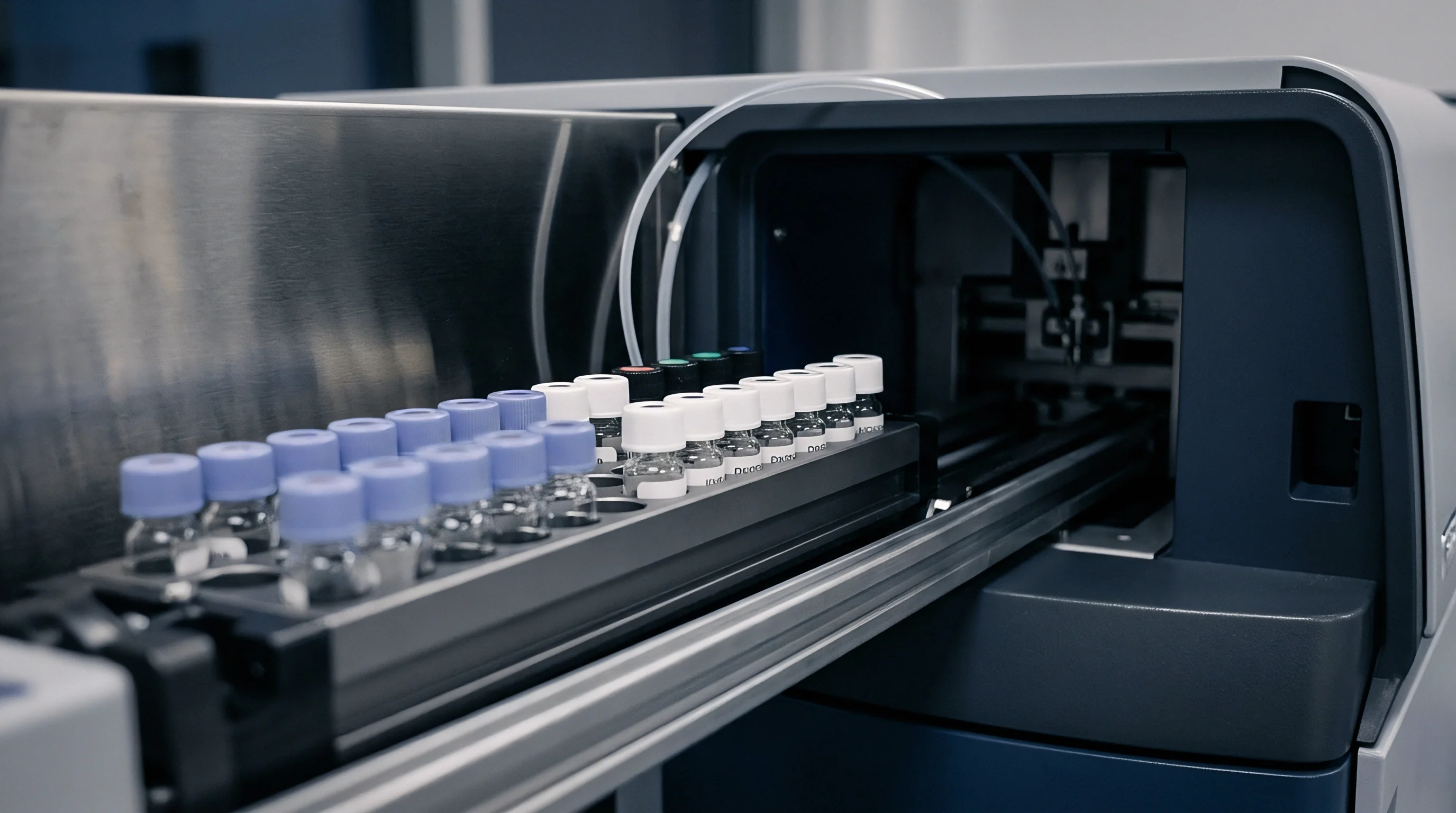
Chromatographic separation resolves complex migrant mixtures before mass analysis, preventing ionization saturation and isobaric spectral overlap. Volatile and semi-volatile compounds with molecular weights under 500 Daltons are routed to capillary gas chromatography systems, while polar, thermally labile, or higher molecular weight migrants require ultra-high-performance liquid chromatography. Coupling these complementary separation techniques to high-resolution mass spectrometers yields accurate mass measurements, isotopic abundance profiles, and fragmentation spectra across the full polarity and volatility range of recycled polyolefin extracts.
Most target analytes elute within twenty minutes. Gas chromatography workflows use non-polar methyl silicone columns ~ such as 100 percent dimethylpolysiloxane or five percent phenyl methylpolysiloxane ~ measuring 30 meters in length, with a 0.25 millimeter internal diameter and a 0.25 micrometer film thickness. Splitless injection optimizes trace migrant transfer from headspace or liquid extracts onto the column head, holding oven temperatures at 40 degrees Celsius to focus volatile species before ramping at 10 degrees Celsius per minute up to 320 degrees Celsius.
Reversed-phase liquid chromatography instead relies on octadecylsilane stationary phases with sub-two-micrometer particles, running acidified aqueous-methanolic or acetonitrile mobile phase gradients at pressures up to 1200 bar.

Dual Platform Separation for Volatile and Non-Volatile Migrants
Fully characterizing unknown migrants requires both gas- and liquid-phase separation. Gas chromatography paired with electron ionization or chemical ionization isolates volatile monomers, low molecular weight aliphatic solvents, monoterpenes from cosmetic packaging, alkyl aromatics from ink residues, and unbranched polyolefin oligomers up to roughly C35. At 70 electron volts, electron ionization yields reproducible structural fragments that match against standard reference libraries.
Chemical ionization with methane or isobutane reagent gas preserves pseudo-molecular ions, giving nominal mass verification for labile species that otherwise fragment completely under standard electron impact.
Reversed-phase ultra-high-performance liquid chromatography handles larger entities, including C30 to C80 oligomers, hindered phenol antioxidant degradation products, organophosphite hydrolysates, and polymeric light stabilizers. Controlling mobile phase additives is critical: adding ammonium formate or formic acid at 0.05 to 0.1 percent promotes protonation in positive-mode electrospray ionization without driving severe ion suppression. Residual non-ionic surfactants or detergents from washing plants distort chromatographic baselines, shifting retention times and degrading peak shapes.

Mass Resolving Power and Instrumental Precision Thresholds
Distinguishing authentic migrants from background solvent noise demands high mass resolving power. Quadrupole time-of-flight instruments and Orbitrap electrostatic field traps reach mass resolving powers from 30,000 to over 140,000 full width at half maximum at m/z 200. This resolving capability separates nominal isobars sharing identical whole-number masses but distinct elemental compositions, frequently exceeding sixty thousand at baseline, while lock-spray correction prevents mass accuracy drift.
- Capillary gas chromatography separates low-boiling non-polar volatiles, alkylated benzenes, and linear hydrocarbons up to 500 Daltons through programmed thermal gradients.
- Reversed-phase liquid chromatography resolves high molecular weight additives, oxidized oligomer clusters, and polar slip agent degradants using sub-two-micrometer particle beds.
- High-resolution mass spectrometry measures exact mass-to-charge ratios within five parts per million mass accuracy, eliminating candidate elemental formulas during unknown screening.
- Electrospray ionization sources generate protonated, deprotonated, and salt-adducted pseudo-molecular species from polar migrant molecules without thermal fragmentation.
Instrumental calibration protocols maintain stability across extended acquisition runs. Infusing calibration reference solutions every five injections corrects electrostatic and magnetic field drift caused by laboratory temperature fluctuations. Resolving power must separate co-eluting matrix peaks from trace migrant targets to ensure accurate integration baselines.
Without proper calibration, systems running post-consumer polyolefin extracts suffer accelerated stationary phase contamination as heavy non-volatile waxes accumulate in the column inlet.
Higher mass resolution allows narrower extraction windows during spectral filtering, eliminating chemical baseline interference and reducing false-positive identifications across complex recycled matrices.


Match
Confirming a migrant’s identity requires systematically comparing accurate mass data, isotopic ratios, and tandem mass fragmentation patterns against suspect inventories and authentic reference standards. Post-consumer polyolefins yield hundreds of discrete chromatographic signals during high-resolution non-target screening. Converting these signals into confirmed chemical entities follows standard confidence scales in environmental and food-contact analytical chemistry: Level 1 denotes unequivocal confirmation with a native chemical standard, Level 2 represents a probable structure matched against spectral libraries, Level 3 indicates a tentative candidate formula or chemical class, Level 4 gives an unequivocal molecular formula, and Level 5 marks an exact mass-to-charge signal of interest.
A Level 1 identification requires matching chromatographic retention time, exact mass within five parts per million, and at least two diagnostic fragment ions against an authentic chemical standard analyzed under identical instrumental conditions.
Because electron ionization fragments unbranched alkanes predictably, high-resolution gas chromatography systems leverage commercial databases containing hundreds of thousands of standard mass spectra. For liquid chromatography coupled to electrospray or atmospheric pressure chemical ionization, fragmentation spectra from collision-induced dissociation depend heavily on collision cell geometry, collision energy, and gas pressure. Data-dependent acquisition triggers product ion scans when precursor intensities breach preset thresholds, whereas data-independent acquisition fragments all ions entering the collision cell across alternating high- and low-energy transmission windows, ensuring complete coverage across co-eluting peaks.
Spectral Deconvolution and Compound Identification Confidence
Overlapping chromatographic peaks present a major hurdle in post-consumer polyolefin extracts, where complex wax envelopes elute across broad retention windows. Automated spectral deconvolution algorithms track ion current signals through the elution profile, grouping fragments and adducts that share identical retention apexes. This isolates true migrant spectra from underlying baseline noise, extracting clean precursor and product ion signals even when three distinct migrants elute within a 1.5-second window.
Generating candidate molecular formulas relies on monoisotopic mass measurements combined with isotopic pattern abundance calculations. High-resolution instruments with mass accuracy within three parts per million narrow composition assignments to a short list of plausible formulas containing carbon, hydrogen, nitrogen, oxygen, phosphorus, and sulfur. The nitrogen rule, parity checks, and double bond equivalents further reduce the options.
Comparing experimental isotopic distribution curves against theoretical patterns calculated from candidate formulas eliminates spurious hits, confirming elements like chlorine or sulfur in suspected legacy additives.
Structural Assignment for Polyolefin Degradation Intermediates
Thermal and photo-oxidative degradation cascades in recycled polyolefins produce structurally complex non-intentionally added substances rarely found in commercial spectral libraries. Secondary stabilizers such as tris(2,4-di-tert-butylphenyl)phosphite oxidize into phosphates and break down into 2,4-di-tert-butylphenol, which can dimerize and oxidize into bis(3,5-di-tert-butyl-4-hydroxyphenyl)ethane derivatives, while degraded antioxidants yield quinone methide migrants. Primary phenolic antioxidants like pentaerythritol tetrakis(3-(3,5-di-tert-butyl-4-hydroxyphenyl)propionate) undergo stepwise ester hydrolysis, producing alkyl hydroxy propionic acids and substituted cinnamate fragments.
Adduct formation frequently suppresses the protonated ion: in positive electrospray ionization, polyolefin migrants form sodium, potassium, and ammonium adducts alongside standard protonated species. In negative electrospray mode, oxygenated degradation products, long-chain fatty acids, and fluorinated processing aids deprotonate cleanly to yield stable molecular ions. Tandem mass spectrometry reveals diagnostic neutral losses ~ a loss of 56 Daltons signals cleavage of tert-butyl groups from hindered phenol rings, while a loss of 18 Daltons indicates water loss from aliphatic alcohol or carboxylic acid backbones.
| Migrant Compound | Chemical Origin | Elemental Formula | Precursor Ion + | Diagnostic MS/MS Fragments | Instrument Platform |
|---|---|---|---|---|---|
| 2,4-Di-tert-butylphenol | Phosphite stabilizer breakdown | C14 H22 O | 207.1743 | 191.1430, 151.0753 | GC-APCI-HRMS |
| 7,9-Di-tert-butyl-1-oxaspiro(4,5)deca-6,9-diene-2,8-dione | Irganox 1010 degradation product | C17 H24 O3 | 277.1798 | 221.1172, 177.0546 | LC-ESI-HRMS |
| Erucamide | Polyolefin slip agent additive | C22 H43 N O | 338.3417 | 321.3155, 224.2372 | LC-ESI-HRMS |
| 13-Docosenamide degradant | Oxidized fatty slip auxiliary | C22 H41 N O2 | 352.3210 | 335.2948, 238.2165 | LC-ESI-HRMS |
| Diisononyl phthalate (DINP) | Post-consumer cross-contaminant | C26 H42 O4 | 419.3156 | 293.1747, 149.0233 | LC-ESI-HRMS |
| Limonene | Cosmetic and detergent fragrance | C10 H16 | 137.1325 | 121.1012, 93.0699 | GC-EI-HRMS |
| Benzophenone | UV-cured printing ink residual | C13 H10 O | 183.0804 | 105.0335, 77.0386 | GC-EI-HRMS |

Suspect Screening Repositories and Oligomeric Signatures
Polyethylene and polypropylene generate repetitive homologous series of cyclic and linear oligomers during compounding. Kendrick mass defect analysis organizes complex high-resolution datasets by converting accurate masses from the standard carbon-12 scale to a Kendrick scale referenced to an ethylene (CH2 = 14.00000) or propylene (C3H6 = 42.00000) repeat unit. Plotting the Kendrick mass defect against nominal Kendrick mass aligns homologous oligomer series along horizontal lines, separating polymer-related degradation series from unrelated organic contaminants.
Petroleum geochemists use the same mass defect transform to unravel thousands of overlapping alkyl-aromatic fractions in fossil fuels.
Suspect screening repositories integrate curated lists of authorized food-contact plastic additives ~ including Annex I of Regulation (EU) 10/2011 ~ alongside known cosmetic ingredients, approved printing inks, and documented degradation products. Automated software queries experimental high-resolution datasets against exact precursor masses in these databases using narrow mass tolerance windows of five parts per million. Any match triggers an automatic check of retention times and isotopic fit scores, quickly separating known packaging additives from truly unidentified substances.
- Data acquisition records high-resolution precursor profiles and fragmentation mass spectra across positive and negative electrospray ionization modes.
- Chromatographic deconvolution separates co-eluting migrant profiles and extracts pure fragmentation spectra from complex chemical backgrounds.
- Kendrick defect filtering isolates polyolefin oligomeric series from non-polymeric chemical contaminants across the mass range.
- Suspect database querying compares measured exact masses against curated packaging additive and printing ink inventories.
- Confirmation verification measures authentic chemical reference standards under identical chromatographic conditions to secure Level 1 structural assignment.
A persistent limitation in non-target screening is the lack of reference standards for proprietary neo-formed oligomers and photo-oxidation intermediates. Without them, laboratories cannot determine whether an unassigned isobaric signal represents a harmless branched aliphatic chain or a toxic heterocyclic contaminant.


Margin
Quantifying migrants without authentic reference standards requires conservative semi-quantification procedures tied directly to toxicological safety thresholds. In targeted food-contact testing, calibration curves from certified reference materials establish exact substance concentrations down to microgram-per-kilogram levels. But in post-consumer recycled polyolefins, hundreds of non-intentionally added substances elute without available standards, forcing laboratories to estimate concentrations by comparing peak areas to surrogate internal standards like deuterated benzophenone, 2-(4-tert-butylphenyl)ethanol, or fluorinated analogues.
Response factors can span two orders of magnitude: in gas chromatography with flame ionization detection, hydrocarbon response factors correlate roughly with carbon number, allowing semi-quantification within an estimated uncertainty factor of two. In electrospray high-resolution mass spectrometry, however, ionization efficiencies vary widely based on proton affinity, gas-phase basicity, mobile phase composition, and charge suppression from co-eluting species. A compound with high ionization efficiency yields a strong chromatographic signal at part-per-trillion levels, while a poorly ionizing migrant at the exact same concentration remains lost in baseline noise.

Toxicological Thresholds and Cramer Classification Rules
Regulatory toxicology uses the threshold of toxicological concern to evaluate substances that lack specific toxicological profiles. European Food Safety Authority guidelines categorize non-evaluated migrants using the Cramer decision tree, typically run through software like Toxtree. Cramer Class I substances ~ simple structures with known metabolic pathways and low toxicity ~ carry a human exposure threshold of 1800 micrograms per person per day.
Cramer Class II represents intermediate toxicity at 540 micrograms per person per day, while Cramer Class III covers complex structures, heteroaromatic systems, and functional groups indicative of significant toxicity, capping human exposure at 90 micrograms per person per day.
Genotoxicity risks override standard Cramer class limits. Any structure showing alerts for direct DNA reactivity ~ such as aromatic amines, epoxides, alkyl halides, or alpha-beta-unsaturated carbonyls ~ triggers an analytical threshold of 0.15 micrograms per person per day. Assuming an adult consumes one kilogram of packaged food daily in contact with six square decimeters of packaging material, this translates to a specific migration detection limit of 0.00015 milligrams per kilogram (0.15 micrograms per kilogram food).
Achieving reliable semi-quantification at 0.15 micrograms per kilogram in fatty food simulants pushes current analytical instruments to their absolute limits.
| Toxicological Assessment Category | Dietary Exposure Threshold | Assumed Migration Limit in Food | Analytical Detection Target (Simulant) | Required Screening Action |
|---|---|---|---|---|
| Cramer Class I (Low Toxicity) | 1800 µg/person/day | 1.8 mg/kg food | 0.30 mg/kg simulant | Structural confirmation via library matching |
| Cramer Class II (Moderate Toxicity) | 540 µg/person/day | 0.54 mg/kg food | 0.09 mg/kg simulant | Suspect list verification and isomer checking |
| Cramer Class III (Severe Toxicity) | 90 µg/person/day | 0.09 mg/kg food | 0.015 mg/kg simulant | Semi-quantification against surrogate standards |
| Genotoxic Structural Alert | 0.15 µg/person/day | 0.00015 mg/kg food | 0.0001 mg/kg simulant | Unequivocal identification and specific toxicology |
| Default NIAS Detection Limit | 10 µg/person/day | 0.010 mg/kg food | 0.002 mg/kg simulant | Threshold screening for unlisted non-genotoxins |
| Methods note: Migration concentrations calculated assuming 6 dm² package surface contact per 1 kg food consumed daily. Action limits incorporate standard analytical safety margins. | ||||

Response Factor Dispersion across Electrospray Ionization Modes
Semi-quantification workflows apply an uncertainty factor to account for response variation across unknown chemical structures. Tests comparing electrospray ionization response factors for hundreds of food-contact additives show that 95 percent of analyzed compounds fall within a thirty-fold variation relative to an internal standard. Applying this uncertainty factor to semi-quantification calculations inflates the estimated migrant concentration, preventing underestimation of dietary exposure.
Because false negatives void a compliance file, evaluating an unknown peak with an intensity corresponding to 0.005 milligrams per kilogram against a surrogate standard requires applying that thirty-fold uncertainty factor, elevating presumed upper-bound migration to 0.15 milligrams per kilogram. This concentration breaches the 0.010 milligram per kilogram default limit for unlisted, non-evaluated substances under European food-contact frameworks, forcing the laboratory to treat the unknown peak as a failure unless structural elucidation and specific calibration prove otherwise.
Semi-Quantitative Evaluation for Unidentified Entities
The operational impact of response factor dispersion is evident in a worked calculation for a thermoformed food tray. Consider a lot of 50,000 recycled polypropylene trays weighing 20 grams each, designed for 500 grams of food across 3.5 square decimeters of contact surface. Migration testing into food simulant D1 for ten days at 40 degrees Celsius reveals an unassigned peak in positive-mode LC-HRMS.
The peak area integrates to 125,000 units, while a surrogate standard (deuterated diphenylbutadiene spiked at 0.010 milligrams per kilogram) yields 250,000 units.
On a nominal basis, the apparent concentration is 0.005 milligrams per kilogram. Scaled to the food surface-to-volume ratio, that puts exposure below the 0.010 milligram per kilogram non-listed substance threshold. However, applying the required thirty-fold uncertainty factor raises the upper-bound concentration to 0.15 milligrams per kilogram ~ breaching the Cramer Class III threshold of 0.090 milligrams per kilogram.
The converter must then either pay for isolation and synthesis of the unknown migrant to determine its exact response factor or reject the entire resin lot at substantial cost.
Relying on unadjusted nominal response factors during screening leaves converters vulnerable to sudden recalls if independent audit testing detects higher concentrations of toxic degraded additives.


Ledger
Commercial sale of recycled polyolefin packaging relies on conformity files that connect high-resolution chromatographic findings to regulatory requirements. Commission Regulation (EU) 2022/1616 governs recycled plastics intended for food contact, replacing Regulation (EC) 282/2008. It mandates that recycling operations use decontamination technologies authorized by the European Commission after EFSA evaluation, or run under national schemes with monitored decontamination efficiency.
A recycling installation operating without validated challenge test data cannot legally sign a declaration of conformity certifying suitability for direct food contact.
When imported recycled polyolefins enter European Union customs clearance without verification, authorities can impound the resin lots. Importers must present a Declaration of Compliance referencing the recycling installation’s unique authorization number, its technology register entry, and accredited laboratory evidence confirming compliance with Article 3 of Regulation (EC) 1935/2004. Lacking non-target screening data for non-intentionally added substances gives enforcement officials grounds for administrative detention, border rejection, and rapid alerts through the Safety Gate and Rapid Alert System for Food and Feed portals.

Decontamination Challenge Tests and Authorization Dossiers
Validating decontamination technology relies on physical challenge tests that measure cleaning efficiency across a range of chemical volatilities and polarities. Equipment manufacturers spike virgin polyolefin flakes with model surrogate contaminants at concentrations between 500 and 1000 milligrams per kilogram. Surrogates include toluene (volatile non-polar), chlorobenzene (halogenated aromatic), methyl salicylate (semi-volatile polar), phenylcyclohexane (heavy non-polar), and benzophenone (high molecular weight additive).
High-resolution gas and liquid chromatography measure surrogate concentrations before and after extrusion, solid-state polycondensation, or vacuum degassing. The ratio of initial contamination to residual concentration determines the decontamination cleaning factor, expressed as a logarithmic reduction value. Polyolefin cleaning processes must achieve factors high enough to ensure residual non-evaluated substances in finished articles cannot migrate above 0.0025 milligrams per kilogram of food ~ reflecting lower diffusivity and higher swelling propensities in polyolefins compared to polyethylene terephthalate.
Commercial Documentation for Cross-Border Customs Clearance
The Declaration of Compliance serves as the legal carrier of conformity across borders. It identifies the decontamination facility, recycling batch, sorting stream source, and explicit operational limits on finished article use ~ including permitted food types, maximum contact temperatures, storage shelf-life, and surface-to-volume constraints. Downstream converters and brand owners incorporate these statements into technical dossiers to defend market placement during official audits.
Because testing costs compound with every resubmission, converting plants purchasing post-consumer resin on spot markets without verifying accredited documentation assume full product liability under cross-border packaging laws. Procurement contracts frequently specify that shipments failing non-target screening against the 0.010 milligram per kilogram migration threshold permit immediate buyer rejection, transferring freight, storage, and re-export penalties directly back to the vendor.
Requiring each delivered lot to carry accredited high-resolution mass spectrometric non-target screening certification ~ with detection limits verified at or below 0.002 milligrams per kilogram ~ shifts the financial burden of regulatory border detentions entirely onto the raw material supplier.