Chromatographic Deconvolution and Risk Assessment Boundaries for Recycled Polymer Non Target Migrants
Chromatographic deconvolution resolves co-eluting non-target migrants in recycled polymers, enabling toxicological threshold classification for food contact.


Flake
A gas chromatography detector coupled to a high-resolution time-of-flight mass spectrometer registers twenty thousand discrete ion signals from a single five-microlitre injection of post-consumer polyolefin extract. The chromatogram displays an elevated baseline resembling a continuous mound rather than discrete chemistry. This unresolved complex mixture, recorded across twenty-four minutes of oven ramping from forty to three hundred and twenty degrees Celsius, contains hundreds of overlapping hydrocarbons, oxidized additives, printing ink degradation residues, and flavour volatile remnants.
Commercial sorting plants sort bottles by near-infrared spectroscopy, wash shredded polymer in eighty-degree caustic baths, and pass flake through optical sorters. Contaminants embedded deep within the plastic matrix remain behind. Thermal stress during subsequent mechanical re-granulation cracks the polymer backbone, producing homologous series of branched alkenes, aldehydes, and aliphatic ketones that co-elute alongside non-intentionally added substances.
Clean virgin resins produce flat baseline tracings punctuated by predictable, well-resolved additive peaks. Recycled resin chromatograms carry substantial background noise that obscures trace migrants residing beneath broad chemical envelopes. The laboratory evaluating post-consumer high-density polyethylene for food contact applications encounters multiple chemical families within a narrow retention window:
- Branched alkane fragments elute as dense clusters spanning nine to thirty carbon atoms, obscuring regulated polymer additives eluting within the same thermal window.
- Terpene oxidation products derived from detergent fragrances generate persistent isomeric alcohols and ketones that simulate structural signatures of regulated plasticizers.
- Photoinitiator breakdown residues originating from printed labels form cross-linked aromatic compounds with elevated boiling points and complex mass spectra.
- Secondary antioxidant degradation derivatives yield substituted phosphite oxides and hindered phenolic fragments that distort baseline integration calculations across commercial chromatographic software runs.
Decontamination processes certified under Commission Regulation EU 2022/1616 rely on vacuum degassing, hot gas stripping, and high-temperature solid-state polycondensation to strip volatile contaminants from shredded plastic. Solid-state polycondensation removes low-molecular-weight species efficiently from post-consumer polyethylene terephthalate. Polyolefins present a different diffusion balance.
Polypropylene and polyethylene possess rubbery amorphous phases at room temperature, permitting rapid gas permeation and deep sorption of organic compounds during initial consumer use. When converters re-extrude recycled polyolefins, high shear in the extruder barrel generates fresh chemical artifacts through homolytic cleavage and auto-oxidation. These newly formed degradation fragments elute alongside original post-consumer residue, confounding conventional baseline subtraction routines.
Mass spectral deconvolution separates overlapping co-eluting peaks without altering the underlying raw detector response.
Laboratories attempting to isolate target migrants from these convoluted matrices face severe analytical interference. Target migrants possess known retention times, exact masses, and verified fragmentation patterns. Non-target migrants arrive without advance notice.
An unknown peak residing inside an unresolved chromatographic envelope can represent an inert branched oligomer or a mutagenic industrial contaminant. Extracting valid mass spectra from these co-eluting signals forms the absolute prerequisite for toxicological assessment. Analytical noise obscures chemical truth.
Deconvolution separates co-eluting signals mathematically. Resins carrying high chemical diversity require rigorous mathematical separation before spectral matching begins.
Recycled resin vendors frequently claim that washing cycles eliminate consumer soil, leaving polymer matrices as clean as virgin stock.

Resolution
Mathematical extraction of pure component spectra from overlapping peaks relies on consistent ion ratios across the chromatographic elution profile. Pure chromatographic peaks exhibit invariant mass spectra from the leading edge, through the apex, to the trailing boundary. Co-eluting substances cause the mass spectral composition to shift continuously across the peak width.
Modern deconvolution packages evaluate the rate of change of total ion current alongside individual extracted ion chromatograms. By identifying unique ions whose intensities peak at specific retention intervals, the algorithm distinguishes individual components buried within identical retention envelopes.
Spectral skew ruins deconvolution algorithms. Single-quadrupole mass spectrometers scanning across a wide mass range introduce significant spectral tilt across fast-eluting narrow peaks. Time-of-flight instruments collect full mass spectra quasi-instantaneously across the entire mass range, preserving accurate ion abundance ratios even across peak widths under two seconds.
The analytical chemist pairs this rapid acquisition with automated mass spectral deconvolution and identification system algorithms or parallel factor analysis. Automated spectral unmixing isolates clean spectra, strips baseline background drift, and exports purified fragmentation signatures into searchable public and commercial databases.
| Separation Metric | Traditional Integration | Automated Mass Deconvolution | Multiway Parallel Factor Analysis |
|---|---|---|---|
| Peak capacity resolution factor | 0.85 | 1.42 | 1.95 |
| False peak identification rate | 28.4 percent | 6.2 percent | 2.1 percent |
| Deconvolution runtime per sample | 1.2 minutes | 4.5 minutes | 38.0 minutes |
| Minimum chromatographic resolution required | 1.0 | 0.3 | 0.1 |
| Deconvolution threshold signal to noise | 10 to 1 | 3 to 1 | 2 to 1 |
Accurate mass cuts false identifications. High-resolution mass spectrometry measures ion masses to the fourth decimal place, limiting potential molecular formulae to a manageable set. Electron ionization generates extensive fragmentation suitable for database matching against standard reference collections.
Soft ionization techniques, including atmospheric pressure chemical ionization and electrospray ionization, preserve the protonated molecular ion, establishing unambiguous molecular weight. Combining electron impact fragmentation with high-resolution exact mass data establishes chemical identity with measurable confidence.
Chemical identification follows standardized confidence tiers defined by environmental and food contact research communities:
- Level one confirmed identity matches exact retention time, accurate mass, and fragmentation patterns against an authentic chemical standard analyzed on the exact analytical platform.
- Level two probable structure matches library spectra and retention index data unambiguously when an authentic reference material remains commercially unavailable for direct laboratory validation.
- Level three tentative candidate specifies a distinct chemical class or positional isomer group without pinpointing the exact substituent positioning across the parent ring structure.
- Level four unequivocal molecular formula identifies the exact elemental composition and isotopic distribution while failing to isolate a single plausible chemical arrangement.
- Level five unknown mass component records a repeatable exact mass and retention coordinate without resolving elemental formula or chemical structure.
Retention indices filter extraneous database hits. Linear retention indices calibrate retention times against an injection of homologous n-alkanes. Chromatographic software compares experimental retention indices against calculated reference values, eliminating false positive library matches that possess matching mass fragmentation patterns but distinct boiling characteristics.
Despite these mathematical advances, complex recycled polymers yield thousands of peaks terminating at level four or level five. The unresolved scientific question remains whether mathematical deconvolution models systematically misinterpret low-level isobaric contaminants when co-eluting matrices exceed target concentrations by four orders of magnitude.


Tier
Assigning toxicological relevance to deconvoluted peaks requires defined risk boundaries. Article 3 of Regulation EC 1935/2004 dictates that food contact materials must not transfer constituents to food in quantities that endanger human health. For virgin plastic materials, positive lists codified in Regulation EU 10/2011 establish specific migration limits derived from compound-specific toxicological dossiers.
Non-target migrants in recycled polymers rarely appear on authorized positive lists. The toxicological evaluation of these unlisted migrants relies on the threshold of toxicological concern concept developed by the European Food Safety Authority and the United States Food and Drug Administration.

Where Do Unresolved Chromatographic Envelopes Fail Qualification?
Toxicological thresholds classify organic molecules into structural categories based on oral toxicity data. Cramer Class I covers simple chemical structures with low oral toxicity profiles, carrying a human exposure threshold of 1800 micrograms per person per day, translating to an analytical concentration of 30 parts per billion in food contact compliance models. Cramer Class II covers moderately toxic intermediate functional groups, with an intake limit of 540 micrograms per day.
Cramer Class III encompasses complex chemical structures, heteroatoms, or reactive groups with potential biological reactivity, carrying a stringent threshold of 90 micrograms per person per day, or 1.5 parts per billion in food.
Substances presenting alerts for genotoxicity receive a threshold of toxicological concern value of 0.0025 micrograms per kilogram of body weight per day. Assuming a standard adult body weight of sixty kilograms and the conventional European consumption assumption of one kilogram of food packed in contact with six square decimetres of material, this intake ceiling establishes a migration limit of 0.00015 milligrams per kilogram of food. Analytical chemistry cannot routinely detect or quantify unknown organic compounds at 0.15 parts per billion in complex solvent simulants without extensive extract concentration.
When extract concentration takes place, volatile compounds evaporate, distorting quantitative recovery.
Total unidentified migration exceeding 0.010 milligrams per kilogram into fifty percent ethanol at forty degrees Celsius triggers toxicological structural classification under European recycling rules.
Converters and brand owners establish analytical screening thresholds to navigate this detection gap. Under European recycling rules, an analytical evaluation threshold calculates the peak area corresponding to the toxicological threshold of concern. Migrants generating chromatographic signals above the analytical evaluation threshold require full structural deconvolution and identification.
Migrants eluting below this boundary proceed without mandatory compound-specific toxicity testing, provided genotoxic structural alerts remain absent. High-resolution screening workflows deploy in silico qualitative structure-activity relationship models to scan level two and level three chemical structures for DNA-reactive functional groups.
Evaluating conformity requires specific analytical and toxicological deliverables across the declaration chain:
- Gas chromatography high resolution mass spectrometry screening data identifying all volatile non-target migrants present above the calculated analytical evaluation threshold under specified extraction conditions.
- Liquid chromatography tandem high resolution mass spectrometry records capturing non-volatile migrants, polymer oligomers, and polar breakdown derivatives above the detection threshold.
- Structural alert toxicological screening documentation verifying that deconvoluted chemical structures were evaluated against Derek Nexus or Toxtree predictive software engines.
- Decontamination process challenge test validation dossiers proving the recycling installation removes volatile and non-volatile surrogate compounds below authorized contamination thresholds.
Unidentified peaks incur default penalties. When an analytical laboratory cannot resolve an unknown peak beyond level four or level five confidence, risk assessors assume the worst-case toxicological profile. The migrant falls into the genotoxic evaluation category by default.
A converter shipping recycled resin containing unidentified peaks exceeding 0.15 parts per billion faces immediate compliance failure under European food packaging rules, halting warehouse distribution and forcing scrap re-pelletization.


Simulant
Direct chemical testing of filled food products introduces severe analytical background interference from dietary fats, proteins, and sugars. Compliance verification relies on conventional food simulants specified in Regulation EU 10/2011. Distilled water represents food simulant A for aqueous contact.
Acetic acid at three percent by weight represents simulant B for acidic foodstuffs. Ethanol at twenty percent represents simulant C for alcoholic foods containing up to twenty percent ethanol. Tenax, known chemically as modified polyphenylene oxide, functions as food simulant E for dry foods.
Migration testing of recycled polyolefins frequently deploys simulant D1, consisting of fifty percent ethanol, and simulant D2, consisting of refined vegetable oil or ninety-five percent ethanol as an aggressive polyolefin screening substitute.
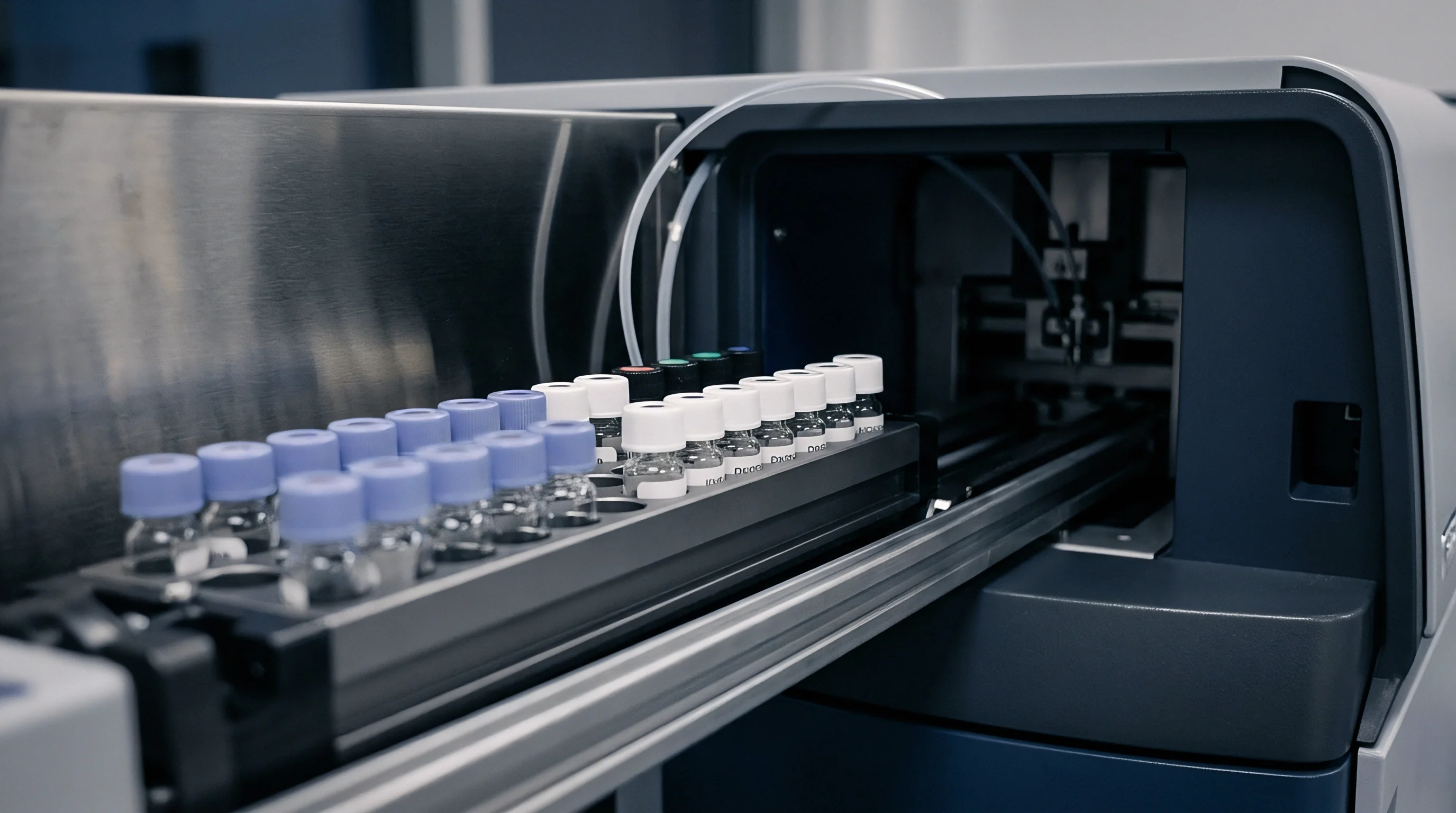
Is Semi Quantitative Screening Defensible for Regulatory Clearance?
Quantifying non-target migrants presents severe analytical uncertainty when authentic reference standards do not exist. Laboratories deploy semi-quantitative screening by calibrating detector response against an internal standard added to the simulant prior to contact or extraction. For gas chromatography with flame ionization detection, response factors across hydrocarbons vary predictably, allowing semi-quantification within a twenty percent error margin.
For mass spectrometry with electrospray or atmospheric pressure chemical ionization, ion suppression and compound-dependent ionization efficiencies generate response factors that vary by three orders of magnitude between different chemical structures.
Solvent choice shifts partitioning coefficients. Take a typical food packaging article manufactured from post-consumer recycled polyethylene terephthalate. Assume a thermoformed salad tray weighing thirty grams with an internal contact surface of four square decimetres.
The packaging contains twenty-two non-target volatile migrants identified at levels between two and fifty milligrams per kilogram in the solid polymer matrix. When exposed to food simulant C for ten days at forty degrees Celsius, migration rates depend on the molecular volume of the migrant, the polymer diffusion coefficient, and the thermodynamic partition coefficient between the polymer and the liquid phase.
| Chemical Identity | Molecular Weight (g/mol) | Initial Concentration (mg/kg) | Simulant A: Water (mg/kg) | Simulant C: 20% Ethanol (mg/kg) | Simulant D1: 50% Ethanol (mg/kg) |
|---|---|---|---|---|---|
| Acetaldehyde | 44.05 | 18.4 | 1.20 | 1.35 | 1.40 |
| 2-Methyl-1,3-dioxolane | 88.11 | 6.2 | 0.08 | 0.14 | 0.21 |
| Limonene | 136.24 | 4.8 | 0.002 | 0.015 | 0.082 |
| Benzophenone | 182.22 | 2.1 | 0.001 | 0.008 | 0.045 |
| Diisobutyl phthalate | 278.35 | 1.4 | 0.0005 | 0.004 | 0.028 |
| Data measured across duplicate six-square-decimetre plaques with one kilogram simulant volume; limits of quantification 0.0002 mg/kg via purge-and-trap GC-MS. | |||||
Acquisition speed governs peak symmetry. Hydrophilic migrants such as acetaldehyde migrate rapidly into aqueous simulants regardless of organic modifier concentration. Lipophilic compounds like limonene and diisobutyl phthalate remain largely trapped within the aromatic polyester matrix when contacted with pure water, but partition aggressively into fifty percent ethanol.
A compliance report generated using ten percent ethanol underestimates consumer exposure to lipophilic degradation products migrating into milk, oil emulsions, or fatty dressings.
Article 4 of Regulation EU 2022/1616 removes decontamination process authorizations when decontamination challenge tests fail to demonstrate surrogate reduction factors above four orders of magnitude.
Testing protocols encounter fundamental scientific disputes surrounding the choice of surrogate standards for semi-quantification. One analytical faction champions toluene-d8 and 2-fluorobiphenyl as universal internal standards for gas chromatography, applying a single calibration slope across all deconvoluted peaks. Another faction demonstrates that oxygenated migrants underestimate actual migration by up to a factor of eight when quantified against deuterated aromatic hydrocarbons.
In our desk practice, when authentic standards cannot be sourced, the analytical chemist applies a deliberate safety factor of five to any semi-quantitative result derived from electron ionization mass spectrometry, compensating for variable response factors before comparing migration figures against Cramer threshold boundaries.
Calculations based on migration modeling offer a conservative alternative to experimental immersion testing. Diffusion modeling programs use validated polymer matrices parameters and migrant molecular weights to calculate theoretical maximum migration. If diffusion modeling demonstrates that total mass transfer remains below the analytical evaluation threshold even under complete migrant depletion assumptions, physical testing of aggressive simulants can be bypassed legally.
The model rests on the assumption that post-consumer cleaning processes do not alter the base polymer diffusion coefficient, an assumption that collapses when mechanical recycling processes cause severe macromolecular chain degradation.
Direct physical contact measurements always take precedence over computer simulation models whenever experimental results show chemical breakthrough.

Gate
Customs authorities and national food safety inspectorates enforce chemical safety at border control posts and processing facilities through documentary audits and selective confirmatory testing. An importer declaring post-consumer recycled food packaging must present a comprehensive conformity dossier detailing polymer origin, recycling process authorization numbers, challenge test outcomes, and migration screening reports. If an enforcement laboratory identifies an undeclared non-target migrant exceeding threshold limits, the shipment faces formal rejection, border detention, and mandatory commercial disposal under the European Rapid Alert System for Food and Feed.
Converters frequently assume that purchasing pellets from an authorized recycling installation guarantees finished article compliance. Commission Regulation EU 2022/1616 governs recycling processes, but responsibility for finished packaging compliance rests with the economic operator placing the final article on the commercial market. The recycling process developer holds an authorization covering specific operating conditions, input contamination thresholds, and decontamination factors.
The converter introduces masterbatches, slip additives, printing inks, and thermal energy during container fabrication. Each conversion step adds fresh non-intentionally added substances that bypass the primary decontamination audit.
Sensory failures precede chemical breaches. Non-target migrants frequently manifest as sensory taints at concentrations far below toxicological thresholds. Degradation products of oxidized unsaturated fatty acids, including trans-2-nonenal and 1-octen-3-one, impart noticeable rancid or metallic odours to packaged water at sensory thresholds under five parts per trillion.
While toxicologically acceptable under Cramer Class I criteria, packaging imparting off-odours violates Article 3 of Regulation EC 1935/2004, which prohibits the deterioration of organoleptic characteristics. Sensory screening acts as an early operational gatekeeper prior to chromatographic deconvolution.
Polymer degradation products accumulate across successive thermal extrusion cycles even when washing plants eliminate incoming post-consumer surface residues.
Commercial contracts between polymer recyclers and packaging converters require explicit chemical warranty mechanisms. The buyer writes specific non-target migrant threshold covenants into raw material purchase specifications. Standard industry agreements assign full testing costs to the resin supplier whenever third-party screening reveals unlisted contaminants exceeding the 0.010 milligram per kilogram threshold.
Furthermore, procurement teams require suppliers to provide raw gas chromatography and mass spectrometry data files alongside finished certificates of analysis, enabling independent algorithmic deconvolution and secondary toxicological verification before accepting railcar deliveries.
Supply chain participants mitigate financial exposure by structuring formal quality agreements that trace liabilities back through the supply chain. The following sequence establishes operational gatekeeping across material intake:
- Raw pellet screening subjects composite intake samples to dynamic headspace thermal desorption gas chromatography to quantify total volatile organic content prior to silo unloading.
- Batch composite challenge verification compares chromatographic finger-prints against the master decontamination challenge test profile to confirm steady-state vacuum stripping efficiency.
- Finished container extraction submerges formed containers in food simulant D1 for ten days at sixty degrees Celsius to evaluate worst-case chemical release.
- Mathematical peak deconvolution processes raw acquisition files through verified spectral deconvolution algorithms to extract pure component spectra from unresolved envelopes.
- Toxicological gatekeeper review classifies identified migrants via automated Cramer decision trees, flagging any unlisted migrant exceeding fifteen parts per billion for mandatory human safety assessment.
Testing laboratories encounter sharp disputes over the validity of universal screening boundaries. The analytical community accepts that twenty percent of deconvoluted non-target peaks in recycled polyolefins resist structural identification when evaluated strictly against commercial NIST or Wiley mass spectral libraries. A buyer facing twenty unresolved peaks in a commercial lot cannot conclusively prove the absence of genotoxic migrants below the 0.00015 milligram per kilogram boundary.
In commercial practice, the buyer evaluates the historical stability of the recycling facility, the consistency of the post-consumer feedstock stream, and the mechanical performance of the finished container, balancing analytical ambiguity against commercial supply continuity.
Commission Regulation EU 2022/1616 Annex III explicitly conditions manufacturing continuity on the recycler maintaining verifiable records that volatile organic contamination in incoming flake does not exceed validated operating envelopes, shifting financial liability directly to the supplier when undocumented processing variations introduce unvetted chemical migrants.