Determining Post-Consumer Flake Baseline Contamination Levels
Determining post-consumer flake contamination requires thermal desorption GC-MS baseline screening, surrogate challenge tests, and lot sampling verification.

Sieve
Mechanical Separation and Initial Extraction Protocols
Physical contamination in post-consumer polyalkylene terephthalate and polyolefin streams divides into surface residues and absorbed matrix penetrants. Mechanical preparation establishes the physical boundaries of the sample before chemical interrogation begins. Flake lots arrive at testing facilities carrying non-polymeric inclusions, adhesive remnants, print inks, and household chemical residues absorbed during primary use.
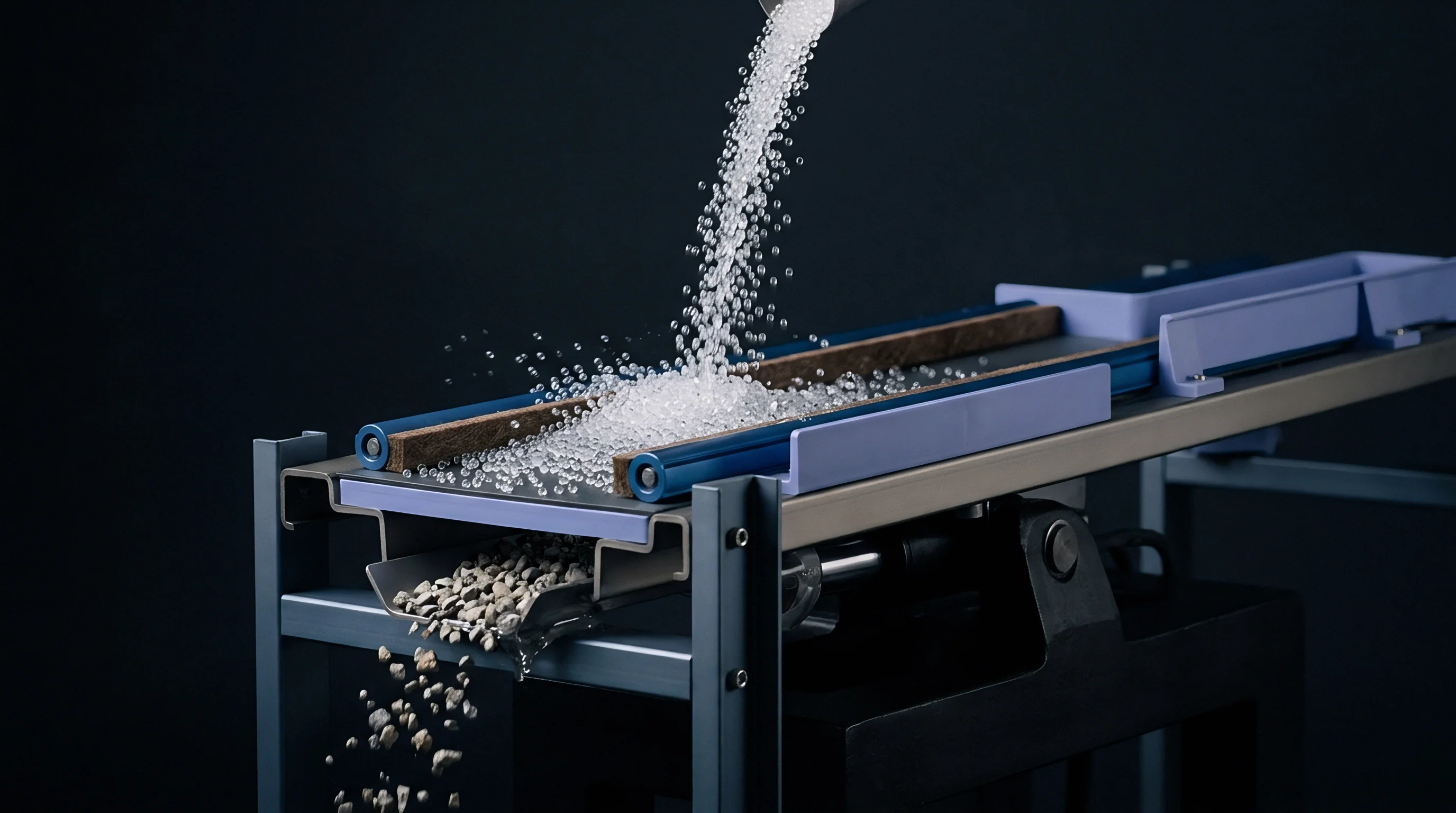
A rigorous baseline assessment begins by isolating flake size fractions using stainless steel wire mesh separators conforming to ISO 3310-1 specifications. Processing unwashed input material through a 4-millimeter mesh separates standard flake sizes from fines and macro-contaminants, preventing dry dust from distorting downstream extraction yields. Clean flakes prevent migration.
Sampling plans that draw directly from gaylords without mechanical size classification introduce systematic variance in volatile desorption rates, because small particles exhibit disproportionately high surface-area-to-volume ratios.
Dry screening passes raw flake into solvent extraction or thermal desorption chambers without alteration. Washing protocols isolate surface-adsorbed contaminants from deeply diffused chemical species. Cold water washing removes water-soluble sugars, inorganic salts, and soil particulate.
Caustic hot washing at 85 degrees Celsius using 1.0 percent sodium hydroxide and 0.3 percent non-ionic surfactant removes pressure-sensitive adhesives, labels, and vegetable oils. Wet friction removing labels improves purity. Quantifying baseline chemical contamination demands separate testing of unwashed flake, washed flake, and caustic wash effluent to construct a mass balance of volatile organic compounds and semi-volatile organic compounds.
Solvents extract matrix volatiles efficiently.
Direct static quantification of limonene in washed post-consumer flake requires thermal desorption gas chromatography at 150 degrees Celsius for 45 minutes to achieve complete desorption from the inner polymer core.
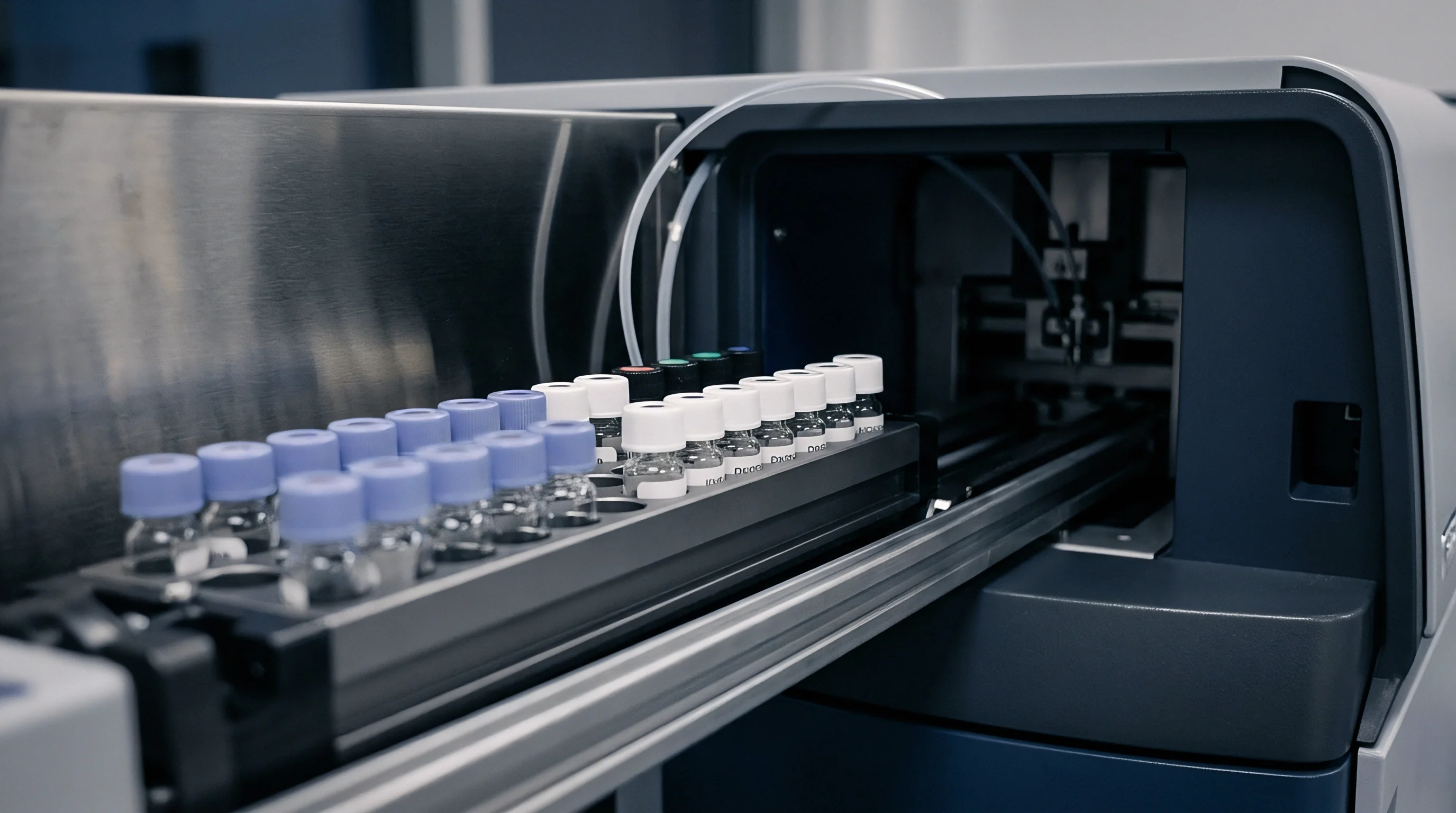
Thermal desorption paired with gas chromatography mass spectrometry provides direct headspace screening for low-boiling-point volatiles without liquid solvent dilution effects. Sample preparation places 500 milligrams of cryogenic ground flake inside a glass tube heated under a high-purity helium flow at 50 milliliters per minute. Dynamic headspace sampling at 150 degrees Celsius for 45 minutes desorbs organic molecules trapped inside the amorphous regions of the polymer matrix.
Cryogenic trapping at minus 30 degrees Celsius focuses the analytes prior to rapid injection into a capillary column. Static headspace sampling at lower temperatures fails to liberate high-molecular-weight alkanes and fragrance compounds, underestimating matrix contamination levels by up to 60 percent.

Quantification of Volatile and Semi-Volatile Organic Residues
Analytical quantification maps specific chemical species to historical package usage. Post-consumer recycled polyethylene terephthalate contains volatile markers such as limonene, alpha-pinene, octanal, and nonanal originating from flavorings and personal care products. Post-consumer high-density polyethylene displays elevated concentrations of linear alkanes, alkylbenzenes, degradation products like 2,4-di-tert-butylphenol, and synthetic fragrance carriers.
Liquid extraction utilizing dichloromethane or hexane at 60 degrees Celsius for 24 hours dissolves the amorphous polymer fraction, releasing both matrix-bound and surface-bound species into liquid phase for gas chromatography flame ionization detection.
| Chemical Species | Unwashed Flake Range (mg/kg) | Caustic Washed Flake Range (mg/kg) | Extraction Method | Quantification Limit (mg/kg) |
|---|---|---|---|---|
| Limonene | 12.4 – 84.5 | 1.1 – 8.2 | Thermal Desorption (150°C) | 0.05 |
| 2-Methyl-1,3-dioxolane | 3.1 – 15.2 | 0.4 – 2.1 | Static Headspace (120°C) | 0.02 |
| Benzophenone | 0.8 – 6.4 | 0.6 – 5.1 | Dichloromethane Soxhlet (24h) | 0.10 |
| Alpha-Pinene | 4.2 – 22.0 | 0.3 – 1.8 | Thermal Desorption (150°C) | 0.05 |
| Linear Alkanes (C10-C20) | 15.0 – 110.0 | 4.5 – 32.0 | Solvent Dissolution / GC-FID | 0.50 |
Contaminant distributions exhibit high standard deviations across post-consumer collection bales. Continuous automated near-infrared sorting reduces material variance, but chemical baseline measurements remain bound to batch-level liquid extraction analytics. Evaluating baseline levels requires establishing the chemical identity, concentration, and diffusion coefficient of every detected volatile peak above an analytical threshold of 0.01 milligrams per kilogram of polymer.
Temperature shifts desorption rates quickly.
Surface washing alone leaves embedded flavor compounds intact within the polymer matrix.

Solvent
Decontamination Efficiency and Challenge Chemistry
Evaluating the cleaning capability of a recycling technology requires spiking clean polymer matrices with high concentrations of surrogate contaminants representing distinct chemical functionalities and molecular weights. Challenge protocols established by the European Food Safety Authority and the United States Food and Drug Administration dictate five canonical model compounds. Volatile non-polar compounds use toluene.
Volatile polar compounds use chlorobenzene or isopropyl alcohol. Semi-volatile non-polar compounds use methyl stearate or hexadecane. Semi-volatile polar compounds use benzophenone.
Non-volatile compounds rely on phenylcyclohexane or stearic acid. Surrogate chemicals model real contaminants.
Preparing challenge samples involves soaking virgin or pre-cleaned post-consumer flakes in a cocktail of surrogate chemicals dissolved in an organic medium. Immersing flakes in a surrogate solution containing 1,000 milligrams per kilogram of each model compound at 50 degrees Celsius for 14 days forces the chemicals to diffuse deep into the bulk polymer matrix. Following spiking, the contaminated flake undergoes solid-state polycondensation, vacuum degassing, or high-temperature gas purging.
Measuring surrogate concentrations before and after the decontamination process yields the residual concentration figure used to calculate percentage cleaning efficiency.
| Surrogate Compound | Target Chemical Class | Molecular Weight (g/mol) | Boiling Point (°C) | Specific Migration Limit (mg/kg food) |
|---|---|---|---|---|
| Toluene | Volatile Non-Polar | 92.14 | 110.6 | 1.20 |
| Chlorobenzene | Volatile Polar | 112.56 | 131.6 | 0.05 |
| Benzophenone | Semi-Volatile Polar | 182.22 | 305.4 | 0.60 |
| Methyl Stearate | Semi-Volatile Non-Polar | 298.50 | 443.0 | 60.00 |
| Phenylcyclohexane | Non-Volatile Hydrocarbon | 160.26 | 237.5 | 0.05 |
High molecular weight compounds resist thermal removal during vacuum decontamination. Core absorption retards vacuum degassing. When semi-volatile surrogates like methyl stearate remain in post-consumer flake above 1.0 milligram per kilogram following decontamination, specific migration testing into food simulants becomes mandatory before food-contact authorization can proceed.
Challenge Test Sample Preparation Procedure
- Homogenization of Input Stock through mechanical blending ensures uniform flake size distribution between 2.0 and 4.0 millimeters across the whole test allocation.
- Chemical Spiking Protocol Application exposes 5 kilograms of polymer flake to an ethanol solution containing 1,000 milligrams per kilogram of each designated surrogate compound.
- Incubation Under Controlled Thermal Exposure holds the spiked mixture at 50 degrees Celsius for 336 hours in a sealed stainless steel vessel to drive diffusion into the amorphous polymer phase.
- Surface Rinsing and Drying Procedure washes the spiked flake three times with cold ethanol to eliminate unabsorbed surface residues prior to baseline analytical determination.
- Decontamination Reactor Processing Subjects the prepared flake to the industrial recycling process under maximum operational speed and minimum operating temperature.
- Post-Treatment Residue Extraction quantifies residual surrogate levels via solvent extraction followed by gas chromatography coupled to triple quadrupole mass spectrometry.
Analytical limits govern commercial acceptance. Laboratory results indicating complete removal of volatile surrogates often obscure low-level retention of high-boiling-point polar compounds. The relationship between internal diffusion coefficients and surface evaporation kinetics determines whether a decontamination system achieves regulatory compliance for thin-gauge thermoforming applications.
Can industrial extrusion processes clear heavy ester surrogates without degrading the underlying polymer chain length?

Spectrum
Identified and Non-Intentionally Added Substance Profiling
Analytical screening of recycled flake reveals complex mixtures of intentional additives and thermal breakdown products. Gas chromatography paired with high-resolution time-of-flight mass spectrometry detects volatile and semi-volatile species, while liquid chromatography coupled to electrospray ionization Orbitrap mass spectrometry captures non-volatile polar compounds. Non-intentionally added substances originate from polymer degradation during original processing, reaction between additives and food components, pesticide absorption, or printing ink set-off during storage.
Unidentified peaks present legal liability.
Identifying unknown signals relies on matching mass spectrum fragmentation patterns against NIST, Wiley, and METLIN spectral databases. Tentative identification requires a minimum mass spectral match score of 80 percent, followed by target confirmation using authentic chemical standards. Non-target screening calculates estimated concentrations relative to an internal standard, such as deuterated naphthalene for gas chromatography or toluene-d8 for liquid chromatography.
Quantitative uncertainty for non-target species remains high due to variable ionization efficiencies across different chemical structures.
Compliance declarations omitting mass spectrometry library screening data for non-target volatiles fail European Union food-contact suitability under Regulation 10/2011 Article 19.
Target screening evaluates specific substances restricted by regulatory frameworks. Standard target lists include organotin catalysts, primary aromatic amines derived from polyurethanes, phthalate plasticizers, phenolic antioxidants, and halogenated flame retardants. Screening post-consumer polyolefins requires measuring oligomer distributions, as low-molecular-weight saturated hydrocarbons between C10 and C35 migrate readily into fatty food simulants.
Chemical identification establishes whether an observed contaminant concentration exceeds maximum allowable toxicological thresholds.
- Cyclic PET Oligomers formed during polymerization and thermal recycling migrate into 50 percent ethanol and vegetable oil simulants at levels up to 5.0 milligrams per square decimeter.
- Hindered Phenolic Antioxidant Degradation Products such as 2,6-di-tert-butyl-p-benzoquinone emerge during thermal re-processing of post-consumer polypropylene flake streams.
- Photoinitiator Residues including 2-isopropylthioxanthone and 4-methylbenzophenone transfer from printed outer carton surfaces to inner plastic packaging layers via roll-stock offset printing.
- Synthetic Fatty Acid Amides used as slip agents, notably erucamide and oleamide, accumulate in recycled polyethylene, altering surface coefficient of friction and specific migration profiles.
Quantifying oligomeric structures requires advanced chromatographic separation to prevent peak co-elution. High-temperature gel permeation chromatography coupled with light scattering yields absolute molecular weight distributions for oligomeric fractions below 1,000 Daltons. These low-molecular-weight fractions determine whether a material requires restricted migration testing under European Union framework rules.
Suppliers frequently declare that unassigned mass spectrometry signals below 0.05 milligrams per kilogram represent inert hydrocarbon isomers requiring no formal toxicological evaluation.


Tariff

Regulatory Limits and Compliance Requirements
Placing post-consumer recycled plastic into food-contact applications requires navigating distinct legal frameworks across regional jurisdictions. In the European Union, Commission Regulation (EU) 2022/1616 governs recycled plastic materials and articles intended to come into contact with foods. This regulation mandates that novel recycling processes achieve a demonstrated decontamination efficiency resulting in residual contaminant levels that ensure migration into food remains below 0.01 milligrams per kilogram for non-evaluated substances.
In the United States, the Food and Drug Administration evaluates recycling processes through the submission of a pre-market consultation, issuing Letters of No Objection when analytical challenge data proves surrogate migration will not exceed 0.5 parts per billion in the daily diet.
| Regulatory Boundary | European Union (Regulation EU 2022/1616) | United States (FDA 21 CFR / Threshold of Regulation) |
|---|---|---|
| Default Migration Ceiling | 0.01 mg/kg food for non-evaluated substances | 0.5 ppb dietary concentration (0.0005 mg/kg) |
| Challenge Test Requirement | Mandatory full challenge evaluation per process scheme | Mandatory surrogate challenge study for LNO issuance |
| Process Qualification | Union register authorization and audit scheme | Case-by-case Letter of No Objection evaluation |
| Batch Traceability | Individual batch decontamination certification | Quality control records retained by converter |
| Fatty Food Simulant Exposure | Ethanol 95% or Isooctane / Vegetable Oil at 40°C | Food Simulant D2 (Vegetable Oil) or 95% Ethanol substitute |
Importers carry full regulatory exposure. Financial liabilities attach to non-compliant resin lots entering regulated markets. Mandatory extended producer responsibility schemes in France, Germany, and the United Kingdom impose eco-modulation fees on packaging materials based on recyclability and post-consumer recycled content purity.
Recycled content mandates penalize non-compliance. Packaging failing chemical safety baselines cannot claim recycled fee discounts and incurs standard plastics tax rates, such as the United Kingdom Plastic Packaging Tax rate of 217.85 pounds sterling per metric tonne for materials containing less than 30 percent verified recycled plastic.
Demonstrating compliance requires comprehensive migration testing using food simulants under standardized time and temperature conditions. Overall migration limits set the absolute allowable quantity of non-volatile substances transferring from plastic into food at 10 milligrams per square decimeter of plastic surface area, tested using Simulant A (10 percent ethanol), Simulant B (3 percent acetic acid), and Simulant D2 (vegetable oil) for 10 days at 40 degrees Celsius for long-term ambient storage claims.
Processors relying on surface washing without vacuum degassing consistently fail downstream migration screening for low-molecular-weight alkanes.
Executing specific migration testing for restricted monomers and additives mandates liquid chromatography mass spectrometry or gas chromatography mass spectrometry calibration against verified standards. Specific migration limits apply to individual compounds regardless of overall migration performance. For example, specific migration of bisphenol A remains restricted to a maximum limit of 0.04 milligrams per kilogram of food under European Union regulations, requiring analytical detection limits down to 0.005 milligrams per kilogram to confirm absolute regulatory compliance.
Purchasing specifications must incorporate explicit language stating that every lot of post-consumer flake delivered under the contract carries a lot-specific analytical test report confirming residual limonene remains below 2.0 milligrams per kilogram and total non-target volatile organic compounds remain below 10.0 milligrams per kilogram under thermal desorption screening.


Batch

Sampling Economics and Statistical Verification
Calculating the true baseline contamination level of a bulk flake delivery depends directly on the statistical sampling design. Post-consumer flake streams display high within-lot variance due to heterogeneous collection sources. A single 20-tonne shipping container contains approximately one billion individual plastic flakes.
Taking a single 500-gram sample from the top of one gaylord introduces extreme sampling bias, rendering downstream laboratory data statistically irrelevant for commercial risk assessment.
Implementing a sampling protocol based on ISO 2859-1 acceptance quality limit principles secures representative analytical data. Sampling plans for bulk flake mandate taking incremental samples from multiple spatial locations across the delivery lot. Combining 30 primary increments of 200 grams taken from different depths across ten distinct gaylords yields a 6-kilogram composite sample.
Mechanical rotary sample splitters reduce this composite sample down to a 500-gram laboratory analytical sample without altering particle size or chemical composition ratios. Verification requires lot-level analytical proof.
Lot acceptance sampling that evaluates only surface color fails to detect embedded volatile migration hazards.
Quantifying chemical variance across large lots requires calculating the sample standard deviation and upper confidence limits for target contaminants. Consider a worked example evaluating a 20-tonne shipment of post-consumer rPET flake intended for sheet extrusion. The buyer specifies a maximum baseline limonene threshold of 5.0 milligrams per kilogram.
The analytical laboratory draws ten independent samples across the shipment, yielding limonene concentration results of 3.2, 4.1, 2.8, 6.5, 3.9, 4.8, 5.2, 3.0, 4.4, and 5.1 milligrams per kilogram.
Calculating the mean yields 4.30 milligrams per kilogram. Calculating the sample standard deviation yields 1.13 milligrams per kilogram. Applying a 95 percent confidence interval calculation using a Student t-distribution value of 2.262 for nine degrees of freedom yields an upper confidence boundary of 5.11 milligrams per kilogram.
Sample size dictates statistical validity. Because the 95 percent upper confidence limit exceeds the contractually specified maximum limit of 5.0 milligrams per kilogram, the lot fails acceptance criteria despite the arithmetic mean staying below the threshold.
Statistical sampling parameters dictate contract acceptance criteria for bulk material transfers.
- Minimum Primary Increments require 30 distinct sample collection points per 20-tonne shipment lot to ensure spatial representation across storage containers.
- Rotary Sample Splitting must replace manual quartering to prevent particle size segregation from biasing chemical extraction testing.
- Target Upper Confidence Level must sit at or below 95 percent of the agreed regulatory or technical specification threshold.
- Duplicate Analytical Runs must maintain a relative standard deviation of less than 10 percent between laboratory test duplicates.
Failing to account for intra-lot chemical variance leads to processing line contamination, off-gassing during extrusion, sheet haze, and potential product recalls when finished thermoformed containers exceed specific migration limits during regulatory enforcement audits.


Customs

Dossier Construction and Border Inspection Protocols
Cross-border transport of post-consumer plastic flake triggers intense scrutiny from customs authorities and environmental agencies enforcing waste shipment regulations. Importing post-consumer flakes into regulated markets requires providing documentation proving the material does not constitute hazardous waste under the Basel Convention on the Control of Transboundary Movements of Hazardous Wastes and Their Disposal. Clean, sorted post-consumer plastic flake intended for recycling enters under green control procedures provided chemical contamination levels remain low enough to render the material suitable for immediate industrial re-processing without preliminary hazardous waste treatment.
Assembling a robust compliance dossier requires linking the commercial shipping document chain to accredited analytical laboratory reports. The compliance dossier must contain the bill of lading, commercial invoice, Certificate of Analysis for each specific batch, Declaration of Compliance detailing regulatory suitability, and safety data sheets covering the flake material. Customs inspectors at major entry ports conduct physical inspections, taking core samples from incoming containers to verify batch identity against accompanying analytical certificates.
Discrepancies between declared volatile organic compound baselines and actual container contents lead to immediate shipment detention, administrative fines, and forced re-export of the material at the importer’s expense.
Auditing the compliance dossier involves verifying that analytical test methods comply with standardized international frameworks. Test reports issuing from laboratories lacking ISO/IEC 17025 accreditation for specific migration and volatile extraction standards face rejection by market surveillance authorities. The declaration chain must trace backward through the supply chain, connecting the final flake lot code to the primary collection origin, washing facility processing logs, and final decontamination reactor certificates, establishing an unbroken chain of custody that withstands regulatory scrutiny.