Gas Chromatography Coulometry Coupling for Contaminated Post Consumer Polymer Moisture Verification
Chromatographically coupled coulometry separates true polymer moisture from volatile organic contaminants, eliminating false titration readings in recycled resin.

Interference
An incoming flake delivery of post-consumer poly(ethylene terephthalate) registering 420 parts per million volatile mass loss on an automated halogen moisture balance at 160 °C often conceals a true water content below 50 parts per million. The compounding plant relies on that mass loss number to schedule desiccant drying cycles. Post-consumer polymer streams arrive saturated with non-aqueous volatile organic compounds that distort conventional moisture measurements.
Household detergent containers leave persistent d-limonene in recycled high-density polyethylene. Printed films yield residual ethyl acetate, methyl ethyl ketone, and toluene in recycled linear low-density polyethylene. Post-consumer polyamides retain caprolactam monomer and cyclic oligomers that vaporize alongside entrained ambient water.
Recycled poly(ethylene terephthalate) contains acetaldehyde, ethylene glycol, and diethylene glycol generated through successive thermal conversion cycles. Recyclate carries persistent chemical noise.
Thermal desorption Karl Fischer titration under DIN EN ISO 15512 Method B vaporizes all volatile constituents into a carrier stream. These extracted gases enter an iodometric titration cell containing sulfur dioxide, iodide, and an organic base dissolved in methanol. Water participates in the classic Bunsen reaction to oxidize sulfur dioxide to sulfuric acid through the consumption of electrochemically generated iodine.
Non-aqueous contaminants introduce severe parasitic chemical reactions within this electrolyte matrix. Aldehydes and ketones react directly with the methanol solvent to form acetals and ketals, a condensation reaction that releases stoichiometric quantities of secondary water. This newly generated water reacts with iodine, driving the coulometer to report an escalating moisture baseline that never stabilizes.
Parasitic reactions distort the result. Unsaturated volatile organic molecules degrade measurement accuracy through a second chemical pathway. Terpenes such as d-limonene, alongside residual unsaturated fatty acids from consumer packaging wash lines, react directly with the electrochemically generated iodine across their carbon-carbon double bonds.
The coulometric cell interprets this direct halogenation as water consumption. The instrument delivers a false positive moisture reading that overstates the true water content by three hundred to five hundred percent. Loss-on-drying balances operating by thermogravimetric analysis register all evaporated matter indiscriminately.
Volatile printing solvents, migration additives, processing waxes, and true moisture register as an undifferentiated weight loss.
The operational vulnerability scales with contamination intensity across post-consumer resin grades. High-density polyethylene flakes from post-industrial closures display minimal interference, whereas post-consumer mixed polyolefin packaging displays volatile fractions exceeding the actual water content by an order of magnitude. Standard coulometric titration cells exhibit electrode fouling when heavy oily condensates coat the platinum indicator pins, suppressing the bipotentiometric sensing voltage and generating false end-point terminations.
- Aldehyde condensation kinetics generate continuous secondary water within methanol-based electrolytes through acetal formation.
- Halogen addition across olefins consumes electrochemically titrated iodine directly, simulating water consumption without moisture present.
- Solvent vapor co-distillation distorts gravimetric moisture balances by recording total volatile loss as water weight.
- Electrode surface passivity occurs when volatilized paraffinic waxes coat the bipotentiometric platinum sensing pins.
Laboratory trials demonstrate that conventional coulometry over-reports water content in contaminated flake stocks by varying margins depending on wash-line efficacy. A post-consumer polyolefin lot containing residual printing inks registers an apparent moisture content of 0.085 weight percent under ISO 15512 Method B at 180 °C, while independent verification isolates the actual water fraction at 0.012 weight percent. Moisture balances measure total weight loss.
The remaining seventy-three milligrams of recorded volatile matter per hundred grams of polymer consists entirely of light hydrocarbons and aromatic fractions.
| Polymer Matrix | Dominant Chemical Contaminant | Test Method | Apparent Water (ppm) | True Moisture (ppm) |
|---|---|---|---|---|
| Post-Consumer PET Flake | Acetaldehyde and Ethylene Glycol | ISO 15512 Method B (170 °C) | 380 | 45 |
| Post-Consumer HDPE Pellets | d-Limonene and Surfactants | ISO 15512 Method B (150 °C) | 290 | 30 |
| Post-Consumer LLDPE Film Flake | Printing Inks and Toluene | Loss on Drying (120 °C) | 720 | 95 |
| Post-Consumer Polyamide 6 | Caprolactam and Cyclic Dimers | ISO 15512 Method B (160 °C) | 1450 | 520 |
An uncorrected false positive reading causes compounding plant operators to overheat flake feedstocks, triggering yellowing, thermal molecular degradation, and unnecessary kilowatt-hour expenditures across the drying cycle.


Column
Chromatographic coupling introduces a capillary separation conduit between the thermal desorption chamber and the detection cell. Pure nitrogen sweeps the volatilized plume. Carrier gas transports the desorbed volatiles away from the heated sample container through an inert transfer line into an integrated gas chromatography oven.
The chromatographic stationary phase separates molecular species based on their boiling points, polarity, and partition coefficients. Water molecules exhibit high polarity and low molecular weight, travelling through the stationary phase at an elution velocity distinct from heavier aliphatic chains, cyclic terpenes, and aromatic ink solvents.
Why Contaminant Volatiles Blind Standard Coulometric Titration?
Thermal desorption yields a complex gas plume containing dozens of volatile hydrocarbons alongside trace moisture. When this vapor enters an uncoupled Karl Fischer vessel, the chemical reagents react with every receptive molecule simultaneously. Chemical selectivity fails completely in an open cell.
The chromatographic separation conduit solves this fundamental limitation by establishing a temporal delay between the elution of water and the elution of interfering organic components. Volatile hydrocarbons vent to waste.
A carrier gas linear velocity of thirty-five centimeters per second across a divinylbenzene-porous polymer phase separates moisture from trace limonene within four minutes at one hundred twenty degrees Celsius.
Stationary phase selection governs the baseline resolution of the water peak. Porous layer open tubular capillaries coated with divinylbenzene and ethylvinylbenzene copolymers deliver exceptional chemical inertness and sharp peak symmetry for polar volatile species. These crosslinked polymer matrices prevent peak tailing, which commonly compromises water quantification on standard siloxane liquid phases.
The separation column operates under isothermal conditions between 110 °C and 140 °C, maintaining water elution within a tight retention window between 1.5 and 3.0 minutes from injection. The separation column resolves both fractions.
Water exits the column first. Solvents and heavier degradation byproducts linger within the capillary bed, eluting long after the water peak has completely migrated into the detector. A dual-position micro-switching valve situated at the column exit directs the carrier gas stream according to retention timing.
During the initial elution interval corresponding to the purified water fraction, the valve directs the carrier gas stream straight into the titration cell. Once the water band clears the stationary phase, the switching valve toggles position, venting residual volatile components to an external exhaust line. Limonene, glycol residues, plasticizers, and ink solvents bypass the electrochemical cell entirely.
The analytical reagent remains completely unexposed to the contaminants that generate false measurement artifacts.
Carrier gas dryness dictates the lower limit of chromatographic detection. High-purity nitrogen or helium containing less than 0.5 parts per million baseline moisture acts as the carrier medium. An auxiliary getter tube containing molecular sieve 5A and phosphorus pentoxide scrubs the carrier gas before it enters the thermal desorption furnace.
Ambient pneumatic leaks at the column fittings destroy analytical resolution, since atmospheric moisture ingress mimics a high chromatographic background signal. Column head pressures between 80 and 120 kilopascals yield the required linear carrier gas velocities to transport the water vapor plug cleanly without longitudinal band broadening.
Transfer line temperature profiles require precise regulation across the entire flow path. Cold zones along the transfer line between the extraction furnace and the column inlet cause water condensation, which appears as severe peak broadening and retention delay on the resulting chromatogram. Heated nickel-clad transfer capillaries operating at 150 °C eliminate condensation boundaries, ensuring that volatile plumes arrive at the column head as a compact, discrete vapor slug.
Transfer lines running below the thermal desorption setpoint inevitably accumulate condensation that ruins subsequent sample injections.

Electrolysis
Quantitative conversion in the detection cell proceeds according to strict Faradaic stoichiometry. The purified carrier gas fraction emerging from the chromatographic column enters an electrolyte bath charged with sulfur dioxide, iodide ions, and imidazole in an alcohol solvent. A pair of platinum anode and cathode mesh assemblies generates molecular iodine directly within the solution upon application of an electric current.
Every mole of water delivered by the carrier gas consumes exactly one mole of iodine according to the reaction equation. Faraday’s constant establishes that 96,485 coulombs of electrical charge correspond to one equivalent of chemical conversion. Faradaic conversion follows exact charge ratios.
Every coulomb quantifies distinct water mass. Two Faradays of charge generate the precise molar quantity of iodine required to consume one mole of water, which establishes an invariant electrochemical equivalence of 10.71 coulombs per milligram of pure moisture. The instrument monitors the integral of the generating current over the duration of the chromatographic water peak.
The coulometer operates without empirical calibration factors because the measurement derives from primary physical constants. Charge integration ceases precisely as the chromatographic water peak terminates, yielding absolute mass quantification down to 0.1 micrograms of water.
Automated heart-cut switching valves direct volatile hydrocarbon fractions to an external exhaust while venting only the isolated aqueous chromatographic peak into the titration vessel.
Electrolyte formulation determines measurement stability over prolonged testing campaigns. Conventional coulometric reagents employ methanol as the reactive solvent base. In coupled systems where volatile organic cuts are completely diverted by switching valves, methanol-based electrolytes function cleanly without developing acetal-induced baseline drift.
Diaphragmless titration cells offer operational advantages over dual-chamber diaphragm cells for coupled gas analysis. Diaphragmless assemblies eliminate the porous glass ceramic frit that separates the catholyte from the anolyte, avoiding the accumulation of particulate residues or oxidized surfactant fractions that increase cell resistance.
Bipotentiometric detection governs the dynamic current generation system. A double-platinum pin indicator electrode monitors the conductivity of the electrolyte solution under a constant alternating micro-amperage bias. The presence of unreacted water strips free iodine from the medium, depressing the electrical conductivity and shifting the polarization potential across the pins.
The instrument’s control loop accelerates the anode current output to restore the target iodine equilibrium level. Because only pure water elutes from the chromatographic column during the titration interval, the polarization voltage tracks the water concentration profile smoothly without erratic potential spikes.
- Anode charge integration measures electrolytic current to quantify absolute water mass through Faraday’s fundamental electrochemical law.
- Bipotentiometric polarization monitoring utilizes twin platinum pins to detect sub-microgram shifts in electrolyte iodine concentration.
- Diaphragmless cell design eliminates porous ceramic barriers that trap particulate matter and increase internal electrical resistance.
- Catholyte reduction balance prevents the formation of reduced sulfur species that degrade reagent sensitivity over extended production shifts.
Electrolyte exhaustion manifests as extended titration recovery times and sluggish end-point identification. In high-throughput inspection laboratories testing contaminated post-consumer lots, uncoupled coulometric cells require reagent replacement after twenty to thirty analyses due to organic fouling. Chromatographically coupled systems isolate the electrolyte from polymer contaminants, allowing a single twenty-milliliter volume of anolyte to process upwards of three hundred individual pellet injections before reagent replacement becomes necessary.
Resin vendors frequently insist that loss-on-drying halogen balances provide sufficient precision for incoming inspection because their own plant laboratories rely on total mass differential.
Inspection
Reliable incoming lot qualification demands precise thermal control during extraction. Heating post-consumer polymer pellets releases moisture through solid-state diffusion toward the pellet boundary, where the carrier gas strips the vapor into the analytical train. Extraction temperatures must balance kinetic vaporization velocity against matrix thermal stability.
Excessive thermal input triggers thermal degradation of the polymer backbone, producing pyrolytic water through structural decarboxylation or end-group condensation. Low extraction temperatures yield incomplete moisture recovery, leaving water molecules immobilized within crystalline lamellae. Heat selection governs extraction integrity.
Which Extraction Temperatures Prevent Thermal Matrix Cleavage?
Post-consumer poly(ethylene terephthalate) requires extraction between 160 °C and 175 °C. At temperatures below 150 °C, the diffusion coefficient of water through semi-crystalline PET remains too low, requiring desorption times in excess of forty minutes per five-gram sample. Thermal extraction exceeding 190 °C causes thermal degradation, inducing ester condensation reactions between terminal hydroxyl and carboxyl groups that yield newly generated water alongside cyclic oligomers. This newly created condensation water corrupts the assay.
For recycled polyamide 6 and polyamide 66, extraction temperatures must not exceed 160 °C to prevent the thermal mobilization of caprolactam vapor and the thermal progression of post-condensation polymerization. Molten polymer coats extraction chambers.
Polyolefin resins demand lower thermal envelopes. Recycled high-density polyethylene and polypropylene pellets must be analyzed between 120 °C and 130 °C. Exceeding the crystalline melt transition temperature causes the polymer to collapse into a viscous liquid pool across the bottom of the extraction vessel. Molten polymer reduces the effective surface area for volatile mass transfer, creating a skin that impedes water diffusion.
Molten polyolefins also foul the mechanical extraction vials, increasing the risk of equipment contamination during automated sample handling cycles.
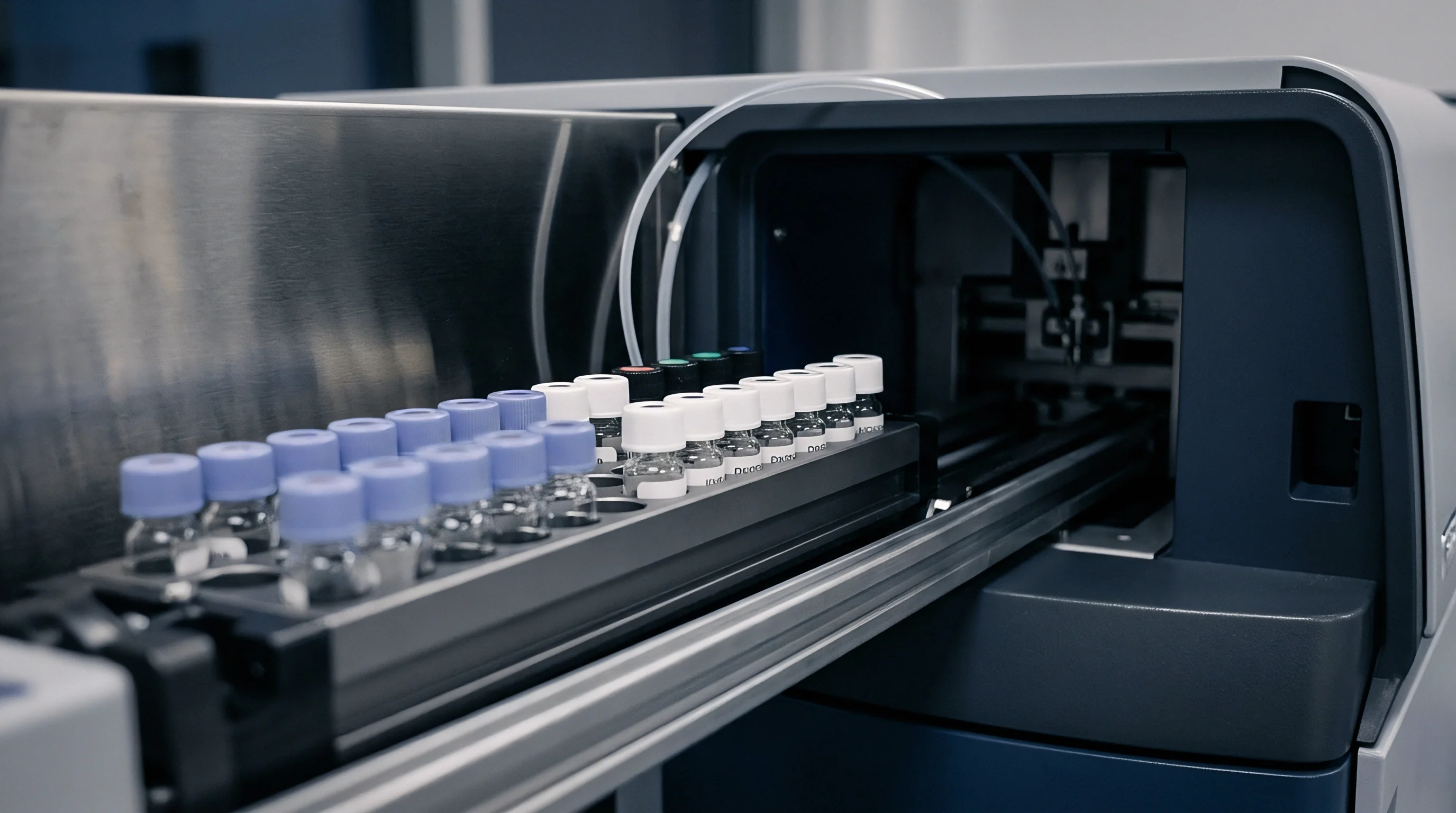
- Sample container hermetic verification guarantees that incoming polymer specimens remain isolated from ambient humidity during laboratory staging and robotic autosampler transfer.
- Carrier baseline drift stabilization confirms that the thermal desorption chamber and pneumatic lines reach an equilibrium moisture bleed below three micrograms per minute.
- Extraction furnace temperature ramping elevates the specimen to the designated target plateau without inducing local surface overheating or polymer melt pooling.
- Timed chromatographic heart-cutting diverts the pre-elution volatile hydrocarbon fraction to exhaust while channeling the aqueous fraction to the coulometer.
- Electrochemical charge integration measures total Faradaic current until the bipotentiometric sensor confirms return to the initial baseline potential.
Calibration validation requires verified chemical water standards. Pure liquid water injections introduce significant volumetric dispensing error at sub-microliter scales. Analytical technicians use sodium tartrate dihydrate containing 15.66 weight percent stoichiometric water or certified water-in-caprolactam solid standards.
These crystalline reference materials release precise moisture payloads across specific temperature bands, verifying the combined extraction efficiency, chromatographic recovery, and electrochemical sensitivity of the coupled instrument train.
Testing conducted under ASTM D6869 parameters without chromatographic separation produces baseline drift rates that void contractual rejection rights for high-grade rPET flakes.
Sample preparation protocols dictate measurement variance. Post-consumer polymer pellets and flakes absorb moisture from room air rapidly. Opening a bulk container in a testing facility with fifty percent relative humidity increases pellet surface moisture within ninety seconds.
Incoming inspection protocols require sampling via sealed glass vials flushed with dry nitrogen inside a controlled glove box or via rapid septum-capped extraction containers. Samples are weighed to the nearest 0.1 milligram on an analytical balance, with specimen weights ranging from 0.5 grams for high-moisture polyamides to 5.0 grams for ultra-dry bottle-grade polyester flakes.
| Resin Designation | Sample Mass (g) | Extraction Temp (°C) | Carrier Flow (mL/min) | Heart-Cut Window (s) | Lower Limit (ppm) |
|---|---|---|---|---|---|
| rPET Bottle Flake | 4.00 | 170 | 40 | 60 to 180 | 5 |
| rHDPE Blow Moulding | 2.50 | 125 | 35 | 50 to 160 | 10 |
| rPP Copolymer Pellets | 3.00 | 130 | 35 | 50 to 160 | 10 |
| rPA6 Engineering Grade | 0.75 | 155 | 45 | 70 to 220 | 15 |
| rLLDPE Film Regrind | 2.00 | 120 | 30 | 45 to 150 | 12 |
Validation trials across multiple compounding shifts demonstrate that chromatographically coupled extraction delivers a relative standard deviation below 3.5 percent for post-consumer resin containing up to 500 parts per million volatile organic contamination. Non-coupled coulometric systems analyzing the identical material yield relative standard deviations exceeding 25 percent, driven by random fluctuations in volatile outgassing and ongoing electrolyte contamination.
Liability
Hydrolytic chain scission in contaminated melt streams translates directly into financial exposure. When poly(ethylene terephthalate) melts inside an extruder barrel in the presence of entrained moisture, water molecules cleave the ester linkages along the polymer backbone. Each cleaved chain reduces the average molecular weight, producing an immediate collapse in the intrinsic viscosity of the melt.
Viscosity loss destroys mechanical margins. A drop in intrinsic viscosity from 0.82 deciliters per gram to 0.68 deciliters per gram causes preform blowouts, wall thinning, and catastrophic drop-impact failure in blow-moulded bottles. True moisture decides line survival.
The financial penalty scales with scrap rates and lost throughput across commercial manufacturing assets. Processing a forty-tonne shipment of post-consumer PET carrying an undetected moisture spike disrupts production schedules. Consider a plant converting forty tonnes of recycled PET pellet into two million twenty-gram beverage preforms.
The purchase contract establishes a strict moisture ceiling of 50 parts per million to maintain a target intrinsic viscosity of 0.80 deciliters per gram after extrusion. The raw material supplier provides an incoming Certificate of Analysis asserting a moisture value of 45 parts per million based on an uncoupled halogen balance.
The buyer receives the resin and injects it into a high-speed seventy-two-cavity preform moulding system. The material actually contains 180 parts per million of true moisture alongside 240 parts per million of residual volatile ink wash solvents that masked the true water balance. Extrusion hydrolyzes the polymer chains, dropping the intrinsic viscosity to 0.69 deciliters per gram.
Parison droop and gate crystallization force the line to reject 8.5 percent of total output as structural scrap, compared to a baseline scrap allowance of 1.2 percent. The converter loses 2.92 metric tonnes of resin value. Material loss combined with eight hours of downtime at 450 EUR per machine hour and decontamination scrap generates a direct operating loss exceeding 6,200 EUR on a single silo charge.
Scrap surges destroy operating margins. The financial consequence shifts completely when incoming inspection implements gas chromatography coulometry coupling. The coupled instrument isolates the 180 parts per million moisture peak from the solvent background within eight minutes of delivery truck arrival.
The incoming inspection engineer rejects the shipment on the receiving dock before the material transfers into storage silos. The buyer bears compounding fallout.
Incoming resin specifications that fail to separate water from volatile organic compounds inevitably penalize the buyer with compounding downtime.
Dispute resolution breaks down when sales contracts cite generic testing standards without defining separation requirements. Standard ASTM D6869 and ISO 15512 Method B define moisture extraction protocols but do not explicitly enforce the separation of volatile co-contaminants from the gas stream. Reprocessors exploit this technical ambiguity to defend contaminated lots, claiming their analytical obligations were satisfied by standard coulometric titration.
Resin supply contracts require rigorous analytical language to remain legally enforceable.
| Analytical Metric | Loss-On-Drying Balance | Uncoupled Coulometry | GC-Coulometry Coupling |
|---|---|---|---|
| Reported Moisture Value | 420 ppm (False High) | 280 ppm (False High) | 42 ppm (Accurate) |
| Secondary Drying Applied | 8 Hours at 170 °C | 6 Hours at 170 °C | 4 Hours at 160 °C |
| Electrical Energy Cost (Drying) | 1,420 EUR | 1,065 EUR | 710 EUR |
| Preform Line Scrap Rate | 4.8% (Thermal Aging) | 3.2% (Thermal Aging) | 1.1% (Standard Baseline) |
| Net Conversion Financial Loss | 2,840 EUR | 1,620 EUR | 0 EUR |
Sourcing teams incorporate explicit clauses into purchase contracts to protect against contaminated lots. A contract clause specifying that moisture compliance must be verified through gas chromatography coupled coulometry under modified DIN EN ISO 15512 parameters shifts the financial burden of contamination disputes directly onto the reprocessor, providing absolute legal standing to reject substandard resin lots before silo intake.