Post Consumer Polyolefin Melt Flow Rate Verification Guidelines
Verify post-consumer polyolefin melt flow using dual-load plastometry to expose degraded chains, gel content, and off-spec lots before charging production silos.


Barrel
Incoming inspection of post-consumer polyolefins starts inside the heated cylinder of an extrusion plastometer. Nominal numbers recorded on a vendor certificate of analysis mean very little until an operator tamps five to eight grams of flake or repro pellets into a clean bore held at temperature. Variations in thermal past, moisture accumulation, residual volatile organic compounds, and microscopic particulate contaminants distort the piston displacement long before the resin reaches a production screw.
Melt mass-flow rate (MFR) and melt volume-flow rate (MVR) measurements serve as primary gatekeeping values for blow molding, film extrusion, and injection molding conversions. A fractional drift in these values alters tool cavity filling, cycles times, part warpage, and clamp pressure requirements.
Extrusion plastometers conforming to ASTM D1238 and ISO 1133 operate by applying a calibrated deadweight to a weighted piston, driving molten polymer through a tungsten carbide or hardened steel capillary die. Polyethylene (PE) testing routinely occurs at 190 degrees Celsius with a 2.16 kilogram load, while polypropylene (PP) requires 230 degrees Celsius under the same nominal load weight. Secondary evaluations frequently introduce 5.0 kilogram or 21.6 kilogram masses to interrogate structural variations across disparate molecular weights.
Laboratory personnel must ensure the test cylinder temperature distribution remains uniform within plus or minus 0.2 degrees Celsius along the entire length of the packing zone, extending upwards from the die exit to seventy-five millimeters above the orifice face.

Plastometer Geometry and Orifice Maintenance
Capillary dimensions govern the calculation of shear stress inside the flowing core. The standard die features an internal diameter of 2.095 plus or minus 0.005 millimeters and an axial length of 8.000 plus or minus 0.025 millimeters. Post-consumer resins carry abrasive fillers such as talc, calcium carbonate, glass micro-shards, and un-melted pigment clusters that scour this cylinder opening during repetitive expulsions.
Routine cleaning protocols utilizing brass or soft bronze tools remove degraded skin layers without scratching the polished substrate. Chemical flushing with high-molecular-weight purge compounds prevents carbonized deposits from adhering to the barrel wall.
The die orifice wears over time. A Go/No-Go plug gauge verified to three decimal places determines whether an orifice has widened beyond the allowable tolerance envelope of 2.100 millimeters. A bore enlarged by merely fifteen micrometers shifts the recorded discharge rate by more than two percent under identical deadweights.
Piston foot clearance constitutes an equally acute source of systemic drift. ISO 1133 establishes a piston foot diameter of 9.474 plus or minus 0.007 millimeters inside a cylinder bore measuring 9.550 plus or minus 0.025 millimeters. Worn piston lands permit molten polymer backflow up the annulus, artificially depressing the extruded gram weight collected at the cutter head.
Extrudate collected under ISO 1133 Procedure A at 190 degrees Celsius with a 2.16 kilogram load displays an allowable mass variance below eight percent across five consecutive cuts.

Moisture Extraction and Sample Packing Routine
Hygroscopic paper labels, cellulose fibers, and surfactant chemistries embedded in post-consumer flakes trap water inside the incoming lots. Surface moisture vaporizes inside the 190 or 230 degree heating chamber, generating gas bubbles that rupture the exiting strand. These voids alter extrudate mass and distort optical timing flags on automated cutting assemblies.
Polyethylene and polypropylene do not undergo hydrolytic degradation in the manner of polyethylene terephthalate or polyamides. Trapped water vapor induces foaming, reduces effective melt density within the barrel, and yields false, elevated flow readings.
Technicians dry post-consumer samples in a desiccant or vacuum oven at 60 to 70 degrees Celsius for a minimum of four hours prior to charging the plastometer. Charging requires rapid, systematic deposition of pellets within forty-five seconds to minimize thermal loss across the open top orifice. A brass charging funnel guides the material directly into the barrel without pellet bridging.
Operators tamp the charge down in three equal increments using a specialized packing tool to purge interstitial air pockets. Trapped air pockets mimic volatile expansion, causing erratic downward piston surges that invalidate the displacement recording interval.
| Polymer Type | Test Method | Temperature (°C) | Nominal Load (kg) | Preheat Time (s) | Die Diameter (mm) |
|---|---|---|---|---|---|
| Post-Consumer HDPE (Blow Molding) | ASTM D1238 Condition 190/2.16 | 190.0 | 2.16 | 420 ± 15 | 2.095 ± 0.005 |
| Post-Consumer HDPE (High Load) | ASTM D1238 Condition 190/21.6 | 190.0 | 21.60 | 300 ± 15 | 2.095 ± 0.005 |
| Post-Consumer Polypropylene (Homopolymer) | ISO 1133-1 Method A | 230.0 | 2.16 | 360 ± 20 | 2.095 ± 0.005 |
| Post-Consumer Polypropylene (Impact Copolymer) | ISO 1133-2 Method B | 230.0 | 2.16 | 360 ± 10 | 2.095 ± 0.005 |
| Linear Low-Density Polyethylene Film Repro | ASTM D1238 Condition 190/2.16 | 190.0 | 2.16 | 420 ± 15 | 2.095 ± 0.005 |
Reclaim suppliers often explain away high incoming flow numbers by asserting that standard virgin preheat cycles cook the material excessively in third-party testing laboratories.


Fraction
Polymer composition within post-consumer scrap streams fluctuates with curbside collection sorting efficiency. High-density polyethylene (HDPE) milk jugs, detergent containers, and polypropylene caps arrive at reprocessors in varying states of mutual contamination. Because near-infrared sorting systems display imperfect separation efficiencies on high-speed conveyor lines, post-consumer polyethylene regularly contains between two and twelve percent entrained polypropylene.
Post-consumer polypropylene retains reciprocal shares of linear low-density and high-density polyethylene. The thermodynamic immiscibility of these two polyolefins creates a multi-phase morphological structure that alters the observed rheology under capillary flow.
Polypropylene degrades through beta scission. Thermal and mechanical stresses experienced during initial compounding, consumer usage, and subsequent wash-line extrusion cleave the tertiary carbon sites along the polypropylene backbone. This chain scission narrows the molecular weight distribution and shifts the nominal melt flow upward, turning an original 1.5 gram per ten minute injection grade into a water-thin four or five gram per ten minute component.
Polyethylene undergoes competitive crosslinking alongside chain scission. Free radicals generated during reprocessing combine to form long-chain branches and localized micro-gels, depressing the standard melt mass-flow rate and elevating low-shear melt viscosity.

What Drives Polyolefin Flow Discrepancies?
Thermodynamic interactions within the molten core establish non-linear flow responses that defy simple proportional calculations. When two percent polypropylene contaminates an HDPE blow-molding grade, the lower-viscosity polypropylene phase migrates toward the high-shear region adjacent to the die wall. This wall slip phenomenon lubricates the bulk flow, yielding an apparent melt flow increase that disguises the actual viscosity of the bulk polyethylene matrix.
A tool designer setting cycles based on this test number experiences severe parison sag in blow-molding heads or early jetting inside injection molds.
Mineral additives, masterbatch carriers, and degradation scavengers complicate this rheological behavior. Reprocessors introduce processing aids and calcium carbonate up to twenty percent by weight to smooth extrusion output and lower raw material expenses. The particulate filler increases viscous dissipation within the capillary die, restricting flow at standard 2.16 kilogram testing loads.
Carbon black loadings exceeding three percent induce noticeable yield stresses, preventing the extrudate from flowing freely until the applied shear stress overcomes the particulate network. Laboratory analysts operating plastometers without optical tracking mistake this delay for thermal lag, extending the preheat dwell and artificially inducing additional degradation.
- Micro-gel agglomeration produces visible surface pimples and irregular extrudate swell during capillary discharge, driving erratic piston travel across the timer flags.
- Residual elastomeric modifiers from olefinic block copolymer sealants depress the overall flexural modulus while dampening the expected shear-thinning response under high-load weights.
- Volatile decomposition products generate microscopic foam structures inside the capillary barrel that cause sudden piston drops and inflate calculated volumetric flow numbers.
- Unmelted polyester flakes derived from scrap container labels lodge directly across the entry cone of the die, partially choking mass throughput.

Polypropylene Entrainment in Recycled Polyethylene
Quantifying the precise percentage of polypropylene in recycled polyethylene requires analytical verification via Differential Scanning Calorimetry (DSC) alongside capillary testing. Standard MFR values hide the physical contamination because the combined flow matches specification lines through artificial balancing. An operator testing a 0.8 gram per ten minute blow-molding lot can inadvertently approve a mix containing fifteen percent degraded 12-MFR polypropylene mixed with a 0.45-MFR high-molecular-weight polyethylene fraction.
The resulting compound displays an acceptable gross flow rate under the test weight while failing environmental stress crack resistance (ESCR) thresholds on the final blow-molded bottle.
| PP Fraction (wt%) | MFR at 190°C/2.16kg (g/10 min) | MFR at 230°C/2.16kg (g/10 min) | Extrudate Swell Ratio | Notched Izod Impact (kJ/m²) |
|---|---|---|---|---|
| 0.0 (Virgin Control) | 0.35 | 0.82 | 1.45 | 18.5 |
| 2.5 | 0.42 | 0.98 | 1.41 | 14.2 |
| 5.0 | 0.54 | 1.25 | 1.36 | 10.8 |
| 10.0 | 0.78 | 1.85 | 1.28 | 6.4 |
| 15.0 | 1.12 | 2.60 | 1.20 | 4.1 |
Differential testing between 190 degrees Celsius and 230 degrees Celsius reveals this thermal contamination. Pure polyethylene experiences an predictable Arrhenius shift in melt index across this forty-degree window, increasing by a factor of roughly 2.2 to 2.4. When polypropylene fractions contaminate the matrix, the ratio of MFR at 230 degrees Celsius to MFR at 190 degrees Celsius expands beyond 2.8, driven by the complete melting and accelerated thinning of the polypropylene chains.
Extrudate swell drops with repeated passes. This differential method gives incoming inspection technicians an operational screening mechanism without relying on daily DSC testing schedules.
How reprocessors will maintain this delicate thermal balance as multi-layer barrier films containing ethylene vinyl alcohol and polyamide enter post-consumer streams in higher volumes remains unresolved across commercial sorting networks.


Lot
Bale collections sourced from regional recycling facilities exhibit seasonal, geographic, and demographic inconsistencies that transfer directly into finished pellet lots. A single twenty-ton shipment of post-consumer pellets represents thousands of discarded consumer packages collected under disparate weathering conditions. Ultraviolet radiation oxidizes outer surfaces of abandoned packaging, depleting primary phenolic and secondary phosphite antioxidant systems.
When an incoming delivery enters a receiving facility, composite sampling protocols govern whether the delivery meets factory technical specifications or risks halting automated moulding cells.
Every bag carries a distinct history. Silo blending operations at the compounding facility homogenize several flake streams, but dead zones within storage bins yield stratified layers of varying molecular weights. Sampling from railcar compartments or palletized bulk boxes requires a double-tube compartmental sampling thief reaching through the full depth of the container.
Surface grabbing fails completely because mechanical vibration during road transit causes smaller, denser pellets or fines to settle toward the bottom discharge gate. Technicians collect gross increments from at least ten separate coordinates per fifty-thousand-pound railcar bay to construct an accurate laboratory composite.

Bale to Bale Heterogeneity and Composite Sampling
Acceptance protocols rely on establishing an internal coefficient of variation across sampled containers. When receiving forty bulk boxes of repro pellets, technicians cannot test a single composite sample and declare the shipment qualified. A composite sample conceals lot bimodality, masking box-to-box variations that disrupt molding machines.
A reliable sampling regime isolates five discrete containers across the shipment matrix, testing each independently for melt flow rate before blending remnants into a final analytical master batch. If the spread across these five discrete tests exceeds eighteen percent of the nominal target, the entire shipment requires isolation for secondary qualification.
Linear low-density polyethylene resists melt rupture. Conversely, degraded low-density film compounds exhibit sudden elasticity variations under extrusion forces. Virgin resins typically display melt flow coefficients of variation below three percent across an entire production campaign.
Post-consumer repro grades operate under far wider acceptable bands, where a six to ten percent standard deviation represents standard commercial processing control. When this variance breaches twelve percent, automated screw recovery times fluctuate wildly, triggering shot-weight variations, short shots in multi-cavity tools, or excessive flashing around parting lines.
- Drive a clean compartmental sampling spear diagonally through the top access hatch of the container down to the bottom discharge cone.
- Rotate the outer sheath to open collection ports, allow pellets to fill the interior chambers, and lock the sheath before extraction.
- Empty the gathered increments into a clean moisture-resistant container, checking visually for un-melted rubber fragments or cross-polymer pellet shapes.
- Riffle the gross collection through a mechanical splitter three consecutive times to isolate a representative five-hundred-gram testing portion.
- Seal the isolated analytical portion in an aluminum-lined moisture-barrier pouch marked with railcar bay, date, and warehouse bay identifiers.
Shipments failing ASTM D1238 tolerance bands by more than fifteen percent trigger an automatic commercial debit against the broker invoice.
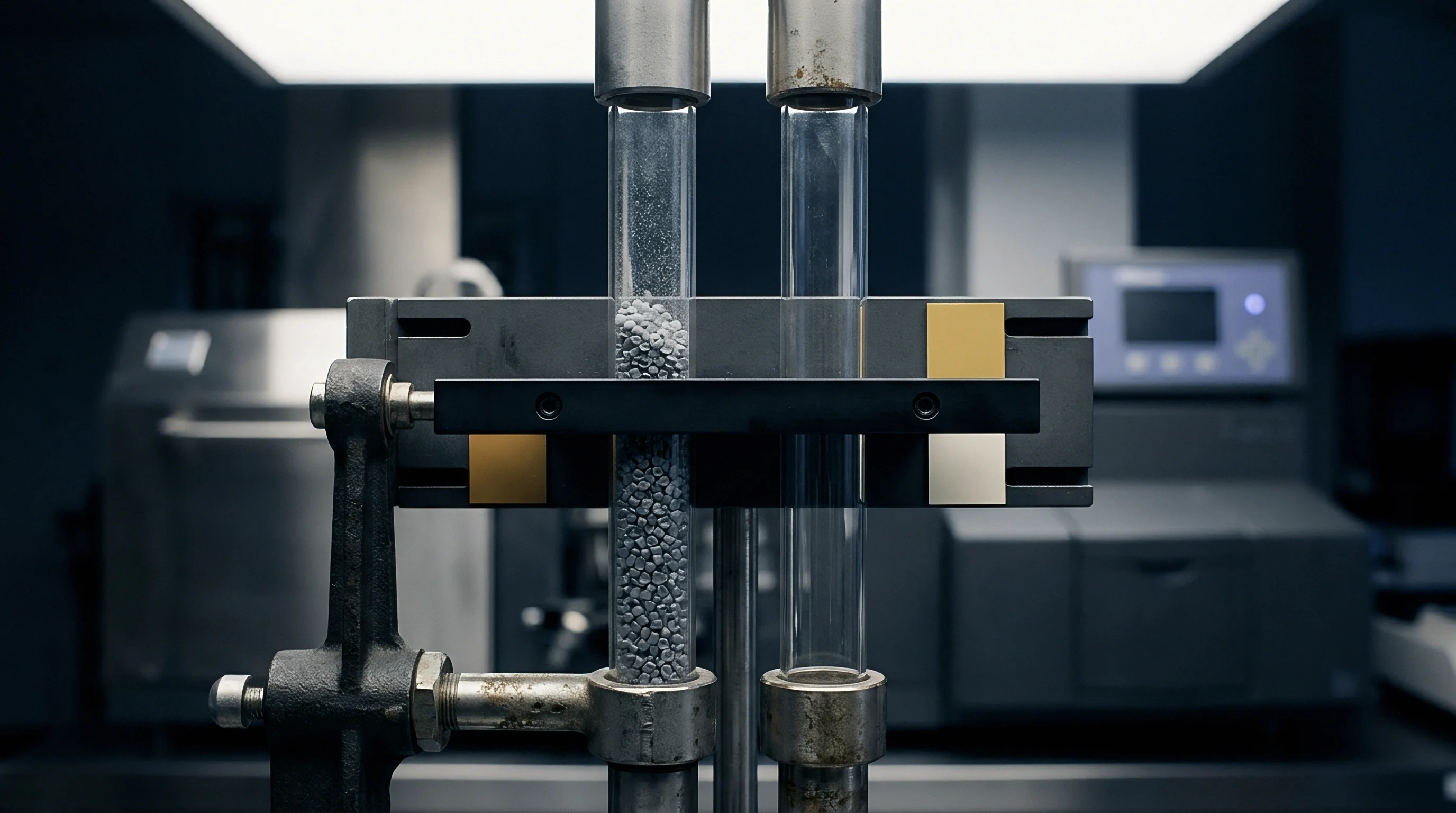
Stepwise Barrel Charging Protocol
Testing accuracy demands rigorous adherence to timing constraints during the plastometer preheat and test cycle. ASTM D1238 Procedure A relies on timed manual or automated cuts of extrudate weighed on an analytical balance to four decimal places. Procedure B utilizes an optical or magnetic encoder measuring piston displacement speed over a prescribed travel distance, calculating MFR through melt density factors.
For post-consumer materials with variable filler loadings, Procedure A remains the preferred standard because shifting pigment and ash content alters the true melt density, generating errors in automated Procedure B displacement algorithms.
High melt flow promotes flash. Uncontrolled piston movement during initial melting alters the thermal history of the charge. The standardized test sequence follows strict steps:
The operator inspects the barrel bore with a lighted bore-scope, ensuring complete absence of oxidized resin crusts. After verifying the setpoint temperature of 190.0 or 230.0 degrees Celsius, the operator installs the calibrated die and inserts the insulating plug into the bottom orifice. The operator charges five to eight grams of prepared sample into the bore within forty-five seconds, applying the packing rod with steady hand pressure after each third of the charge.
The weighted piston assembly enters the top of the barrel, resting freely under its own minor tare mass without the primary test weight applied.
The timer starts immediately upon piston insertion. The sample undergoes a preheat cycle lasting exactly 360 seconds for ISO 1133 or 420 seconds for ASTM D1238. At the conclusion of the preheat period, the technician removes the bottom insulating plug and lowers the primary deadweight gently onto the piston stem.
Dynamic drop of the deadweight is prohibited because impact forces shear the molten core, inducing premature chain alignment. The extrudate purges until the piston foot reaches the designated measurement zone, located between forty-eight and twenty millimeters above the die face. The automated cutting tool takes three to five successive extrudate cuts at fixed time intervals between thirty and two hundred seconds, matched to the anticipated flow speed.
The cut strands cool to ambient temperature, shed static electricity, and pass to the balance pan for mass verification.
Ignoring this sampling protocol results in thousands of pounds of out-of-specification repro filling plant production silos, triggering widespread machine jamming, ruined hot-runner tips, and massive post-production sorting costs on failed parts.


Load
Standard capillary testing conducted under a single 2.16 kilogram weight provides an incomplete assessment of post-consumer resin rheology. A single point on a flow curve cannot describe how a non-Newtonian polymer melt behaves across the wide spectrum of shear rates encountered in commercial processing equipment. Extrusion plastometers operate at low shear rates, typically between one and fifty reciprocal seconds, representing conditions inside a gravity parison or an un-pressurized sheet die entry zone.
Injection molding operations push materials through sprues, runners, and gates at shear rates ranging from one thousand to over one hundred thousand reciprocal seconds, where shear thinning behaviors dominate.
Virgin polyolefins display predictable shear sensitivity dictated by the linear or branched architecture of the polymer chains. In post-consumer polyolefins, multiple processing histories, thermal degradation, and inconsistent cross-polymer components fundamentally distort the shear-thinning index. A grade exhibiting an acceptable melt index under a 2.16 kilogram weight can experience severe flow resistance at high shear rates, overloading hydraulic pumps and causing cavity short shots.
Conversely, an over-sheared lot with degraded short chains can drop in shear viscosity prematurely, flashing across tool inserts.

Why Does High Load Testing Unmask Crosslinking?
Crosslinked structures generated in post-consumer polyethylene through radical recombination yield significant non-Newtonian responses. High Load Melt Index (HLMI) testing utilizes a 21.6 kilogram mass at 190 degrees Celsius, corresponding to ASTM D1238 Condition 190/21.6. By comparing the mass discharged under 21.6 kilograms against the mass discharged under 2.16 kilograms, technicians calculate the Flow Rate Ratio (FRR), sometimes designated as the melt flow ratio.
This value reflects the molecular weight distribution and highlights the presence of long-chain branching or micro-gel crosslinking networks that remain undetectable under standard minor loads.
Unmelted fractions plug the capillary. A standard 2.16 kilogram weight does not exert sufficient pressure to force crosslinked micro-gels through the entry cone of an 8.000 millimeter die. Under low loads, these gels accumulate above the die orifice, acting as an internal throttle that artificially depresses the measured flow rate.
Under a 21.6 kilogram load, the shear stress rises by an order of magnitude. This force deforms the gel particles, driving them through the orifice and exposing the true, underlying viscosity of the fluid matrix. An elevated FRR warns the engineer that the material contains crosslinked degradation products that will cause surface tearing, reduced gloss, and degraded dart drop impact resistance in blown film converters.
Post-consumer resin exhibiting visible extrudate distortion indicates unmolten crosslinked gels upstream of the die orifice.
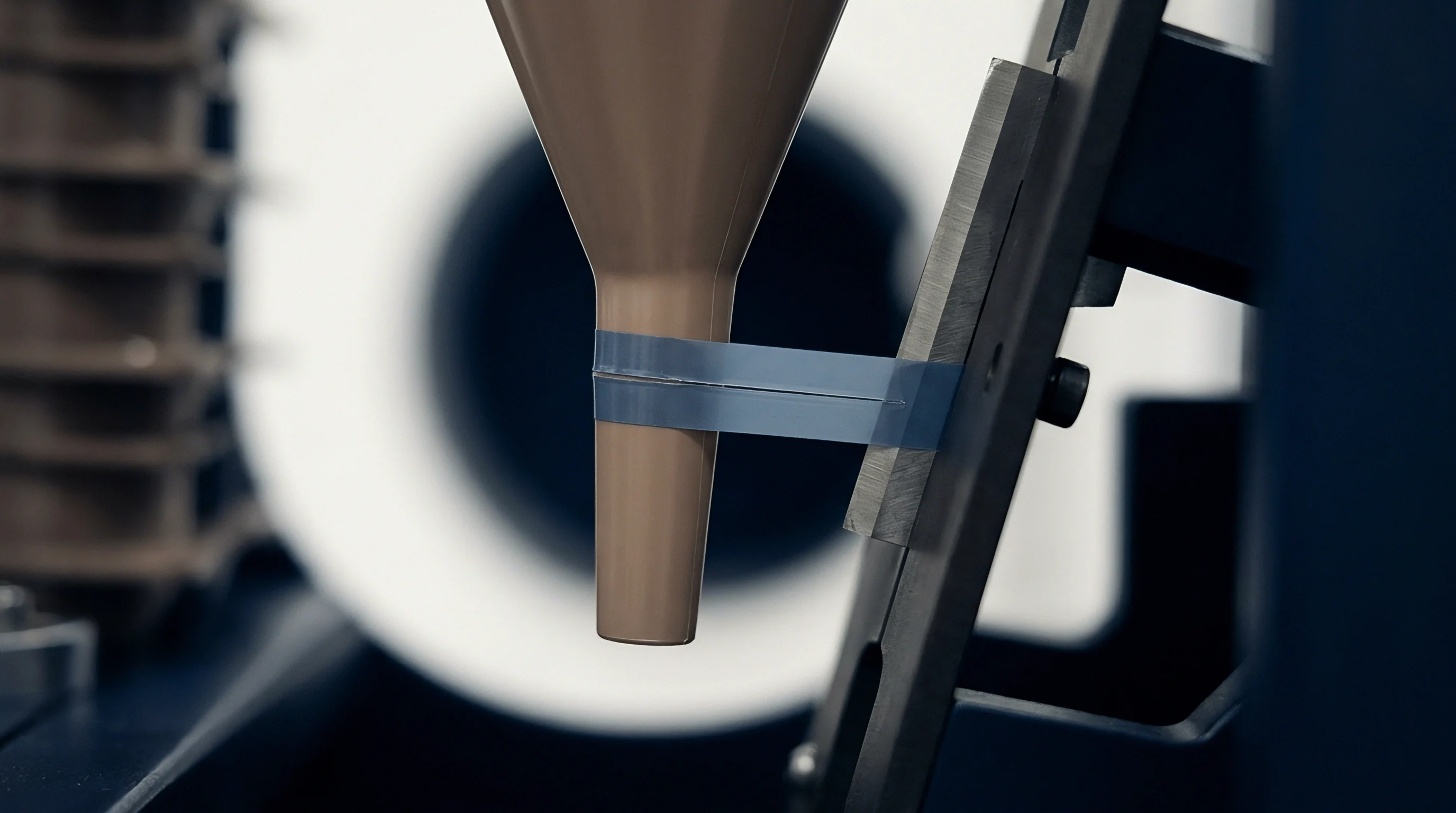
Flow Rate Ratio Mechanics in Shear Thinning Melts
Standard virgin blow-molding HDPE resins exhibit an FRR (21.6 kg / 2.16 kg) between eighty and one hundred twenty, establishing balanced melt strength and ease of extrusion. Post-consumer HDPE recovered from recycled containers often displays FRR values spanning from one hundred thirty to over one hundred eighty. This wide ratio signals extreme polydispersity resulting from the random intermixture of fractional-melt pipe scrap, medium-flow blow molding fractions, and high-flow injection molded container closures.
| Polyolefin Resin Grade | MFR (190°C / 2.16kg) | MFR (190°C / 5.0kg) | HLMI (190°C / 21.6kg) | FRR (21.6kg / 2.16kg) | Processing Stability |
|---|---|---|---|---|---|
| Virgin Fractional Blow Molding HDPE | 0.30 | 1.05 | 28.5 | 95.0 | Stable bubble, predictable parison swell |
| Recycled HDPE Drum Reclaim (Clean) | 0.28 | 1.12 | 34.2 | 122.1 | Minor parison sag, good weld lines |
| Post-Consumer Mixed HDPE Bottle Repro | 0.45 | 2.10 | 68.0 | 151.1 | Variable parison thickness, rough surface |
| Degraded Post-Consumer Agricultural Film | 0.18 | 0.95 | 38.0 | 211.1 | Bubble flutter, frequent melt fracture |
| Reprocessed PP/HDPE Co-Extrusion Scrap | 1.20 | 4.50 | 110.0 | 91.6 | Poor melt strength, localized phase tears |
Multi-weight verification protocols require testing each production lot at dual load conditions before silo loading. Procedure B instruments equipped with automated weight lifters execute these dual-load sequences automatically within a single barrel charge. The plastometer applies the minor weight during the initial phase of the test stroke, measures the displacement rate, and seamlessly shifts the 21.6 kilogram secondary weight onto the piston foot to measure the high-load displacement rate.
This dual test takes eight minutes to complete and yields both the basic MFR and the diagnostic Flow Rate Ratio.
Low shear rates hide pigment agglomerates. High shear loading crushes fragile clusters, altering the dynamic flow resistance. Buyers specifying post-consumer compounds for technical moldings must evaluate the five-kilogram test load (ISO 1133 Condition 190/5) alongside standard 2.16 kilogram evaluations.
The intermediate weight matches the internal shear forces generated inside standard extruder feeding sections, providing a realistic proxy for motor torque demand and barrel pressure profiles.
Wider molecular weight spreads deliver lower shear viscosities at high screw speeds than their standard melt flow numbers suggest.


Dossier
Incoming quality assurance operations achieve financial security only when technical test guidelines integrate directly into purchase orders and material supply agreements. A technical data sheet published by a reprocessor represents an optimized historical snapshot rather than a commercial warranty for future deliveries. Without contractual verification protocols governing test frequencies, load conditions, and acceptable lot standard deviations, buyers absorb all downstream conversion risks.
The receiving plant must construct a quality dossier for every incoming railcar or truckload, linking the supplier certificate of analysis to internal laboratory bench verifications.
Testing post-consumer resins under standard virgin tolerances is an expensive mistake. Virgin prime polymers ship with narrow MFR bands, typically within plus or minus ten percent of the nominal target rating. Post-consumer reprocessed grades require wider commercial operating envelopes to accommodate feed heterogeneity.
A compounding line attempting to buy post-consumer injection-grade polypropylene with a tight 12.0 plus or minus 0.5 MFR window faces astronomical reject rates and un-fillable purchase orders. Realistic commercial contracts establish tiered acceptance boundaries, balancing processing capability against raw material landed costs.

Specification Bands and Certificate Calibration
Procurement teams negotiate three distinct operational zones within the resin purchase specification: the prime target zone, the adjustment zone, and the hard rejection threshold. For a nominal 0.80 MFR blow-molding post-consumer polyethylene repro, the prime target band covers 0.70 to 0.95 grams per ten minutes. Material arriving within this envelope receives immediate warehouse clearance and full invoice processing.
The second tier spans 0.60 to 0.69 and 0.96 to 1.05 grams per ten minutes, representing usable but shifted inventory that requires processing adjustments, such as screw temperature alterations or cycle extensions.
Material falling into this secondary adjustment zone triggers an automatic, contractually defined price deduction per metric ton, reimbursing the converter for operational inefficiencies and extended machine cycles. Shipments displaying MFR values below 0.60 or above 1.05 grams per ten minutes breach the hard rejection threshold. The material undergoes quarantine, the supplier dispatches a return authorization within seventy-two hours, and all demurrage costs transfer to the vendor account.
Without pre-established contract clauses governing these boundaries, converters remain vulnerable to contentious broker disputes while factory floor space remains choked with unusable inventory.
Repeated mechanical recycling shifts the molecular weight distribution while increasing the high-load melt flow ratio.

Contract Thresholds and Settlement Calculations
Disputes settle on third-party test data. When internal laboratory testing clashes with vendor certificate values, formal arbitration mechanisms dictate the outcome. Both parties must reference a designated accredited ISO 17025 testing facility whose findings supersede preliminary factory determinations.
The contract defines identical preparation steps, requiring vacuum desiccation at 65 degrees Celsius for four hours and specific plastometer configurations using ASTM D1238 Procedure A with manual cut-and-weigh execution. The losing party covers all third-party testing and shipping expenses associated with the contested sample set.
Settlement formulas establish clear financial adjustments when marginal lots enter plant production lines. Consider a standard forty-metric-ton delivery of post-consumer polypropylene intended for automotive interior substrates, priced at 1,250 dollars per metric ton with a target MFR of 15.0 grams per ten minutes under ISO 1133 at 230 degrees Celsius and 2.16 kilograms. The contractual adjustment band covers 12.0 to 13.9 MFR on the low side and 16.1 to 18.0 MFR on the high side.
Laboratory verification records an average incoming MFR of 17.5 across five discrete samples, reflecting excess chain scission during recycling.
The contract specifies a two percent invoice reduction for every whole MFR point deviating beyond the primary specification band of 14.0 to 16.0 grams per ten minutes. The measured deviation of 1.5 MFR points beyond the 16.0 upper boundary triggers a three percent price deduction across the entire forty-ton delivery. This penalty yields a 1,500-dollar credit against the gross invoice of 50,000 dollars, offsetting the increased stabilizer and processing aid let-down costs needed to stabilize the fast-flowing melt inside the tool.
The buyer registers these figures directly in the receiving dossier, establishing historical supplier capability metrics that dictate future purchase order allocations.
Commercial contracts governing post-consumer polyolefins explicitly state that all incoming lot acceptance decisions rely on the buyer plastometer verifications conducted under ASTM D1238 Condition 190/2.16 within forty-eight hours of physical arrival, superseding all conflicting data points listed on the seller initial certificate of analysis.