Analytical Determination of High Weight Oligomer Diffusion Limits under Dynamic Freight Heat Exposure
Dynamic freight heat spikes reaching 60 °C accelerate high weight oligomer diffusion, requiring LC-QTOF-MS testing beyond standard OM2 compliance conditions.

Kinetics
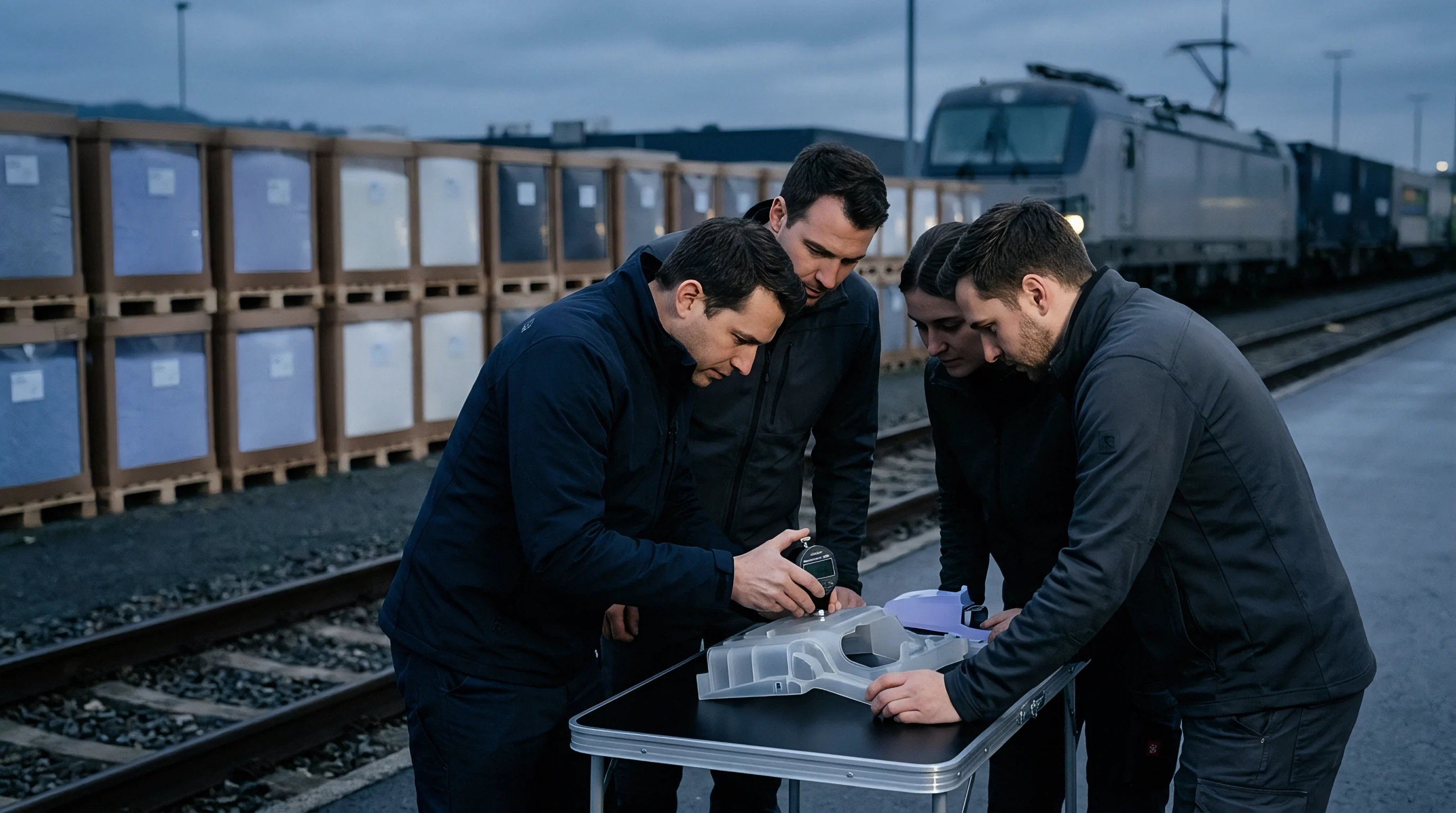
Thermal recording strips retrieved from ocean freight consignments crossing equatorial trade routes regularly document internal container spikes reaching 59.4 degrees Celsius. Under these conditions, multi-layer polyethylene terephthalate and polybutylene terephthalate liners release cyclic oligomers into dry and fatty food simulants at rates that outstrip static compliance models. Standard laboratory verification protocols rely on Regulation (EU) 10/2011 testing condition OM2, prescribing ten days at 40 degrees Celsius.
That baseline assumes stable warehousing. When freight sits on a tarmac in transshipment hubs, interior ambient temperatures exceed 50 degrees Celsius for eighteen consecutive hours. The resulting kinetic acceleration forces high molecular weight cyclic species across the polymer boundary layer into dry matrices and oily goods.
Diffusion of cyclic polyester trimers and tetramers possessing molecular weights between 500 and 1200 Daltons follows modified Fickian mechanics governed by temperature-dependent polymer segment relaxation. Below the glass transition temperature of 75 degrees Celsius for dry polyethylene terephthalate, migrant movement is constrained by free volume availability. Plasticization by absorbed moisture or fatty acid vapors lowers this glass transition threshold toward 52 degrees Celsius.
Once container temperatures enter this relaxation zone, the diffusion coefficient shifts by two orders of magnitude.
Cyclic polybutylene terephthalate trimers exhibit an activation energy of 108 kilojoules per mole in contact with oily media.
Laboratory assessment of this thermal surge demands high-pressure solvent extraction coupled to liquid chromatography and quadrupole time-of-flight mass spectrometry. The analytical challenge centers on resolving non-intentionally added cyclic oligomers from linear degradation fragments without inducing thermal cleavage inside the electrospray ionization source. Standard gas chromatography fails for these structures because non-volatile cyclic trimers degrade inside injection ports set to 280 degrees Celsius.
Quantitative recovery requires liquid extraction using dichloromethane or hexafluoroisopropanol mixtures, followed by reversed-phase separation on octadecylsilane columns under sub-ambient column temperatures.
Resin manufacturers defend their compliance files by claiming that standardized ten-day migration tests at 40 degrees Celsius legally envelop every distribution contingency encountered during ocean transit.

Hold
Steel container holds behave as thermal amplifiers during maritime transit. Solar radiation loading on uninsulated container roofs generates internal air temperatures 25 degrees Celsius above external ambient levels. The cargo holds of container vessels also transfer engine room heat through structural bulkheads into adjacent freight cells.
Packaging materials held inside these boundary zones experience continuous thermal cycling between 32 degrees Celsius at night and 63 degrees Celsius during daytime solar exposure.
How Do Thermal Spikes Shift Arrhenius Diffusivity?
Diffusive flux across packaging films scales exponentially with temperature through Arrhenius relationships. The diffusion coefficient D relates to absolute temperature through the activation energy of diffusion. For high molecular weight species such as cyclic polyethylene terephthalate trimers with a molecular weight of 576.5 Daltons, activation energy ranges from 95 to 115 kilojoules per mole.
Calculating diffusion coefficients under static 40 degrees Celsius bench conditions produces an estimated diffusion coefficient of 1.2 multiplied by 10 to the power of negative fifteen square centimeters per second. Recalculating that parameter at a freight peak temperature of 60 degrees Celsius yields a diffusion coefficient of 1.8 multiplied by 10 to the power of negative fourteen square centimeters per second.
The rate increases fifteen-fold. Barrier performance calculated at room temperature vanishes. Molecules that remain immobile during shelf-life studies migrate rapidly during ocean passage.
A container temperature increase from forty to sixty degrees Celsius raises cyclic oligomer partition coefficients across oily interfaces by twelvefold.
Thermal loading alters physical partitioning at the polymer surface. Elevated thermal states increase the solubility of cyclic oligomers within lipid food simulants such as olive oil and 95 percent ethanol. When partition coefficients drop, packaging additives and residual oligomer fractions bleed into food matrices at rates exceeding conventional compliance limits.
| Exposure Profile | Effective Temperature | Duration | Diffusion Coefficient | Specific Migration into Oil |
|---|---|---|---|---|
| Standard OM2 Testing | 40 °C | 10 days | 1.2 × 10⁻¹⁵ cm²/s | 0.012 mg/kg |
| Equatorial Marine Hold | 48 °C | 21 days | 4.6 × 10⁻¹⁵ cm²/s | 0.038 mg/kg |
| Port Tarmac Staging | 58 °C | 5 days | 1.4 × 10⁻¹⁴ cm²/s | 0.071 mg/kg |
| Bulkhead Heat Zone | 64 °C | 14 days | 2.9 × 10⁻¹⁴ cm²/s | 0.142 mg/kg |
Improper temperature modeling during transport qualification results in border rejections, mandatory container destruction at destination ports, and the immediate suspension of import clearances.


Isolation
Accurate quantitation of high molecular weight oligomers requires separation from the bulk polymer matrix without creating artefactual fragments. High molecular weight cyclic oligomers include cyclic polybutylene terephthalate dimers, trimers, tetramers, and pentamers, spanning 440 to 1100 Daltons. These molecules lack charged functional groups, showing limited ionization efficiency under standard acidic electrospray conditions.
Separation strategies must suppress background polymer noise while recovering non-volatile species intact.

Which Extraction Solvents Isolate Polyester Oligomer Fractions?
Extraction protocols must dissolve packaging contact layers without precipitating high molecular weight polymer chains into the analytical capillary. Chloroform dissolves the matrix entirely but introduces chlorinated waste streams and causes chromatographic column fouling. Dichloromethane extraction at room temperature provides selective isolation of cyclic species while leaving high molecular weight linear polyesters undissolved.
Solid-liquid extraction procedures depend on precise solvent parameters:
- Dichloromethane leaching isolates cyclic oligomer fractions through selective dissolution over twelve hours without degrading the ester backbone.
- Hexafluoroisopropanol mixtures dissolve crystalline packaging films completely, facilitating total oligomer content determination via size-exclusion clean-up steps.
- Ethanol evaporation stages precipitate linear polymer chains while retaining cyclic oligomers in the liquid supernatant.
- Supercritical fluid extraction recovers migrants from packaging surfaces at 45 degrees Celsius using carbon dioxide modified with five percent methanol.
Quantitative liquid chromatography coupled to electrospray ionization requires ammonium formate or sodium acetate additives to generate stable adduct ions. Sodium adducts of cyclic trimers appear at mass-to-charge ratio 599.1 within the positive ion mode. Quantitation against certified standards presents technical hurdles because commercial reference standards for cyclic oligomers above 800 Daltons remain unavailable.
Laboratories must synthesize, isolate, and purify cyclic oligomer fractions using preparative flash chromatography, verifying purity through proton nuclear magnetic resonance before establishing calibration curves.
Laboratory reports quoting non-detected results without documenting method limits of quantitation below 0.01 milligrams per kilogram fail regulatory review.
Validation of an analytical method for transshipment heat stress requires empirical calibration. Consider a packaging line evaluating 45-micrometer biaxially oriented polyethylene terephthalate films intended for fatty dry food contact. The laboratory tests a 100-square-centimeter sample exposed to food simulant E, composed of poly(2,6-diphenyl-p-phenylene oxide), known commercially as Tenax, at 60 degrees Celsius for ten days to simulate transshipment hold dynamics.
The European specific migration limit for non-evaluated substances under the toxicological threshold of concern concept sits at 0.05 milligrams per kilogram of food.
The worked extraction recovery demonstrates the analytical boundary:
- The exposed Tenax adsorbent undergoes complete desorption using 40 milliliters of diethyl ether under ultrasonic agitation for thirty minutes.
- The solvent extract evaporates under a gentle nitrogen stream at 30 degrees Celsius until reaching a dry residue.
- The dried vial receives reconstitution in exactly two milliliters of acetonitrile and water in an eighty-to-twenty volumetric ratio.
- The sample injects into a reversed-phase liquid chromatograph fitted with a high-resolution time-of-flight mass spectrometer operating at 30,000 resolving power.
- The instrument response for the cyclic trimer peak at mass-to-charge 599.1 reveals a peak area corresponding to 0.42 micrograms per milliliter against an isolated trimer calibration series.
- Multiplying by the reconstitution volume yields 0.84 micrograms total migrated trimer per test specimen.
- Applying the conventional European surface-to-volume ratio of six square decimeters per kilogram of food yields an actual calculated migration value of 0.0504 milligrams per kilogram.
The finished packaging film breaches the toxicological threshold of concern under transport heating despite passing the standard OM2 migration test conducted at 40 degrees Celsius. The measurement uncertainty of 0.006 milligrams per kilogram leaves open whether customs authorities classify this border result as an absolute regulatory violation or an allowable analytical tolerance.

Disparity
Discrepancies between supplier declarations and container inspection results stem from contradictory thermal assumptions. Raw resin suppliers certify their materials based on standard test specimens molded under pristine conditions and exposed to room-temperature extractions. Converters add slip additives, colorants, and heat stabilizers that lower resin crystallization rates.
These unreacted additives alter the final material matrix, generating additional free volume that accelerates high molecular weight oligomer mobility.
Importers face serious liability when their documentation relies on supplier declarations that explicitly exclude transport degradation. A typical declaration of conformity states adherence to Regulation (EU) 10/2011 for room-temperature storage. The customs declaration lists import into southern European ports during mid-summer.
Port authorities selecting random containers for verification test the linings under OM6 conditions, specifying four hours at 100 degrees Celsius or equivalent dynamic cycles, revealing migrating cyclic fractions five times higher than declared.
| Dossier Layer | Declared Boundary | Tested Specimen | Excluded Thermal Range |
|---|---|---|---|
| Resin Manufacturer | Pristine Granulate | Virgin Resin Plaque | Processing history above 260 °C |
| Film Converter | Base Polymer and Slip | Laminated Webbing | Continuous heating over 40 °C |
| Adhesive Formulator | Cured Polyurethane | Neat Adhesive Film | Humidity-driven hydrolysis in transit |
| Importer of Record | Finished Food Contact Article | Filled Retail Container | Hold temperatures reaching 60 °C |
The analytical audit must reconcile the physical chemistry of the container with the legal boundaries of the dossier. When testing laboratories evaluate only volatile compounds by headspace gas chromatography, they fail to identify high molecular weight cyclic trimers and tetramers. These large molecules do not enter the vapor phase.
They migrate strictly through liquid extraction or direct surface contact with fatty food constituents.
Declarations that fail to specify maximum allowable freight temperatures transfer full product liability directly to the importing party.
Remedy
Mitigating diffusion risks during ocean transport demands adjustments to both procurement specifications and analytical verification regimes. Technical procurement agreements must replace general compliance references with explicit testing conditions that reflect actual distribution corridors. Contracts should specify that test reports include dynamic thermal exposure cycles spanning the 55 to 65 degrees Celsius range.
Packaging engineers control oligomer migration by modifying resin specifications. Specifying solid-state polymerization reduces the total concentration of residual cyclic oligomers in polyester resins. Solid-state processing extracts volatile species and drives oligomers back into the polymer chain backbone, lowering extractable cyclic trimer fractions below 0.3 percent by weight.
Incorporating internal barrier layers such as ethylene vinyl alcohol or inorganic silicon dioxide vapor coatings restricts oligomer movement even when outer layers undergo thermal softening.
Supply agreements specifying solid-state polymerized resin grades reduce migrant cyclic trimer fractions by eighty percent.
Procurement teams must audit the complete documentation dossier before loading containers at origin ports:
- Migration report correlation confirms that test reports match the specific resin grade, batch code, and film thickness loaded into the shipping container.
- Extended test validation establishes that specific migration limits remain satisfied at 60 degrees Celsius rather than relying exclusively on standard 40-degree OM2 parameters.
- Non-intentionally added substance screening documents high-resolution mass spectrometry profiling for cyclic oligomers above 500 Daltons with method limits of detection below 0.01 milligrams per kilogram.
- Dual-use additive transparency identifies any slip or thermal stabilization agents that accelerate polymer plasticization under sustained marine hold conditions.
Standard master purchase contracts incorporate a specialized temperature warranty clause: The supplier warrants that the articles delivered comply with specific migration thresholds of 0.05 milligrams per kilogram under continuous thermal exposure of 60 degrees Celsius for twenty-one consecutive days, and failure to document this performance shifts all port rejection costs and customs demurrage fees to the seller.