Analytical Traceability Limits in Chemically Recycled Olefin Co-Processing Streams
Analytical traceability in co-processed olefins fails at low blend ratios, requiring administrative mass balance audit trails backed by rigorous NIAS screening.
Feed
Pyrolysis Distillates in Naphtha Steam Crackers
Feeding thermal pyrolysis liquids alongside virgin naphtha into steam cracking furnaces introduces complex hydrocarbon mixtures into the high-temperature reaction zone. Recycled feedstocks derived from mixed polyolefin waste break down thermochemically into paraffinic, olefinic, naphthenic, and aromatic fractions. The cracking furnaces themselves run at coil outlet temperatures between 780 degrees Celsius and 875 degrees Celsius, optimized for linear alkanes.
However, raw pyrolysis oils carry high levels of conjugated dienes, organosilicon compounds, nitrogenous bases, chlorinated hydrocarbons, and trace transition metals, all of which alter coke buildup inside radiant coils and degrade catalyst performance in downstream hydrotreaters.
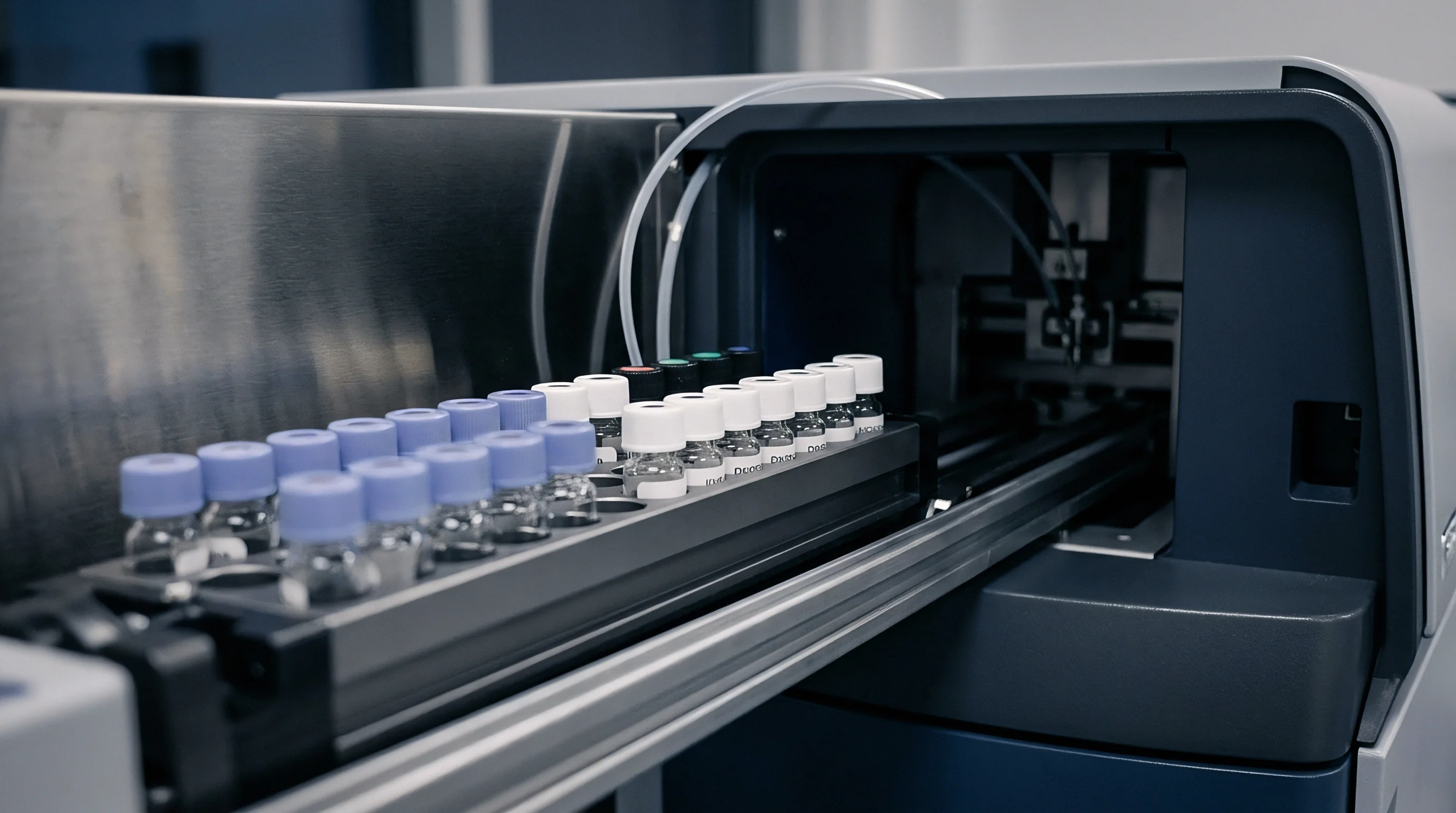
Analyzing these raw recycled feeds requires comprehensive two-dimensional gas chromatography with time-of-flight mass spectrometry (GCxGC-TOFMS). Virgin naphtha consists almost entirely of saturated hydrocarbons boiling between 35 degrees Celsius and 200 degrees Celsius. Unrefined plastic pyrolysis distillate, on the other hand, spans a much broader boiling range past 350 degrees Celsius, carrying heavy waxes that foul preheat trains.
Commercial operators typically cap pyrolysis liquid blending at one to five percent by weight of total feed, keeping furnace pressure drop and heat transfer coefficients within workable limits.
Pre-treatment needs depend on contaminant levels in the raw pyrolysis oil. Organic nitrogen from polyurethane or polyamide residues forms nitriles and amines under furnace heat, poisoning noble metal catalysts in acetylene hydrogenation units at concentrations above two parts per million. Chlorine from trace polyvinyl chloride yields corrosive hydrogen chloride gas in the convection section, driving chloride stress corrosion cracking in austenitic stainless steel pipework.
Meanwhile, iron, copper, and calcium promote unwanted dehydrogenation, accelerating coke buildup on radiant tubes and shortening decoking intervals from sixty days to just fifteen.
Unsaturated molecules in the radiant coil alter cracking kinetics. Raw pyrolysis oils contain up to thirty percent olefins and diolefins by mass, species that readily undergo radical addition to build heavy aromatic precursors. These condense as coke on internal alloy walls, raising metal temperatures until the furnace must be thermally derated.
To protect cold-box heat exchangers from fouling, co-processing specifications cap total conjugated dienes at under one percent by weight. Battery-limit testing checks these limits before recycled liquids reach main feed headers.
Batch variations in raw waste plastics account for trace element spikes that exceed pipeline acceptance limits.
Mass

Yield Distributions across Furnace Coils
Thermal cracking runs on free-radical chain reactions driven by temperature, residence time, and hydrocarbon partial pressure. Straight-run naphtha yields follow predictable models tied to paraffin-to-naphthene ratios and carbon distributions. Adding plastic pyrolysis oil shifts these yield patterns because of its branched alkanes and internal olefins.
Pure n-paraffins convert to ethylene at up to thirty-two percent by mass, while highly branched isoparaffins yield under eighteen percent ethylene while boosting methane and propylene. Once mixed feed enters the coil, tracking individual carbon atoms from the recycled fraction is physically impossible.
Administrative mass balance standards allocate recycled content mathematically without requiring its physical presence in the final product.
Chain-of-custody rules under ISO 22095 distinguish physical mix mass balancing from physical segregation. For steam crackers, physical segregation is economically impractical since running dedicated furnace coils and recovery trains requires duplicating heavy capital equipment. Administrative mass balance methods allow site-level accounting instead, converting input tonnes of certified recycled pyrolysis oil into credit tonnes of ethylene, propylene, butadiene, and benzene.
These figures rely on conversion factors from plant yield models or real-time process simulations. At the quench tower outlet, the physical reality is that all molecules share identical chemical properties whether their carbon came from crude oil or post-consumer packaging.

Worked Yield Allocation Model
Take a commercial steam cracker processing 100 tonnes per hour total feed: 95 tonnes per hour of virgin light naphtha blended with 5 tonnes per hour of hydrotreated plastic pyrolysis oil. Coil outlet temperature is 840 degrees Celsius with a 0.50 steam-to-oil weight ratio. Quantifying the gap between administrative credit allocation and actual chemical yields requires calculating reactor mass balances from empirical kinetic cracking factors for each feed component.
Under these operating conditions, virgin naphtha yields 30.0 percent ethylene, 15.0 percent propylene, 4.5 percent butadiene, 12.0 percent aromatics (benzene, toluene, xylene), 14.5 percent methane, and 24.0 percent balance gases and fuel oil. Hydrotreated pyrolysis oil, higher in iso-alkanes and mono-olefins, shows a different yield profile: 22.0 percent ethylene, 21.0 percent propylene, 3.5 percent butadiene, 9.0 percent aromatics, 16.5 percent methane, and 28.0 percent balance gases and fuel oil.
Total physical output across the combined 100 tonnes per hour feed stream breaks down as follows:
- Ethylene output calculation yields 28.50 tonnes per hour from naphtha plus 1.10 tonnes per hour from pyrolysis oil, totaling 29.60 tonnes per hour physical output.
- Propylene output calculation yields 14.25 tonnes per hour from naphtha plus 1.05 tonnes per hour from pyrolysis oil, totaling 15.30 tonnes per hour physical output.
- Butadiene output calculation yields 4.275 tonnes per hour from naphtha plus 0.175 tonnes per hour from pyrolysis oil, totaling 4.45 tonnes per hour physical output.
- Aromatics output calculation yields 11.40 tonnes per hour from naphtha plus 0.45 tonnes per hour from pyrolysis oil, totaling 11.85 tonnes per hour physical output.
Strict physical-yield allocation credits the site with 1.10 tonnes per hour of recycled ethylene and 1.05 tonnes per hour of recycled propylene. Under standard ISCC PLUS commercial rules using unweighted flat attribution on total mass feed, a plant can instead claim 5.0 percent of total ethylene production as recycled. Taking 5.0 percent of the 29.60 tonnes per hour ethylene stream gives 1.48 tonnes per hour of credited recycled ethylene.
That allocation overstates actual physical recycled ethylene by 0.38 tonnes per hour ~ a 34.5 percent divergence from cracking stoichiometry.
Mass balance bookkeeping overstates recycled content whenever administrative rules decouple from kinetic cracking yields.
Isotopes
Which Analytical Markers Distinguish Recycled Pyrolysis Oils in Crackers?
Isotopic characterization can separate biogenic carbon from fossil carbon, but fails when applied to post-consumer synthetic polyolefins. Radiocarbon testing by Accelerator Mass Spectrometry (AMS) follows ASTM D6866 and EN 16640. Fossil-derived ethylene contains no radiocarbon because Carbon-14 decays with a 5,730-year half-life; synthetic plastics made decades ago show the same total C-14 depletion as fresh crude oil.
So while radiocarbon measurement readily tracks bio-attributed content from bio-naphtha or hydrotreated vegetable oil, it cannot detect chemically recycled fossil polyolefins.
Stable isotope ratio mass spectrometry (IRMS) measuring delta 13C provides limited discrimination using kinetic isotope fractionation from initial synthesis and pyrolysis. Petroleum-derived polyolefins typically show delta 13C values between minus 26 per mil and minus 32 per mil against the Vienna Pee Dee Belemnite (VPDB) standard. Plant feedstocks using C3 or C4 pathways have distinct signatures: C3 plants span minus 20 to minus 37 per mil, while C4 plants run from minus 9 to minus 16 per mil.
When plastic pyrolysis oil mixes into crude-derived naphtha, the resulting delta 13C shift sits inside the natural variance of virgin petroleum, ruling out precise quantitative tracking.
| Analytical Method | Target Analyte or Parameter | Limit of Detection | Primary Limitation in Co-Processing |
|---|---|---|---|
| Accelerator Mass Spectrometry (AMS) | Carbon-14 / Total Carbon ratio | 0.05 percent biogenic carbon | Cannot differentiate fossil polyolefin pyrolysis oil from virgin crude |
| Isotope Ratio Mass Spectrometry (IRMS) | Delta 13C isotopic distribution | 0.1 per mil VPDB | Isotopic variance overlaps with virgin petroleum naphtha ranges |
| GC-AED (Atomic Emission Detection) | Heteroatoms (Hetero-N, Hetero-S, Hetero-Cl) | 0.5 ppm element concentration | Detects feed impurities rather than polymer backbone origin |
| Pyrolysis-GC-MS / PTR-MS | Specific polymer additive degradation fragments | 1.0 ppm polymer matrix concentration | Thermal cracking inside furnace destroys characteristic parent molecules |
| High-Resolution NMR (13C / 1H) | Branching density and end-group structures | 0.1 mol percent structural isomers | Downstream polymerization erases structural memory of recycled feed |
Dosing recycled pyrolysis oil with intentional chemical markers offers another traceability option. Halogenated tracer molecules or deuterated hydrocarbons remain stable during storage and transport. Inside the radiant coil, however, thermal cracking breaks covalent bonds indiscriminately.
A halogenated aromatic tracer injected at ten parts per million breaks down into volatile halogen acids and small radicals at 850 degrees Celsius, severing the link between tracer and recycled carbon. Any working tracer must survive extreme cracking without fouling hydrotreating catalysts or contaminating polymer products.
Whether molecular markers can operate at sub-ppm detection levels without compromising product compliance remains an open question.

Fractions
Contaminant Partitioning in Downstream Distillation
Cracker products leave the quench furnace and enter distillation trains made up of primary fractionator, demethanizer, deethanizer, depropanizer, debutanizer, and C4/C5 splitters. Unreacted heteroatoms and degradation products partition by boiling point and vapor-liquid equilibrium. Chlorinated hydrocarbons convert partially to hydrogen chloride, which rises to the top of the deethanizer and accumulates in the recycled ethane-ethylene overheads.
Unconverted organic chlorides like chlorobenzene and chloroalkanes move into C4 and pyrolysis gasoline streams, complicating hydrotreatment downstream.
Polymer purity standards cap total heteroatoms in monomer feeds at low parts-per-billion levels to prevent catalyst poisoning.
Organosilicon contaminants from silicone rubbers and personal care packaging break down into volatile siloxanes and hexamethyldisiloxane during pyrolysis. These species distill primarily into C5 and pyrolysis gasoline cuts. When the pyrolysis gasoline is hydrotreated, siloxanes deposit silica on alumina supports, permanently deactivating nickel-molybdenum or palladium sites.
In the C3 cut, trace organosilicons poison green-oil removal catalysts and drag propylene purity below the 99.5 percent polymer-grade mark.
- Sample liquid olefin monomer streams using high-pressure stainless steel cylinders passivated with inert sulfinert coatings.
- Depressurize gaseous samples through heated capillary injection loops directly into gas chromatography systems fitted with sulfur and nitrogen chemiluminescence detectors.
- Determine total halogens by oxidative microcoulometry per ASTM D5808, keeping lower quantitation limits at 0.2 milligrams per kilogram.
- Screen heavy distillation bottoms and pyrolysis gasolines using inductively coupled plasma mass spectrometry (ICP-MS) after microwave-assisted acid digestion to measure trace silicon, iron, and phosphorus.
- Analyze trace oxygenates including methanol, acetone, and dimethylether by gas chromatography with flame ionization detection and column switching under ASTM D7423 conditions.
Non-intentionally added substances (NIAS) create specific screening issues when recycled olefins are polymerized into polyethylene or polypropylene. Food-contact polyolefin packaging must meet strict migration limits under Regulation (EU) 10/2011. Low-molecular-weight oligomers, aromatic side-reaction products, and breakdown products from old polymer additives pass through monomer purification into the finished resin.
Testing these polymer extracts for non-target NIAS uses GC-HRMS down to detection limits of 0.01 milligrams per kilogram of food simulant to satisfy Article 19 toxicity rules.
Supply contracts for recycled monomers typically include explicit purity limits under fifty parts per billion total organosilicon and organic nitrogen.

Interference

Matrix Effects in High-Sensitivity Mass Spectrometry
Quantifying trace contaminants in co-processing streams is complicated by severe matrix suppression and spectral overlap. In electron ionization mode, GC-MS/MS runs into isobaric interference when measuring low-level targets in heavy hydrocarbon matrices. Co-eluting branched paraffins create dense fragment backgrounds at m/z 41, 55, 69, and 83 that distort baselines for trace phthalates, organophosphorus antioxidants, or brominated flame retardants.
Resolving target exact masses from matrix background requires high-resolution mass spectrometry (HRMS) with mass accuracy better than two parts per million.
| Target Contaminant Class | Analytical Technique | Primary Matrix Interference | Limit of Quantitation (LOQ) | Compliance Threshold Reference |
|---|---|---|---|---|
| Organophosphorus Antioxidants | GC-MS/MS (Triple Quad) | Co-eluting polyolefin oligomers (C20 to C40) | 0.05 mg/kg resin | SML 5.0 mg/kg (Regulation EU 10/2011) |
| Polycyclic Aromatic Hydrocarbons | LC-APPI-HRMS | Heavy aromatic pyrolysis gasoline fractions | 0.005 mg/kg resin | REACH Annex XVII Entry 50 (0.2 mg/kg) |
| Organosilicon Compounds | ICP-OES / ICP-MS | Polymer carbon background suppression | 0.10 mg/kg liquid | Cracker catalyst specification (0.50 ppm) |
| Organic Halogens (Cl, Br) | Microcoulometry / CIC | Sulfate and carbonate combustion products | 0.20 mg/kg hydrocarbon | Maximum feedstock threshold (10.0 ppm) |
Procuring matrix-matched calibration standards is a major hurdle for testing labs. Clean virgin resins lack the complex background of co-processed materials, while solvent-based calibration curves underestimate analyte levels due to ion suppression in APCI and ESI ionization sources. Spiking samples directly through standard addition solves the suppression error, but it increases runtime and sample cost by three hundred percent.
False positives happen frequently when non-target NIAS share fragmentation patterns with regulated substances. On low-resolution mass spectrometers, degraded antioxidants yield alkylphenol fragments identical to restricted alkylphenol ethoxylates. Unless labs confirm retention times against authentic reference standards, they risk issuing false non-compliance reports that trigger product rejections and contract disputes.
Testing failures carry direct operational consequences across manufacturing sites:
- False positive non-compliance flags trigger quarantines on entire polymer lots, driving demurrage and storage penalties above fifty thousand Euros per incident.
- Undetected catalyst poison spikes reach polymerization reactors, poisoning catalyst beds and forcing unplanned shutdowns and replacements.
- Inaccurate migration limit determinations allow non-compliant food packaging onto the market, exposing importers to recall orders under Article 25 of Regulation (EC) 695/2004.
- Unresolved spectral interferences lower reported contaminant levels on Declarations of Compliance, shifting legal liability to whoever places the finished article on the market.
Underestimating NIAS concentrations during compliance testing leaves brand owners vulnerable to enforcement actions from national market surveillance authorities.
Ledger
Chain of Custody and Audit Trail Integration
Verifying recycled content claims in co-processed polyolefins takes tight alignment between laboratory test results and administrative mass-balance ledgers. Under the EU Packaging and Packaging Waste Regulation (PPWR), mandatory recycled content limits for plastic packaging rise from twenty-two percent in 2030 to sixty-five percent by 2040. Meeting these rules requires an unbroken chain of custody from scrap collector to chemical recycler, steam cracker operator, polymer producer, and converter.
A single gap anywhere along that chain invalidates the compliance status of downstream finished products.
Mass balance accounting runs on credit ledgers governed by third-party schemes like ISCC PLUS, REDcert2, or RED II. Chemical recyclers log raw post-consumer plastic inputs, deducting non-polymeric contamination, moisture, and ash. For instance, a fifty-tonne shipment of sorting residue with fifteen percent moisture and inert dirt leaves thirty-four tonnes of net dry plastic feed.
After hydrotreating, that yields twenty-seven tonnes of pyrolysis oil at the cracker battery limit. The ledger tracks these mass transfers directly, applying stage-by-stage conversion yields to stop credit inflation.
Auditors reconcile mass balance entries by checking physical weighbridge tickets, flow meter calibration logs, and fiscal metering against administrative credit transfers.
Mismatches between lab screening data and mass balance records are a primary target in regulatory audits. Claiming high mass-balance recycled content while lab tests show no physical trace markers or reveal non-compliant impurities points to systemic credit misallocation. Cross-border credit trading faces tight site and regional constraints: even intra-company transfers require proof of physical logistics connectivity, preventing sites from moving recycled credits from cheap feed regions into premium markets without moving actual material.
Compliance dossiers for food-contact polyolefins from co-processing streams must tie together three distinct document tiers:
- Raw material input declarations establishing the post-consumer origin of the waste plastic, including waste code classifications under Decision 2000/532/EC and proof of sorting efficiency.
- Process mass balance audit certificates detailing site conversion factors, credit allocation ledgers, yield models, and active third-party certification status under recognized standards.
- Analytical testing reports covering specific migration testing, total migration in simulants A, B, and D2, and high-resolution NIAS screening for the specific resin batch.
Conformity files lacking batch-specific analytical testing fail market surveillance audits. The burden of proof lies squarely on the entity placing packaging on the market. If administrative credits conflict with analytical reality, customs authorities hold shipments at border posts, forcing costly re-testing or re-export.