Analytical Identification Thresholds for Non Intentionally Added Substances in Recycled Polyolefin Packaging Formulations
Analytical identification thresholds for polyolefin NIAS must be set to 10 ppb in simulants to prevent uncharacterized genotoxins from voiding food contact dossiers.


Flotation
Analytical identification thresholds for non-intentionally added substances in recycled polyolefins decide whether a packaging blend can legally touch food or gets downgraded to non-food applications. When wash and density tanks process post-consumer high-density polyethylene or polypropylene flakes, surface tension and caustic bath density pull away the heavier fractions, but volatile breakdown compounds, ink fragments, and legacy additives remain locked inside the polymer. A declaration citing Article 3 of Regulation (EC) 1935/2004 hinges entirely on where the laboratory draws its screening line for unidentified migrants.
Pitch that threshold too high and toxicologically critical substances slip through undetected; push it too low and baseline instrument noise clogs laboratory workflows and stalls clearance files.
Post-consumer polyolefin streams carry unpredictable chemical loads that virgin polymers never see. Thermal stress during extrusion degrades phenolic antioxidant packages into quinone methides, phosphite stabilizers turn into organophosphates, and ink residues yield cleavage products like alkylphenols and photoinitiators. European Regulation (EU) 2022/1616 requires mechanical recycling plants to prove adequate cleaning efficiency, but validation protocols rely on challenge tests spiked with surrogates such as toluene, chlorobenzene, phenylcyclohexane, and benzophenone.
Production batches frequently carry unspiked, unexpected contaminants that ignore decontamination kinetics because their partition coefficients in non-polar polyolefins run too high.
A screening cutoff that misses low-molecular-weight aromatic amines voids the batch compliance file regardless of decontamination challenge scores.
The Analytical Identification Threshold, or AIT, anchors an analytical detection limit to toxicological dietary exposure figures, expressed as substance mass per polymer mass or food volume. Under the Threshold of Toxicological Concern framework applied by the European Food Safety Authority and the United States Food and Drug Administration, uncharacterized migrants have no dedicated toxicological files. That absence defaults non-genotoxic chemistries to the Cramer Class III threshold of ninety micrograms per person per day, while structural alerts for genotoxic mutagens trigger the severe Ten-in-Ten ceiling of fifteen-hundredths of a microgram per person per day.
Translating daily dietary exposure into a concentration limit in plastic rests on standard consumption defaults: European practice assumes an adult eats one kilogram of food wrapped in six square decimeters of contact surface each day. On that geometry, ninety micrograms per person per day equals ninety parts per billion in food or liquid simulant. Direct instrument injection of a migration extract would make ninety micrograms per kilogram the required reporting boundary.
Routine screening, however, rarely starts with simulant migration; it begins with total solvent extraction of the flake or pellet to measure the full mass fraction before any migration physics come into play.
Connecting bulk resin concentration to migration in a finished bottle or tray depends on diffusion and partition dynamics, routinely modeled using the Piringer equation under European compliance workflows. In high-density polyethylene and polypropylene, room-temperature diffusion coefficients for substances under three hundred Daltons run two to four orders of magnitude higher than in polyethylene terephthalate. Given ten days at forty degrees Celsius in thirty percent ethanol or vegetable oil simulants, light contaminants in polyolefins migrate quickly toward the food boundary.
In the absence of kinetic migration data, screening assessments must assume complete migration, tying the identification threshold in raw resin straight to the mass balance of the container.

Vent
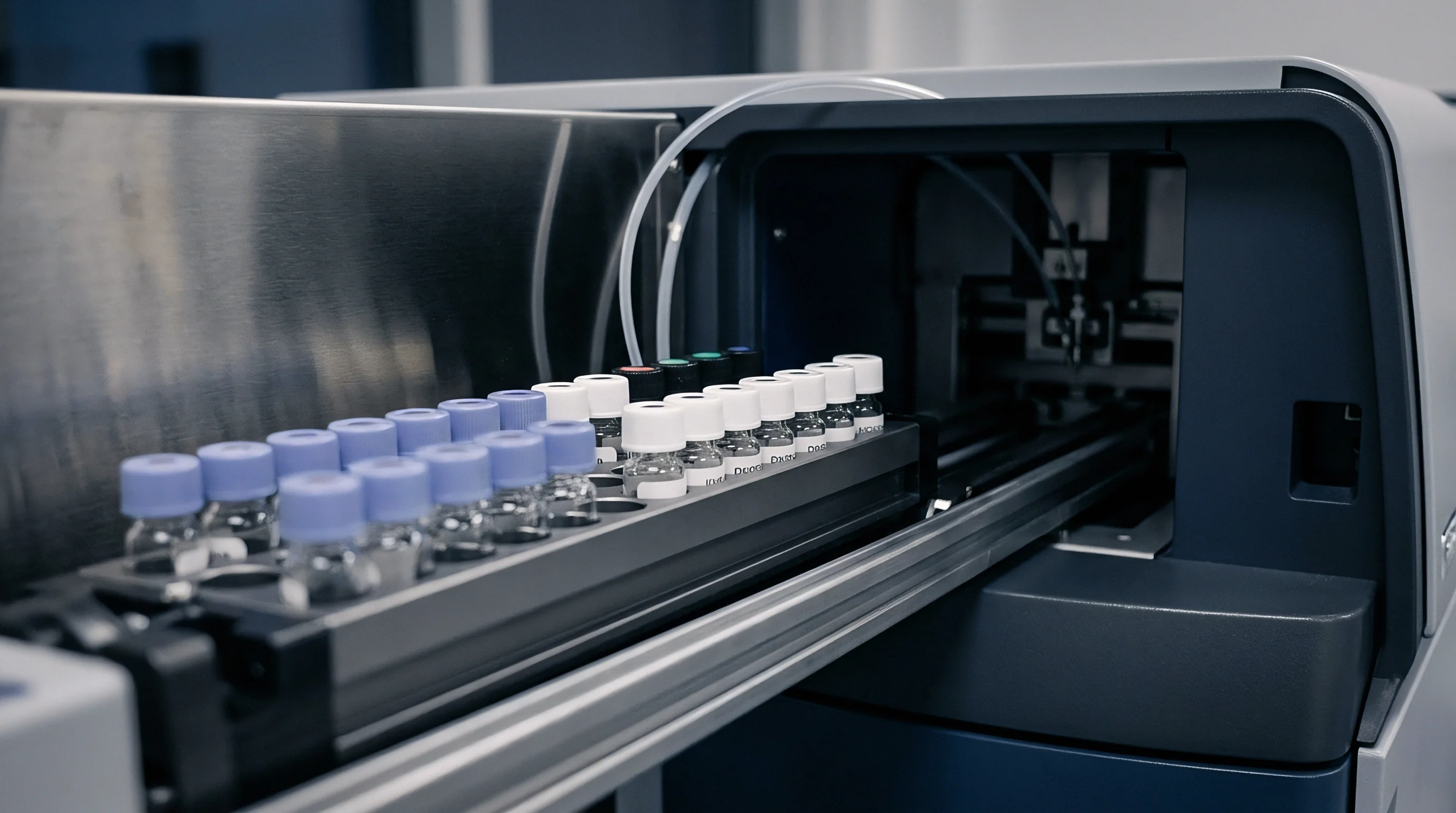
Vacuum ports on twin-screw extruders draw off light volatiles during compounding, but semi-volatile and heavier chemistries linger in the melt. Vacuum levels of twenty to fifty millibars effectively extract short-chain aldehydes like hexanal and heptanal formed during polypropylene beta-scission, yet high-boiling residues pass straight through. Tracking what vents out versus what stays trapped requires distinct chromatographic methods across volatile, semi-volatile, and non-volatile ranges.
Volatiles are captured through headspace sampling into capillary gas chromatography-mass spectrometry. Mixed-phase divinylbenzene and carboxen fibers in solid-phase microextraction setups isolate volatile alkanes, alkylbenzenes, and cyclic terpenes such as limonene, which routinely turn up in recycled domestic post-consumer streams. Semi-volatile non-intentionally added substances require four to eight hours of dynamic extraction in refluxing dichloromethane, acetone, or hexane.
Polyolefins swell readily in non-polar solvents, releasing oligomers alongside additive fragments into solution. These extracts then run through gas chromatography hyphenated to high-resolution time-of-flight mass spectrometry, using electron ionization and positive chemical ionization to confirm molecular structures.
Non-volatile species above five hundred Daltons, mostly heavy oligomers and deep oxidation products, require ultra-high-performance liquid chromatography paired with electrospray ionization high-resolution quadrupole time-of-flight mass spectrometry. Recycled polyolefins carry recognizable breakdowns from synthetic phenolic antioxidants, notably oxidized tris(2,4-di-tert-butylphenyl)phosphite (oxidized Irgafos 168) and related bis(2,4-di-tert-butylphenyl)phosphate pathways. Liquid chromatography methods have to resolve these additive traces from the surrounding polymer oligomers while preserving sensitivity down to parts-per-billion levels.
| Technique | Analyte Class | Solvent or Vehicle | Operating Temperature | Analytical Limit |
|---|---|---|---|---|
| Static Headspace GC-MS | Volatiles under C10 | Matrix Equilibrium | 120 deg C for 45 min | 10 to 50 ppb |
| SPME-GC-MS | Terpenes and Aromatics | DVB-CAR-PDMS Fiber | 80 deg C for 30 min | 2 to 10 ppb |
| GC-QTOF-MS (EI/CI) | Semi-volatiles C10-C32 | Dichloromethane Leach | 40 deg C for 8 hr | 20 to 50 ppb |
| LC-ESI-QTOF-MS | Non-volatiles and Oligomers | Methanol-Isopropanol | 50 deg C for 4 hr | 10 to 30 ppb |
Extract analysis is complicated by matrix suppression. Homologous series of ethylene or propylene oligomers wash out into the solvent and overload mass spectrometer ion sources. In electron-ionization gas chromatography, heavy wax peaks suppress ionization of co-eluting analytes and distort fragmentation patterns.
In electrospray liquid chromatography, non-polar oligomers precipitate inside source capillaries, causing baseline signal to drift across analytical runs. A laboratory cannot verify its identification threshold simply by observing instrument response in clean solvent; it must run internal standard mixtures across a broad log P range to track recovery through the entire run.

What Governs Toxicological Threshold Assignment?
Toxicological categorization dictates the sensitivity a screening method must deliver. Under European Food Safety Authority guidance on non-intentionally added substances, unknown chromatographic peaks are categorized by running structural alerts through in silico engines such as Derek Nexus or the Toxtree decision tree. If an unassigned peak shows alerts for DNA-reactive mutagenicity ~ epoxides, alkyl halides, or aromatic amine precursors ~ the required toxicological target shifts straight to the mutagenic floor of fifteen-hundredths of a microgram per person per day.
Take a five-hundred-micrometer-thick package with a contact ratio of six square decimeters per kilogram of food: keeping migration at or below fifteen-hundredths of a microgram per kilogram under a total-migration assumption requires an identification threshold of two and a half parts per billion in the base polymer. Achieving reliable untargeted identification at two and a half parts per billion inside a heavy polyolefin matrix is practically impossible. Instrument sensitivity runs out long before theoretical toxicological limits are reached.
Because instruments cannot meet raw mutagenic thresholds in untargeted scans, testing protocols fall back on semi-quantitative estimation and exposure classes. Peaks without mutagenic alerts go into Cramer Class I or Class III. Class I covers simple chemistries with known metabolic clearance pathways, permitting up to eighteen hundred micrograms per person per day, or eighteen hundred parts per billion in food.
Class III handles more complex structures or reactive chemistries lacking direct genotoxic flags, capping exposure at ninety micrograms per person per day, or ninety parts per billion. In migration screening, laboratories frequently use ten parts per billion as a operational floor, mirroring the limit in Article 11(4) of Regulation (EU) 10/2011 for unlisted substances placed behind functional barriers.
Regulation (EU) 10/2011 Article 11 sets ten parts per billion as the screening frontier behind a functional barrier.
Commercial recycled polyolefin compounds for food contact rarely include virgin barrier layers. Converters generally buy monomaterial post-consumer blends for blow-molded bottles or thermoformed trays. Sourcing personnel evaluating compliance paperwork must realize that an analytical report built around a ninety parts per billion Cramer Class III threshold offers no protection against unidentified genotoxins, pushing that liability directly onto packaging fillers and brand owners.

Flake
Incoming flake quality dictates baseline noise on high-resolution chromatograms. Kerbside post-consumer high-density polyethylene flakes carry traces of household detergents, cosmetics, food scents, and polymer breakdown from prior extrusion cycles. Recycled polypropylene homopolymer flakes from secondary logistics crates show slip additives, antistatic agents, and automotive fluid cross-contamination.
A standard high-density polyethylene compounding run illustrates how these thresholds operate in purchasing verification.
Take a commercial twenty-metric-ton compounding lot of natural high-density polyethylene pellets carrying thirty percent post-consumer material blended with prime copolymer. The target container is an extrusion-blow-molded bottle: wall thickness of six hundred micrometers, total weight of thirty grams, contact area of four hundred square centimeters, and a volume of five hundred milliliters. Sourcing criteria require verification that non-intentionally added substances will not exceed migration limits when holding acidic products formulated against three percent acetic acid or ten percent ethanol simulants.
With four hundred square centimeters contacting zero point five kilograms of product, the packaging surface-to-volume ratio works out to eight square decimeters per kilogram of food. That is higher than the standard European assumption of six square decimeters per kilogram, concentrating potential migrant levels in the food volume. The mass-balance calculation follows six distinct steps:
- Bottle wall mass concentration assumes thirty grams of resin spread over four hundred square centimeters, yielding seventy-five milligrams of polymer per square centimeter of contact surface.
- Migration volume exposure factor dictates that one square decimeter of wall material, weighing seven point five grams, directly contacts one hundred and twenty-five grams of food.
- Conservative screening assumption mandates that one hundred percent of a low-molecular-weight non-intentionally added substance migrates from the wall into the food phase during shelf life.
- Mutagenic threshold calculation establishes that fifteen-hundredths of a microgram per kilogram of food corresponds to zero point zero seven five micrograms total migrant in five hundred milliliters of volume.
- Polymer mass allocation distributes zero point zero seven five micrograms of migrant across thirty grams of container resin, producing a maximum permitted concentration of two point five parts per billion in the container wall.
- Cramer Class III allocation sets ninety micrograms per kilogram in food, allowing forty-five micrograms total migrant per bottle, which equates to fifteen hundred parts per billion in the resin.
When an analytical laboratory extracts a ten-gram pellet sample into fifty milliliters of boiling dichloromethane and concentrates the solvent to two milliliters, the sample achieves an enrichment factor of five. With an instrument detection limit of five hundred picograms on-column for a reference standard like deuterated naphthalene on a gas chromatograph coupled to a high-resolution time-of-flight mass spectrometer, a compound sitting at fifteen hundred parts per billion delivers seventy-five nanograms per microliter in the final extract, producing a clean, easily deconvoluted peak with reliable library matching.
At the mutagenic threshold of two point five parts per billion, the concentration in that same extract drops to zero point one two five nanograms per microliter. A one-microliter injection delivers one hundred and twenty-five picograms on-column, well below the untargeted deconvolution limit once polyolefin oligomer interference is factored in. That peak simply disappears into baseline noise.
A buyer accepting a test certificate reporting no non-intentionally added substances above the screening threshold must verify the exact detection limit the testing facility used.
A laboratory report declaring non-detect at an unspecified threshold confirms instrument blindness rather than chemical purity.
Pushing recycled content from thirty percent to fifty percent or seventy percent to meet packaging tax rules increases the mass of degradation chemistries in lockstep. The chromatographic noise floor rises as short oligomer fragments, branched cyclic alkanes, and alkyl-substituted benzenes accumulate. Higher baseline noise forces analytical software to raise peak-picking thresholds so processing jobs do not crash.
That higher software threshold cleans up the appearance of the certificate by reducing flagged peaks, but it conceals uncharacterized compounds from the compliance review.


Sieve
Melt screens remove physical particles during compounding, but chemical separation relies on analytical sieving across chromatography, spectral libraries, and toxicological filters. Untangling untargeted analytical data requires a four-gate screening process to separate harmless polymer fragments from hazardous migrants.
The first analytical gate distinguishes intentional additives and authorized chemistries from true unknowns. Polyolefins contain antioxidants, slip agents, and acid scavengers listed on the Union List of Regulation (EU) 10/2011, such as octadecyl 3-(3,5-di-tert-butyl-4-hydroxyphenyl)propionate, erucamide, and calcium stearate. These compounds show up at high levels, typically five hundred to three thousand parts per million.
The laboratory subtracts these peaks and their expected degradation by-products before reviewing lower-concentration signals.
The second gate isolates linear and branched polymer oligomers. Synthetic oligomers from C12 to C35 are normal fragments generated during thermal shearing of polyethylene and polypropylene chains. Polyolefin oligomeric saturated hydrocarbons, or POSH, elute in the same window as hazardous mineral oil saturated hydrocarbons (MOSH) brought in by printing inks or wash lubricants.
Separating endogenous polymer oligomers from petroleum hydrocarbons requires coupled liquid chromatography-gas chromatography with flame ionization detection. Identification thresholds cannot be applied to an unresolved complex oligomeric mixture; instead, the laboratory integrates across defined carbon brackets (C10 to C16, C16 to C25, and C25 to C35) against specific migration limits set by national bodies.
| Fraction Gate | Chemical Identity Target | Instrument Configuration | Identification Standard | Action Limit |
|---|---|---|---|---|
| Authorized Matrix | Antioxidants, Slip, UV Agents | GC-FID or HPLC-UV | Reference Standard Match | Substance SML |
| Endogenous Oligomers | Linear and Branched POSH | LC-GC-FID Bands | Internal Standard Triolein | Toxicological Assessment |
| Exogenous Contaminants | Mineral Oils MOSH and MOAH | LC-GC-FID Epoxidation | Biphenyl and Perhydropyrene | Zero Point Five ppm MOAH |
| Unknown NIAS | Cleavage, Inks, Aromatics | GC-QTOF / LC-QTOF | Deuterated Surrogates | Ten to Ninety ppb Food |
The third gate targets hazardous non-intentionally added substances carrying critical structural liabilities. Mineral oil aromatic hydrocarbons with three to seven condensed rings (MOAH) are mutagenic carcinogens with no applicable threshold of toxicological concern. Under the 2022 European Standing Committee on Plants, Animals, Food and Feed joint statement, packaging that releases detectable MOAH into food above quantified limits requires withdrawal.
For dry and fatty foods, migration exceeding zero point five milligrams per kilogram triggers product recalls. In polymer screening, the method must resolve individual aromatic bands down to one milligram per kilogram in the flake.
Should Importers Reject Semi-Quantitative Absence Screening?
Conformity documentation often relies on semi-quantitative estimates benchmarked against arbitrary internal standards. An analyst spikes an extract with deuterated toluene or 2-fluorobiphenyl, assumes an unknown compound has a response factor of one, and calculates its concentration. That assumption can introduce large errors.
Electron ionization mass spectrometry response factors can shift by a factor of three between structural classes; in electrospray ionization mass spectrometry, ionization efficiencies across unknowns fluctuate by more than two orders of magnitude based on proton affinity and solution dynamics.
An error of that scale can make a five-hundred-part-per-billion contaminant appear as a five-part-per-billion peak. Relying on semi-quantitative numbers against non-matrix-matched internal standards undermines the toxicological assessment required under Article 19 of Regulation (EU) 10/2011. Importers facing regulatory inquiries cannot defend an assumed response factor once an enforcement laboratory quantifies the contaminant against a synthesized reference standard.
When purchasing post-consumer polyolefin packaging, the analytical protocol attached to the specification must spell out explicit peak-identification criteria. Specifications stating only that material must comply with Article 3 leave buyers exposed to cargo rejections. The testing method should require accurate mass measurements below five parts per million mass error, isotopic pattern checks, and retention index matching against verified alkane ladders.
- Mass accuracy verification requires high-resolution instruments operating above twenty thousand resolving power to separate isomeric structures and eliminate false matrix identifications.
- Retention index alignment compares observed retention times against n-alkane series standards, restricting acceptable identity matches to within twenty Kovats units of verified database values.
- Blank subtraction protocols run laboratory process blanks alongside polyolefin flake extracts to subtract extraction solvent impurities and laboratory plasticizer artifacts.
- Surrogate recovery validation establishes minimum eighty percent recovery across polar, neutral, and non-polar surrogate compounds spiked into the solid matrix prior to extraction.
Without meeting these four benchmarks, an identification remains provisional. Provisional identities cannot substantiate an exposure dossier, leaving compounders to run targeted re-analyses or write off the pellet lot.
Commercial friction between recyclers and converters usually turns on who pays for secondary identification when screening flags peaks above the threshold. Recyclers often claim that unidentified peaks between ten and ninety parts per billion are harmless oligomer isomers that do not warrant custom synthesis. Brand owners, vulnerable to supermarket audits and public testing campaigns, need confirmed clearance before resin enters blow-molding tools.
Supply contracts increasingly feature mandatory identification triggers: if a recycled batch yields more than three unassigned peaks above twenty parts per billion in migration simulants, the recycler must fund liquid chromatography fractionation paired with nuclear magnetic resonance spectroscopy to identify them. That contractual liability pushes recyclers to improve hot-wash efficiency and fit higher-vacuum venting on degassing barrels, stripping out contaminants before pellets ship to converters.

Customs
Imported food-contact packaging faces tight document scrutiny at European borders, where border control laboratories test declared recycled resins. Border officials inspect import paperwork against Regulation (EU) 2022/1616 post-consumer plastic requirements. When a declaration of compliance lacks a verifiable non-intentionally added substance dossier backed by raw chromatography files, customs authorities hold the cargo under import-control regulations.
Port holds generate fast storage and demurrage charges that quickly outstrip the profit margin on the plastic. An importer of record unable to produce the underlying analytical dossier within the regulatory window faces rejected customs entries, compulsory return of the container, or destruction of the goods at their own expense.
| Resin Type | Declared Recycled Content | Intended Application | Primary NIAS Liability | Documentation Requirement |
|---|---|---|---|---|
| rHDPE Pellets | 100 Percent PCR | Dairy and Juice Bottles | Limonene, Decanal, Alkylamines | Challenge Test, QTOF NIAS File |
| rPP Copolymer | 30 Percent PCR Blend | Ready-Meal Microwave Trays | Polypropylene Dimers, Photoinitiators | Thermal Extraction Report |
| rHDPE Flake | 50 Percent Regrind | Personal Care and Food Cap Closure | Phthalate Esters, Phenolic Degraded | Tenax Migration Screening |
| rPP Homopolymer | 100 Percent Closed-Loop | Produce Crates and Bins | Slip Breakdown, Heavy MOSH Bands | LC-GC Mineral Oil Report |
Border laboratories use direct thermal desorption gas chromatography-mass spectrometry to rapidly screen incoming shipments. If tests reveal volatile cyclic ketones or photoinitiator residues like 4-methylbenzophenone exceeding twenty parts per billion, the entry receives a notification under the European Rapid Alert System for Food and Feed. A RASFF alert triggers automatic inspection holds across subsequent containers from that exporter, tying up material flows for months.
The true landed cost of imported recycled polyolefins includes assembling and defending the analytical compliance file. Sourcing low-cost post-consumer resin without an accredited screening certificate creates unhedged compliance risk. Testing a composite sample across volatile, semi-volatile, and non-volatile fractions using high-resolution mass spectrometry costs three thousand to five thousand euros per compounding lot.
Spread over a forty-ton shipping lot, that testing adds roughly one hundred euros per ton. Skipping it leaves the importer responsible for product recalls, rejected shipments, and statutory fines.
Commercial contracts must bind suppliers to clear analytical thresholds. Supply agreements should require an ISO/IEC 17025 accredited laboratory certificate for every lot, stating the exact identification threshold applied during screening. The certificate should confirm no unidentified peaks above ten parts per billion in fatty and aqueous food simulants, calculated using validated response factors against matrix-matched standards.
If a supplier cannot share screening spectra or refuses to guarantee the identification threshold in writing, the cargo should be rejected before it leaves port.
Section 14 of standard European food contact declarations requires suppliers to certify that non-intentionally added substances have been evaluated under recognized scientific protocols. A generic claim referencing Article 3 of Framework Regulation (EC) 1935/2004 without detailing the screening cutoffs, extraction parameters, and toxicological rules used to evaluate unassigned peaks will not survive an audit. Sourcing teams that review the analytical file before releasing payment protect their operations from border holds, packaging recalls, and brand damage.