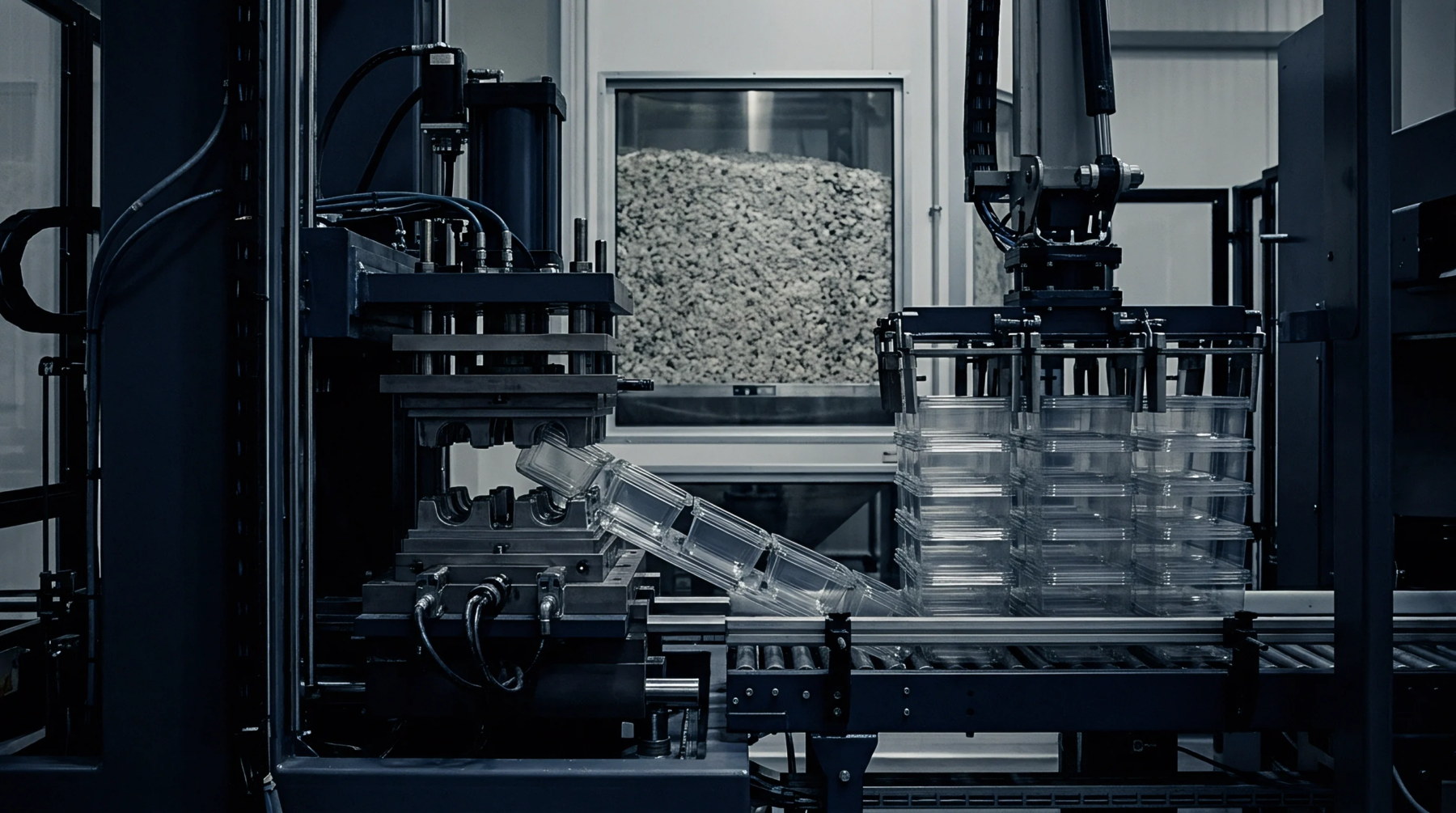
Thermoforming against Injection for Volumes below Fifty Thousand Units
Thermoforming delivers lower total landed cost below fifteen thousand units by saving upfront tooling capital, beyond which injection piece price efficiency dominates.
Metallic moulding hardware constructed from high-strength alloys allows injection processors to conduct rapid thermal cycling for medium-volume production runs. Aluminum tooling facilitates faster cooling compared to steel alternatives because the thermal conductivity of the metal moves heat away from the polymer melt quickly. Heat dissipation directly controls the solidification of the resin inside the cavity.
Operators verify that this hardware remains suitable for cycles where thermal load stays within the mechanical limits of the chosen alloy. Cycle times decrease because the material dissipates energy at a higher rate. This hardware represents an investment choice for bridge production or low-cavity counts where the cost of hardened steel fails to justify the expenditure.
Energy transfer rates dictate the efficacy of the heat exchange between the polymer and the surrounding metal walls. Aluminum tooling conducts heat more effectively than its ferrous counterparts by maintaining a flatter temperature gradient across the insert face. Rapid evacuation of heat reduces the dwelling duration for parts in the mould.
Moulders observe that crystalline resins show different shrinkage profiles when processed with highly conductive inserts. Differences between the cooling rate of a steel mould and a metal alloy mould produce internal stress variations within the final part geometry. Operators adjust cooling channel locations to prevent uneven solidification across large surface areas.
Proper design prevents the warping or twisting that follows inconsistent cooling patterns.
Financial trade-offs shift when production requirements target short timeframes or moderate quantities of finished components. Procurement teams compare the material specification of the alloy against the expected lifetime of the production run to determine value. Virgin resin performs predictably within this metallic environment as long as the surface hardness remains sufficient to resist deformation under high injection pressure.
Regrind cycles increase wear on the mould surface because abrasive fillers in the secondary material degrade the metal finish over time. Moulders hold dimensions tighter on short runs while accepting higher maintenance intervals for the hardware. Budget allocations favour these lighter weight constructs because the initial investment remains lower than traditional hardened steel sets.
Savings accrue from the reduced machining time required to prepare the blocks for service.
Soft metal surfaces deform under excessive clamping force or abrasive particulate contact over prolonged use. Aluminum tooling degrades when the injection pressure exceeds the yield strength of the alloy, leading to cavity wall collapse. Part quality suffers as the gate area shows wear or metal fatigue begins to compromise the edge definition of the moulded component.
Technicians monitor the surface finish regularly to ensure that the cavity integrity supports the required tolerances of the technical drawing. High-volume production mandates the transition to steel once the wear rate exceeds the financial gain of the faster cycle. Wear at the parting line indicates that the hardware has reached the end of the operational life.
Consistent monitoring ensures that the metal alloy prevents component failure throughout the production run.
Thermoforming delivers lower total landed cost below fifteen thousand units by saving upfront tooling capital, beyond which injection piece price efficiency dominates.
Expertise is a utility, not a secret. sentiention™ publishes its working knowledge as open reference: intelligence layer covering the materials it sources, the markets it enters, and the reference that serves both.