Thermal Degradation Volatile Identification in Trace Polymer Analysis
Micro-scale thermal volatile analysis identifies trace polymer contaminants and degradation pathways to prevent costly batch failures and regulatory non-compliance.
Plume
Thermal decomposition of macromolecular chains under controlled kinetic heating releases characteristic low-molecular-weight gaseous compounds. These gaseous products reflect the chemical structure of the parent polymer, the presence of thermal stabilizers, and the historical degradation state of the material. When analyzing micro-gram quantities or trace inclusions within a resin matrix, tracking evolved volatile species provides precise chemical identification where traditional infrared spectroscopy struggles due to signal overlap or filler interference.
Mechanisms of Macromolecular Scission
Homolytic cleavage of carbon-carbon bonds along the polymer backbone initiates thermal breakdown when local kinetic energy exceeds specific bond dissociation values. Temperature profiles govern whether a polymer undergoes random chain scission, end-chain depolymerization, or side-group elimination. Polyolefins like polypropylene and polyethylene decompose primarily through random scission, yielding an extended homologous series of alkanes, alkenes, and alkadienes.
Radical recombination alters species ratios.
Polypropylene degradation generates distinctive methyl-branched hydrocarbons due to the repeating tertiary carbon centers along its backbone. Cleavage at these tertiary sites produces trimer, tetramer, and pentamer clusters that act as definitive structural markers. The relative abundance of unsaturated terminal olefins compared to saturated alkanes reflects the thermal intensity and radical transfer activity occurring inside the sample capsule during heating.
Polyethylene thermal breakdown at 550 C produces an oligomeric alpha-olefin series spaced by 14 mass units across the mass spectrum.
Depolymerization and Side-Chain Stripping
Unzipping reactions dominate thermal breakdown in methacrylate and styrenic systems, returning high yields of original monomer building blocks. Polymethyl methacrylate degrades almost entirely into methyl methacrylate monomer via end-chain unzipping above 300 degrees Celsius. Styrenic polymers undergo competing unzipping and intramolecular hydrogen transfer, yielding styrene monomer alongside dimer, trimer, and tetramer fragments in predictable proportions.
Heterochain polymers containing polar functional groups follow distinct energetic pathways. Polyvinyl chloride undergoes side-group elimination at lower temperatures, stripping hydrogen chloride gas between 200 and 300 degrees Celsius and leaving behind a conjugated polyene structure. This polyene backbone subsequently cyclizes at higher temperatures to evolve aromatic volatiles like benzene, toluene, and naphthalene.
Monomer yield drops abruptly.
- Random Scission Pathways generate a broad distribution of fragment molecular weights through non-selective backbone cleavage across aliphatic polymer chains.
- End-Chain Depolymerization produces high concentrations of monomer units by unzipping active radical chain ends sequentially along the backbone.
- Side-Group Elimination releases small non-polymeric volatile molecules while leaving the carbon backbone intact for secondary aromatic cyclization.
- Intramolecular Hydrogen Transfer creates cyclic dimers and trimers through back-biting radical rearrangements during thermal breakdown.
Understanding these primary fragmentation mechanisms enables precise back-calculation of original resin compositions from evolved gas fragments. A compounder evaluating an unknown micro-inclusion utilizes these chemical signatures to separate foreign resin contamination from additive degradation products. Solid thermal stability dictates yield.
Pyrolysis
Micro-furnace injection systems deliver rapid thermal ramping up to 800 degrees Celsius directly at the gas chromatograph inlet. Achieving precise, reproducible cracking requires transferring microgram-scale polymer samples into passivated sample cups without ambient contamination. The interface temperature between the heating chamber and the separation column must remain high enough to prevent condensation of high-boiling oligomers while avoiding secondary thermal degradation inside the transfer line.

Instrumental Parameters for Micro-Scale Heating
Furnace repeatability depends on precise mass placement within deactivated quartz cups. Sample masses between 50 and 200 micrograms represent the ideal operating window for trace volatile analysis. Exceeding 500 micrograms induces thermal lag across the sample bed, causing incomplete degradation, peak broadening, and severe column saturation.
Conversely, samples under 10 micrograms risk mass measurement errors and signal loss for minor degradation components.
Carrier gas purity controls baseline stability and protects passivated column phases during high-temperature ramps. Ultra-high purity helium or hydrogen passing through oxygen and moisture traps minimizes secondary oxidation reactions inside the furnace zone. Split ratios must be adjusted based on anticipated volatile concentration.
Split ratios control column load.
A clean carrier gas baseline prevents ghost peaks from obscuring microgram-scale polymer degradation volatiles.
Thermal Desorption Sequence for Volatiles
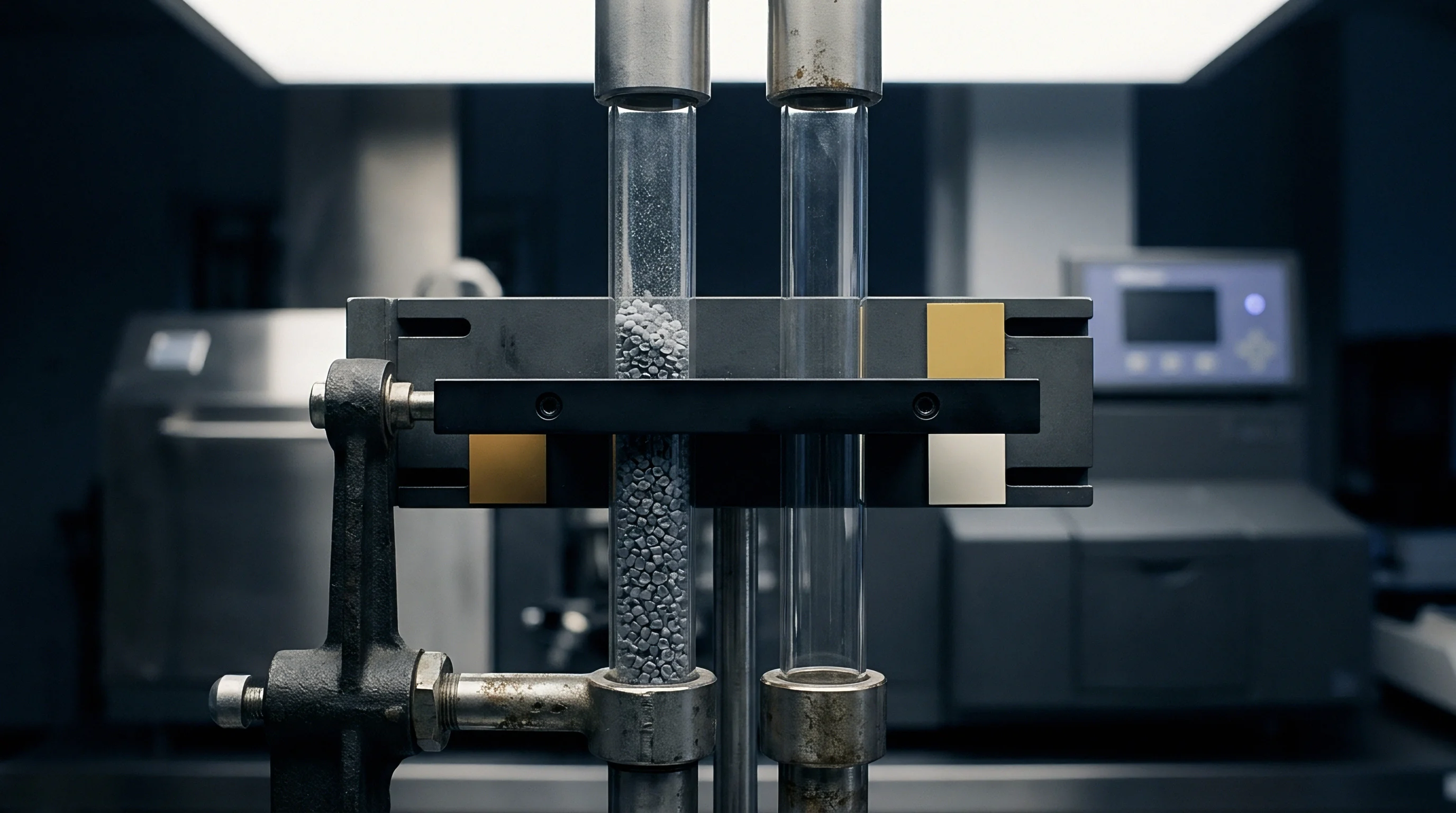
Low-temperature extraction cycles trap mobile compounds without cleaving the underlying polymer backbone. A double-shot analytical protocol heats the sample first to an intermediate temperature between 100 and 300 degrees Celsius to volatilize absorbed additives, residual solvents, and low-molecular-weight oligomers. The trapped volatile fraction passes to the gas chromatograph, while the remaining solid polymer undergoes high-temperature flash cracking in a second step.
- Micro-dissect the suspect resin area under optical magnification to isolate a solid sample mass between 50 and 100 micrograms.
- Place the isolated polymer fragment into a passivated quartz sample cup using deactivated platinum tweezers.
- Weigh the loaded cup on a microbalance with 0.1 microgram precision and record the exact sample mass.
- Load the quartz cup into the auto-sampler interface and purge the air lock with helium carrier gas for 60 seconds.
- Desorb residual volatile species at 250 degrees Celsius for 5 minutes onto a cryo-trapped column inlet held at minus 40 degrees Celsius.
- Ballistically ramp the furnace to 600 degrees Celsius at 20 degrees per millisecond to flash-crack the remaining polymer matrix.
- Initiate the gas chromatography oven temperature program to resolve evolved degradation fragments across the capillary column.
| Polymer Family | Pyrolysis Temperature | Primary Volatile Products | Diagnostic Mass Fragments (m/z) |
|---|---|---|---|
| Polypropylene (PP) | 550 C | 2,4-dimethyl-1-heptene, trimer isomers | 70, 126, 168 |
| Polystyrene (PS) | 500 C | Styrene monomer, dimer, trimer | 78, 104, 208, 312 |
| Polyethylene Terephthalate (PET) | 600 C | Vinyl benzoate, benzoic acid, divinyl terephthalate | 77, 105, 122, 149 |
| Polyamide 6 (PA6) | 550 C | Caprolactam monomer, cyclic oligomers | 55, 85, 113 |
| Polycarbonate (PC) | 650 C | Bisphenol A, phenol, p-cresol, 4-ethylphenol | 94, 107, 119, 213 |
Controlling these physical heating parameters ensures that observed volatile distribution profiles match theoretical cleavage patterns. Deviations in furnace calibration shift peak area ratios and complicate cross-referencing against reference mass spectral libraries. A purchase specification citing ISO 17250 requires thermal desorption zone temperatures to stay within 1.5 degrees Celsius of setpoint to prevent early degradation of heat-sensitive stabilizers during the initial desorption pass.

Spectrum
Electron ionization mass detectors fragment volatile degradation products into reproducible mass-to-charge ratios at 70 electronvolts. Standard commercial libraries like NIST or Wiley match clean spectra easily, but degradation plumes from complex compounds frequently yield overlapping fragmentation patterns. Resolving trace contaminants requires tracking specific fragment ions unique to target polymer backbones or specific additive breakdown pathways.
Where Do Secondary Degradation Markers Diverge?
Thermal exposure in oxygen-depleted environments yields straightforward unzipping products, whereas atmospheric oxidative degradation produces oxygenated fragments including lactones, carboxylic acids, and aldehydes. Polyolefin thermo-oxidation creates characteristic cyclic ethers and methyl ketones alongside aliphatic hydrocarbon series. Identifying these oxygenated species confirms thermal processing stress prior to the analytical testing phase.
Hindered amine light stabilizers (HALS) and phenolic antioxidants generate distinct volatile breakdown products when subjected to high thermal loads. Dealkylation of sterically hindered phenolic antioxidants yields substituted phenols like 2,6-di-tert-butyl-4-methylphenol derivatives. Tracking the ratio of intact antioxidant to its thermal degradation products quantifies the remaining useful life of the stabilization package.
Retention indices verify identity.
Method ASTM D4526 limits residual monomer contamination by requiring flame ionization detection calibration curves to hold a correlation coefficient above 0.995.
Mass Spectrometry Fragmentation Pathways
Diagnostic ions allow target compound identification even when thermal volatiles co-elute on non-polar gas chromatography columns. Polyethylene terephthalate degradation generates benzoic acid and vinyl benzoate, which exhibit intense fragment peaks at m/z 105 and m/z 77 due to the stable benzoyl cation structure. Polar columns retain glycol species.
Polyamides yield cyclic lactams upon thermal breakdown. Caprolactam from polyamide 6 produces a base peak at m/z 55 accompanied by diagnostic fragments at m/z 85 and m/z 113. Distinguishing polyamide 6 from polyamide 6,6 involves checking for cyclopentanone and hexamethylenediamine derivatives, which appear prominently in polyamide 6,6 degradation spectra.
| Chemical Compound | Source / Mechanism | Base Ion (m/z) | Confirming Ions (m/z) |
|---|---|---|---|
| Acrolein | Polypropylene thermal oxidation | 56 | 27, 55, 58 |
| 2,4-Di-tert-butylphenol | Phosphite antioxidant degradation | 191 | 57, 163, 206 |
| Benzene | PVC dehydrochlorination / cyclization | 78 | 51, 52, 77 |
| Styrene Trimer | Polystyrene back-biting scission | 91 | 117, 207, 312 |
| Limiting Phosphite Ester | Tris(2,4-di-tert-butylphenyl)phosphite oxidation | 647 | 147, 203, 662 |
- Aliphatic Hydrocarbon Series present characteristic 14 mass unit spacing patterns with intense m/z 41, 55, 69, and 83 alkyl cluster fragments.
- Phthalate Plasticizers exhibit a dominant, unambiguous m/z 149 protonated phthalic anhydride fragment resulting from double hydrogen rearrangement.
- Organophosphite Processing Stabilizers yield oxidized phosphate species exhibiting significant loss of tert-butyl radical fragments at mass offset 57.
- Siloxane Column Bleed Artifacts display sharp cyclical siloxane ions at m/z 207, 281, and 355 that must be separated from resin volatiles.
Discrepancies in electron ionization response factors between aliphatic hydrocarbons and polar oxygenated volatiles require empirical calibration factors when converting peak area counts into quantitative mass fractions. Baseline drift signals overload. How does an analyst definitively isolate secondary oxidation products from primary polymer degradation when analyzing recycled polyolefin blends containing mixed antioxidant packages?

Sieve
Isolating sub-milligram polymer inclusions from bulk compounds demands physical micro-dissection under polarized optical microscopy. Cross-contamination during sampling introduces false positive volatile signals that completely invalidate subsequent mass spectral interpretation. Solvents used during extraction must be ultra-pure grade to prevent phthalate ester or siloxane contamination from laboratory glassware.

Micro-Sampling and Contamination Elimination
Surgical steel scalpels transferred directly to passivated quartz cups eliminate plasticizer transfer from handling equipment. Nitrile gloves off-gas low levels of sulfur compounds and plasticizers when heated, making direct gloved contact with sample tools a common source of analytical error. Cleanroom wipes and plastic storage bags introduce fatty acid amides like erucamide and oleamide into trace samples.
Blank runs isolate system bleed. Executing an empty quartz cup heating cycle before analyzing the trace polymer sample confirms that the furnace liner, transfer line, and chromatographic column remain free of residual heavy oligomers. Accumulated high-boiling residues from previous runs bleed continuously off the column head, creating ghost peaks that mimic actual polymer breakdown fragments.

Sample Pan Inertness and Catalytic Effects
Metallic residues on unpassivated steel sample cups catalyze unexpected thermal breakdown at lower temperatures. Active metal surfaces lower the thermal activation energy required for backbone cleavage, shifting peak evolution temperatures downward by as much as 40 degrees Celsius. Passivated quartz or high-purity platinum sample vessels provide chemical inertness, ensuring pure thermal cracking without catalytic distortion.
- Passivated Quartz Inserts eliminate surface metal catalytic activity and withstand repeated thermal cycling to 900 degrees Celsius without chemical degradation.
- Solvent Extraction Verification isolates trace additives using mass-spectrometry grade dichloromethane prior to thermal degradation analysis.
- Atmospheric Air Exclusion prevents premature thermal oxidation during the initial heating phase through positive-pressure helium purging.
- Optical Density Isolation separates pigmented contaminant gel particles from translucent matrix resin using micro-manipulator pins under stereo illumination.
A masterbatch supplier defends batch variations by asserting that minor volatile peaks represent standard processing aid residue rather than degraded resin backbone. Micro-dissection and passive thermal desorption prove whether the volatile species originate from raw additive packages or thermal scission of contaminated post-consumer scrap.
Audit
Verification of volatile organic emissions protects downstream molders from regulatory rejections and batch recalls. In medical device, automotive interior, and food contact packaging applications, trace volatile organic compounds evolved during thermal processing migrate into final products, causing off-odor, taste contamination, or toxicity compliance failures. Quantifying these volatile emissions provides the empirical foundation for incoming resin acceptance specifications.

Regulatory Limits and Volatile Emission Standards
Standards like VDA 278 establish explicit concentration ceilings for volatile organic compounds and fogging substances in automotive interior plastics. The VDA 278 protocol quantifies organic emissions evolving between 20 and 120 degrees Celsius as total volatile organic compound value, while emissions evolving between 120 and 280 degrees Celsius define the fogging value. Excess fogging values indicate the presence of low-molecular-weight polymer degradation fragments or unreacted synthetic monomer.
Food contact packaging compliance relies on identifying Non-Intentionally Added Substances evolving during extrusion. Thermal breakdown products of antioxidants, such as 2,4-di-tert-butylphenol, face strict specific migration limits under European Union Regulation 10/2011. Trace polymer contaminants in recycled feedstock streams frequently generate unexpected degradation products during thermoforming, breaching safety thresholds despite pristine virgin resin additions.
| Standard Protocol | Target Compound Class | Thermal Extraction Condition | Qualification Threshold / Limit |
|---|---|---|---|
| VDA 278 (VOC) | C6 to C16 volatile organics | 90 C for 30 minutes | Less than 50 mg/kg total toluene equivalent |
| VDA 278 (FOG) | C16 to C32 fogging compounds | 120 C for 60 minutes | Less than 250 mg/kg total hexadecane equivalent |
| ISO 12219-1 | Whole-vehicle interior VOCs | 65 C chamber sampling | Substance-specific hazard concentration limits |
| ASTM D4526 | Volatiles in polymers by HS-GC | 90 C to 150 C equilibrium | Method detection limits down to 0.1 mg/kg |
Trace cross-contamination of polyvinyl chloride in polyethylene recyclate generates corrosive hydrochloric gas above 180 C, stripping mold coatings within hours.
Commercial Exposure in Contaminated Resin Streams
Financial losses accumulate rapidly when trace cross-contamination generates volatile degradation species during high-temperature injection molding. Consider a compounding facility processing a 20-tonne lot of recycled polypropylene valued at 1,350 USD per tonne. A 0.05 percent by weight cross-contamination of post-consumer polyvinyl chloride introduces active hydrogen chloride gas during extrusion at 230 degrees Celsius.
This trace contaminant releases approximately 5 kilograms of corrosive hydrochloric acid throughout the melt stream. The evolved gas corrodes tool steel cavity inserts, damages barrel screws, and induces autocatalytic degradation across the polypropylene matrix, lowering melt strength and turning the entire lot off-spec. The resulting loss includes the 27,000 USD resin lot value, 12,000 USD in tool re-polishing costs, and 8,000 USD in unscheduled press downtime.
Skip the incoming thermal volatile verification protocol and the supplier warranty claim dies on the spot.