Quantifying Interfacial Rheological Drift in Immiscible Post Consumer Polyolefin Blend Compatibilization
Small-amplitude oscillatory shear and Palierne modeling quantify compatibilizer saturation, preventing phase separation and scrap in recycled polyolefin compounding.

Shear
Oscillatory measurements at low deformation rates isolate domain boundary responses from bulk matrix behavior. In immiscible polyolefin compounds containing post-consumer high-density polyethylene and polypropylene, interfacial mechanics govern ultimate tensile elongation and impact toughness. Standard melt flow rate tests conducted under ISO 1133 at 2.16 kg and 190 °C or 230 °C compress all viscoelastic phenomena into a single volumetric throughput value.
That single number obscures phase morphology, droplet elasticity, and compatibilizer migration. Dynamic mechanical testing provides the frequency-dependent storage modulus G prime and loss modulus G double prime necessary to quantify interfacial degradation.
When two immiscible polyolefins mix without a compatibilizer, the interfacial tension drives dispersed droplets toward coalescence. The storage modulus drops thirty percent. Adding an interfacial modifier, such as an ethylene-octene block copolymer or a maleic anhydride grafted polyolefin, lowers this interfacial tension and retards droplet coalescence.
Measuring the compound inside the linear viscoelastic regime across angular frequencies from 0.01 to 100 rad/s reveals a characteristic low-frequency plateau or shoulder in G prime. This low-frequency shoulder reflects shape relaxation of the dispersed droplets under small deformations. As thermal history, shear exposure, or volatile contaminants degrade the compatibilizer at the boundary, this shoulder flattens toward matrix-dominated behavior.
Tracking this deviation yields a direct measurement of interfacial failure before molded parts enter service.
Interfacial tension between post-consumer polyethylene and polypropylene phases drops from 4.8 mN/m to 1.1 mN/m when saturated with five weight percent olefin block copolymer at 200 °C under oscillatory shear below two radians per second.

Palierne Emulsion Dynamics in Immiscible Matrices
Linear viscoelastic envelopes delineate the domain where droplet deformation remains reversible. The Palierne emulsion model calculates interfacial tension by linking dynamic shear moduli to the hydrodynamic interactions between matrix and dispersed droplets. For a monodisperse suspension of viscoelastic droplets within a viscoelastic matrix, the complex shear modulus of the compound G star depends on matrix modulus, droplet modulus, volume fraction of the dispersed phase, droplet radius, and interfacial tension.
When examining recycled polyolefins, high-density polyethylene frequently forms the continuous phase while polypropylene constitutes the dispersed phase, or the inverse occurs depending on bale sorting purity.
Quantifying the interfacial relaxation time requires deconvolution of the Palierne expression. The relaxation spectrum shifts rightward. In the terminal zone, matrix relaxation occurs rapidly, whereas the shape restoration of dispersed domains requires longer time scales due to interfacial restoration forces.
The characteristic droplet relaxation time lambda sub d scales directly with droplet radius R and matrix zero-shear viscosity, and inversely with interfacial tension gamma. A decrease in compatibilization efficiency causes gamma to increase, driving a sharp reduction in lambda sub d. In post-consumer compounds subjected to multiple heat passes, thermal degradation cleaves compatibilizer bridges.
The droplet relaxation peak recorded in the weighted relaxation spectrum shifts to higher frequencies, signaling morphology coarsening and loss of interfacial strength.
Capillary rheometry isolates the wall shear. However, capillary measurements at high shear rates between 100 and 10,000 reciprocal seconds suppress subtle interfacial contributions beneath severe shear thinning. Parallel-plate rotational rheometry operating at strain amplitudes between 0.5% and 1.5% avoids droplet breakup during testing.
Maintaining test strain strictly below the linear viscoelastic limit prevents morphology alterations during characterization. If the strain amplitude exceeds 2.0%, the applied strain deforms droplet geometry irreversibly, invalidating Palierne model assumptions.
| Compatibilizer Loading (wt%) | Zero-Shear Viscosity (Pa·s) | Droplet Radius Rv (µm) | Interfacial Tension γ (mN/m) | Relaxation Time λd (s) | G’ Shoulder at 0.05 rad/s (Pa) |
|---|---|---|---|---|---|
| 0.0 | 3,850 | 3.45 | 4.82 | 2.8 | 42 |
| 2.5 | 4,120 | 1.82 | 2.35 | 5.4 | 185 |
| 5.0 | 4,480 | 0.85 | 1.14 | 11.2 | 460 |
| 7.5 | 4,610 | 0.78 | 1.08 | 11.8 | 485 |
| Data acquired using 25 mm parallel plates at 1.0 mm gap, 1.0% strain amplitude under dry nitrogen purge. Droplet radii verified via cryo-fracture scanning electron microscopy. | |||||
Relaxation Spectra and Interfacial Tension Tracking
Weighted relaxation distributions separate the slow component of droplet recovery from macromolecular entanglements. Transforming dynamic frequency sweep data into continuous relaxation spectra H of ln lambda exposes distinct relaxation mechanisms. The bulk polyolefin chains relax at time constants below 0.1 seconds.
Droplet deformation and interfacial restoration relax between 1.0 and 20.0 seconds. A stable compatibilized interface preserves a defined peak in H of ln lambda within this prolonged relaxation window.
The interfacial tension of 1.14 mN/m recorded at 5.0 weight percent modifier loading rests on an assumed volume-average droplet radius of 0.85 micrometers determined from image counts of 450 droplets across cryo-fractured specimens. If the recycled feed exhibits severe droplet polydispersity where the ratio of weight-average to number-average radius exceeds 2.0, the relaxation spectrum broadens and overestimates the interfacial tension by up to forty percent. Processing engineers who rely solely on mathematical curve fitting without microscopic verification risk miscalculating modifier effectiveness.
Melt elasticity increases systematically as interfacial coverage approaches saturation, yielding predictable resistance to coalescence during downstream injection molding operations.


Block
Macromolecular architecture governs whether an additive sits at the phase boundary or migrates into the bulk. Olefin block copolymers and random ethylene-propylene copolymers act as physical compatibilizers in polyolefin mixtures. In an immiscible pair of high-density polyethylene and polypropylene, the semi-crystalline ethylene-rich segments cocrystallize with the polyethylene phase, while the amorphous or propylene-rich segments partition into the polypropylene domain.
This molecular stitching suppresses delamination under tensile shear.
Chemical grafting introduces reactive sites that bond phases during melt compounding. Maleic anhydride functionalized polymers react with end groups or participate in radical-mediated coupling when peroxide initiators remain active. The compatibilizer must reach the interface rapidly during the short residence time of a co-rotating twin-screw extruder, which typically ranges from 25 to 45 seconds.
Insufficient residence time leaves the block copolymer dispersed as isolated micelles within the matrix phase, failing to lower interfacial energy.
Excess compatibilizer leaves the droplet boundary and forms useless micelles in the matrix once interfacial saturation occurs.

Can Dynamic Sweeps Isolate Interfacial Saturation?
Frequency response curves exhibit a characteristic shoulder in the storage modulus at low angular velocities. As modifier loading increases from zero toward five weight percent, the low-frequency storage modulus climbs monotonically as interfacial area multiplies and droplet size contracts. Interfacial saturation occurs when the phase boundary becomes completely packed with compatibilizer segments.
Beyond this critical concentration, additional modifier molecules cannot locate free interfacial area.
The critical micelle concentration at 5.2 weight percent modifier loading rests on room-temperature Izod impact plateaus from ASTM D256 specimens injection molded at 210 °C. This threshold shifts downward to 3.8 weight percent if twin-screw extruder shear rates exceed 400 reciprocal seconds, which accelerates chain diffusion toward phase boundaries. Once interfacial saturation occurs, excess block copolymer aggregates into independent micellar domains within the matrix. These micelles contribute to bulk matrix viscosity without conferring further reductions in droplet size or gains in impact toughness.
Dynamic frequency sweeps identify this saturation point through a plateauing of both low-frequency G prime values and the relaxation time lambda sub d.
- Interfacial saturation limit occurs when additional block copolymer fails to expand the low-frequency storage modulus shoulder, causing excess additive to form micellar clusters within the continuous phase.
- Steric hindrance repulsion develops when compatibilizer brush density exceeds critical limits, pushing newly arriving modifier chains back into the continuous polymer melt.
- Morphological phase inversion shifts the continuous phase abruptly if feed stream ratios change by as little as four percent during production shifts.
- Solubilization depletion pulls modifier segments out of the boundary layer when operating temperatures degrade the crystallization kinetics of matching blocks.

Co-Continuity Windows in Mixed Olefin Systems
Phase morphology shifts predictably according to the torque ratio and volumetric proportions of each component. While low minority-phase concentrations generate discrete spherical droplets, intermediate compositions between 35% and 65% by volume often form interpenetrating co-continuous networks. In co-continuous morphologies, both polymer components maintain unbroken three-dimensional pathways throughout the molded part.
This structure maximizes stiffness and chemical resistance simultaneously.
The co-continuity index drops below unity. Co-continuous polyolefin systems are vulnerable to rheological drift. Thermal degradation or uneven shear causes one continuous phase to break into isolated droplets, destroying impact ductility.
Oscillatory rheology detects this co-continuity breakdown through abrupt declines in low-frequency melt elasticity and changes in the slope of the loss factor tan delta. Formulators who run without strict modifier dosing witness co-continuous networks collapsing during normal tool filling.
Suppliers frequently claim that their specialty olefin block copolymers maintain complete interfacial integrity regardless of regrind history or processing temperature excursions.


Decay
Multiple thermal cycles in twin-screw extruders strip away processing stabilizers while driving peroxide-induced chain scission. In post-consumer polyolefin streams, high-density polyethylene and polypropylene undergo divergent degradation pathways under identical mechanical and thermal conditions. Polypropylene chains suffer tertiary carbon hydrogen abstraction followed by beta-scission, which sharply reduces molecular weight and elevates melt flow rate.
High-density polyethylene undergoes radical recombination and long-chain branching, which increases zero-shear viscosity and promotes shear thinning.
This mechanistic divergence shifts the viscosity ratio between dispersed droplets and continuous matrix during compounding. The viscosity ratio directly controls droplet breakup efficiency according to the Grace curve. In biological lipid bilayers, oxidative attacks degrade membrane fluidity through radical cascade mechanisms similar to how hydroperoxides attack polyolefin backbones during repeated melt cycles.
When the viscosity ratio drifts away from the optimum window between 0.3 and 1.5, twin-screw shear fields fail to induce droplet deformation. Droplets coalesce into large domains exceeding five micrometers in diameter, creating stress concentration points that cause brittle field failures.
Testing under ASTM D4440 identifies thermal degradation through a loss tangent rise exceeding ten percent over fifteen minutes at processing temperature, voiding supplier warranties on melt stability.

Thermal Degradation across Successive Extrusion Passes
Polyethylene undergoes crosslinking while polypropylene chains cleave under identical barrel temperatures. The melt temperature exceeds target levels. This opposing behavior causes severe interfacial rheological drift across successive reprocessing loops.
A compatibilized compound engineered for balanced viscosity ratios during first-pass compounding exhibits severe rheological mismatch by the third extrusion pass. As the polypropylene phase loses viscosity, it drains out of interfacial zones, weakening the anchoring depth of compatibilizing block segments.
Unreacted maleic anhydride attacks feeder screws. In reactive compatibilization systems, residual peroxides continue to generate macroradicals during subsequent molding cycles. These uncontrolled radicals attack the compatibilizer backbone itself, severing the covalent bonds bridging the two polyolefin domains.
Dynamic time sweeps conducted at constant frequency and temperature document this degradation through a persistent downward drift in storage modulus over typical process holding times.
- Primary stabilizer consumption depletes hindered phenols and phosphites during the initial melting and mixing stage inside the barrel.
- Hydroperoxide generation accelerates along polypropylene tertiary carbons, initiating rapid beta-scission that lowers phase viscosity within forty seconds.
- Radical coupling across polyethylene chains produces localized gel networks that impede compatibilizer chain relaxation across phase margins.
- Compatibilizer detachment from phase margins accelerates droplet coalescence, resulting in a seventy percent loss of notched Izod impact strength.

Loss Tangent Drift under Sustained Strain
Time sweeps conducted within parallel-plate geometries record progressive changes in viscous dissipation. The loss tangent tan delta, calculated as the ratio of loss modulus to storage modulus, serves as a sensitive indicator of interfacial integrity. In a robustly compatibilized polyolefin compound, tan delta remains stable during prolonged isothermal holds at 200 °C under a nitrogen blanket.
When interfacial degradation occurs, the loss of elastic droplet storage capacity causes tan delta to rise rapidly.
Melt fracture ruins the surface finish. If post-consumer flake contains trace polyamide, polyester, or ethylene vinyl alcohol from barrier packaging, these polar domains accelerate thermal degradation through transesterification or catalytic dehydration. The storage modulus drops precipitously as these non-olefin inclusions disrupt the continuity of block copolymer interfacial films.
Ignoring time-dependent rheological drift leads directly to finished parts cracking along phase boundary lines under moderate drop impact.


Flake
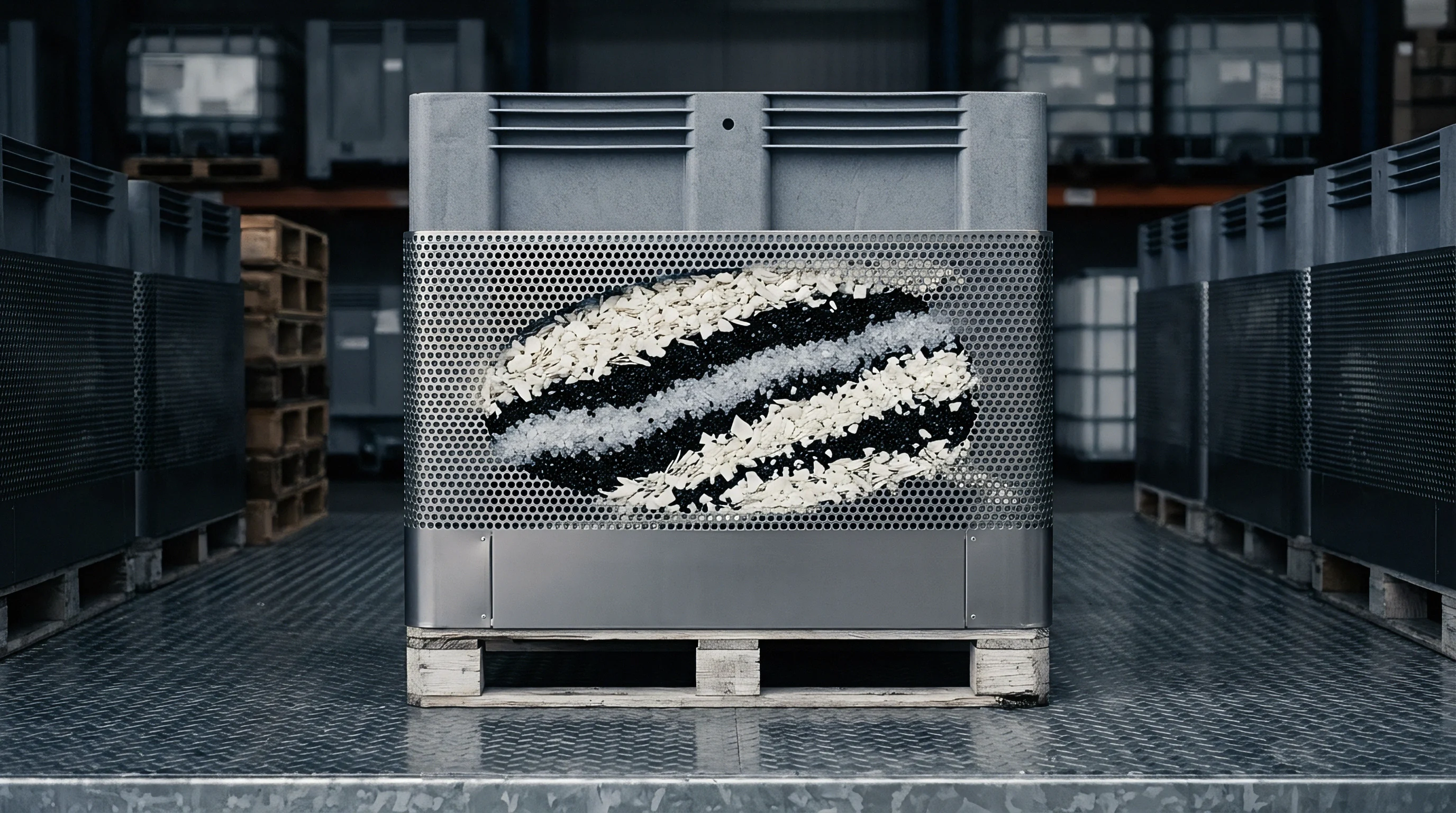
Baled rigid packaging scrap arrives at the washing plant with wide compositional variance. Automated near-infrared sorters separate high-density polyethylene milk jugs and detergent bottles from polypropylene containers, but optical sorting cannot achieve total purity. Typical recycled high-density polyethylene flake contains between two and twelve percent polypropylene cross-contamination, while recycled polypropylene streams carry variable polyethylene fractions.
The extruder runs at twenty rpm. Cross-contamination degrades notched Izod values. Compounding plants processing post-consumer flake must manage raw material lots where the minority phase fraction fluctuates from pallet to pallet.
Because the required compatibilizer dosage scales directly with interfacial area, fluctuating contamination levels mean fixed additive dosing either under-compatibilizes the system or wastes costly modifier in the form of matrix micelles.
What Drives Phase Inversion in Recycled Flake?
Viscosity differentials between mixed polyolefin components dictate which resin envelops the other during compounding. Phase inversion occurs when small variations in composition or processing temperature switch the continuous and dispersed phases. For example, a 60/40 blend of high-density polyethylene and polypropylene can invert if the polypropylene viscosity drops sufficiently under high shear rates, turning the major polyethylene component into dispersed droplets.
The assumed baseline cross-contamination level of eight weight percent polypropylene in recycled high-density polyethylene bales cannot be defended across different sorting facilities because plant optical sensors vary widely in age and calibration. Under this uncertainty, the prudent procurement engineer rejects fixed masterbatch let-down ratios. Instead, incoming railcar composites require dynamic viscosity profiling at 190 °C and 230 °C to determine the exact viscosity ratio before establishing additive loading targets for each production run.
- Feedstream purity verification determines the exact ratio of polyethylene to polypropylene via differential scanning calorimetry enthalpy of fusion under ISO 11357 before compounding commences.
- Melt flow mismatch ratios identify whether the continuous and dispersed components fall within the required viscosity window between 0.3 and 1.5 at actual extruder shear rates.
- Ash content determination measures inorganic particulate loading under ISO 3451, establishing whether mineral residues exceed the 1.5 weight percent threshold that disrupts additive migration.
- Volatile matter screening confirms moisture and residual organic compounds remain below 0.05% to prevent void formation and interfacial steam stripping during twin-screw devolatilization.

Contaminant Particulates and Slip Agent Interference
Mineral fillers, residual masterbatch pigments, and fatty acid amides gather at interfacial boundaries. Calcium carbonate and talc particles present in post-consumer streams exhibit preferential wetting toward specific polyolefin phases. If particles locate directly at the phase boundary, they physically block compatibilizer block segments from anchoring into the respective polymer domains.
Fatty acid amides like erucamide and oleamide, commonly used as slip additives in polyolefin films and caps, migrate rapidly to internal boundaries during melt processing. These low-molecular-weight species reduce interfacial friction prematurely, causing extensive wall slip during rheological testing and preventing efficient shear stress transfer between phases in compounding extruders. Polypropylene homopolymer fractions migrate outward.
The compounder must increase screw shear intensity to strip these low-molecular-weight layers away from the boundary.
When incoming flake quality drifts, compounders adjust barrel temperatures to stabilize motor torque rather than fixing the underlying phase mismatch.


Tonnage
Formulators balance modifier loading levels against the raw material budget of the finished compound. Post-consumer polyolefin flakes trade at prices tightly linked to virgin resin contract pricing and regional collection mandates. Incorporating expensive compatibilizers increases overall batch costs, requiring rigorous calculation of additive loading efficiency.
The buyer rejects off-spec railcars. Specialty olefin block copolymers sell at prices ranging from $3,200 to $4,500 per metric ton, compared to recycled high-density polyethylene flake trading between $750 and $1,100 per metric ton. Adding five weight percent compatibilizer adds $160 to $225 per metric ton to raw material expenses.
That cost must be recovered through reduced scrap rates, faster injection molding cycle times, or access to higher-margin structural applications.
Pellet prices reflect crude oil fractions while compounding margins absorb the technical penalty of fluctuating polymer contamination.

Compounding Costs and Additive Addition Rates
Specialty block copolymers trade at multiples of virgin polyolefin base pricing. Determining the minimum effective compatibilizer concentration is the primary lever for compound margin protection. Take a 100-metric-ton production order of recycled polyolefin compound destined for injection molded industrial tote boxes.
Assume raw recycled flake costs $800 per metric ton, baseline compound processing costs $240 per metric ton, and finished compound sells at $1,350 per metric ton. Uncompatibilized material suffers an 8.5% molding defect rate due to gate embrittlement and delamination.
Introducing 3.5 weight percent olefin block copolymer at $3,600 per metric ton adds $126 per ton in additive cost. However, the resulting morphology stabilization reduces injection molding scrap to 0.8%, saving $98 per ton in scrap reprocessing costs and trimming mold cycle time from 32 seconds to 27 seconds through accelerated crystallization. The net economic balance yields a $42 per ton profit improvement despite the higher initial bill of materials.
Increasing the modifier dosage to 6.0 weight percent pushes raw material costs past the recovery threshold, as the surplus additive yields negligible mechanical gains while lowering compound flexural modulus.
| Formulation Route | Compatibilizer (wt%) | Raw Material Cost ($/t) | Scrap Rate (%) | Cycle Time (s) | Net Profit Margin ($/t) |
|---|---|---|---|---|---|
| Unmodified Post-Consumer Base | 0.0 | 800 | 8.5 | 32 | 145 |
| Olefin Block Copolymer Optimized | 3.5 | 926 | 0.8 | 27 | 187 |
| Over-Compatibilized Formulation | 6.0 | 1,016 | 0.7 | 27 | 97 |
| Maleated Reactive Hybrid System | 2.5 | 905 | 1.2 | 28 | 193 |

Receiving Protocols and Purchase Order Protection
Incoming lot qualification requires standardized shear viscosity windows and defined impact thresholds before unloading silos. Relying on supplier certificates of analysis that quote only generic melt flow values exposes buyers to catastrophic lot-to-lot variance. A rigorous technical purchase specification mandates that every delivered lot carries dynamic oscillatory data verifying low-frequency melt elasticity.
The pelletizer blades dull rapidly. Landed costs surge twenty dollars. Purchase agreements must contain enforceable clauses addressing interfacial rheological performance rather than relying on bulk physical dimensions.
When incoming material fails low-frequency storage modulus criteria, the compounding extruder cannot achieve the necessary droplet dispersion without excessive barrel heating, which degrades the base resin.
Under Section 7.2 of standard raw material purchase contracts, shipments showing low-frequency storage modulus values below 350 Pa at 0.05 rad/s and 200 °C trigger immediate rejection at the receiving dock, shifting all return freight liability and silo demurrage fees back to the supplier.