Polypropylene Visbreaking Kinetics and Rubber Phase Morphologies under Sub Zero Multi Axial Strain
Visbreaking polypropylene matrix reduces molecular weight and alters rubber morphology, shifting sub-zero fracture mechanics from ductile yielding to brittle craze failure under triaxial stress.

Scission
Thermal-peroxidative degradation in polypropylene homopolymers and copolymers relies on radical-initiated chain scission at elevated compounding temperatures. In controlled rheology processing, organic peroxides ~ typically 2,5-dimethyl-2,5-di(tert-butylperoxy)hexane or di-tert-butyl peroxide ~ are injected into the polymer melt between 200 degrees Celsius and 250 degrees Celsius. Oxygen-oxygen bonds undergo homolytic cleavage, producing alkoxy and alkyl radicals that abstract hydrogen from tertiary carbon positions along the polypropylene backbone.
The resulting macro-radicals undergo rapid tertiary beta-scission to yield a terminal alkene and a primary alkyl radical. Because longer polymer chains present a higher probability of radical attack, this mechanism preferentially cleaves high molecular weight species, shifting the overall distribution lower while narrowing the polydispersity index from reactor values of 6.0 to 8.0 down to controlled rheology levels of 2.5 to 3.5.
Peroxide decomposition is rapid at compounding temperatures, following first-order kinetics driven by the initiator’s temperature-dependent decomposition rate constant. At 210 degrees Celsius, 2,5-dimethyl-2,5-di(tert-butylperoxy)hexane has a half-life under one second, ensuring near-complete peroxide consumption across standard twin-screw extruder residence times of 15 to 30 seconds. Unreacted peroxide residue causes ongoing degradation during secondary injection molding, driving uncontrolled melt flow rate drift and VOC emissions.
Matrix rheology is primarily tracked by melt flow rate measured under ISO 1133-1 conditions at 230 degrees Celsius and 2.16 kilograms load. Raising peroxide loading from 0.01 weight percent to 0.10 weight percent increases the melt flow rate from a reactor baseline of 2.0 grams per 10 minutes up to 30.0 grams per 10 minutes.
A peroxide loading of 0.08 weight percent at 210 degrees Celsius increases melt flow rate from 2.0 to 12.0 grams per 10 minutes under 2.16 kilogram load.
Although radical recombination remains a minor pathway, reducing ultra-high molecular weight fractions (Mw > 106 g/mol) fundamentally alters the relaxation spectrum of the polymer melt. High molecular weight chains contribute disproportionately to melt elasticity and strain hardening during extensional flow. Eliminating them lowers zero-shear viscosity, prevents melt fracture during high-speed processing, and dampens die swell at the extruder orifice.
Removing these long species also reduces intermolecular entanglements in the amorphous phase, changing how the solidified matrix responds to downstream deformation.
| Property | Test Method | Reactor Grade | Visbroken Grade A | Visbroken Grade B |
|---|---|---|---|---|
| Melt Flow Rate (230°C / 2.16 kg) | ISO 1133-1 | 2.1 g/10 min | 12.5 g/10 min | 35.0 g/10 min |
| Weight-Average Mol. Weight (Mw) | ISO 16014-4 | 380,000 g/mol | 210,000 g/mol | 145,000 g/mol |
| Polydispersity Index (Mw/Mn) | ISO 16014-4 | 6.5 | 3.1 | 2.6 |
| Zero-Shear Viscosity (200°C) | ISO 6721-10 | 8,200 Pa·s | 1,400 Pa·s | 380 Pa·s |
| Zero-Shear Relaxation Time | ISO 6721-10 | 1.20 s | 0.15 s | 0.03 s |
Kinetic Factors Governing Matrix Chain Scission
Extrusion process conditions affect peroxide efficiency through local mass- and heat-transfer limits. Shear fields inside twin-screw kneading zones dictate how thoroughly the peroxide masterbatch disperses into the viscous melt. If dispersion is poor when reaction temperatures are reached, localized over-visbreaking occurs, producing pockets of ultra-low molecular weight polymer alongside under-treated high molecular weight material.
- Initiator Half-Life Kinetics ~ Temperature profiles across extruder barrel zones govern spatial decomposition rates, making melt homogeneity essential before the feed reaches 180 degrees Celsius.
- Specific Mechanical Energy Input ~ Mechanical shear generates localized viscous dissipation, raising melt temperature above setpoints and accelerating peroxide breakdown independent of barrel heating elements.
- Antioxidant Consumption Competitions ~ Hindered phenol and phosphite primary antioxidants compete with the polymer matrix for radicals, demanding a precise balance between stabilization packages and peroxide dosage.
- Melt Residence Time Spectrum ~ A narrow residence time distribution in co-rotating twin-screw extruders prevents unreacted peroxide carryover while suppressing secondary thermal degradation pathways.
Predicting how persistent free radicals interact with hindered phenols and secondary phosphites across repeated regrind heat cycles remains difficult whenever peroxide residue survives past pelletization.

Inclusion
Morphological evolution of the disperse phase in heterophase polypropylene impact copolymers depends directly on the viscosity ratio between the ethylene-propylene rubber phase and the surrounding polypropylene matrix. Impact copolymers consist of a semi-crystalline polypropylene matrix enclosing dispersed domains of amorphous ethylene-propylene rubber (EPR) and semi-crystalline ethylene-rich copolymer inclusions. During compounding, shear and elongational fields stretch the rubber phase into thin filaments that break into spherical droplets through Rayleigh-Taylor instabilities.
Droplet breakup occurs once the capillary number, representing the ratio of viscous deforming forces to interfacial tension, exceeds a critical value (Cacrit).
Narrow molecular weight distribution matrix resins yield uniform elastomeric dispersion during high-shear compounding.
Droplet breakdown is governed by the viscosity ratio (ηr = ηrubber / ηmatrix), which sets the threshold for Cacrit. Visbreaking the polypropylene matrix lowers ηmatrix, driving up ηr across processing shear rates. Once ηr exceeds 3.8, simple shear can no longer break up disperse rubber droplets, leaving domain division entirely dependent on elongational flow within twin-screw mixing elements.
Consequently, visbroken impact copolymers compounded at elevated matrix MFR display larger average rubber particle diameters (dv), ranging from 1.5 to 3.5 micrometers compared to 0.5 to 1.0 micrometers in non-visbroken reactor grades. High matrix fluidity simultaneously promotes droplet coalescence during static residence periods in injection molds.

Disperse Phase Morphological Breakdown Modes
The structure of elastomeric inclusions determines stress distribution under mechanical load. Reduced matrix viscosity alters interfacial stress transfer, disrupting the core-shell morphology where semi-crystalline ethylene-rich cores sit enclosed by amorphous rubber shells.
- Coalescence-Driven Domain Coarsening ~ Low matrix viscosity allows dispersed rubber droplets to collide and merge in runner channels, creating oversized domains that act as primary flaw sites under impact stress.
- Core-Shell Morphology Stripping ~ High shear forces during rapid injection molding peel amorphous rubber envelopes away from crystalline ethylene-rich cores when interfacial tension exceeds matrix yield strength.
- Anisotropic Inclusion Elongation ~ Unrelaxed shear stress in thin-walled tooling draws elastomeric inclusions into elongated fibrils aligned with the flow path, creating directional impact sensitivity.
- Phase Inversion Instability ~ Rubber volumetric loadings above 35 percent undergo phase inversion under low matrix melt strength, forming continuous rubber channels that destroy matrix flexural modulus.
Elevated viscosity ratios between the elastomeric disperse phase and visbroken matrix inevitably broaden particle size distribution toward coarse inclusions.
Notch
Deformation responses under multi-axial impact loading at sub-zero temperatures involve rapid transitions in mechanical energy dissipation pathways. Standard impact evaluations employ instrumented drop-weight tests under ISO 6603-2 or ASTM D3763 standards, applying strike velocities of 4.4 meters per second to clamped disc specimens at temperatures down to minus 40 degrees Celsius. In this state, the material encounters complex triaxial tensile stress fields beneath the spherical impactor.
Polypropylene homopolymer matrix phases exhibit a glass transition temperature (Tg) around 0 degrees Celsius, rendering the matrix brittle under sub-zero testing conditions. The ethylene-propylene rubber phase maintains rubbery mobility down to its lower Tg between minus 50 degrees Celsius and minus 55 degrees Celsius, serving as the sole mechanism for impact energy absorption.
Temperature shifts matrix failure modes entirely. Below its glass transition, frozen matrix material cannot undergo unconstrained, volume-conserving shear yielding under triaxial strain. Triaxial tension instead generates hydrostatic tension within elastomeric inclusions.
Because the rubber phase has a low bulk modulus relative to its shear modulus, hydrostatic stress triggers cavitational voiding inside the rubber droplets. Void nucleation relieves local triaxial constraint, converting the local stress state to uniaxial tension at the void equator and promoting matrix shear yielding or micro-crazing.
What Drives Cavitation in Frozen Impact Copolymers?
Cavitation occurs when local strain energy density overcomes the surface energy cost of expanding a microscopic void within a rubber inclusion. Particle size governs this energy balance. Inclusions smaller than 0.2 micrometers resist cavitation because the internal pressure required to nucleate a void exceeds matrix yield stress, causing premature brittle failure of the surrounding matrix.
Conversely, particles larger than 2.0 micrometers cavitate at low strain levels, but the resulting large voids initiate sharp, unstable cracks that propagate rapidly through the embrittled sub-zero matrix.
| Temperature (°C) | Failure Mode | Peak Force (N) | Total Energy (J) | Ductility Index (%) |
|---|---|---|---|---|
| 23 | Ductile Puncture | 3,850 | 28.5 | 58 |
| 0 | Ductile-To-Brittle Transition | 4,100 | 22.1 | 42 |
| -10 | Stable Crazing / Yielding | 4,350 | 17.8 | 31 |
| -20 | Brittle / Cavitational Yield | 4,150 | 11.2 | 18 |
| -30 | Catastrophic Brittle Splitting | 3,200 | 4.5 | 5 |
| -40 | Shatter / Multi-Fragment | 2,400 | 1.8 | 0 |
- Striker impact launches high-velocity multi-axial tensile waves through specimen thickness.
- Hydrostatic tension builds within rubber inclusions located directly beneath the central impact site.
- Cavitational voiding occurs inside rubber droplets measuring between 0.5 and 1.5 micrometers in diameter.
- Void expansion shifts local stress fields from triaxial tension to plane-stress conditions at particle boundaries.
- Shear bands initiate at cavitated particle equators, traversing matrix ligaments toward neighboring inclusions.
- Inter-particle plastic shear yielding consumes kinetic impact energy before microcracks consolidate into a primary crack front.
Visbreaking narrows the molecular weight distribution and lowers chain entanglement density, reducing the crazing stress threshold below the shear yield stress at minus 30 degrees Celsius. When craze initiation dominates over shear yielding, microcracks grow rapidly with minimal plastic energy dissipation. Oversized rubber domains resulting from matrix visbreaking worsen this transition by nucleating sharp cracks, leading to catastrophic brittle splitting under sub-zero multi-axial impact loads.
Using high-MFR visbroken matrix impact copolymers in thin-walled sub-zero structural components without adjusting disperse rubber morphology leads to cold-temperature impact shatter failures in service.
Assay
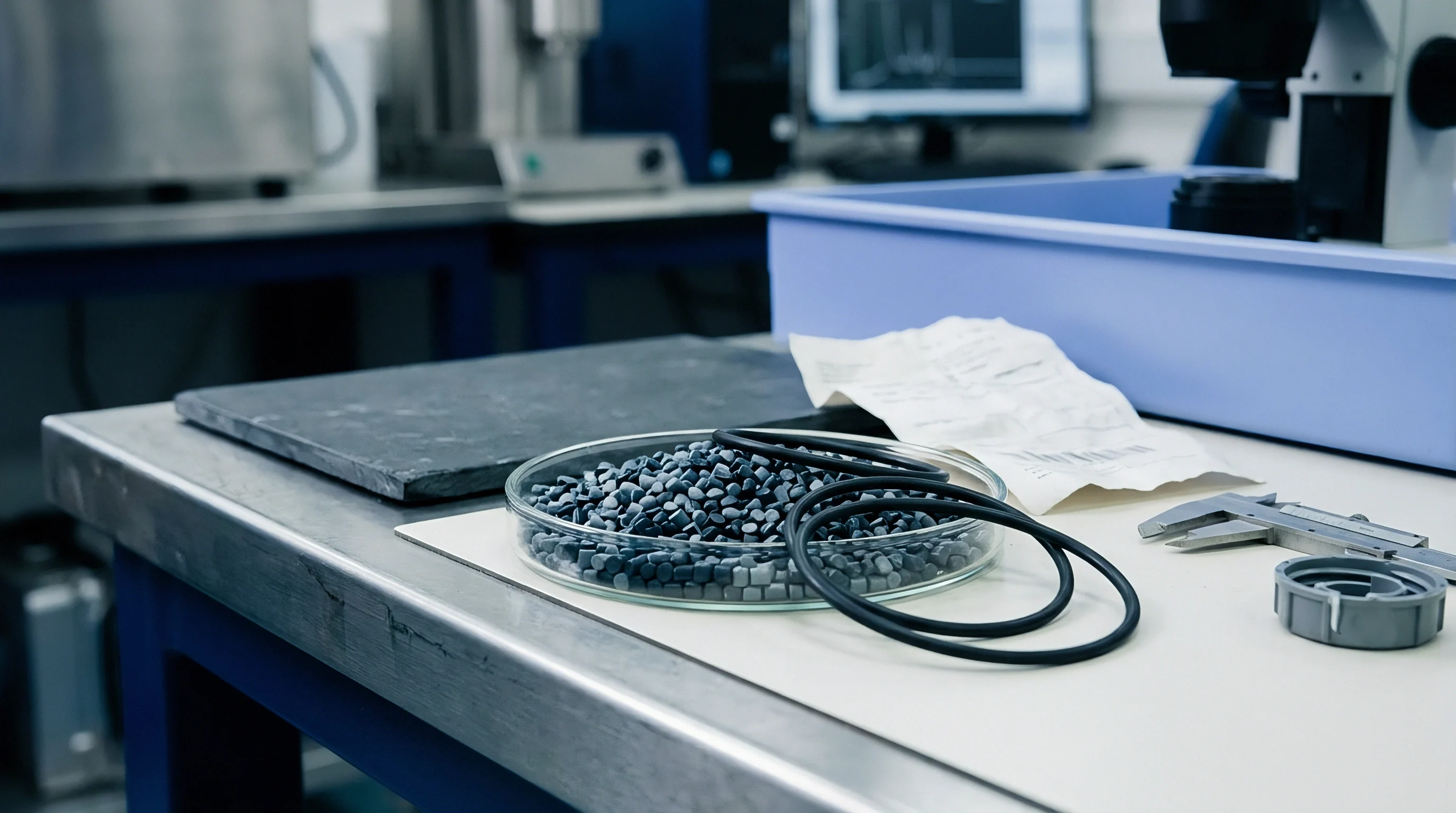
Analytical verification of visbroken impact copolymers requires precise characterization of molecular weight distributions, rubber phase content, and sub-zero multi-axial fracture energy. Melt flow rate testing under ISO 1133-1 provides initial screening but fails to reflect low-temperature mechanical performance or molecular weight distribution breadth. Gel Permeation Chromatography carried out at 160 degrees Celsius in 1,2,4-trichlorobenzene quantifies high molecular weight tail loss (Mz) caused by peroxide scission.
Dynamic Mechanical Thermal Analysis under ISO 6721-4 isolates phase transitions, identifying Tg shifts in the rubber phase caused by secondary crosslinking or degradation during visbreaking.
While melt flow testing flags batch variation and high-temperature SEC measures scission across the molecular weight curve, instrumented puncture testing per ISO 6603-2 at minus 30 degrees Celsius serves as the primary mechanical benchmark. The test records load-deflection profiles using a 20-millimeter hemispherical striker at 4.4 meters per second, logging peak force, deflection at peak force, and total puncture energy (Ep). A ductile-to-brittle failure transition manifests as an abrupt vertical load drop in the force-displacement trace immediately following peak load, accompanied by radial crack propagation without plastic deformation around the impact ring.
ISO 6603-2 multi-axial puncture energy below thirty joules at minus thirty degrees Celsius mandates batch rejection under automotive instrument panel delivery contracts.
Morphological inspection via Scanning Electron Microscopy demands atomic contrast enhancement. Etching polished specimen surfaces with xylene or utilizing ruthenium tetroxide (RuO4) vapor staining selectively targets the amorphous rubber phase. Image analysis software calculates the volume-average domain size (dv), micro-domain distribution, and mean interparticle distance (ID).
Interparticle distance relates directly to matrix ligament thickness (L), defined by:
L = dv left( left( fracπ6 φr right)1/3 – 1 right)
where φr represents the total volumetric rubber fraction. When visbreaking increases average particle size dv from 0.8 micrometers to 2.2 micrometers at a fixed rubber loading of 20 volume percent, matrix ligament thickness increases from 0.65 micrometers to 1.78 micrometers. Because critical matrix ligament thickness for shear yielding in polypropylene sits between 0.30 and 0.80 micrometers, this morphological coarsening suppresses matrix shear yielding, driving sub-zero mechanical response into brittle cleavage.
| Analytical Parameter | Test Standard | Target Range | Critical Rejection Boundary |
|---|---|---|---|
| Melt Flow Rate (230°C / 2.16 kg) | ISO 1133-1 Method B | 20.0 ± 2.0 g/10 min | > 23.5 or < 16.5 g/10 min |
| Polydispersity Index (Mw/Mn) | ISO 16014-4 | 2.8 ~ 3.4 | > 4.2 (un-visbroken) or < 2.4 |
| Sub-Zero Puncture Energy (-30°C) | ISO 6603-2 | ≥ 25.0 Joules | < 15.0 Joules (brittle fracture) |
| Mean Rubber Domain Size (dv) | SEM / RuO4 Staining | 0.6 ~ 1.2 micrometers | > 1.8 micrometers |
| Rubber Phase Tg (DMA) | ISO 6721-4 | -52°C to -48°C | > -42°C |
Batch Verification Decision Protocol
Receiving inspection procedures for high-flow impact copolymers must validate both rheological consistency and sub-zero toughness before silo unloading.
- MFR Spread Verification ~ Confirm incoming shipment melt flow rates stay within plus or minus 10 percent of nominal standard values to prevent injection molding cavity flash or short shots.
- Sub-Zero Drop Impact Validation ~ Perform instrumented puncture tests at minus 30 degrees Celsius on injection-molded disc plaques from target production batches, logging ductile failure percentage across ten specimens.
- Peroxide Residue Screening ~ Check VOC headspace emissions via gas chromatography-mass spectrometry to ensure unreacted peroxide fragments or decomposition byproducts remain below 50 ppm.
- Morphological Dispersion Audit ~ Conduct atomic force microscopy or SEM cross-sectional imaging on selected production lots displaying low impact readings to evaluate rubber particle agglomeration.
Purchase contracts for controlled-rheology impact polypropylene specify that lot release requires certified ISO 6603-2 multi-axial impact energy traces at minus 30 degrees Celsius, rejecting shipments where brittle failure occurrences exceed zero percent across test replicates.

Tariff
Commercial sourcing of visbroken impact copolymers involves balancing pricing between reactor-grade base resins, peroxide masterbatch additive costs, and compounder conversion margins. Virgin reactor-modified impact copolymers command pricing premiums of $100 to $250 per metric tonne over standard commodity homopolymer grades, driven by extended reactor residence times and complex multi-stage gas-phase polymerization processes. Compounding lines frequently attempt to reduce landed material costs by purchasing low-MFR reactor impact grades and let-down masterbatches containing 5 to 10 weight percent active peroxide during secondary extrusion.
While masterbatch let-down economics appear favorable on preliminary bills of materials, compounding-line processing variances undermine theoretical margin savings. Improper masterbatch dosing, extruder temperature drift, and screw shear variations create lot-to-lot MFR fluctuations that spike finished part scrap rates by 3 to 8 percent in thin-walled sub-zero molding operations. A 5 percent scrap rate increase completely eradicates a $120 per metric tonne feedstock price advantage.
Melt flow rate compliance alone may technically satisfy delivery specifications, even when poor sub-zero multi-axial impact values originate from tool design, gate placement, or cavity cooling conditions in the molding facility.